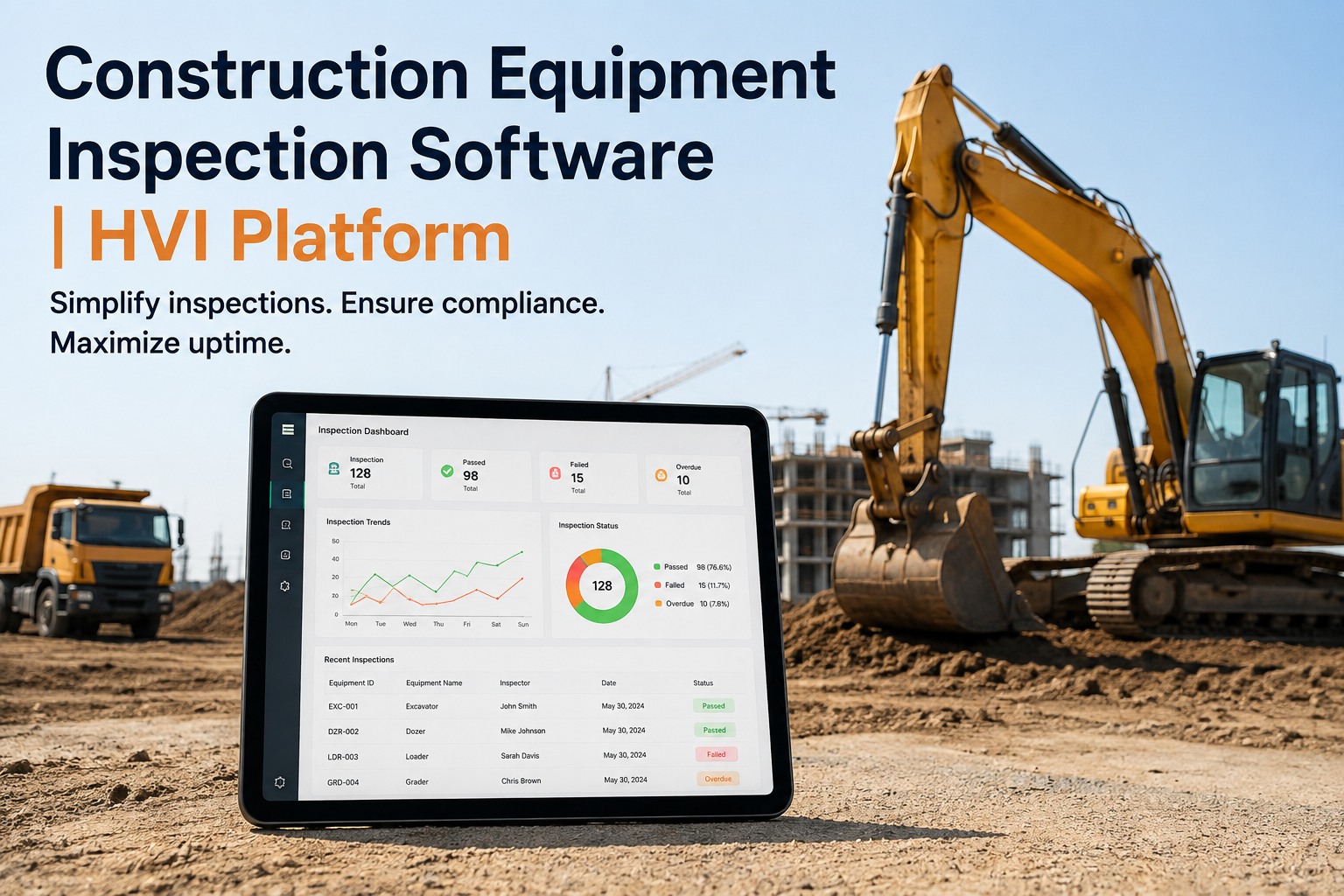
A DOT roadside inspection is a pop quiz on a process you either built months ago or you didn't. By the time an officer waves your truck onto the scale, the outcome is mostly decided — by whether the brakes were adjusted, the DVIR chain was closed, and the driver's paperwork is current. For construction fleets running dusty jobsites and trucks that bounce between locations, the exposure is real. Book a demo to see how a tight inspection process cuts roadside risk. This guide covers the CVSA levels, the violations that park trucks, and how to prepare before the stop.
Roughly 1 in 5 Trucks Failed the Roadside Check — the Question Is Which Fifth You're In
During CVSA's 2025 International Roadcheck, inspectors ran 56,178 checks and placed 18.1% of vehicles and 5.9% of drivers out of service. The gap between rolling through and getting parked isn't luck — it's the inspection process behind the truck.
The figures above come from CVSA's 2025 International Roadcheck, a 72-hour blitz — not a year-round average — but the failure patterns hold steady: brakes, tires, lights, cargo securement, and driver paperwork. A quick note before the detail: federal rules and CVSA procedures set the national baseline, but states run their own enforcement and some add requirements, so treat this as the shared framework and confirm the specifics for the states you operate in.
What a roadside inspection isand why the result is decided before you reach the scale
A DOT roadside inspection is an examination of a commercial motor vehicle and its driver against the North American Standard Inspection Program — a standardized set of procedures created by the Commercial Vehicle Safety Alliance (CVSA) and used by trained enforcement officers across the U.S., Canada and Mexico. Around 4 million of these inspections happen every year. The inspector checks the driver's credentials and hours, and depending on the level, the vehicle's mechanical condition — and if something crosses a defined threshold, the truck or driver is placed out of service on the spot.
That last part is why readiness is a process, not a moment. An out-of-service brake, a missing medical card, or a cargo strap short of the requirement isn't something a driver can talk their way out of at the window. It reflects whether the pre-trip caught it, whether the DVIR defect got fixed, and whether the paperwork was in the cab. The construction fleets that pass consistently aren't lucky — they've made the roadside stop a formality by handling the real work earlier. Book a demo to see inspection status per truck before an officer does
The CVSA inspection levelswhat each one covers — and which issue a decal
Not every roadside inspection is the full crawl-under-the-truck exam. CVSA defines eight inspection levels; these are the ones a construction fleet driver is most likely to encounter. The level determines the depth — and only Levels I, V and VI can result in a CVSA decal when no critical violations are found.
The full exam: driver credentials, hours, and a complete mechanical check with the inspector physically under the vehicle. Roughly 45–60 minutes. Brakes, steering, suspension, coupling, tires, lights, exhaust, cargo securement.
Driver documents plus everything on the vehicle that can be checked without going underneath. Common at weigh stations. Faster than a Level I, but still serious — no decal issued.
Driver and paperwork only: license, medical certificate, hours-of-service/ELD records, seatbelt, DVIR, carrier ID. No mechanical inspection — though visible defects can still be cited or trigger an upgrade.
A one-time examination of a single item or system, usually to support a study or check a suspected trend. Narrow by design.
Every vehicle item from a Level I, but without the driver present — conducted at any location, such as a terminal or jobsite yard.
Enhanced inspection for select radiological shipments, with its own stricter standard and a special decal. Rare for general construction work.
CVSA also defines Levels VII (jurisdictional/other) and VIII (electronic inspection), which most construction drivers won't meet at a typical roadside stop. The takeaway: a Level III can park a driver on paperwork alone, so document readiness matters as much as mechanical condition. Start free and keep driver documents ready to pull
What actually parks trucksthe vehicle out-of-service violations, by share
Out-of-service violations aren't spread evenly — a handful of systems account for most of them, and they're the same systems year after year. Here's the breakdown of vehicle out-of-service violations from CVSA's 2025 International Roadcheck. Every one of these is something a disciplined pre-trip and a closed-out DVIR process is built to catch.
Notice what these have in common: none of them are exotic. They're brake adjustment, tread depth, a dead lamp, a strap short of the working-load requirement — the exact things a real pre-trip inspection exists to find. The violations that park trucks are almost never surprises; they're missed checks. Book a demo to see which defects recur across your fleet
What "out of service" meansthe threshold that stops the truck — and the clock
Being placed out of service isn't a fine you pay and drive off with. When an inspector finds a violation that meets the North American Standard Out-of-Service Criteria — the shared standard defining which defects are serious enough to prohibit operation — the vehicle or driver cannot move until the condition is corrected. A loaded dump truck grounded on the shoulder means a missed pour, a rescheduled job, and a driver waiting on a repair.
A mechanical defect meeting the criteria — a brake out of adjustment beyond the limit, a flat or cord-exposed tire, a cracked frame, a steering or coupling defect. The truck is parked until it's fixed and re-verified.
A driver-side violation — an hours-of-service breach, no valid medical certificate, wrong or suspended license class, or falsified logs. The driver can't operate until the issue is resolved, even if the truck is perfect.
The distinction matters for construction fleets because the two failure modes have completely different fixes. A vehicle OOS is a maintenance-process problem; a driver OOS is a documentation-and-scheduling problem. A readiness program has to close both gaps, not just keep the trucks mechanically sound. Book a demo to tighten both the vehicle and driver side
Why construction fleets carry extra riskjobsite conditions the highway never sees
A long-haul carrier's truck lives on clean interstate. A construction fleet's truck lives in mud, aggregate and vibration — and that operating environment attacks the exact systems inspectors cite most. The risk isn't that construction drivers are careless; it's that the conditions age safety-critical components faster and hide defects between jobs.
Jobsite grit works into brake components, coats lights until they read as "out," and hides slow tire leaks. The two top OOS categories are the two most exposed to site conditions.
Loaded dump and aggregate hauling pounds brakes, tires and suspension harder than steady highway freight, accelerating wear between scheduled service.
A unit that moves across jobsites and rarely returns to a yard can go days without a proper eye on it — defects surface at the roadside instead of the shop.
Equipment, pipe and material moved between sites must meet securement rules every trip — a common construction citation when tie-downs are rushed under production pressure.
The honest tension: when a site is running hot, the walkaround gets rushed. A driver knows the left marker light is flaky but the load's due, so it rolls. That's the gap a real inspection process closes — not by adding paperwork, but by making the flag-and-fix loop fast enough that the light gets replaced instead of ignored.
What drivers must carrythe paperwork that fails a Level III on its own
A Level III inspection never touches the truck — and it can still put a driver out of service. Document readiness is the cheapest roadside insurance there is, because none of it requires a repair, just organization. The exact set depends on the operation, but a construction driver should generally have:
The recurring trap is the expired medical card or the DVIR nobody can produce — both entirely preventable with a system that flags expirations and stores inspection records where they can be pulled in seconds. Book a demo to see inspection records retrieved on demand Always confirm the exact document list against current FMCSA rules and your state's requirements.
What to do after a roadside violation
A violation isn't just a bad day — it's data. Roadside inspection results feed FMCSA's Safety Measurement System and factor into a carrier's safety profile, so how you respond matters beyond the immediate repair. The goal is to close the specific defect and stop it recurring, then make sure the record reflects the correction. Here's the workflow a strong fleet runs every time.
-
1Correct & document the cited defectRepair the exact violation, keep the parts-and-labor record, and note who verified it — the correction has to be provable, not just done.
-
2Certify & return the inspection reportComplete any required certification of corrections on the roadside inspection report within the required timeframe and retain it.
-
3Trace it back to the root causeAsk why the pre-trip or PM didn't catch it. A cited brake is a symptom; the missed adjustment interval is the disease.
-
4Fix the pattern, not just the truckIf the same defect appears across units, change the process — the inspection checklist, the PM interval, or the driver coaching — so it stops recurring fleet-wide.
This is where defect analytics earns its place. One cited tire is a repair; the same tire violation on six trucks is a purchasing or inspection-standard problem you can actually fix. Consider reviewing CSA and SMS data carefully rather than reacting to a single event — the scoring is nuanced, and a considered corrective pattern does more for your profile than a panic. Start free and track recurring defects across the fleet
From a construction fleet safety manager
We got parked at a scale on a 20% defective brake finding — loaded, on the way to a pour. Cost us the afternoon and a very tense call with the GC. The frustrating part was our driver had noted "brakes feel soft" on a paper DVIR two weeks earlier and it never made it off the clipboard.
We moved to digital DVIRs with photos, and the difference is the defect can't disappear now — it becomes a work order the same day and I can see it. What actually moved the needle was the recurring-defect view: we found three trucks with the same brake wear pattern and traced it to a PM interval that was too long for our load cycle. Fixed the interval, not just the trucks. Haven't been parked since.
A practical pre-roadside checklist
Run this before the truck leaves the yard or jobsite — it maps directly to what inspectors cite most. It's a starting framework; align it with your own operation and the FMCSA/state requirements that apply to you.
- Brakes: adjustment, air leaks, warning devices
- Tires: tread depth, inflation, cuts, matched duals
- Lights: all lamps, reflectors, wiring clean of grime
- Steering, suspension, coupling & frame for cracks/play
- Tie-downs rated and counted for the load
- Equipment, pipe or aggregate contained & legal
- No leaking or spilling material
- Dump body/tailgate latched and secure
- CDL valid for the vehicle class
- Medical certificate current, not expired
- HOS/ELD records accurate and available
- Latest DVIR & inspection record in the cab
DOT roadside inspection FAQs
What is a DOT roadside inspection?
A DOT roadside inspection is an examination of a commercial motor vehicle and its driver against the North American Standard Inspection Program, a standardized set of procedures created by the Commercial Vehicle Safety Alliance (CVSA) and carried out by trained enforcement officers across the U.S., Canada and Mexico. Roughly 4 million of these inspections are conducted each year. Depending on the inspection level, the officer checks the driver's credentials and hours of service, the vehicle's mechanical condition, and cargo securement. If a violation meets the North American Standard Out-of-Service Criteria, the vehicle or driver can be placed out of service on the spot and prohibited from operating until the problem is corrected. For construction fleets, the practical point is that the result is largely determined before the stop — by the quality of the pre-trip inspection, the state of maintenance, and whether the driver's paperwork is current and in the cab.
What are the CVSA inspection levels?
CVSA defines eight inspection levels. The ones a driver is most likely to encounter at roadside are: Level I, the full North American Standard inspection of both driver and vehicle, including components the inspector checks from underneath; Level II, a walk-around driver and vehicle inspection covering what can be checked without going under the truck; Level III, a driver and credential inspection covering license, medical certificate, hours of service, DVIR and carrier documents with no mechanical check; Level IV, a one-time special inspection of a single item; Level V, a vehicle-only inspection conducted without the driver present; and Level VI, an enhanced inspection for certain radioactive-materials shipments. Levels VII and VIII cover jurisdictional and electronic inspections respectively. Only Levels I, V and VI can result in a CVSA decal, and only when no critical out-of-service violations are found. Because a Level III can place a driver out of service on paperwork alone, document readiness matters as much as mechanical condition.
What causes a truck to be placed out of service?
A truck or driver is placed out of service when an inspector finds a violation that meets the North American Standard Out-of-Service Criteria — the shared standard defining which defects are serious enough to prohibit operation until corrected. On the vehicle side, common out-of-service conditions include brakes out of adjustment beyond the allowable limit, defective brakes across a threshold portion of the vehicle, flat or cord-exposed tires, insufficient tread, cracked frames, and steering or coupling defects. On the driver side, out-of-service violations include hours-of-service breaches, an expired or missing medical certificate, an invalid or wrong-class license, and falsified logs. In CVSA's 2025 International Roadcheck, brake-related issues made up about 41% of vehicle out-of-service violations and tires about 21%, while hours of service was the leading driver out-of-service reason. The exact criteria are detailed and periodically updated, so fleets should reference the current North American Out-of-Service Criteria rather than rely on general summaries.
What documents does a driver need for a roadside inspection?
The exact set depends on the operation, but a commercial driver generally needs a valid commercial driver's license for the vehicle class, a current medical examiner's certificate (plus any waiver or Skill Performance Evaluation certificate that applies), hours-of-service records or ELD data as required, the most recent driver vehicle inspection report and evidence of the last periodic inspection, carrier identification and operating-status information, and any shipping or cargo-securement paperwork relevant to the load. During a Level III inspection the officer reviews exactly these items and can place a driver out of service on a documentation problem alone — an expired medical card or a DVIR that can't be produced are common, entirely preventable examples. Because requirements vary by operation and state, and because federal rules change, confirm the current document list against FMCSA guidance and the states you operate in rather than relying on a generic checklist.
How do pre-trip inspections and DVIRs prevent roadside violations?
Almost every violation that parks a truck — a brake out of adjustment, a worn tire, a dead lamp, a loose strap — is something a proper pre-trip inspection is designed to find first. The driver's daily inspection is the first line of defense, and the driver vehicle inspection report (DVIR) is the mechanism that turns a found defect into a documented, tracked repair rather than a mental note that gets forgotten under production pressure. The failure mode on paper is that a noted defect never leaves the clipboard, so the same problem shows up at the roadside two weeks later. A digital DVIR process closes that gap: the driver flags the defect with a photo, it becomes a work order automatically, it's tracked to a verified repair, and recurring defects across the fleet become visible so you can fix the root cause — a too-long PM interval, a batch of bad tires — instead of the same symptom over and over. That closed loop is what converts inspection readiness from a hope into a process, and it's exactly what HVI is built to run.
Make the roadside inspection a formality, not a gamble
HVI gives construction fleets the process behind a clean inspection: digital DVIRs with photo evidence, defects that become work orders and get tracked to a verified repair, analytics that surface the recurring problems worth fixing at the source, and inspection records you can retrieve in seconds when an officer or auditor asks. The brakes, tires and paperwork that park trucks get caught in the yard — not at the scale.
No credit card · Digital DVIR & defect tracking · Records ready to pull on demand