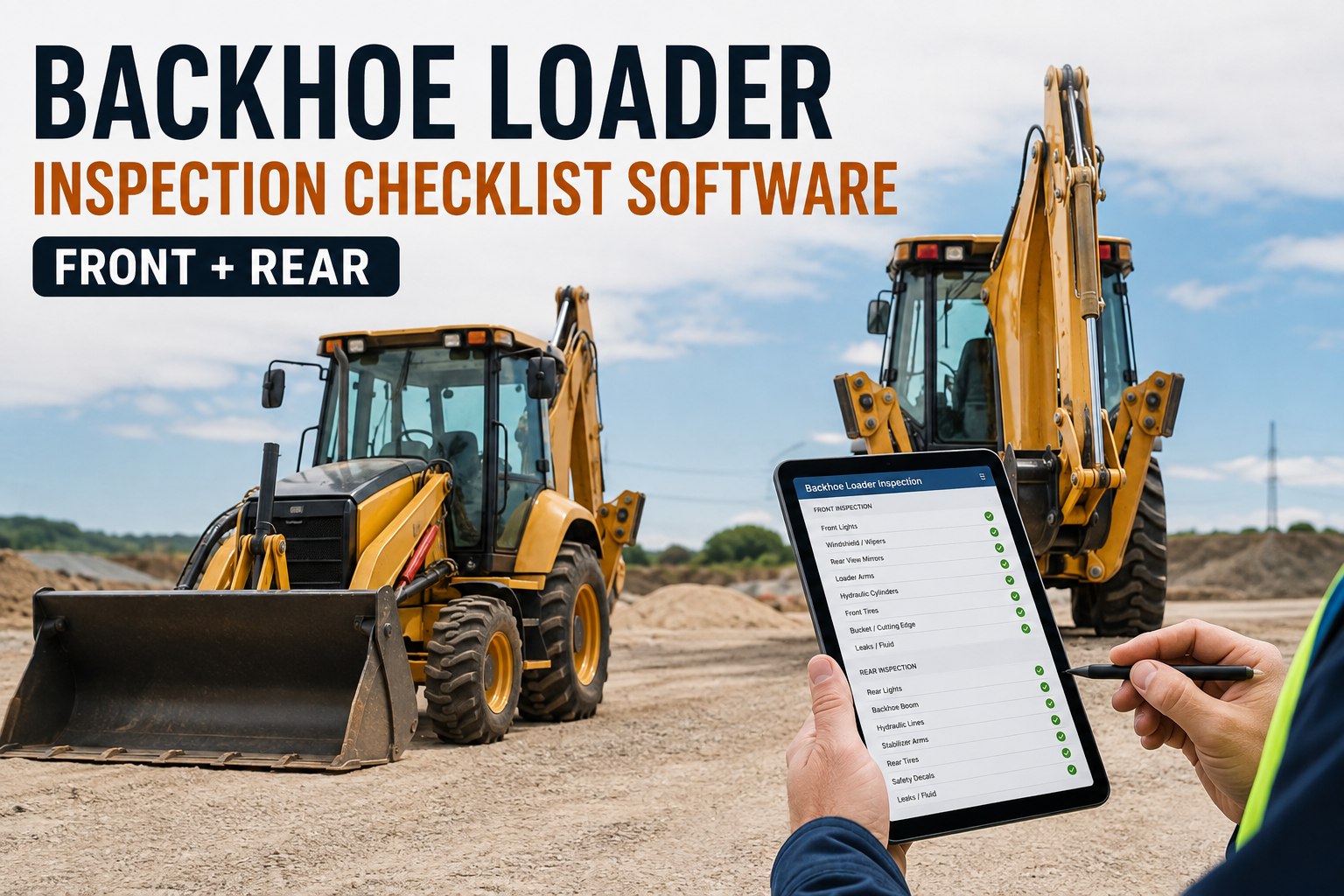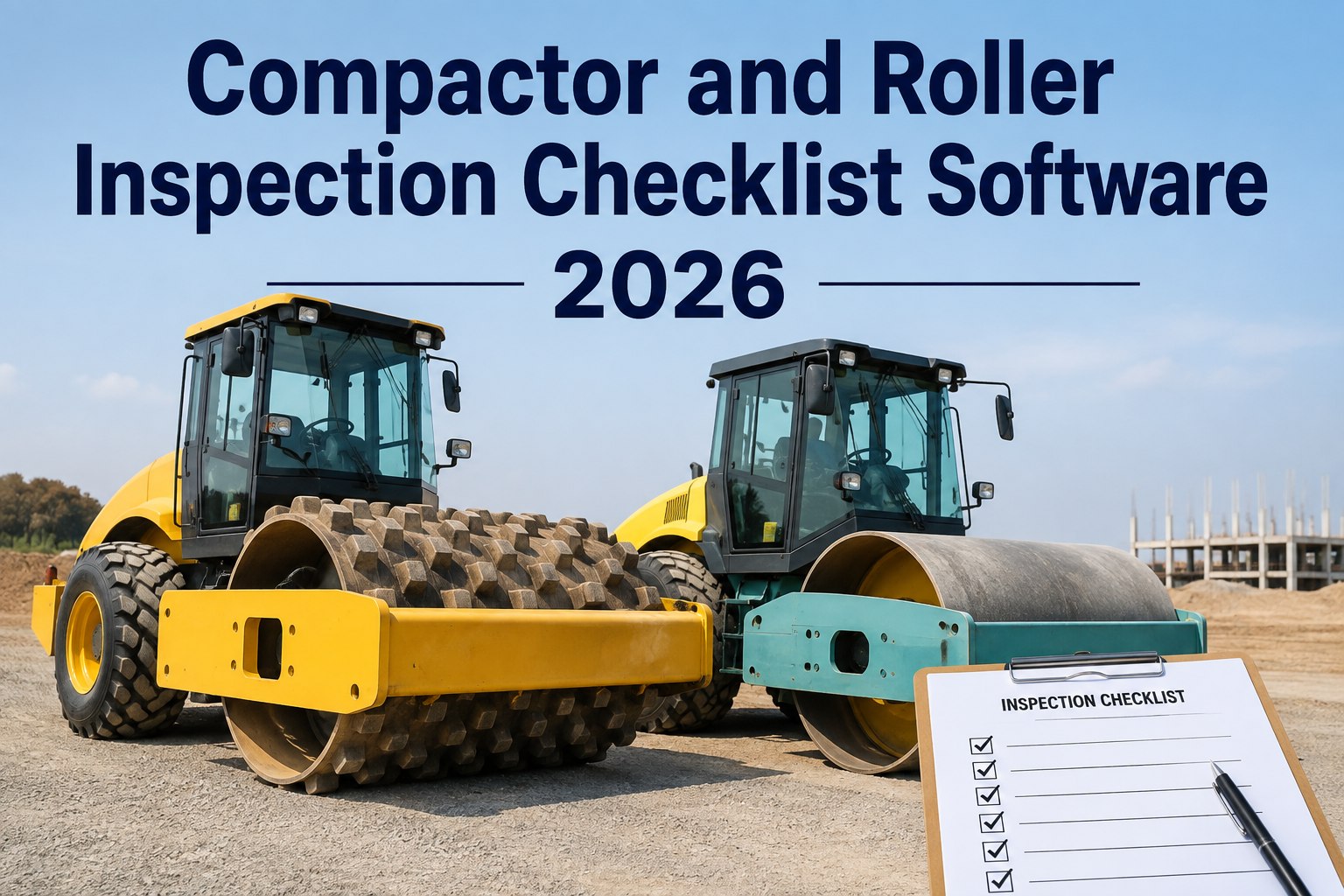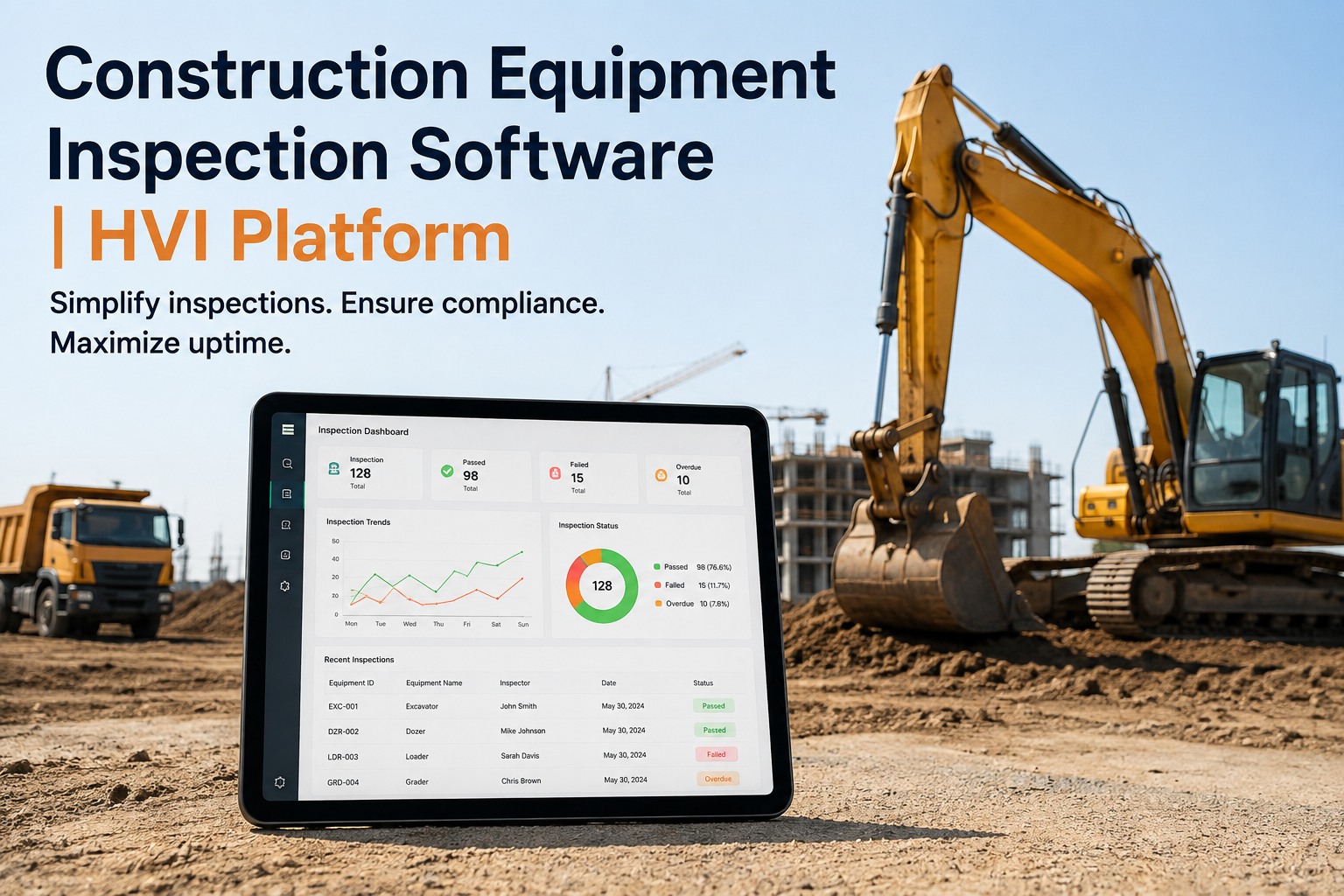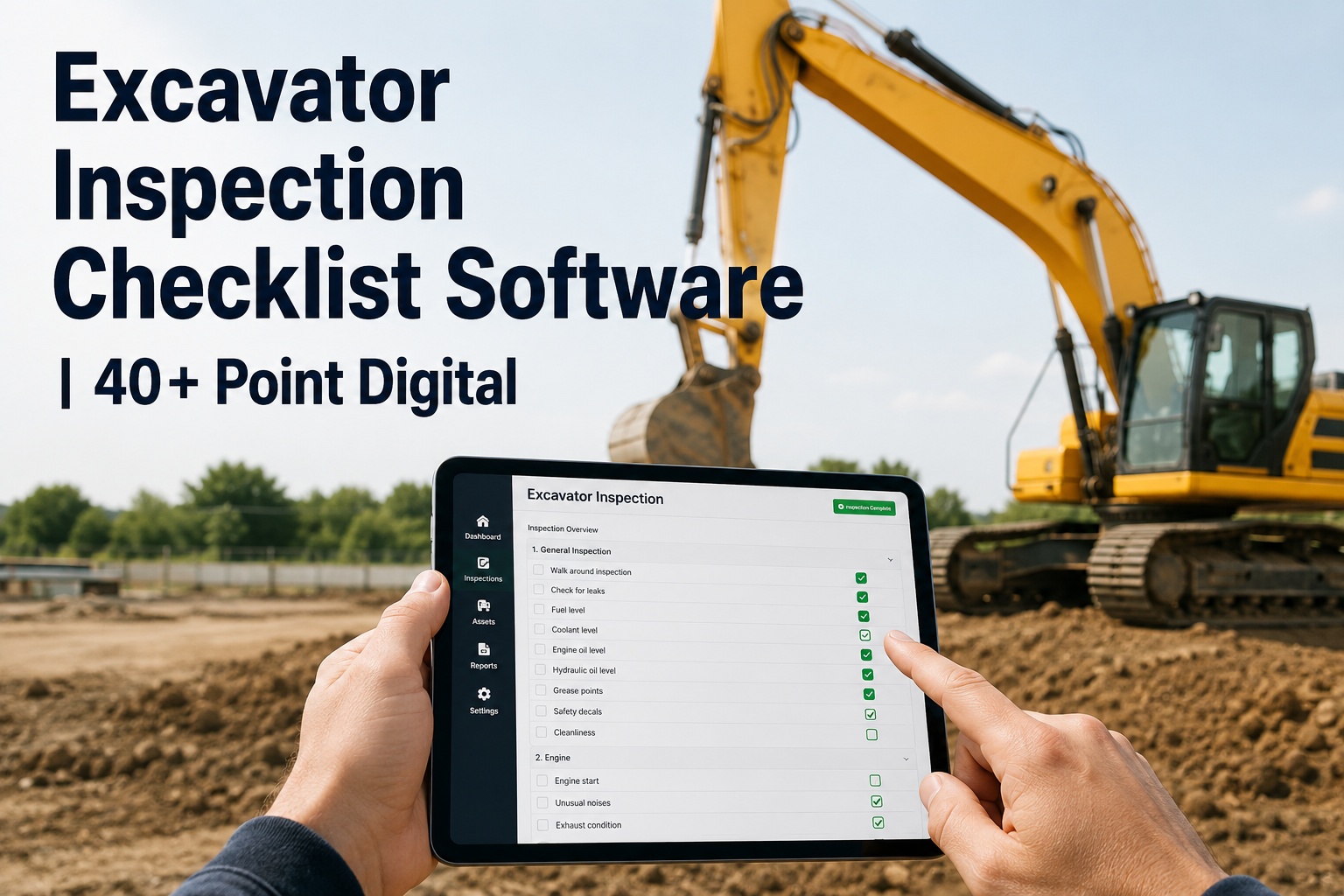
You’ve seen it on a Monday morning: an operator ticks “brakes, lights, horn” on a generic pickup-truck checklist, signs it, and climbs into a 22-tonne excavator whose track tension, swing bearing and hydraulic hoses nobody has looked at. That form didn’t just fail to protect you — it created a paper trail proving you inspected the wrong things. Proper construction equipment inspection checklist templates are built per machine class, with the right items, the right frequency and the right regulation printed on the form itself. This page walks through what belongs on checklists for excavators, cranes, loaders, dozers, forklifts, compactors and generators, why item counts differ so much between them, and when to customise versus stay standard. If you’d rather skip the build work, you can book a 30-minute walkthrough of the full template library and see every checklist running on your own units.
Is your excavator checklist actually an excavator checklist?
Pre-built, regulation-referenced templates for every machine class on your jobsite — ready on any phone, editable in minutes, and audit-proof from day one.
- Excavators — 40+ items across 6 zones for Cat, Komatsu, Volvo, Hitachi, Deere
- Cranes — 70 items across 7 systems, mapped to ASME B30.5
- Forklifts — 62 items in 3 phases per OSHA 1910.178, battery-chemistry variants included
- Loaders, dozers, compactors, generators, light vehicles — all covered
What a wrong checklist really costs you
A generic form feels free. It isn’t. These four numbers show what rides on the checklist your operator holds at 6 a.m.
Why item counts differ so much between machine classes
A forklift checklist and a crane checklist are not the same document with a different title. The item count follows the failure modes: the more ways a machine can hurt someone or strand a crew, the longer the list. Here is how the HVI template library breaks it down.
Excavators — 40+ items
Six zones: engine, hydraulics, undercarriage, boom-stick-bucket, cab safety and ground level. Undercarriage alone carries track tension, roller wear and sprocket condition — items a truck form never mentions. Variants ship for Cat, Komatsu, Volvo, Hitachi and Deere, because hose routing and sight-glass positions differ by make.
Cranes — 70 items, 7 systems
Built to ASME B30.5: wire rope and reeving, sheaves, boom structure, load moment indicators, outriggers, brakes and operator aids. Seventy items sounds long until a rope with broken wires beyond discard criteria lifts a load over a live site. Each item carries its B30.5 clause reference on the form.
Forklifts — 62 items, 3 phases
Structured around OSHA 1910.178: key-off checks, engine-on checks and operational checks. Electric units get battery-chemistry-specific variants — lead-acid watering and venting checks differ from lithium-ion thermal and connector checks. Propane units get cylinder and hose-leak items instead.
Wheel loaders — 35+ items
Bucket cutting edge and teeth, articulation joint play, brake accumulator pressure, ROPS integrity and sight lines. Loaders live at the face, so visibility and braking items carry extra weight — a worn centre pivot pin shows up here before it shows up as a steering failure.
Bulldozers — 30+ items
Blade and ripper hydraulics, cutting-edge wear, track frame alignment, final-drive oil levels and cab mounts. Dozers push all day, so the list leans hard on undercarriage and structural pins — the components that turn a small defect into a multi-day stoppage.
Compactors, generators, light vehicles
Drum vibration bearings and scraper bars on compactors; coolant, belts, fuel lines and auto-start panels on generators; full DVIR-style checks on site pickups. Every asset that moves, lifts or powers the job gets its own form — nothing inherits a checklist that doesn’t fit.
The case for printing the regulation on the template itself
Three reasons the CFR or ASME clause belongs next to the item, not in a binder in the site office.
Operators check harder when they know why
“Wire rope — broken wires within one lay (ASME B30.5-5.1.7)” gets looked at. “Check rope” gets ticked. The reference turns a box-tick into a judgement call the operator understands, and it trains new hires on the standard without a classroom session.
Inspectors and auditors move faster
When an OSHA compliance officer, a client’s auditor or an insurance assessor asks how you inspect forklifts, handing over a form that cites 1910.178(q)(7) line by line ends the conversation in minutes. Without the reference, you’re reconstructing your process from memory under pressure.
Defects convert to work orders with the right priority
A flagged item tied to a regulation tells the shop it’s a stop-work defect, not a “when convenient” repair. In HVI, that defect becomes a work order automatically, with the photo and the clause attached — you can see that defect-to-work-order flow in a live demo on one of your own machines.
| Equipment class | Items | Frequency | Reference printed on form |
|---|---|---|---|
| Excavator (Cat, Komatsu, Volvo, Hitachi, Deere) | 40+ | Daily pre-start + hourly service intervals | OSHA 1926.1412 / OEM manual |
| Mobile crane | 70 across 7 systems | Each shift + monthly + annual | ASME B30.5, OSHA 1926.1412 |
| Forklift (LPG, diesel, lead-acid, lithium) | 62 across 3 phases | Each shift, before use | OSHA 1910.178(q)(7) |
| Wheel loader | 35+ | Daily pre-start | OSHA 1926.600 / OEM manual |
| Bulldozer | 30+ | Daily pre-start | OSHA 1926.600 / OEM manual |
| Compactor / generator / light vehicle | Class-specific | Daily or per-use | OEM manual / site rules |
When to customise a template — and when to leave it alone
The biggest template mistake after using a generic form is over-editing a good one. Use this split to decide.
Stay standard when…
- The machine is a common make and model already in the library — the 40+ excavator items came from OEM manuals and field failure data, not guesswork.
- The item exists because of a regulation. Removing a 1910.178 check from a forklift form doesn’t save 10 seconds; it removes your legal defence.
- You’re tempted to shorten the list to speed up mornings. A faster checklist that misses a cracked boom pin is not faster — it’s deferred downtime.
Customise when…
- You run attachments — hammers, augers, grapples. Each adds its own pins, hoses and wear points that belong on the daily list.
- Site conditions demand it: dust-heavy aggregates work justifies extra air-filter and radiator checks; coastal UAE or UK marine work justifies corrosion items.
- A client or contract specifies inspection points. Add them verbatim so the record matches the contract language.
In HVI every template is fully editable — add, remove, reorder or require photos on any item — and a completely new equipment type takes under 30 minutes to build. Most managers sign up free and clone their first template the same afternoon.
See every template on your own machines
Book a 30-minute demo and we’ll load your excavators, cranes and forklifts into HVI live — checklists, references and all.
What one missed item costs — a real-world sum
Take a 12-machine earthworks crew: two excavators, three loaders, a dozer, a compactor, two forklifts, a generator and two site pickups.
Multiply that across a year of pre-starts and the template library stops looking like admin and starts looking like the cheapest insurance on the job. If you want the numbers on your own fleet, walk through a downtime-cost calculation in a demo with your actual machine rates.
The template library is only the start
HVI (Heavy Vehicle Inspection & Maintenance, by JRS Innovation Inc.) is a cloud + mobile inspection and maintenance work order CMMS. The checklists plug straight into the rest of your maintenance operation.
Any phone, any jobsite
Operators complete the checklist on their own phone at the machine — yard, roadside or remote site — with photos forced on critical items. No paper binders, no texted photos lost in group chats.
Defect to work order, instantly
A failed item creates a work order with the photo, the regulation reference and the operator’s note already attached. The shop sees it before the operator walks back to the crib room — cutting the defect-to-repair lag that kills uptime.
Preventive maintenance on hours, not guesses
PM schedules run by date, mileage or engine hours with due and overdue alerts, fed by the same inspections. Parts and inventory across multiple shops, fuel and tire tracking, and cost-per-asset analytics close the loop.
Audit-ready in seconds
Every inspection is timestamped, photo-backed and tied to the asset. When DOT, a client auditor or an insurer asks for proof, you pull the record on screen — one platform across trucks, trailers, off-road plant and shop equipment. Book a demo and try an audit pull live.
Construction inspection checklist templates: the short version
A generic vehicle checklist on heavy plant is worse than no checklist — false confidence plus a paper trail of inspecting the wrong things.
Item counts follow failure modes: 40+ for excavators, 70 across 7 systems for cranes, 62 across 3 phases for forklifts, 35+ for loaders, 30+ for dozers.
Print the OSHA or ASME reference on the form — operators check harder, auditors move faster, defects get the right priority.
Customise for attachments, site conditions and contract language; never customise away a regulatory item. New equipment types take under 30 minutes to build in HVI.
The fastest way to put this into practice is to start a free account and assign your first template today — your operators could be running the right checklist tomorrow morning.
My gripe was always the same: the operator ticks the box, the hose still bursts, and I’m the one explaining the downtime. Now I track one number — defects caught at pre-start versus found broken. Since we moved every machine onto its proper template, that ratio flipped. Last quarter pre-start finds outnumbered breakdowns four to one, and the crane auditor was in and out of my office in twenty minutes because the B30.5 references are printed right on the form.
Daniel Reyes — Maintenance Manager, civil earthworks and siteworks contractor
Construction equipment checklist questions, answered
What should be on an excavator inspection checklist?
How often should construction equipment be inspected?
Can I customise the templates for my attachments and site conditions?
Do digital checklists hold up in OSHA or client audits?
Why not just use a free PDF checklist from the internet?
Stop inspecting the wrong things
Get the full 2026 template library — excavators, cranes, forklifts, loaders, dozers and more — running on your crew’s phones this week.
Free to start — Works on any phone — No card needed