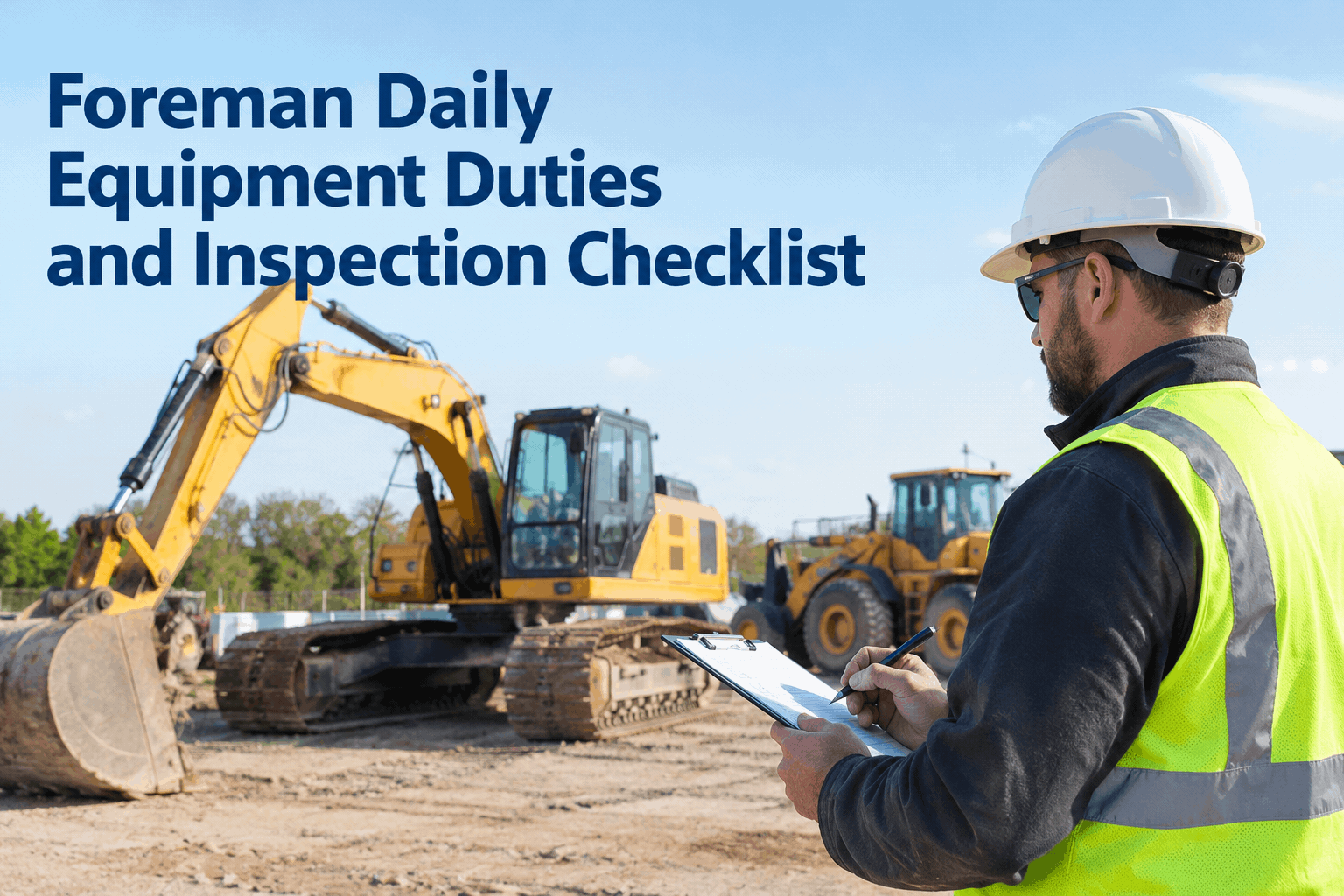
If you run a crew, the equipment carries your name. An operator does the walk-around, but you are the one who signs that a machine is fit, decides whether a flagged defect parks it or runs it and answers for it when an incident or an auditor asks who knew. That is the real shape of foreman equipment duties — a daily chain of checks, calls and records, not a single morning task. This page maps that chain duty by duty and shows exactly where it breaks. Book a demo of the foreman shift board once you see your day laid out.
The foreman owns the machine the moment the crew clocks in
Five equipment duties sit on you every shift — verify the inspection, judge the defect, release or park the unit, push the repair, keep the record. Miss one and it lands on you at the audit.
A foreman's equipment job isn't "do the inspection yourself." It's owning the loop that starts when an operator checks a machine and ends when the record is filed and the defect is closed. Here is that loop, broken into the five duties you actually answer for.
5 foreman equipment dutieswhat you answer for on every machine, every shift
Verify the inspection happened
Confirm every operator ran the walk-around before the engine turned — not that they said they did. A blank or back-dated check is your gap, not theirs.
Record dutyJudge every defect that returns
A weeping fitting, a cracked step, a dead backup alarm — you decide which is a note and which is a stop. The regulation puts that competent-person call on you.
Judgment callRelease the machine — or park it
Only fit units go to work. Production is waiting and a replacement is a week out — "run it today, fix it Friday" is the call that shows up in incident reports.
Judgment callPush the defect to a real repair
A flagged part no one orders is a note waiting to become a breakdown. You turn the defect into a work order and chase it until the fix is signed off.
Follow-throughKeep the record an auditor accepts
Signed, dated, with the defect and what you did about it. "The operator eyeballs it" isn't a record. When DOT, OSHA or a client audit lands, the paper trail is all that speaks.
Record dutyTwo duties are about records, two are judgment calls, one is follow-through — and a clipboard helps with none of them. Book a demo to see the five duties on one screen.
Daily equipment inspection: who does whatoperator inspects, foreman owns the loop
The hands-on check is the operator's. The accountability — four of five stages — is yours. That is why a tool that only digitizes the operator's form misses most of the job. Explore HVI's digital equipment inspections to see both sides on one record.
The foreman's shift clockwhere the equipment duties fall across your day
-
06:00Pre-start, before any engine runs Operators run the walk-around; you confirm each is done and read the defects that came back. Nothing moves until this clears.
-
06:45Release / park decision Cleared units go to the face. Flagged units get your call — park, or run with a defined limit. You log the reason either way.
-
MidChase the open defects Raise work orders on parked machines, confirm parts are ordered, and plan production around what is actually down.
-
EndClose the loop and file Sign off completed repairs, update the record, and hand the next shift a clean picture of what runs and what doesn't.
The duties thread through the whole shift — the day falls apart when the morning check lives on paper and the afternoon follow-up lives in your head. Sign up free and keep the whole shift on one board.
Paper clipboard vs digital equipment inspectionsthe same duty, done two ways
- You trust the walk-around was done — no timestamp to prove it
- Defect photos get texted into a group chat and lost by lunch
- A parked machine's repair lives on a sticky note until it doesn't
- Records sit in a cab binder that's wet, torn, or in the wrong truck
- At audit you reconstruct the week from memory
- Each inspection carries a time, a unit ID and the operator's name
- Critical items force a photo — the leak is on the record, not in a chat
- A flagged defect becomes a work order in one tap and tracks to closed
- The signed PDF record is stored the moment the check is submitted
- At audit you pull the whole history in seconds
Same five duties either way — one version makes you the single point of failure, the other makes you the person with the receipts. This pairs with how teams Read our guide on cutting equipment downtime with daily inspections — the duty here is the foreman's side of that same loop.
Foreman equipment release checklistwhat you confirm before any machine goes to work
This is the foreman's release checklist — not the operator's full walk-around, but the short set of confirmations you run before a unit is cleared. Grouped by what actually stops a machine.
Run this on every unit and the "run it today" trap loses its grip — parking a machine now comes with a work order and a record, not a shrug. Book a demo to load this release checklist on your fleet, or start from HVI's ready See HVI's construction equipment checklist templates.
Equipment defect to repair, done rightthe follow-through duty, as a traceable flow
HVI's one-click Explore HVI's work order and maintenance management closes that exact gap, and ties into See how preventive maintenance scheduling catches the wear before it ever becomes a defect.
Why equipment duties land on the foremanthe numbers behind the daily inspection duty
OSHA puts pre-shift equipment inspection by a "competent person" on the record under 29 CFR 1926 — and on most crews, that competent person is the foreman. The duty isn't optional; the only question is whether it's tracked or trusted to memory.
The takeaway: foreman equipment duties aren't the morning walk-around alone — they're the whole chain from verifying the daily inspection to closing the work order and filing a record that holds up at audit. Do that chain on paper and you're the single point of failure; do it on a connected board and every judgment call, defect and repair leaves a trail you can prove. Book a demo to see your foreman equipment duties on one board.
From a foreman who stopped running it off a clipboard
My worst habit was "run it today, I'll flag it Friday" — the loader was needed and the part was a week out. The day a dozer I'd waved through dropped a hose on a slope, I realized my sign-off was the whole safety net. Now every release is a tap with my name on it, every parked machine throws its own work order, and when the client's auditor showed up I pulled six weeks of records in under a minute. The duty didn't change — I just stopped carrying it in my head.
Turn the foreman's equipment job into a dashboard, not a memory test
HVI runs the pre-shift inspection on every operator's phone, flags the defect with a photo, turns your park decision into a tracked work order, and files the signed record automatically. The loop you answer for becomes something you can see — and prove. Live across your sites in weeks.
No credit card · No hardware · Your first shift board ready on day one
Foreman equipment duties — FAQs
What are a foreman's daily equipment duties?
Verify every pre-shift inspection happened, judge each defect that returns, release fit machines or park unfit ones, push flagged defects into real repairs, and keep a signed record of it all. In short, you own the loop from inspection to closed work order — not just the morning check.
Does the foreman have to do the equipment inspection personally?
The operator usually runs the walk-around, but the foreman is typically the "competent person" OSHA references — the one who confirms it was done, judges the defects, and has authority to park the machine. The hands-on check can be delegated; the accountability sits with you.
What should a foreman check before releasing a machine to work?
Confirm the walk-around is complete and timestamped, the operator is authorized, and safety-critical systems pass — brakes, steering, backup alarm, lights, no active hydraulic leak. Then check structure and stability, and make sure any parked unit has an open work order, not just a note.
How does a digital checklist help a foreman meet these duties?
It timestamps each inspection, forces photos on critical defects, and turns a flagged item into a tracked work order in one tap — so judgment and follow-through don't rely on memory. The signed record is stored automatically, which is what an audit actually asks for.
What happens if a foreman releases a machine with a known defect?
If that defect contributes to an incident, the release decision is the first thing reviewed — and an undocumented "run it today" call offers no defense. A logged disposition with a work order shows you managed the risk, which is exactly what the record is there to prove.