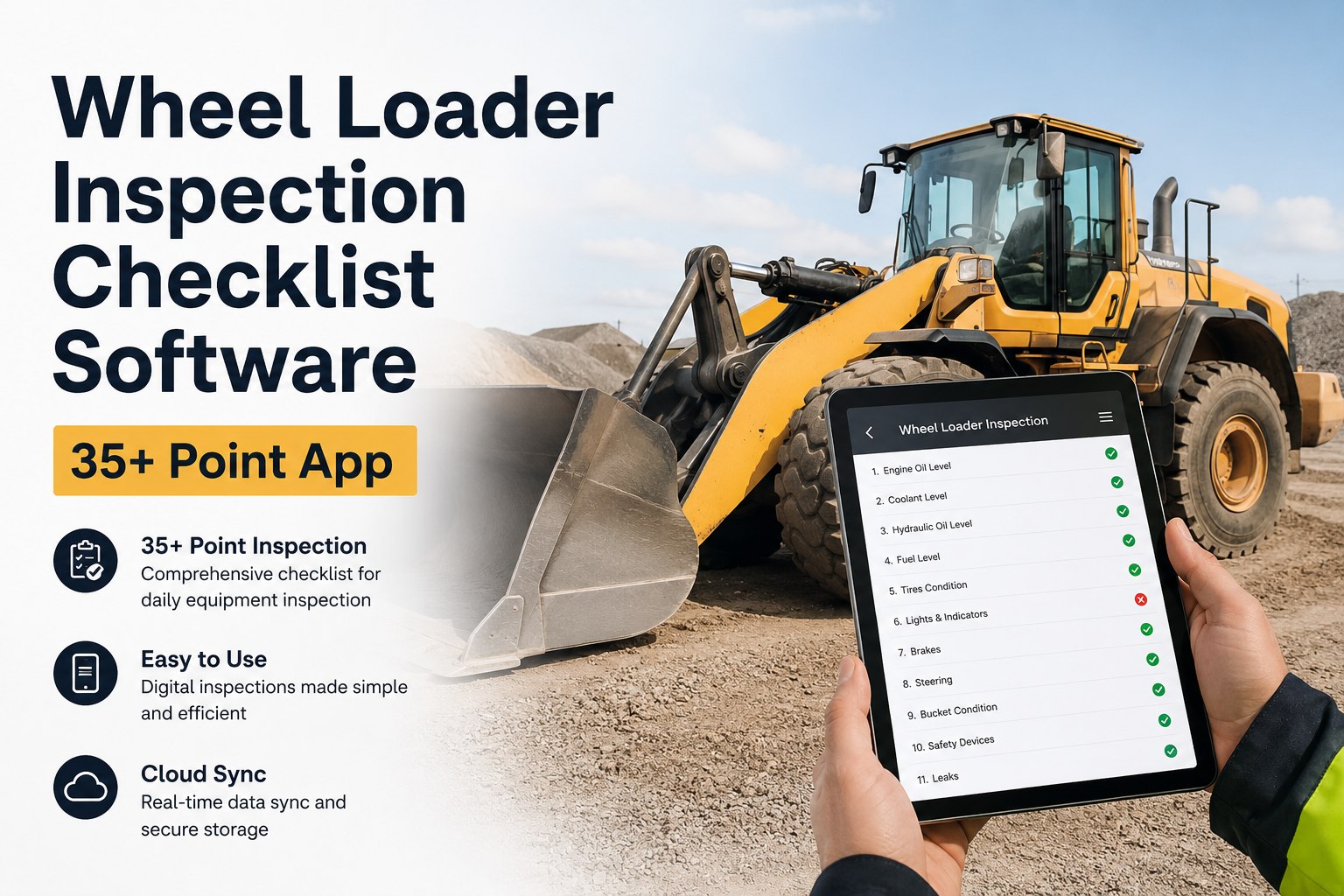
The operator climbs into the cab at 5:40, fires the engine, and rolls straight to the stockpile because the pit is already loading trucks. Nobody has looked at the articulation pin, the bucket teeth, or the brake accumulator since Tuesday. A solid wheel loader inspection checklist fixes that in under ten minutes a shift: engine and cooling, hydraulics, drivetrain, articulation joint, bucket and cutting edge, brakes, steering, tires, cab and lights. This page gives you the full 10-zone checklist, the failure points that actually take loaders down, and how to run the whole thing from a phone with photos and automatic work orders. If you want to see it working on your own units first, you can book a 30-minute walkthrough of the loader template and judge it against your current paper process.
Digital Loader Pre-Shift Checklist
The articulation joint is the most ignored catastrophic failure point in your fleet
Excavators and cranes get the inspection attention. Wheel loaders do the daily grind work with a hinge in the middle of the frame that wears silently until it doesn't. HVI's 35+ point loader template covers all ten zones below, offline, with photo capture and defect-to-work-order automation.
- Articulation pin play measured and logged every shift, not guessed at
- Cutting edge and tooth wear photographed against the last reading
- Brake accumulator hold test recorded before the loader moves a metre
- Any failed item auto-creates a work order with the photo attached
Why the daily check pays for itself
What skipping a loader pre-shift check actually costs
$16,550
Per OSHA serious violation in 2026 — and 1926 requires a competent-person daily equipment inspection
35+
Inspection items in HVI's wheel loader template, covering all ten zones from engine to lights
8–10 min
Time a full digital walk-around takes on a phone — less than the paper version with a pen that won't write in the cold
1 day+
Typical downtime when a worn articulation pin or burst hydraulic hose fails under load instead of being caught at the walk-around
The 10 Inspection Zones
Wheel loader inspection checklist: the ten zones that matter
A front end loader inspection that skips any of these zones is a partial inspection. Each zone below lists what the operator checks, and what it costs you when nobody does.
01
Engine & Cooling
Oil, coolant, fuel and DEF levels; belt condition; air filter restriction indicator; leaks under the machine. A loader working in dust eats air filters — a clogged filter costs measurable fuel burn before it ever throws a code.
02
Hydraulic System & Visible Leaks
Hoses at the boom pivot, cylinder rod scoring, fitting weep, reservoir level. A hose that weeps today bursts under full bucket load next week, and a burst hose on a hot manifold is a fire risk, not just a mess.
03
Drivetrain & Transmission
Transmission oil level and condition, axle oil, driveshaft guards, unusual noise on direction changes. Loaders shuttle all day in forward-reverse cycles — drivetrain wear shows up here first.
04
Tires — Condition & Pressure
Cuts, chunking, bead damage, and pressure on every corner. Tire condition drives both safety and fuel burn: an underinflated loader tire on a 3-cubic-yard machine can add noticeable fuel cost per shift and heat-builds toward a sidewall failure.
05
Articulation Joint
Pin play, bushing wear, grease evidence, and the hinge area for cracking. This is the zone that separates a real loader inspection from a generic equipment checklist — details below.
06
Bucket, Teeth & Cutting Edge
Tooth wear and missing teeth, cutting edge wear against the wear line, bucket floor cracking, hinge pin condition. A missing tooth in a crusher feed or a finished-grade job is a contamination problem, not just wear.
07
Brakes & Accumulator
Service brake feel, parking brake hold on grade, and the accumulator hold test: engine off, key on, pump the brake pedal — you should get several firm applications before pressure fades. Fewer than that means the accumulator is weak, and a weak accumulator means no reserve braking if the engine dies on a ramp.
08
Steering
Full lock-to-lock response, no dead spot at center, secondary/emergency steering function where fitted. On an articulated machine, steering and the hinge are the same conversation.
09
Cab Safety Devices & ROPS
Seatbelt, horn, mirrors, camera and wipers, door latches, and the ROPS structure for damage or unauthorised modification. A bent ROPS from a rollover that "wasn't worth reporting" is a liability sitting in plain sight.
10
Lights & Backup Alarm
Work lights, beacons, turn signals, and the backup alarm under load. Loaders work around ground crews and haul trucks in low light — a dead alarm is a struck-by incident waiting for a shift change.
Zone 05 Deep Dive
Articulation joint inspection: the hinge that takes loaders out of service
Wheel loaders steer by bending in the middle. That hinge carries the full weight transfer of every loaded bucket, every turn, every shift. It wears slowly and fails expensively.
What pin play actually is
The articulation pin runs through bushings that are designed to be replaced — they are sacrificial wear items. As they wear, clearance opens up between pin and bushing. You feel it as a clunk on direction change or see it as visible movement when the machine articulates under load. A few millimetres of play is a maintenance item. Ignored, the pin starts working against the bore of the frame bosses instead of the bushing — and now you are line-boring a loader frame instead of pressing in a $40 bushing.
How the operator checks it in 60 seconds
Articulate the machine fully both ways and look at the hinge: fresh grease pushed out means it was greased; dry, rusty streaks mean it wasn't. With the bucket loaded and the machine turning, listen for the clunk. In HVI, the operator answers "articulation pin play — none / minor / excessive" and attaches a photo of the hinge area. That photo is timestamped, so you can compare wear progression month over month instead of relying on memory.
Why it matters more than the checklist item suggests
A failed articulation joint doesn't strand a loader politely. It fails under load, often mid-turn with a raised bucket, which is a stability event. Beyond the safety exposure, the repair is a multi-day shop job with heavy press work — versus a bushing swap done at a scheduled PM. Catching play early is the difference between a planned half-day and an unplanned week.
If you want to see how the articulation item sits inside the full 35-point template, book a demo and walk through the loader checklist on screen with your own machines in mind.
Catch It Early vs Pay For It Late
Loader daily inspection findings: what early detection saves per zone
Every item on the checklist maps to a repair decision. Here is how the same defect plays out depending on when it gets caught.
| Zone | Caught at pre-shift | Caught when it fails | Typical consequence |
|---|---|---|---|
| Articulation joint | Bushing swap at next PM | Line-bore frame bosses, new pins | Multi-day downtime, major shop bill |
| Hydraulics | Hose replaced in the yard | Burst hose under load, oil everywhere | Fire risk, cleanup, lost shift |
| Tires | Pressure corrected, cut monitored | Sidewall failure on a loaded machine | Tire callout plus stability risk |
| Cutting edge / teeth | Edge flipped or teeth replaced on schedule | Worn through into bucket floor | Bucket rebuild instead of a wear part |
| Brakes / accumulator | Accumulator recharged or replaced | No reserve braking on engine stall | Runaway risk on grade, incident report |
| Lights / alarm | Bulb or alarm swapped same day | Struck-by near-miss at shift change | Investigation, claim, site stand-down |
A worked example: one loader down for three days on an articulation repair, at a conservative $800–$1,200 per day in lost production and rental cover, is a $2,400–$3,600 event — before the shop bill. The bushing that would have prevented it costs less than a tank of diesel. When your operator flags pin play in the app, that defect becomes a work order automatically, so the cheap fix actually gets scheduled instead of forgotten in a group chat. You can start logging loader inspections free and see the defect-to-work-order flow on your first shift.
See the 35+ point wheel loader template running on your own fleet
Book a 30-minute demo and we will load your loader makes — Cat, Deere, Volvo, Komatsu, whatever you run — and show the full defect-to-work-order flow live.
How HVI Helps
Wheel loader inspection software that works where the loader works
Four capabilities, each mapped to a problem you already have.
Offline photo capture, any phone
Pits, quarries and remote pads have no signal. The loader operator checklist runs fully offline and syncs when the device reconnects — so the pre-shift happens at the machine, not back at the office. Outcome: no more "I'll fill it in later" inspections that never happened.
Defect-to-work-order automation
A failed item — pin play, a weeping hose, a soft brake pedal — creates a work order the moment the inspection is submitted, with the photo attached. Outcome: defects stop dying in text messages, and the cheap fix gets scheduled before it becomes the expensive one.
PM scheduling by engine hours
Loaders live by engine hours, not calendar dates. Preventive maintenance triggers on hours, mileage or date with due and overdue alerts, so greasing intervals and bushing checks land on time. Outcome: wear items get replaced as wear items, not as failures.
One dashboard, every asset class
Loader inspections flow into the same dashboard as your trucks, trailers, excavators and shop equipment — uptime, cost per asset, compliance rate. Outcome: when a client, insurer or auditor asks for records, you pull timestamped, photo-backed history in seconds. Book a demo to see the mixed-fleet view.
Compliance Without the Paper Chase
OSHA 1926 daily inspections: what "competent person" means for your loaders
OSHA's construction standard requires equipment to be inspected by a competent person — someone who can identify hazards and has authority to correct them. For most contractors, that competent person is the operator at the start of the shift, and the inspection has to actually happen and be provable.
The requirement
A documented daily check of the machine's safety-critical systems before it works. In 2026, a serious OSHA violation runs $16,550 — and "the operator usually looks it over" is not a defence when an incident investigator asks for records.
The paper problem
Paper checklists get pencil-whipped, lost in cabs, and are unreadable by the time anyone files them. When you need to prove a specific loader was inspected on a specific morning, you are digging through a binder hoping the sheet exists.
The digital record
Every HVI inspection is timestamped, geolocated, named to the operator, and photo-backed. Pulling a loader's full inspection history for an audit, an insurer or a client prequal takes seconds. Sign up free and run your first digital pre-shift this week.
Key Takeaways
The bottom line on loader pre-shift checks
- The articulation joint is the zone that separates a real wheel loader inspection from a generic checklist. Pin play caught early is a bushing; caught late, it is a frame repair and a week of downtime.
- Tires, brakes and the backup alarm are the daily items with the highest incident exposure. Ten minutes a shift covers all ten zones.
- OSHA 1926 expects a competent-person daily inspection with proof. At $16,550 per serious violation in 2026, a timestamped digital record is the cheapest compliance insurance you can buy.
- A wheel loader inspection checklist only works if defects turn into repairs. Automatic work orders on every failed item close that loop — and your loaders report into the same dashboard as every other asset you run.
"I track one number on our loaders: articulation grease. If the hinge is dry in the photo, I know the whole walk-around was rushed. We used to find worn pins when the operator complained about the clunk — by then the bore was already egged out. Now the pre-shift photo lands before the machine leaves the pad, and a flagged item is a work order before I've finished my coffee. Last year we did two bushing swaps at scheduled PMs instead of one frame job. That one change paid for the software several times over."
Marc Delaney — Maintenance Manager, regional aggregates and site-development contractor
Frequently Asked Questions
Wheel loader inspection questions, answered
What should a wheel loader daily inspection include?
A complete loader daily inspection covers ten zones: engine and cooling, hydraulic system and visible leaks, drivetrain and transmission, tires (condition and pressure), the articulation joint, bucket teeth and cutting edge wear, brakes and the accumulator hold test, steering, cab safety devices and ROPS, and lights with the backup alarm. HVI's wheel loader template builds all 35+ items across these zones into a phone-based checklist with photo capture.
How do you check articulation pin play on a wheel loader?
Articulate the machine fully in both directions and watch the hinge area for visible movement between the pin and its bosses; listen for a clunk on direction change with a loaded bucket. Check for fresh grease at the pin — dry, rusty streaks mean missed greasing. Log the finding as none, minor or excessive with a photo, so wear progression is tracked over time rather than guessed.
Does OSHA require a daily wheel loader inspection?
Yes — OSHA 1926 requires equipment to be inspected by a competent person before use, and that expectation falls on the operator's pre-shift check for loaders on construction sites. In 2026 a serious violation carries a $16,550 penalty, so you need a provable record, not a verbal "he checks it." A timestamped digital inspection with photos is the simplest way to prove it — book a demo to see the audit trail.
How long does a digital loader pre-shift inspection take?
Eight to ten minutes for the full 35+ point checklist on a phone — typically faster than paper, because the app walks the operator zone by zone and photos replace written descriptions. It works offline at the machine and syncs later, and any failed item generates a work order automatically instead of relying on the operator remembering to tell someone.
Does the loader checklist work for Cat, Deere, Volvo and Komatsu machines?
Yes. The 35+ point template covers the systems common to all articulated wheel loaders, and you can add model-specific items — like OEM service points or site-mandated checks — per asset. Loader inspections sit in the same dashboard as your trucks and other plant, and you can sign up free and build your first loader checklist in minutes.
Put every loader on a 35+ point digital pre-shift this week
Start free with the wheel loader template, or book a 30-minute demo and watch a defect become a work order live — with your own fleet in mind.
Free to start - Works on any phone - No card needed