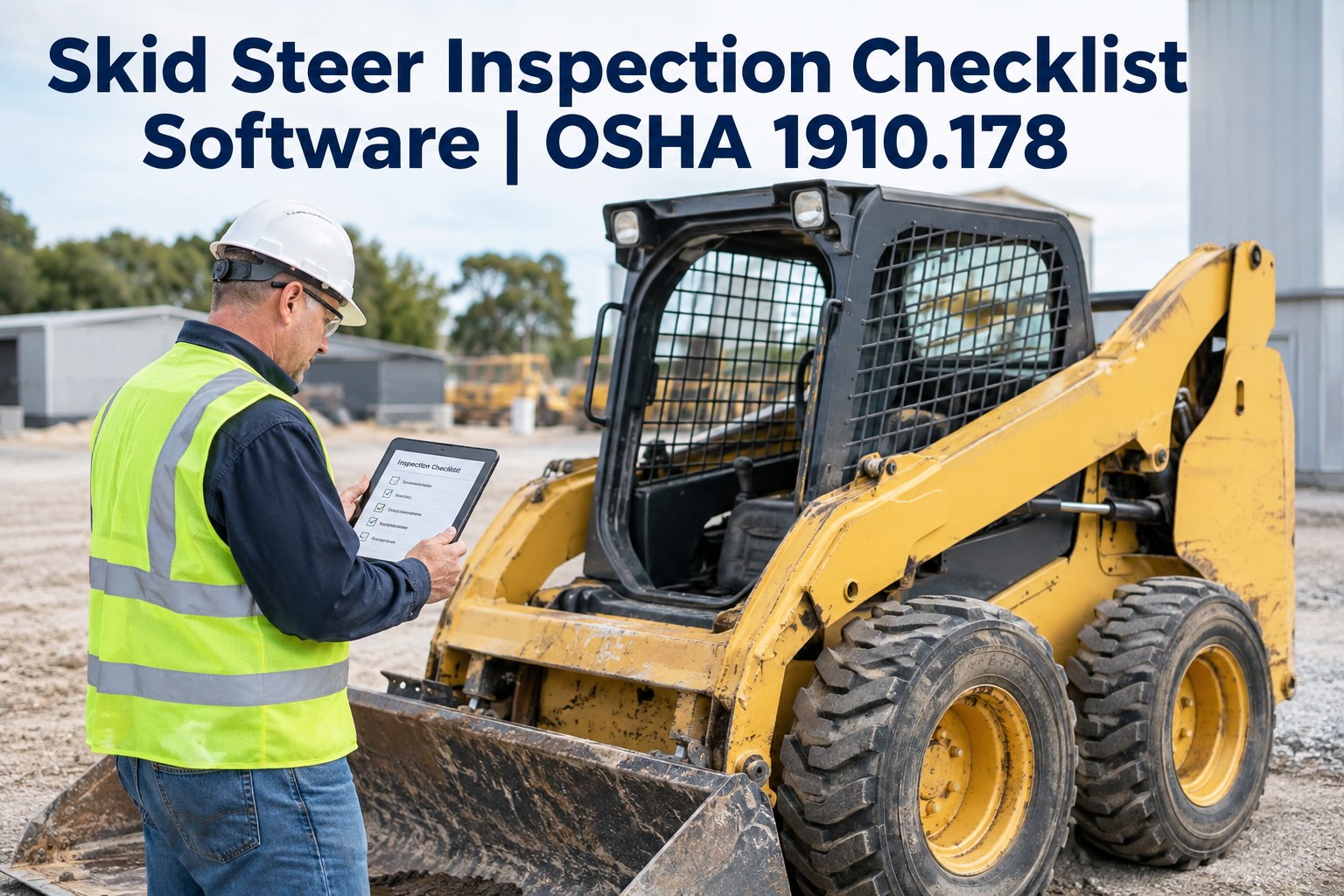
Monday morning, 6:40 a.m. Your operator climbs into the skid steer, fires it up, and rolls straight to the stockpile without touching the lift arm lock, the quick attach pins, or the seat belt interlock — and nobody can prove otherwise because the paper checklist is still sitting in the site trailer. A skid steer inspection checklist done properly takes under five minutes and catches the exact failures that put these compact machines in the incident reports: hydraulic couplers weeping under pressure, ROPS bolts loosened by vibration, and quick attach pins that were never fully seated. If you are still running these checks on paper or memory, book a 30-minute walkthrough and see what a digital pre-operation looks like on your own units.
The 5-minute skid steer pre-operation that stands up in an audit
Skid steers and compact track loaders fall under OSHA 1910.178 as powered industrial trucks — which means a documented pre-operation inspection by a trained operator is not optional, it is the rule. Here is the checklist your crew should be running, and the fastest way to prove they ran it.
Four numbers every skid steer fleet manager should know
The skid steer inspection checklist, broken into the checks that actually prevent incidents
A solid skid steer loader inspection is not a generic walk-around. These machines fail in specific, repeatable ways — and the checklist below is built around the failure modes that put operators in hospital and machines in the shop. Every item should be a pass/fail with photo capture, not a blank line.
Hydraulic system and coupler circuit
Cycle the lift, tilt and auxiliary circuits and watch for weeping couplers, chafed hoses at the lift arm pivot, and slow or drifting response. A coupler that seeps under no load will spray under full load — and a pinhole leak at pressure injects fluid into skin. Check the reservoir sight glass before start-up, not after.
ROPS and FOPS integrity
Inspect the rollover and falling-object protective structures for cracks at welds, bent members from a previous strike, and mounting bolts loosened by vibration. A ROPS that has taken a hit and never been reported is worse than no ROPS at all — it gives false confidence. Photo any damage and flag it before the machine moves.
Seat belt and operator presence interlock
This is the single most bypassed safety system on this machine class. Operators wedge the belt, tape the seat switch, or clip the belt behind them to defeat the interlock. Test it properly: engine should not allow lift or drive functions without the belt latched and weight on the seat. If it does, that is a red-tag defect, not a note.
Lift arm safety lock
Before anyone works under a raised lift arm — greasing, changing a coupler, clearing a jam — the mechanical safety lock must be engaged. Hydraulics alone are not a support system; a hose failure or an accidental control bump drops the arm in a fraction of a second. Verify the lock deploys, seats fully, and is not bent or binding.
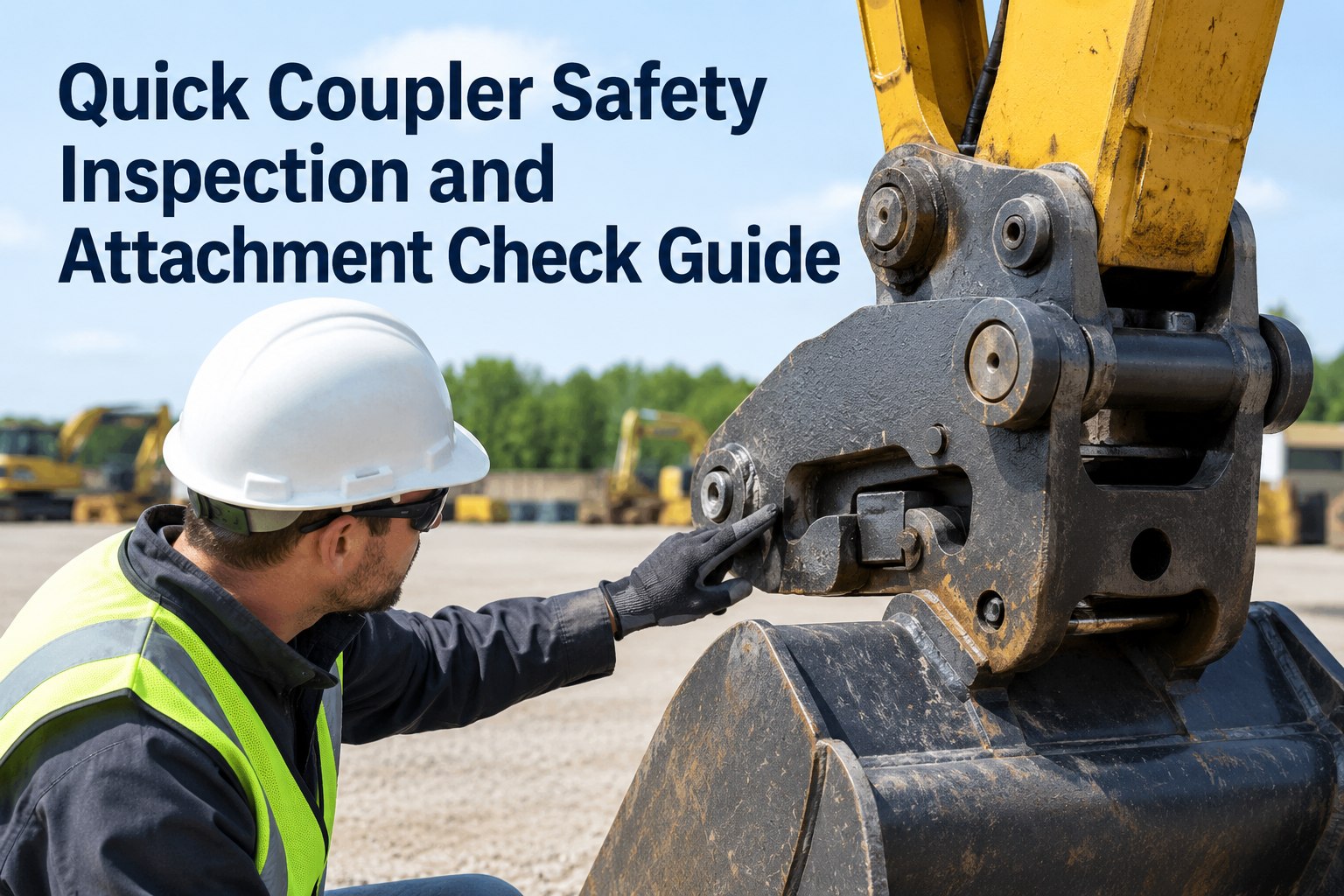
Quick attach pin lockdown
Physically confirm both locking pins are fully through the attachment plate — visually from the cab is not enough. A bucket or set of forks that looks seated can ride on one pin and release under load. This check kills people when it is skipped, and it takes ten seconds. Make it a forced photo step in the app so it cannot be tapped through.
Tires or rubber tracks
On wheeled units: sidewall cuts, chunking, bead damage and correct pressure. On compact track loaders: track tension per the OEM spec, missing or cracked rubber lugs, exposed cords, and delamination where the tread separates from the carcass. A delaminated track lets go without warning and can take the undercarriage with it.
One template does not fit both: skid steer vs compact track loader inspection points
A CTL inspection checklist shares most of its DNA with a wheeled skid steer checklist — but the undercarriage is a different machine entirely. Here is where the two diverge, and why your inspection software needs to handle both variants without a compromise template.
| Inspection area | Wheeled skid steer | Compact track loader (CTL) |
|---|---|---|
| Ground engagement | Tire pressure, sidewall cuts, lug nut torque, rim damage | Track tension, lug condition, cord exposure, delamination |
| Undercarriage | Axle seals, wheel bearing play, hub oil leaks | Rollers, idlers, sprocket wear, debris packed in the frame |
| Wear cost driver | Tire life — expect faster wear on hard surfaces and tight turning | Track and undercarriage life — the single biggest consumable on the machine |
| Daily failure to catch | Slow leaks and bead damage from curbs and rebar | Over-tight or loose tracks accelerating roller and sprocket wear |
| Shared checks | Hydraulics, ROPS/FOPS, seat belt interlock, lift arm lock, quick attach pins, controls, lights, backup alarm, fluid levels | |
In HVI you clone the base skid steer template, swap the ground-engagement section, and have a tracked variant live in under 30 minutes — no IT ticket, no PDF redesign. If you want to see that done on screen, grab a demo slot and we will build one with you.
Why the seat belt interlock check deserves its own line — and a photo
What actually happens in the field
Operators defeat the interlock because it slows them down on short hops. The belt gets buckled behind the seat, the seat switch gets taped, and the machine now drives and lifts with nobody restrained. In a tip-over — the highest-severity skid steer event — an unrestrained operator is thrown into the cage or under the ROPS. The interlock existed precisely for this scenario, and it was bypassed before 7 a.m.
What a digital check changes
When the interlock test is a forced step with a photo of the latched belt and a pass/fail on function, bypassing becomes visible. The supervisor sees the record. The pattern shows up in reporting. You are not relying on trust — you are relying on a timestamped, photo-backed record that the test was run, on that machine, by that operator, that morning.
This is the difference between a skid steer safety inspection that exists on paper and one that actually runs. You can start logging inspections free and have forced photo steps live on your first machine today.
From paper card to audit-ready record in one platform
HVI is a cloud and mobile CMMS built for fleet-heavy operations. Here is what it does specifically for your skid steer and CTL inspection program.
Dedicated skid steer template
A pre-built checklist covering hydraulics, ROPS, interlock, lift arm lock, quick attach and tires or tracks — customisable for wheeled and tracked variants in under 30 minutes, pushed to every operator's phone instantly.
Offline photo defect capture
Operators snap a photo of a weeping coupler or a delaminating track from the yard, the pit or a remote site with no signal. The record syncs when connectivity returns — timestamped, geotagged and attached to the asset.
Automatic work orders from defects
A failed interlock test or a cracked ROPS weld does not sit in a notebook — it becomes a work order the moment the operator taps submit, assigned to your shop with the photo attached. Nothing falls through the gap between inspection and repair.
Operator certification tracking
OSHA 1910.178 requires trained, certified operators. HVI tracks each operator's certification with expiry alerts, so nobody runs a machine on a lapsed ticket and you can prove qualification in seconds during an audit or incident review.
See your own skid steer checklist running in HVI
Book a 30-minute demo and we will load your wheeled and tracked templates live — or sign up free and build the first one yourself today.
What a digital skid steer pre-operation looks like, step by step
The whole loop — from operator pick-up to closed work order — runs on one platform. No paper card, no texted photos, no spreadsheet reconciliation at the end of the week.
Operator scans the machine's QR code
The correct checklist for that exact unit — wheeled or tracked — opens on their phone. No hunting for the right form, no using last week's card.
Runs the checks with forced photo steps
Quick attach pins, latched seat belt, track condition — the items that get pencil-whipped on paper require a photo before the checklist can be submitted.
Defects become work orders automatically
A failed item generates a work order with the photo, the operator's note and the asset history attached. Your shop sees it before the operator finishes the walk-around.
You pull the record in seconds
Audit, client request, insurance claim or incident review — every inspection is timestamped, photo-backed and searchable by asset, operator or date. If you want to walk through this loop on your own fleet, a demo takes 30 minutes.
What one missed track check costs versus one caught early
Missed: delamination not caught
A CTL track delaminates on a job site and lets go under load. You lose the machine for two to three days waiting on a track and a service call, the undercarriage takes damage from running derailed, and the crew stands idle. Realistic cost: a new track, roller repairs, freight, labour and two-plus days of lost production on a machine that bills out by the day.
Caught: photo flagged on day one
The operator photographs early tread separation during the pre-operation. The machine is pulled before failure, the track is ordered that morning, and the swap happens during a planned window. Cost: one track and a scheduled hour of labour — no secondary damage, no emergency freight, no lost days. That is the entire ROI case for a five-minute daily check.
Multiply that across a mixed fleet of skid steers, CTLs and other compact plant and the math gets obvious fast. Book a demo and run your own numbers against the platform.
The bottom line on skid steer inspection checklists
Skid steers and CTLs are powered industrial trucks under OSHA 1910.178 — a documented pre-operation by a trained operator is a legal requirement, not a best practice.
The checks that matter most are the ones that get skipped — the seat belt interlock, the lift arm safety lock and the quick attach pins. Force them with photo capture or accept they are not happening.
Wheeled and tracked units need different checklists — a CTL's track tension, delamination and undercarriage checks are not interchangeable with tire checks.
A skid steer inspection checklist only protects you if you can prove it ran — timestamped, photo-backed records are what stand up in an OSHA visit, an insurance claim or a client audit. Paper in a trailer does not.
You can sign up free and run your first digital pre-operation today — no card, no IT project, no six-week rollout.
"The interlock was my white whale. I knew guys were buckling the belt behind the seat, but I could never prove it and I was not going to stand at the gate every morning. Once the belt check became a forced photo in the app, the bypassing stopped within two weeks — not because I wrote anyone up, but because everyone knew there was a record. I track one number now: machines that moved without a completed pre-op. Last quarter it was zero."
Skid steer inspection questions, answered directly
Does OSHA actually require a daily skid steer inspection?
Yes. Skid steers and compact track loaders are classified as powered industrial trucks under OSHA 1910.178, which requires a pre-operation examination before each shift and removal from service if any unsafe condition is found. The inspection must be performed by a trained, certified operator — and in an audit or incident investigation, you need to be able to prove it happened.
What is the most important item on a skid steer inspection checklist?
The quick attach pin lockdown and the seat belt interlock are the two that kill people when skipped. An unseated pin can release a bucket or forks under load, and a bypassed interlock means the machine operates with an unrestrained operator — the worst-case scenario in a tip-over. Both should be forced photo steps, not tick boxes.
How is a CTL inspection different from a wheeled skid steer inspection?
The cab, hydraulic and safety checks are shared, but the undercarriage is entirely different. A compact track loader inspection must cover track tension against OEM spec, lug condition, exposed cords and delamination, plus roller, idler and sprocket wear. HVI lets you clone the base template and swap the undercarriage section in under 30 minutes — book a demo and we will show you both variants side by side.
Can operators complete the inspection without cell signal?
Yes. HVI captures the full checklist, photos and defect notes offline on any phone or tablet and syncs automatically when connectivity returns. The record keeps its timestamp and geotag, so a remote site or a dead zone in the yard is not an excuse for a missed inspection.
How do I prove operator certification during an OSHA visit?
OSHA 1910.178 requires documented training and evaluation for each operator. HVI stores each operator's certification with expiry alerts, linked to the assets they run, so you can pull a complete qualification record in seconds instead of digging through a filing cabinet. You can sign up free and load your first operators today.
Stop trusting paper. Start proving every pre-operation.
Your skid steers and CTLs get inspected every shift — HVI makes sure you can prove it, catch the defects that matter, and turn them into work orders before they become downtime.
Free to start — Works on any phone — No card needed