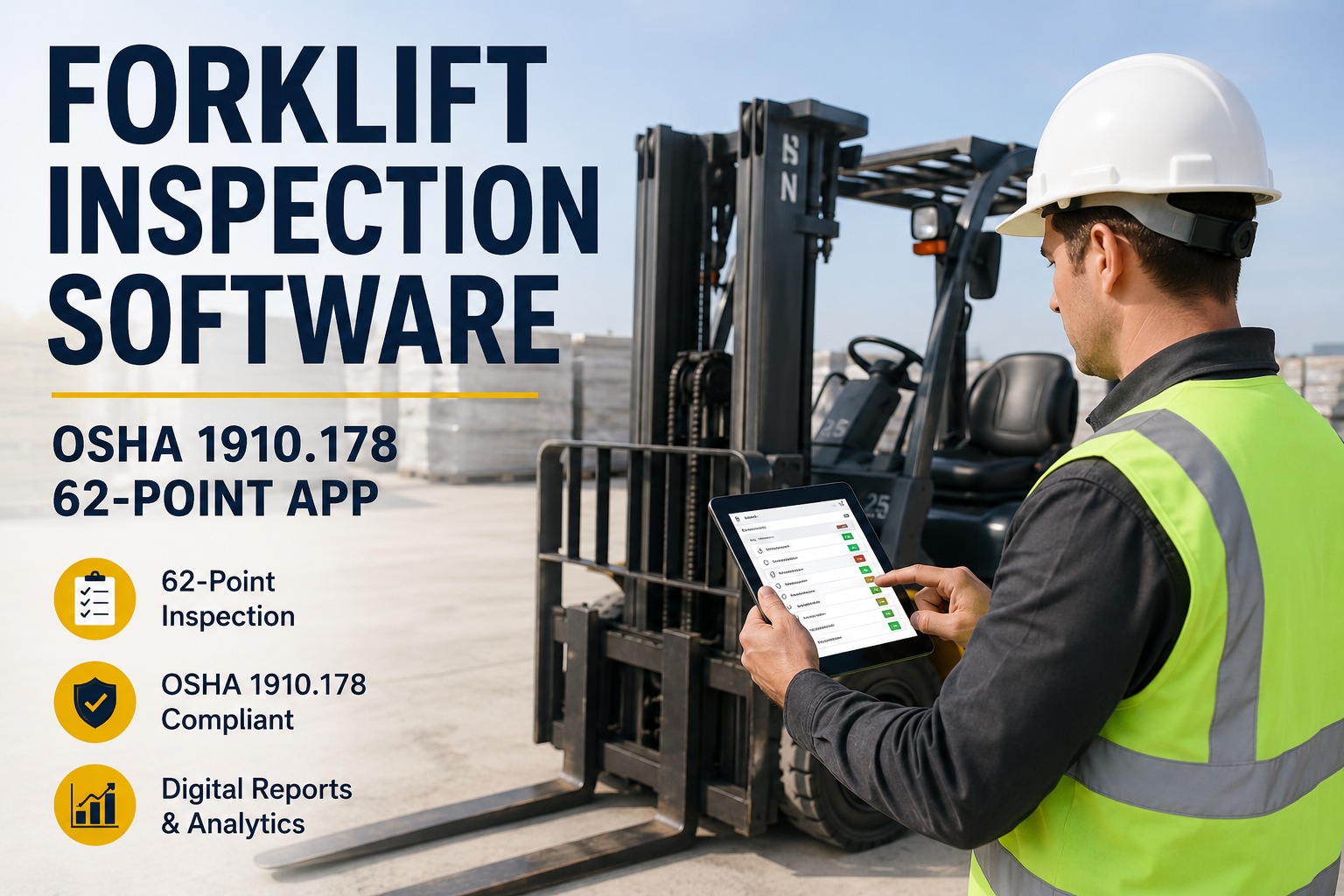
The shift starts at 6 a.m., and the first forklift operator is already on the truck before anyone asks the question that matters: did anyone actually inspect this machine today, or did someone just tick a photocopied sheet on the way past? Forklift inspection software exists because that gap between "checked" and "documented" is exactly where OSHA citations live. Powered industrial trucks pulled 1,826 citations in OSHA's FY2025 most-cited list, and the uncomfortable truth is that most of those were paperwork failures on trucks that were probably fine to run. A missing signature, a checklist with no date, a battery inspection nobody recorded. If you are running a mixed fleet of lift trucks across a warehouse, a yard or a remote site, the fastest way to close that gap is to see how a 62-point digital inspection actually runs on your own units before your next audit does it for you.
Is your forklift fleet actually inspection-ready, or just paper-ready?
HVI runs a 62-item, 3-phase powered industrial truck checklist on any phone, with battery-chemistry-specific checks for lead-acid and lithium-ion, photo capture on every defect, and operator certification alerts at 90, 60 and 30 days. One missed record costs up to $16,550 per serious violation in 2026.
The real numbers behind forklift inspection failures
These are not abstract regulatory figures. Each one maps directly to a line item in your budget or a day your operation does not get back.
What a forklift pre-operation checklist actually covers
OSHA 1910.178(q)(7) requires that powered industrial trucks be examined before each shift. The HVI template splits that examination into three phases so nothing gets skipped when the yard is busy and the operator is in a hurry.
Pre-Operation Walkaround
24 items- Fork condition: cracks, bends, heel wear measured against the caliper rule
- Mast and chain: lubrication, tension, broken links, carriage stops
- Tires: chunking, inflation, lug tightness on pneumatic and cushion types
- Overhead guard and load backrest: structural integrity, no unauthorized welds
- Hydraulic lines and cylinders: leaks, chafing, fitting condition
- Fluid levels: engine oil, coolant, hydraulic reservoir
- Data plate and capacity markings: legible and matched to attachments
Operational Checks
21 items- Service brakes and parking brake: hold on grade, pedal feel, stopping distance
- Steering: free play, response left and right at low speed
- Horn, lights, backup alarm and beacon: all functioning and audible
- Seatbelt and interlock: retracts, latches, prevents start when unbuckled where fitted
- Lift, tilt and side-shift hydraulics: smooth travel, no drift under load
- Gauges and warning lights: no active fault codes, hour meter reading logged
- Unusual noise or vibration through the mast and drivetrain
Battery and Powertrain
17 items- Lead-acid: electrolyte level above plates, vent caps seated, no case bulging
- Lead-acid: terminal corrosion, cable insulation, charging area ventilation
- Lithium-ion: BMS status lights normal, no thermal warning flags on the display
- Lithium-ion: pack casing intact, connector pins clean, no swelling or odor
- LPG and diesel variants: tank mounting, hose condition, fuel leaks
- Charger cables and plugs: no frayed insulation or heat damage at contacts
The fork wear rule deserves its own mention because it is the single most failed physical check. Once fork heel thickness drops 10 percent below the original blade dimension, that fork has lost roughly 20 percent of its rated capacity and must come out of service. Operators do not carry calipers, and paper forms do not prompt them to measure. A digital checklist that requires a photo of the measurement closes that gap. If you want to see how that photo requirement works in practice, book a 30-minute walkthrough on your own fleet and we will show you on a live unit.
Why battery chemistry changes the checklist materially
A single generic battery check is not enough anymore. Lead-acid and lithium-ion fail differently, and the inspection items that catch those failures are not interchangeable.
| Inspection Area | Lead-Acid Battery | Lithium-Ion Battery |
|---|---|---|
| Primary failure mode | Sulfation, low electrolyte, terminal corrosion | Thermal event, BMS fault, cell imbalance |
| Daily visual check | Electrolyte above plates, vent caps seated, case not bulging | Pack casing intact, no swelling, no discoloration at seams |
| Electrical check | Terminal torque, cable insulation, specific gravity if flooded | BMS status lights, state-of-charge display, fault code history |
| Charging area | Ventilation for hydrogen off-gassing, eyewash station, spill kit | No flammable storage nearby, charger firmware current, ambient temp in range |
| What the operator logs | Water added yes/no, corrosion found yes/no, photo of terminals | BMS normal yes/no, thermal warning yes/no, photo of display |
| Escalation trigger | Any electrolyte below plates or case crack = out of service | Any thermal flag or BMS fault = out of service, do not charge |
HVI ships both variants of the battery phase so a warehouse running lithium-ion reach trucks and a yard running lead-acid counterbalance units each get the right checklist on the right asset. You do not maintain two paper forms or rely on the operator to remember which truck needs which check. The template follows the asset, and the record follows the template. Fleets that start logging inspections free typically have both variants live across their trucks within the first day.
Book a demo and see the 62-point checklist running on a real forklift
Thirty minutes, your fleet's truck types, and a live look at how defects become work orders before the next shift starts.
Training records are the other half of forklift compliance
A perfect inspection history does not protect you if the person behind the wheel has an expired certification. OSHA 1910.178(l) requires formal training, practical evaluation and recertification every three years, plus immediate re-evaluation after any accident, near-miss or observed unsafe operation.
First Alert
HVI flags the operator's file and notifies the safety manager. Enough time to schedule a refresher without pulling anyone off a shift at short notice.
Escalation
A second notification goes to the operator's direct supervisor. The training session should now be booked, not just planned.
Final Warning
The operator appears on a daily exception report. If the expiry date passes, HVI can block checklist completion until certification is updated.
Re-Evaluation
Any logged accident or near-miss tied to an operator triggers a re-evaluation task automatically, so the 1910.178(l)(4) requirement is never missed in the shuffle after an event.
This is where most paper systems break down. The training matrix lives in a spreadsheet in the safety office, the inspection forms live in a binder at the charging station, and nobody connects the two until an OSHA compliance officer asks for both in the same visit. A digital system that ties the operator's certification status to the inspection they just submitted gives you one record instead of two arguments. If you are managing this across multiple sites, a demo is the fastest way to see how the alerts cascade before your next three-year cycle comes due.
What changes when you move off the clipboard
The difference is not convenience. It is whether the record exists, whether it is legible, and whether you can produce it in the first five minutes of an audit.
Paper Checklist
- Form filled in after the shift, if at all
- No photo proof of fork wear or battery condition
- Defects reported by text message or word of mouth
- Records stored in a binder, one site at a time
- Certification expiry tracked in a separate spreadsheet
- Audit prep means digging through months of paper
HVI Digital Inspection
- Checklist completed on the phone before the truck moves
- Photo required on forks, battery and any flagged defect
- Defect auto-creates a work order with priority and assignee
- Records timestamped, searchable and visible across all sites
- Certification alerts at 90, 60 and 30 days, tied to the operator
- Audit response is a filtered report, exported in seconds
A worked example makes the payback concrete. Take a 25-truck warehouse fleet running two shifts. On paper, each daily inspection takes about 8 minutes including walking to the binder, finding a blank form and chasing a pen. That is 400 minutes a day across the fleet, or roughly 33 hours a week of paid time spent on paperwork instead of moving product. A phone-based inspection cuts that to under 3 minutes per truck. You recover about 21 hours a week, and every one of those inspections is audit-ready the moment it is submitted. Fleets that sign up and load their first template usually see the time saving inside the first week.
Forklift inspection software built for the yard, not the office
62-Item OSHA Template
Pre-built to 1910.178 with 3 phases and battery-chemistry variants. Assign by asset type so every operator sees the right checklist on the right truck.
Photo-Backed Defects
A flagged fork crack or battery fault requires a photo before submission. That image attaches to the work order and the permanent record, so there is no dispute later.
Defect-to-Work-Order
A failed item does not sit in a report waiting for someone to read it. It becomes a work order with a priority, an assignee and a due date the moment the operator taps submit.
Certification Alerts
Every operator's training expiry is tracked with notifications at 90, 60 and 30 days. Post-incident re-evaluation tasks fire automatically when an event is logged.
What to do before your next shift starts
Count your exposure. Multiply your truck count by $16,550. That is the maximum cost of one undocumented day across your fleet if OSHA finds a pattern of missing inspections.
Split your battery checks. If you run both lead-acid and lithium-ion, a single generic battery line is not enough. The failure modes are different and the checklist must reflect that.
Tie training to inspection. An operator with an expired 1910.178(l) certification should not be able to complete an inspection without the system flagging it. Connect the two records.
Make defects actionable. A checklist item that fails and goes nowhere is worse than no checklist at all, because it proves you knew and did not act. Every defect needs a work order attached.
Forklift inspection software is not about replacing the operator's judgment. It is about making sure that judgment gets recorded, that the record survives, and that the right person sees it before the truck goes back on the floor. The fleets that get this right are not the ones with the biggest safety budgets. They are the ones where the inspection takes three minutes, the photo is required, and the work order is automatic. If that sounds like the operation you want to run, book a demo and we will walk through it on your actual fleet in under half an hour.
We run 40 lift trucks across three warehouses, mixed lead-acid and lithium. Before we went digital, I was chasing paper forms every Friday and still finding gaps during our insurance audit. Now I check one dashboard on Monday morning and I know exactly which trucks were inspected, which batteries flagged a fault, and which two operators have certifications expiring inside 60 days. The number I track is zero missed inspections per week. We have held that for eight months.
Forklift inspection software questions, answered
Does OSHA require a forklift inspection every day?
What is the fork wear caliper rule?
How often does forklift operator certification need to be renewed?
Is the battery inspection different for lithium-ion forklifts?
Can I use forklift inspection software across multiple sites?
Stop defending paper records. Start proving every inspection.
HVI puts the 62-point OSHA 1910.178 checklist on every operator's phone, tracks every certification, and turns every defect into a work order before the truck moves. See it running on your fleet in 30 minutes.
Free to start - Works on any phone - No card needed