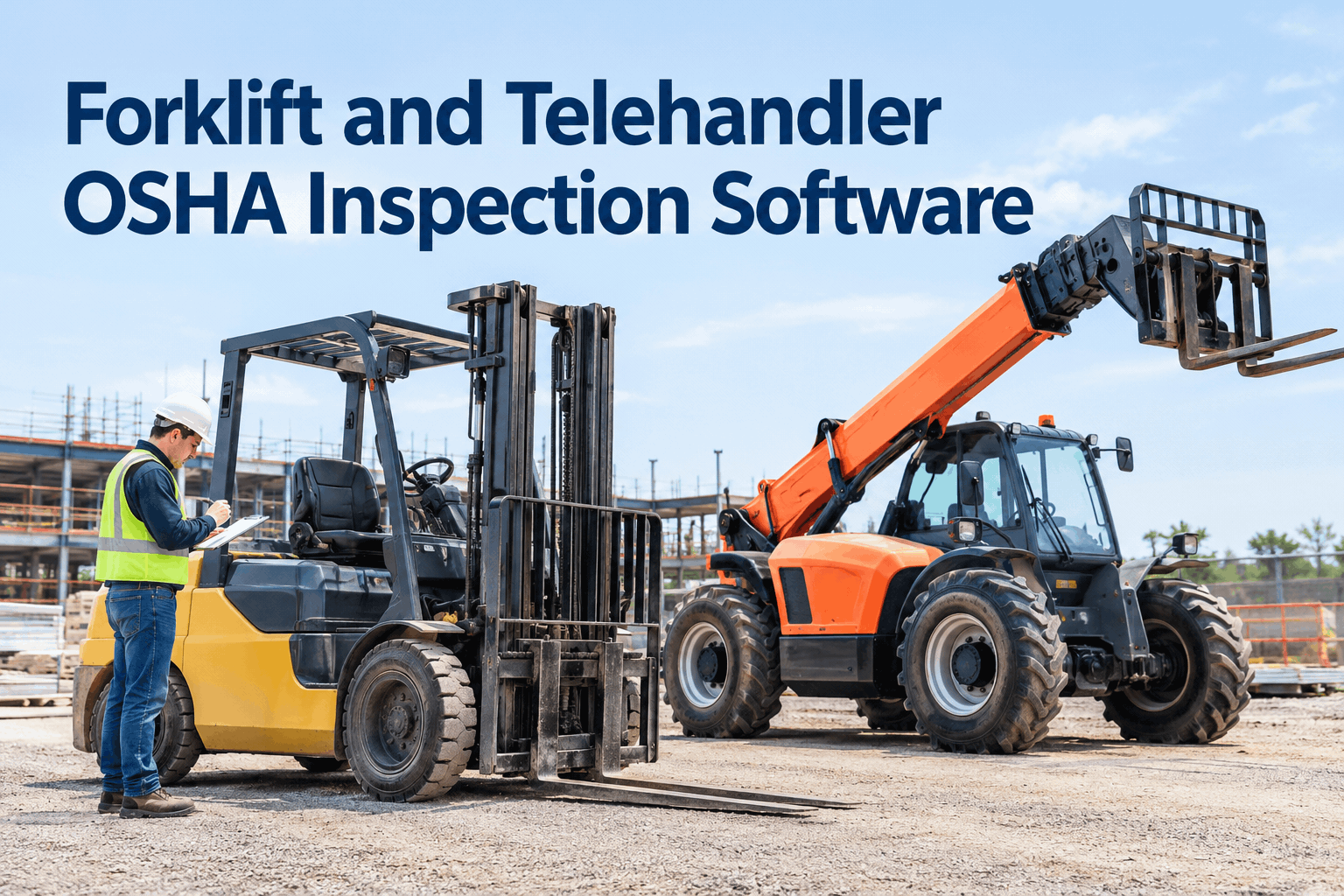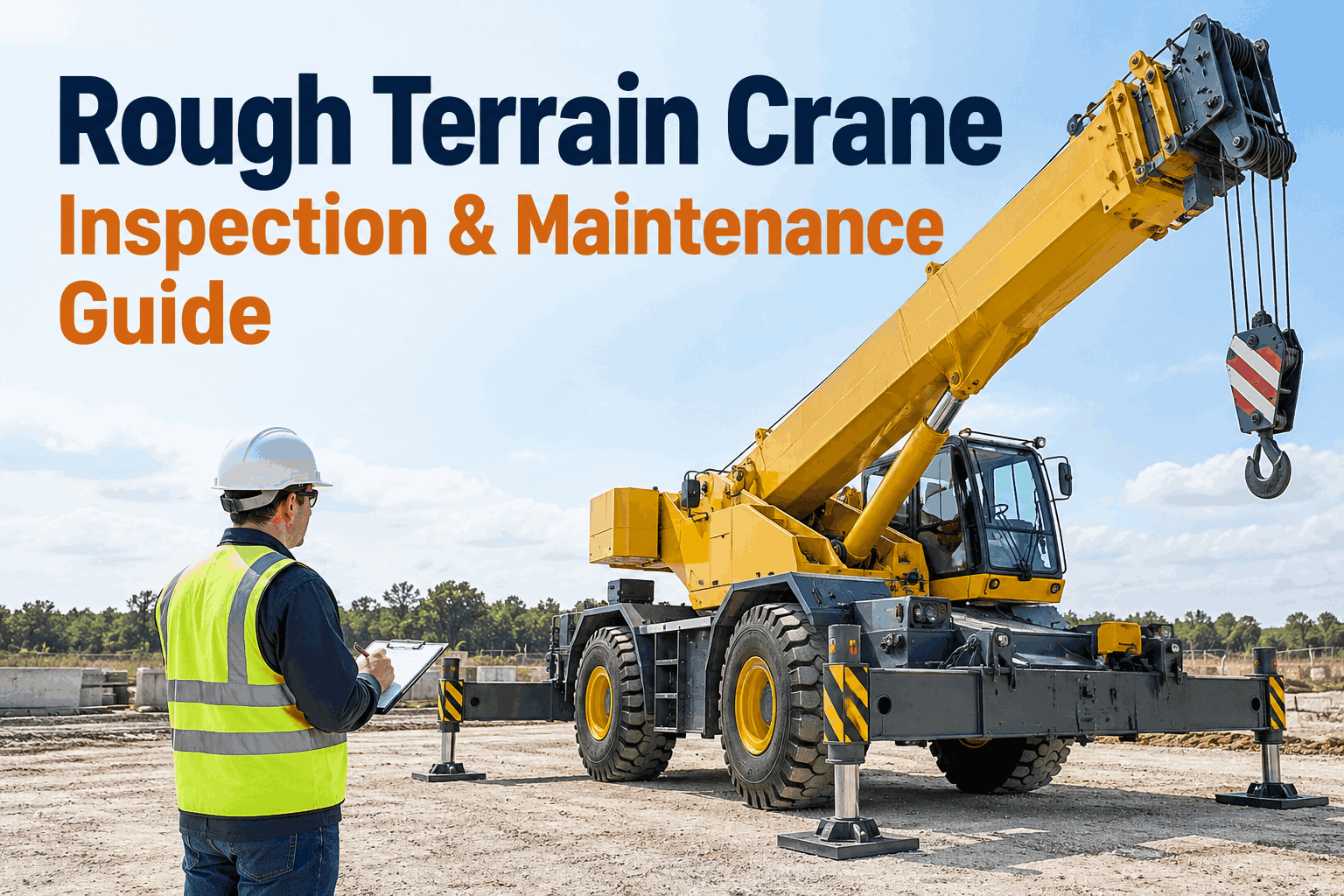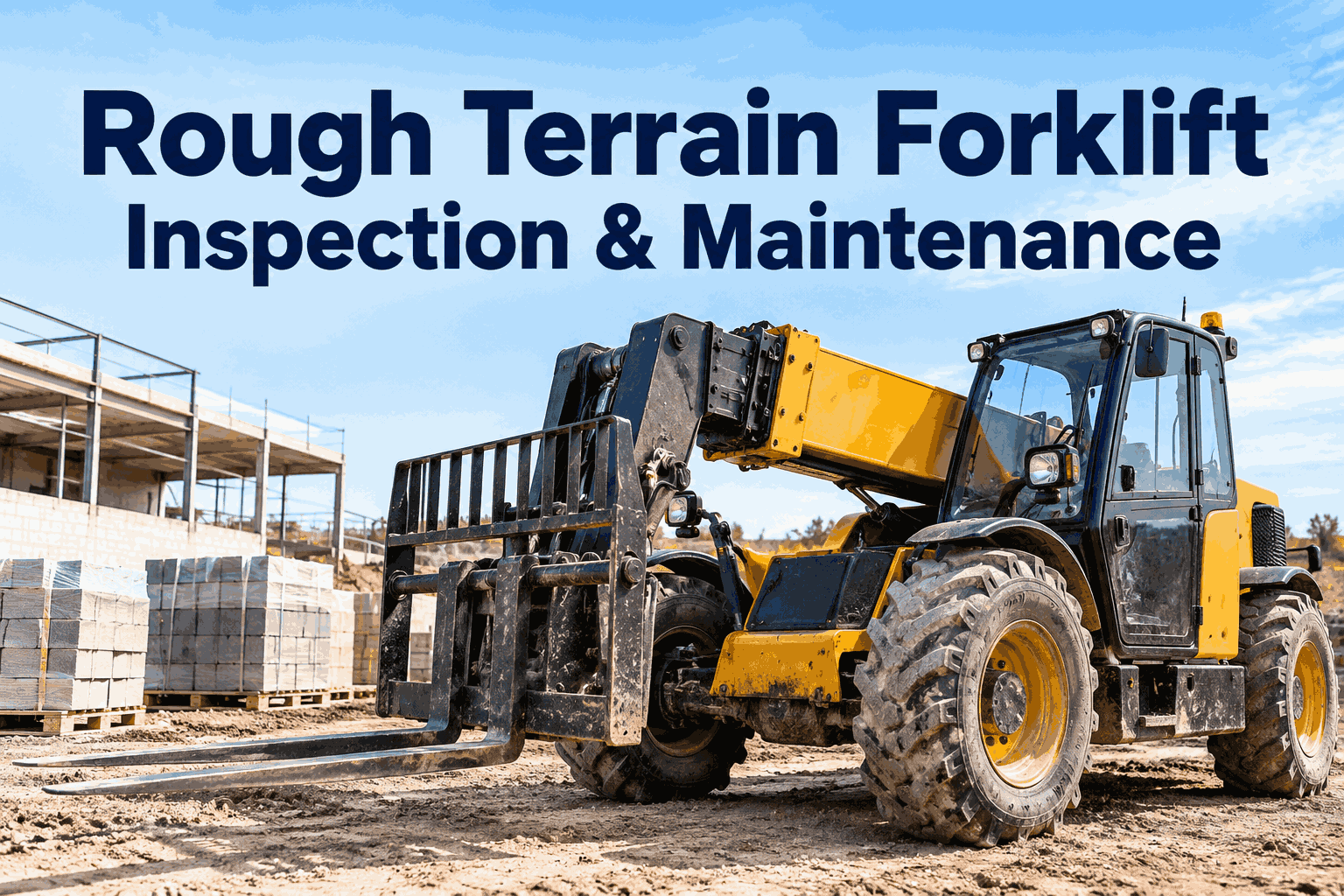
A rough terrain forklift doesn't tip over on flat, empty ground at walking speed. It tips over with a load extended, on a grade nobody measured, during a turn that felt routine right up until it wasn't. This guide covers what a real rough terrain forklift inspection has to catch — tires, forks, hydraulics, steering, brakes, and attachments — before any of that becomes the reason for an incident report.
The same machine, four very different stability pictures
Step through how load position and ground condition move a rough terrain forklift from stable to tip-over risk — and why inspection findings feed directly into that picture.
Load carried low and close to the machine, boom retracted, operating on level, solid ground. The center of gravity sits well inside the stability triangle formed by the axles and pivot points — this is the condition the machine was designed to hold all day.
Raising the load shifts the center of gravity upward and narrows the margin before the stability triangle is tested. Still manageable on good ground at rated capacity, but every other variable now matters more than it did a minute ago.
Extending the boom moves the load's weight further from the machine's base, and a slope or uneven surface shifts the center of gravity toward the edge of the stability triangle. This combination is repeatedly identified as a leading contributor to tip-over incidents.
Add a turn to an extended, elevated load on uneven ground and lateral force pushes the center of gravity outside the stability triangle entirely. This is the exact sequence behind most rough terrain forklift tip-over fatalities — and tires, steering, and brakes all have to be working correctly for the operator to even have a chance to recover.
Inspection findings don't sit next to this picture — they're part of it. Worn tires, soft brakes, or a steering fault narrow the stability margin before the load ever moves. Book a demo to see inspection data tied directly to the machines carrying the most risk.
A rough terrain forklift inspection has to reflect what these machines actually do: carry a load up and out, over ground a warehouse forklift would never see, with stability that depends on tires, hydraulics, and steering all performing exactly as designed. A daily visual check that skips any of these isn't a shorter inspection — it's a different, less complete one.
What a rough terrain forklift inspection has to cover
OSHA 1910.178 requires a documented pre-operational inspection before each shift, and on rough terrain equipment that inspection needs to go further than a warehouse forklift checklist.
Tires & wheels
Rough terrain operation puts extra demand on stability and traction, so tire condition and inflation need close, repeated attention — a damaged or underinflated tire changes the stability triangle before the load even moves.
Forks & carriage
Cracks, distortion, and excessive wear on forks, plus secure locking and retaining components, need checking before every shift — a compromised fork fails under load, not sitting still.
Boom, mast & hydraulics
Hydraulic hoses, fittings, and cylinders need checking for leakage, abrasion, or damage, especially around articulation and attachment points where flexing and chafing concentrate wear.
Steering & brakes
Service brakes, the parking brake, and steering response all need a functional check, not just a visual one — these are the systems an operator depends on most when ground conditions change without warning.
Attachments & rated capacity
Where interchangeable attachments are used, record attachment identity and inspect the locking mechanism, hydraulic connections, and rated-capacity information before each use — the load chart changes with the attachment.
Safety systems
ROPS/FOPS structure, seat belt, lights, alarms, and mirrors round out the inspection — any structural damage to the overhead guard compromises the exact protection it exists to provide.
See the telehandler inspection checklist and load chart guide for how these checkpoints apply across boom configurations.
What a missed rough terrain forklift inspection actually risks
forklift fatalities and roughly 34,900 serious injuries occur in U.S. workplaces every year, according to OSHA data — with mechanical failures and inspection gaps a recurring factor across incident investigations.
of all forklift fatalities are tip-over incidents, making them the single deadliest type of forklift accident OSHA tracks — and the condition most directly tied to tires, steering, and ground inspection.
of construction site fatalities involve telehandlers specifically, with tip-overs the leading cause, per HVI's own telehandler compliance research — a rough terrain class with its own distinct risk profile.
is the current maximum OSHA penalty per willful or repeat violation in 2026, with serious violations capped at $16,550 — the cost of an inspection program that exists on paper but not in practice.
None of these numbers are abstract once a tire, a fork crack, or a hydraulic leak gets missed on a machine already working at the edge of its stability triangle. Book a demo to see inspection data captured before it becomes an incident report.
Where rough terrain forklift defects hide from a fast walk-around
The daily checks that get rushed are rarely the obvious ones. These are the spots that separate a real pre-operation inspection from a glance.
A structured checklist that names each of these points — and requires a photo on anything flagged — is what turns a five-minute glance into an inspection that would actually hold up in an investigation. See the daily forklift inspection checklist for the full Class VII rough terrain template.
From pre-shift glance to a defensible inspection record
Each step closes a gap between what the inspection is supposed to catch and what a rushed shift-start check actually catches. Recurring defects and maintenance history, tracked by asset, are what reveal which machine or which component keeps generating downtime before it generates an incident.
Paper DVIRs vs. a digital rough terrain forklift inspection program
| Paper checklists & memory | Digital inspection program on HVI | |
|---|---|---|
| Checklist coverage | Generic form borrowed from a warehouse forklift | Configurable template for rough terrain & telehandler classes |
| Defect evidence | A written note, if the sheet makes it back to the office | Photo documentation attached to every flagged item |
| Corrective action | Relies on someone remembering to follow up | Defect auto-routes to a work order with sign-off required |
| Audit readiness | A binder, if it can be located, by shift or by site | Exportable, timestamped record per machine, any date range |
Start a free trial and see a rough terrain forklift's full inspection and maintenance history, start to finish, on one asset record.
From a safety manager who stopped trusting the sign-off alone
We had a fork crack get missed for two weeks because the paper sheet had a checkbox, not a photo, and whoever signed it clearly didn't climb down and look closely. Nothing happened that time, but it easily could have, and that's not a program I wanted to keep running on hope.
Now every flagged item needs a photo before the form closes, and anything safety-related locks the machine out until a work order is signed off. We catch things a week earlier than we used to, and when an auditor asks for a machine's history, it's a two-minute export instead of a search through a filing cabinet.
Rough terrain forklift inspection FAQs
What should a daily rough terrain forklift inspection include?
A daily rough terrain forklift inspection should cover tires and wheels for damage and proper inflation, forks and carriage for cracks or distortion, hydraulic hoses and cylinders for leaks or abrasion particularly around articulation and attachment points, steering and braking response, lights, alarms, mirrors, and seat belts, and the rollover protective structure for any structural damage. Where interchangeable attachments are used, the inspection should also verify attachment identity, the locking mechanism, hydraulic connections, and rated-capacity information before the attachment is used. OSHA 1910.178 requires this inspection be conducted before each shift and documented.
What causes most rough terrain forklift tip-overs?
Rough terrain forklift and telehandler tip-overs are most commonly linked to a combination of factors: an extended or elevated boom that raises and shifts the load's center of gravity away from the machine's base, operation on a slope or uneven surface, and turning or lateral movement while the load is extended. Each factor on its own narrows the machine's stability margin; combined, they can push the center of gravity outside the stability triangle formed by the axles and pivot points. Tip-over accidents account for roughly 25% of all forklift fatalities, making them the leading cause of fatal forklift incidents tracked by OSHA, and worn tires, soft brakes, or a steering fault found during inspection narrow that stability margin even further before the load ever moves.
How often does OSHA require rough terrain forklift inspections?
OSHA 1910.178 requires a documented pre-operational inspection before each shift for all powered industrial trucks, including rough terrain forklifts and telehandlers, covering both a visual check for defects and an operational check of key safety systems. Beyond the daily inspection, equipment should also follow manufacturer-recommended preventive maintenance intervals based on operating hours and application severity, and many organizations add periodic or annual inspections by a qualified or third-party inspector for additional assurance. Some state-specific regulations impose further requirements beyond the federal baseline, so it's worth confirming the specific schedule that applies to your jurisdiction and equipment class.
What should be inspected on rough terrain forklift attachments?
Attachment inspection should confirm the attachment's identity matches what's being used for the job, verify the locking mechanism is fully engaged and functioning correctly, check hydraulic connections for leaks or damage, and confirm the rated-capacity information for that specific attachment is current and legible, since load capacity changes depending on which attachment is fitted. A quick-attach that appears seated from a quick glance can still release under load if the locking pin or hydraulic lock hasn't been physically verified. Attachment checks should happen before each use, not just when the attachment is first installed.
How should rough terrain forklift defects be documented and resolved?
Defects should be recorded by the specific asset they were found on, with enough detail, and ideally a photo, for someone reviewing the record later to understand exactly what was found and where. Safety-related defects should generate corrective work automatically and the affected equipment should be held out of service until the problem is verified resolved and signed off, rather than relying on a verbal handoff or a note that may not reach the right person. Tracking recurring defects and full maintenance history by asset over time also helps identify specific machines or components generating repeated downtime, which is often a leading indicator of a bigger problem before it becomes a safety incident.
Digitize forklift inspections with HVI
HVI gives every rough terrain forklift and telehandler a configurable inspection form, photo documentation on every defect, preventive maintenance scheduled by hours and severity, work orders for anything flagged, and a complete service history per asset — so the inspection record actually holds up when it matters.
No credit card · Photo-documented defects from day one · OSHA-ready export, any date range