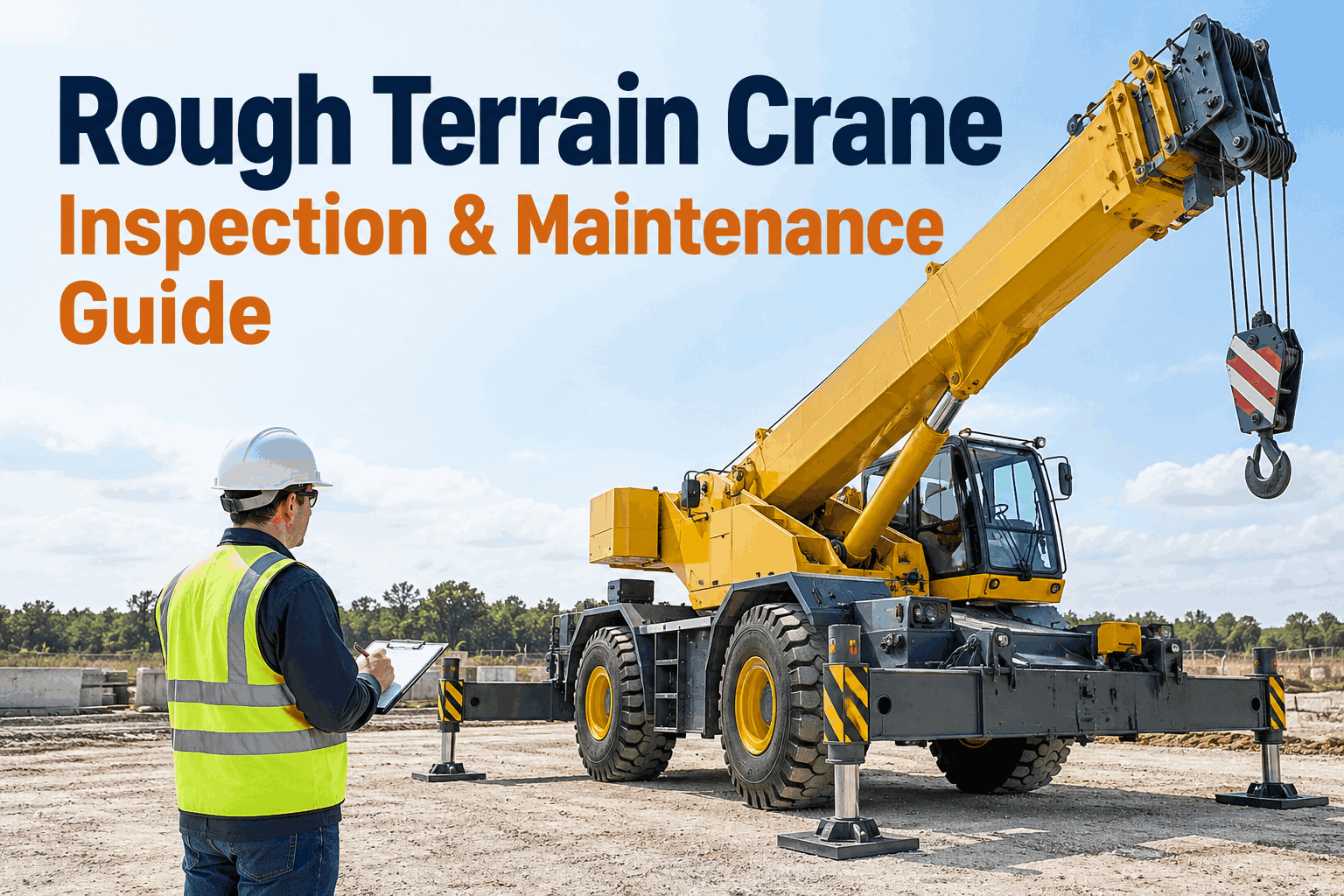
A rough terrain crane inspection isn't a truck inspection with a boom bolted on — it's a check built around big off-road tires, telescoping boom sections and outriggers that have to set on unprepared ground. Skip the daily walkaround and you're trusting a 40-ton pick to a tire with a hidden cut or an outrigger sinking into soft fill. Here's what a rough terrain crane inspection and service routine covers, and how to run it digitally — or book a demo.
On rough ground, the tires and outriggers carry the whole pick.
A rough terrain crane works off-road, on fill and slopes, on four big rubber tires and four outrigger pads. The daily inspection and a disciplined service schedule are what keep that base solid — and keep a lift from becoming a tip-over.
One honest point first: HVI doesn't perform or certify the annual comprehensive crane inspection — the structural, load and hydraulic assessment a qualified person must sign off under OSHA and ASME stays with someone competent to do it. What a digital rough terrain crane inspection replaces is the paper around everything else: the daily pre-use walkaround, the hour-based preventive maintenance, the service and defect records, and the proof it all happened on schedule. It runs on the same fleet inspection and preventive maintenance backbone as the rest of HVI. Book a demo to see it on a crane fleet.
The rough terrain crane inspection walkaroundsix areas the daily check can't skip
Rough terrain cranes fail where the off-road duty hits hardest — the places a highway truck never sees the same punishment. Mud, grade, fill and constant set-up and tear-down load the tires, pads and boom pads far more than a paved yard ever would. A real walkaround covers six areas, and knows exactly what it's looking for in each.
Tires & wheel ends
Watch for: cuts, low or uneven pressure, sidewall damage, loose wheel nuts — on rubber, the tires carry the pick.
Outriggers & pads
Watch for: cylinder drift, cracked or undersized pads, soft or uneven ground, anything short of full deployment.
Telescoping boom & wear pads
Watch for: worn boom wear pads, cracks or dents in sections, poor lube, uneven extension.
Hydraulic system
Watch for: leaks and weeps, low fluid, chafed hoses, slow or jerky boom and outrigger function.
Wire rope, hook & load chart
Watch for: broken wires, kinks, corrosion, hook deformation or throat spread, a missing or illegible load chart.
Carrier, drivetrain & controls
Watch for: 4-wheel-drive and steer faults, brakes, and safety devices — anti-two-block, LMI and warning alarms working.
The mobile crane pre-operation checklist lays each of these out step by step. Book a demo to run it on a phone.
The rough terrain crane service schedulepreventive maintenance by the hour, not by the breakdown
Daily checks catch what's visible; the service schedule catches what isn't — the filter clogging, the fluid breaking down, the wire rope wearing from the inside. These are typical hour-based intervals, always set to the maker's manual for your crane and its duty cycle, and what each one adds on top of the daily walkaround.
- DailyPre-use walkaround, fluid levels, function test, safety devices
- 50 hrGrease all points, outrigger and boom lube, quick fastener check
- 250 hrHydraulic filter, fluid sampling, tire and boom wear-pad check
- 500 hrEngine service, hoses and fittings, detailed wire-rope inspection
- 1000 hrHydraulic fluid change, major component and structural inspection
- AnnualComprehensive certified inspection by a qualified personQualified person
Meter-based PM only works if someone is tracking the hours — which is exactly what a digital system does in the background. Start a free trial to schedule crane PM by the hour.
Where HVI fits rough terrain crane upkeepthe features behind digital crane inspection and service
HVI runs the daily and preventive work and keeps every record together. Five features carry it.
Fleet inspection / DVIR
Pre-use walkaround completed on a phone, signed and time-stamped before the crane makes a pick.
Digital inspection checklists
Build the rough terrain crane checklist to the maker's manual — same areas, every operator, every shift.
Preventive maintenance
Trigger service by engine hours or calendar — 50, 250, 500, 1000 — so wear items are caught on time.
Equipment maintenance records
Every inspection, service and certified report kept per crane — the full history in one lookup.
Defect tracking
A flagged tire cut or hydraulic leak becomes a tracked work order with a photo — never a lost note.
It's the same maintenance management engine HVI runs across heavy fleets, tied to the mobile crane maintenance programme. Book a demo of the crane workflow.
From a crane maintenance manager
With rough terrain cranes the killer isn't the big annual failure — it's the small stuff that the off-road duty grinds on. A tire running low for a week, a boom wear pad nobody greased, an outrigger cylinder starting to drift. On paper it all got "checked." The change for us was tying the walkaround and the hour meters together, so a missed service or a flagged defect actually surfaces instead of sitting in a logbook. The annual inspection is still our certified guy — but the day-to-day stopped sneaking up on us.
Rough terrain crane inspection — FAQs
What makes a rough terrain crane inspection different?
A rough terrain crane works off-road on four large rubber tires, so the inspection puts extra weight on the things the terrain punishes: tire condition and pressure, outrigger deployment and pad bearing on unprepared ground, and the telescoping boom's wear pads and sections. Unlike a truck-mounted crane, it's a single self-propelled machine with four-wheel drive and steer, so the carrier and drivetrain are part of the check too. The hydraulics, wire rope, hook and safety devices are inspected much like any mobile crane.
Does HVI replace the certified annual crane inspection?
No. The annual comprehensive inspection — the structural, load and hydraulic assessment required under OSHA and ASME — must be performed and signed off by a qualified person. HVI doesn't carry out or certify that inspection. What it does is run and record the frequent work: daily pre-use walkarounds, hour-based preventive maintenance, service and defect records, and storage of the certified report, so the complete inspection and maintenance history for each crane lives in one place.
How often should a rough terrain crane be serviced?
Preventive maintenance is usually meter-based, on engine hours, layered with calendar intervals. Typical schedules run daily pre-use checks, lubrication around 50 hours, hydraulic filter and sampling around 250, engine and wire-rope service around 500, and a hydraulic fluid change with major-component inspection around 1,000 hours — plus the annual certified inspection. The exact intervals come from the manufacturer's manual for your model and duty cycle, which is why tracking actual hours matters more than a fixed calendar.
Why are tires and outriggers so critical on rough terrain cranes?
Because they're the crane's only contact with the ground, and the ground is rarely level or firm. When the crane picks on outriggers, the pads have to bear the full load on whatever surface is under them — soft fill or an unseen void is how outriggers punch through and cranes tip. When it travels or picks on rubber, the tires carry the load, so a cut, under-inflation or damaged sidewall directly reduces capacity and stability. Both get close attention on every pre-use check.
Why run crane inspection and PM digitally?
Paper checks get ticked and filed but rarely drive action, and hour-based PM is easy to lose track of across a busy fleet. A digital system enforces the same walkaround for every operator, captures photos, triggers PM automatically when a crane hits its hour interval, and turns a flagged defect into a tracked work order so it can't be forgotten. It also keeps a complete, signed history per crane — which makes an audit or insurance review a quick lookup instead of a scramble.
Keep every rough terrain crane inspection and service on record
Leave the certified inspection with your qualified person — and put the daily walkaround, the hour-based PM, the service history and the defect follow-up on one system. A rough terrain crane inspection then isn't a ticked box; it's a record you can stand behind.
Daily walkaround · hour-based PM · certified-report storage — one history