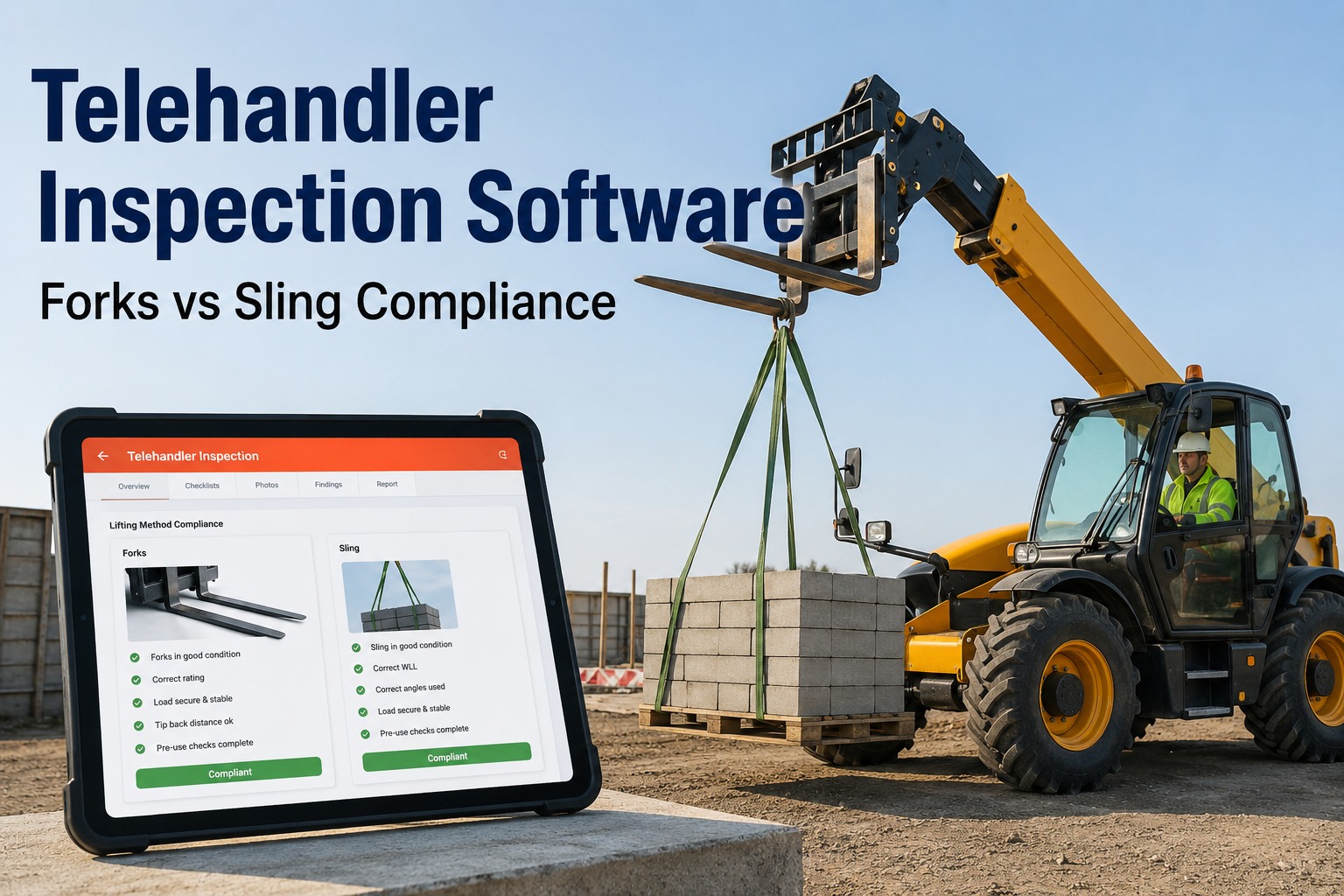
Monday morning your telehandler is moving pallets of block on forks, and by Wednesday the same machine is flying HVAC units onto a roof with slings - and almost nobody on site realises it just switched rulebooks. A telehandler inspection checklist that covers forks-only material handling is not the same inspection that machine needs when it lifts suspended loads, because the moment a hook or sling goes on, crane rules with tiered periodic inspections apply on top of the daily operator check. Miss that switch and you are one incident away from a serious citation that now runs $16,550 per violation in 2026. This page gives you the practical decision tree your operators should follow before every lift, the LMI calibration and load chart checks that matter, and how HVI maps the right standard to the right lift automatically - walk through it on your own telehandlers in a 30-minute demo.
Same machine, two rulebooks. Which inspection does today's lift need?
Forks-only work sits under ANSI B56.6 with a daily operator inspection. Rig a suspended load and crane-style tiered inspections, LMI checks and operator qualification rules kick in. Most sites only run one regime - and it is usually the wrong one for half their lifts.
- ANSI B56.6 rough-terrain truck rules
- Daily operator inspection each shift
- Fork, carriage, chain and tyre checks
- Crane rules apply (OSHA 1926.1441 territory)
- Tiered shift, monthly and annual inspections
- LMI function check and load chart verification
Four numbers every telehandler owner should know
The regulation mix-up is not academic. It shows up as citations, failed client audits and machines parked while someone hunts for paperwork.
Telehandler daily inspection: forks or slings, decide before you start the engine
Your operator should answer three questions in order, every shift. The answers pick the inspection tier - not habit, not whatever checklist is in the cab.
What is on the front end today?
Forks, bucket or work platform means standard industrial truck territory under ANSI B56.6: a documented daily operator inspection of forks, carriage, chains, hoses, tyres, brakes, steering, horn, lights and safety decals. A hook, shackle or lifting beam means the machine is now handling a suspended load - keep walking down the tree.
Is the load suspended and freely rigged?
If yes, the lift falls under crane-style rules - in the US that is the OSHA 1926.1441 space for equipment with a rated capacity over 2,000 lb. Now the machine needs its tiered inspection structure: a shift inspection before each use, a monthly documented inspection, and an annual comprehensive inspection by a qualified person, plus rigging checks on every sling and shackle.
Is the operator qualified for this configuration?
Suspended-load work demands documented operator qualification for that setup, not just a generic telehandler card. This is where most sites get caught: the machine is inspected, but the person rigging the load holds the wrong credential. HVI's certification tracking fires 90, 60 and 30-day alerts so qualification gaps surface months before an auditor does.
A worked example: a site running one JLG and one Genie telehandler switches to sling work two days a week for steel erection. That is roughly 100 suspended-load days a year where the crane-tier inspection applies. If your records only show the forks checklist, every one of those days is undocumented exposure. Book a demo and see both regimes mapped on one asset.
Forks vs slings: what changes in your telehandler compliance
The machine does not change. The rulebook, the inspection depth and the records you must produce all do.
| Requirement | Forks / bucket work | Suspended load on slings |
|---|---|---|
| Governing framework | ANSI B56.6 rough-terrain forklift rules | Crane rules (OSHA 1926.1441 territory) |
| Baseline inspection | Daily operator check each shift | Shift inspection plus monthly documented and annual comprehensive |
| Load handling focus | Fork blades, heel wear, carriage, fork stops, chains | Hook, rigging, slings, shackles, anti-two-block device |
| Load chart | Capacity plate for fork configuration | Load chart for the exact boom and rigging setup, verified in cab |
| Operator credential | Telehandler operator training | Documented qualification for suspended-load operation |
| Records an auditor asks for | Daily checklists, PM history | Shift, monthly and annual reports, LMI checks, rigging logs, qualifications |
LMI calibration and load chart checks that actually get skipped
On sling work the load moment indicator is the last line between a good lift and a tipped machine. These checks are cheap, fast and constantly missed.
LMI function test, every shift
Before the first suspended lift, the operator runs the LMI through its self-test and confirms the display matches the boom angle and extension. A dead display or a fault code means the machine is down for suspended work - not "be careful out there".
Load chart matches the configuration
The chart in the cab must match the attachment and rigging in use. A SkyTrak running a hook on the fork carriage reads a different chart than the same machine on forks. Wrong chart, wrong capacity, and the LMI may not know the difference.
Calibration on schedule, on record
LMI calibration follows the OEM interval and any boom or sensor repair. When a client or insurer asks for proof, "the dealer did it last year" is not a record. HVI stores the calibration certificate against the asset and flags the next due date automatically.
Boom wear pads, chains and hoses
Telescopic sections wear from the inside out. Boom inspection means wear pad condition, chain tension and lubrication, hose chafing at the boom nose and any weeping at cylinder seals - the items that fail quietly between annual inspections.
Whether you run Cat, JLG, Genie or SkyTrak units, the pattern is the same: the daily telehandler safety inspection covers the machine, and the suspended-load tier adds the lifting system on top. Sign up free and start logging both tiers today.
Stop guessing which rulebook applies
HVI maps every equipment type to every applicable standard automatically, so your operators complete one correct inspection - whichever way the machine is rigged that day.
One machine, one inspection, the right standard every time
Automatic standards mapping
HVI maps each equipment type to every applicable standard and merges them into a single template. Your operator answers one checklist that already contains the forks checks and the suspended-load tier - no one decides compliance from memory at 6 a.m.
Template variants in under 30 minutes
Need a sling-lift variant for one project, or a site-specific Cat telehandler inspection? Build the variant in under 30 minutes and push it to every phone. No printing, no binders, no version confusion across yards.
Certification tracking with 90/60/30 alerts
Operator qualifications for suspended-load work live against the person, not in a filing cabinet. HVI fires alerts at 90, 60 and 30 days before expiry, so renewals happen on your schedule instead of after an incident review.
Defect to work order, instantly
A photo of a worn boom wear pad or a failed LMI self-test becomes a work order the moment the operator submits. The machine is flagged out of service for suspended work until the repair closes - the paper trail writes itself.
Every inspection is timestamped, photo-backed and retrievable in seconds when a client, insurer or regulator asks. See the compliance mapping live on a demo call.
How a single telehandler runs two inspection regimes in five days
This is what the confusion looks like on a real schedule - and why a single static checklist cannot cover it.
Forks: block and pallet work
Daily operator inspection under ANSI B56.6. Fork heels measured against wear limits, carriage and chains checked, tyres and brakes confirmed. One checklist, five minutes on a phone.
Slings: rooftop units and steel
Crane-tier rules apply. Shift inspection plus LMI self-test, load chart verification for the hook configuration, rigging inspection on every sling, and confirmation the operator's suspended-load qualification is current.
Back to forks - and the monthly falls due
The monthly documented inspection for the lifting system lands mid-week regardless of configuration. HVI's preventive maintenance scheduling tracks it by date and engine hours and raises it automatically, so it never depends on someone remembering.
Five days, two rulebooks, three inspection types. On paper this is three different forms in three different places. In HVI it is one asset record with every tier attached - book a demo and we will build this exact week on screen.
Telehandler inspection software turns a judgement call into a process
If you remember nothing else from this page, remember these four points.
The attachment picks the rulebook
Forks mean ANSI B56.6 and a daily operator inspection. Slings mean crane-tier rules with shift, monthly and annual inspections. The machine does not decide - the lift does.
LMI and load charts are sling-lift essentials
A shift-level LMI function test, a load chart matched to the configuration, and calibration on record are the difference between a defensible lift and a $16,550 serious violation.
Operator qualification is part of the inspection
The best checklist in the world does not help if the person rigging the load holds the wrong credential. Track qualifications with 90, 60 and 30-day alerts, not a spreadsheet.
One correct inspection beats three paper forms
A telehandler inspection app that merges the applicable standards into one template removes the daily judgement call. That is what HVI does out of the box, and you can start your first telehandler checklist free.
"My gripe was never the inspections - it was that Wednesday the machine was a forklift and Thursday it was basically a crane, and my paperwork treated both days the same. I track one number now: how many suspended-load days we ran with a matching tiered inspection on file. Since we moved the telehandlers onto HVI that number is 100%, and the last client audit took twenty minutes instead of two days of digging through the conex box."
Mark Delaney - Safety & Compliance Manager, regional structural steel and precast contractor
Telehandler inspection and compliance FAQ
Does a telehandler lifting on slings really fall under crane rules?
What should a telehandler daily inspection cover?
How often does a load moment indicator need calibration?
What records will an auditor ask for on suspended-load work?
Can one checklist really cover both forks and sling configurations?
See your telehandlers mapped to the right standards
Book a 30-minute demo and we will load one of your units - forks, slings, LMI checks, operator qualifications and all - so you can watch one correct inspection replace three paper forms.
Free to start - Works on any phone - No card needed