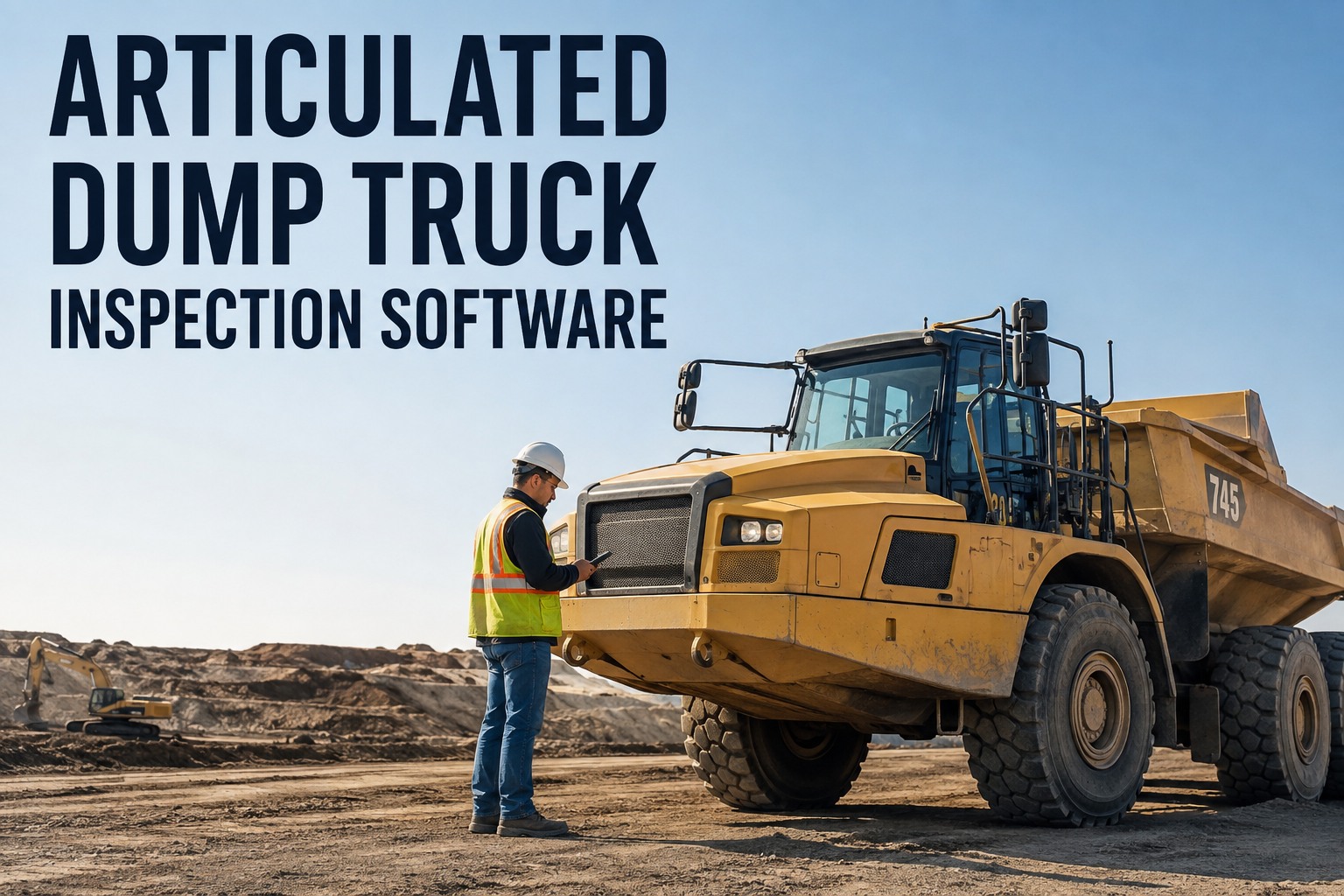
You've got a 40-tonne articulated dump truck running a wet quarry face all shift, and the only record of its condition is a carbon-copy book that lives in the cab door pocket. That gap is exactly where articulated dump truck inspection programs fail: the machine's defining components — the articulation joint, the suspension struts, the dump body pins and hoist cylinders — take punishment no on-road truck ever sees, yet many fleets still check them with a road-truck checklist. A proper ADT daily inspection is a ground-level walkaround plus a cab and articulation check that takes an operator 10 to 15 minutes, catches play in the joint before it becomes a rebuild, and documents six tires, ROPS and the tailgate lock with photos. This page walks through what a real articulated hauler inspection covers, why overloading and slope work drive this machine class's rollover numbers, and how digital checklists close the loop from defect found to work order raised. If you want to see it running on your own units, you can book a 30-minute walkthrough with the HVI team and bring your toughest checklist questions.
Is your pre-shift actually checking the articulation joint — or just ticking boxes?
An articulated dump truck bends in the middle on every cycle. The joint, the struts and the body pins absorb loads a rigid truck never feels. HVI gives your operators a digital ADT checklist built for that reality — photo every defect, raise the work order instantly, and keep the record even from a pit with no signal.
- Articulation joint pin and bearing play check with photo capture
- Suspension strut or air bag condition, leaks and ride height
- Dump body pins, hoist cylinders and tailgate lock verification
- All six tires, ROPS, cab safety devices and full walkaround
Four numbers every ADT fleet manager should know
Articulated haulers in the 40 to 60 tonne class are production machines — when one stops, the excavator stops loading and the whole cycle collapses. These figures frame why a serious articulated dump truck inspection routine pays for itself.
What a proper articulated hauler inspection covers
A road-truck DVIR won't catch ADT failures because it was never written for a machine that hinges in the middle. A real ADT operator checklist works through six zones — and the first three are where the expensive failures live.
Articulation Joint & Steering
- Pin and bearing play — rock the joint, check for movement and listen for knock
- Steering cylinders for weeping seals, scored rods and loose mountings
- Articulation lock bar present, serviceable and stowed correctly
- Grease condition at joint pins — dry or purged grease is an early warning
The joint is the defining ADT failure point. Unchecked play becomes oval bores and a five-figure rebuild.
Suspension & Frame
- Oil-pneumatic struts or air bags for leaks, damage and correct ride height
- A-frame and bogie beam welds for cracks, especially near stress points
- Axle and differential housings for oil seepage and loose fixings
- Frame rails around the hinge for cracking from overload cycles
A strut losing pressure shows up as uneven ride height first — catch it there, not after the axle hits the stops.
Dump Body, Hoist & Tailgate
- Body pivot pins and retainers for wear, movement and missing keepers
- Hoist cylinders for seal leaks, rod scoring and barrel damage
- Body guide pads and wear plates for gap and condition
- Tailgate lock mechanism where fitted — engaged, undamaged, releasing cleanly
A body pin working loose under a 50-tonne load is a dropped body. This is a photo-every-time item.
Tires, Wheels & Brakes
- All six tires for cuts, sidewall damage, embedded rock and uneven wear
- Front versus rear condition recorded separately — they wear differently
- Wheel nuts and rims for looseness indicators, cracks and distortion
- Brake test on the move plus park brake hold on grade
Quarry rock cuts sidewalls fast. A logged photo trend tells you which haul road section is doing the damage.
ROPS, Cab & Safety Devices
- ROPS/FOPS structure for damage, cracks and unauthorised welds
- Seat belt, door latches, mirrors, glass and wipers
- Horn, reverse alarm, beacons, cameras and lights all functional
- Fire extinguisher charged and pinned; cab steps and handholds secure
Rollover is this class's killer — a sound ROPS and a working belt are the last line when slope judgement fails.
Ground-Level Walkaround
- Engine oil, coolant, hydraulic and fuel levels; visible leaks under the machine
- Hydraulic hoses and fittings for chafing, weeping and abrasion points
- Air system build-up time and warning buzzer function
- Guards, access panels and belly plates secured after night-shift servicing
Most walkaround finds are cheap to fix today and expensive to fix Friday. The trick is making sure they reach the fitter.
The two habits behind articulated truck safety incidents
Ask any quarry manager what keeps them up at night and the answer is the same: an ADT on its side at the dump edge. The physics are not mysterious — the incidents cluster around two operating habits, and your inspection data can expose both before the accident does.
Overloading the body
Heaped loads past the rated payload shift the centre of gravity up and back, overload the rear tires and struts, and stretch braking distances on every descent. It also accelerates exactly the wear your checklist watches: joint play, strut seals, body pin ovality, frame cracking. If your operators are reporting the same suspension defects on the same units every few weeks, look at what the loader is putting in them.
Slope and dump-edge operation
Most ADT rollovers happen at low speed — tipping on a soft edge, turning across a camber, or reversing to a berm that gives way. The machine feels planted right up until it isn't. That's why the pre-shift matters here too: a soft strut, an underinflated rear tire or a sticking tailgate all change how the body behaves when it's raised on anything less than flat, compacted ground.
- Body up on a slope — raised body plus cross-slope is the classic tip-over geometry
- Soft dump edges — overnight rain turns a safe edge into a collapse zone
- Uneven tire condition — one low rear tire tilts the whole loaded body
A worked example: the $400 photo that saved $38,000
Picture a six-unit ADT fleet in a limestone quarry. An operator photographs wetness around a hoist cylinder seal on a Tuesday pre-shift. The defect lands in the workshop queue the same morning; the fitter reseals the cylinder during Wednesday's fuel stop for roughly $400 in parts and labour. Left unreported — the paper-book outcome — that seal fails under load three weeks later, dumps the body, scores the rod and contaminates the hydraulic system. Now you're buying a cylinder, flushing the system and losing the truck for days: a $38,000 event plus the excavator standing idle. That gap between a photo and a paper form is the entire business case for a digital ADT inspection app you can see in a live demo.
What changes when the checklist lives on the operator's phone
Most fleets don't skip inspections — they lose them between the cab and the workshop. Here's the honest comparison of how a defect travels in each system.
| Step in the defect journey | Paper book in the cab | HVI digital ADT checklist |
|---|---|---|
| Defect found at 6:40 am pre-shift | Written in a duplicate book, maybe legibly | Photographed, described and submitted from the phone in under a minute |
| Workshop finds out | When the book is handed in — end of shift, end of week, or never | Instantly — defect raises a work order with the photo attached |
| Evidence for an audit or incident investigation | A carbon copy, if the book survived the cab | Timestamped, GPS-located, photo-backed record per unit |
| Repeat-defect visibility | Buried across months of paper | Flagged automatically — same unit, same fault, third time this quarter |
| Remote pit with no signal | Works, but the record stays in the cab | Captures fully offline and syncs when the truck reaches coverage |
| Hours and PM triggers | Someone reads the hour meter and writes it on a whiteboard | Hours flow in automatically from OEM telematics feeds |
If your current system is the left-hand column, you can start logging ADT inspections free and run both side by side for a week to see the difference.
Built for machines that work where the signal doesn't
HVI is a cloud and mobile inspection and maintenance work order CMMS used across mixed fleets — trucks, trailers and off-highway plant in one platform. Four capabilities matter most for articulated hauler operations.
Custom ADT templates in under 30 minutes
Build a checklist around your exact units — Cat, Volvo, Bell or Komatsu HM — with mandatory photos on the joint, body pins and tailgate. No two fleets run the same template, and none should.
Hour-based PM triggers
ADTs maintain by engine hours, not miles. HVI schedules preventive maintenance off the hour meter and alerts you before services come due — no more whiteboard arithmetic or missed 500-hour greases.
OEM telematics integration
Cat VisionLink, Komatsu KOMTRAX and John Deere JDLink feed hours and fault codes straight into HVI, so PM triggers and defect history update without anyone reading a meter.
Full offline capture in the pit
Quarries and remote earthworks sites rarely have coverage. HVI records the complete inspection offline — photos included — and syncs automatically when the unit reaches signal.
See your own ADT checklist running in HVI
Bring your current paper form to a 30-minute demo and we'll rebuild it live — articulation joint, struts, body pins, six tires and all — on one of your units.
How fleets roll out digital ADT inspections without stopping production
The fear with any new system is the changeover week. In practice, ADT fleets move over in days because the operator's job barely changes — walk the same route, tap instead of write.
Day 1 — Build the template
Take your existing pre-shift sheet and recreate it in HVI, adding the ADT-specific items the generic sheet missed: joint play, strut condition, body pins, tailgate lock. Set which items demand a photo. Most fleets finish in under 30 minutes per machine type.
Day 2 — Connect hours and units
Load your fleet list and hook up the telematics feeds — VisionLink, KOMTRAX or JDLink — so engine hours flow in automatically. Set your PM intervals by hours and HVI starts tracking due and overdue services from day one.
Day 3 — Train the crew in the yard
One toolbox talk per shift: open the app, pick your unit, walk the checklist, photograph what it asks for. Operators who can use a phone camera can run it — there is no technician training burden, which is why fleets booking a demo usually pilot on their least tech-confident crew first.
Day 4 onward — Defects become work orders
Every flagged item lands in the workshop queue with its photo and timestamp. The fitter orders parts against the work order, closes it out, and the unit's history builds automatically — ready for the next client audit, insurer review or incident investigation.
The short version for busy fleet managers
The joint is the machine
Articulation pin and bearing play is the defining ADT failure point. If your checklist doesn't force a look and a photo, it isn't an articulated dump truck inspection — it's a truck checklist on the wrong machine.
Rollover risk is built daily
Overloading and slope operation drive this class's rollover statistics. Soft struts, uneven tires and sticking tailgates — all pre-shift items — decide how the machine behaves when conditions turn.
The defect journey is the cost
A $400 seal becomes a $38,000 cylinder-and-downtime event when the report travels by paper. Digital capture with instant defect-to-work-order is where the payback lives.
Hours, not miles, run the PM
Off-highway plant maintains by engine hours. Automated hour feeds from Cat, Komatsu and Deere telematics into hour-based PM triggers remove the whiteboard from your maintenance planning.
You don't need to rip out your whole maintenance process to start. Most fleets sign up free and digitise one ADT crew first, then roll it across the pit once the workshop feels the difference.
"My gripe was never the inspections — the lads did them. It was finding out about a weeping hoist seal on Friday that the operator wrote down on Monday. Now the photo hits my phone before he's finished his walkaround, and I track one number every month: defects reported same-shift. It went from about half to every single one. That's the difference between a reseal and a cylinder."
Darren Whitfield — Maintenance Manager, regional aggregates and quarrying contractor
Frequently asked questions about articulated dump truck inspection
What should an articulated dump truck daily inspection include?
A proper ADT daily inspection covers six zones: the articulation joint (pin and bearing play, steering cylinders, lock bar), suspension struts or air bags and frame welds, dump body pins and hoist cylinders plus the tailgate lock, all six tires with front and rear recorded separately, ROPS and cab safety devices, and a ground-level walkaround for leaks, hoses and fluid levels. On a phone-based checklist it takes 10 to 15 minutes.
How do you check articulation joint play on an ADT?
With the machine on level ground, have a second person articulate the steering slowly while you watch and feel the joint pins for movement, or rock the joint against its stops and listen for knock. Any visible lift, side movement or metallic clunk means the pins or bearings are wearing. Photograph it and flag it immediately — play left running turns round bores oval and a pin kit into a line-boring job.
Why do articulated dump trucks roll over so often?
Two operating habits drive most ADT rollovers: overloading the body, which raises and shifts the centre of gravity, and slope or dump-edge work, where a raised body on a camber or soft edge tips at low speed with little warning. Pre-shift condition matters too — a soft suspension strut or one low rear tire tilts a loaded body before the operator ever leaves flat ground.
Does ADT inspection software work offline in a quarry?
Yes — HVI is built for remote sites with no coverage. The full checklist, including photo capture, works offline on any phone or tablet and syncs automatically when the unit reaches signal, so nothing stays trapped in the cab. You can book a demo and test the offline mode against your own pit conditions before committing.
Can HVI pull engine hours from Cat, Komatsu or Deere telematics?
Yes. HVI integrates with Cat VisionLink, Komatsu KOMTRAX and John Deere JDLink, pulling engine hours and fault data automatically. Those hours drive your preventive maintenance triggers, so 250 and 500-hour services alert on real meter readings instead of whiteboard estimates — and every inspection, work order and part stays on the unit's permanent record. Sign up free to connect a unit and see the feed.
Put your ADTs on a checklist built for how they actually work
Articulation joint to tailgate lock, photo-backed and offline-ready — see HVI running on your own articulated haulers in a 30-minute demo, or start free today.
Free to start — Works on any phone, even offline in the pit — No card needed