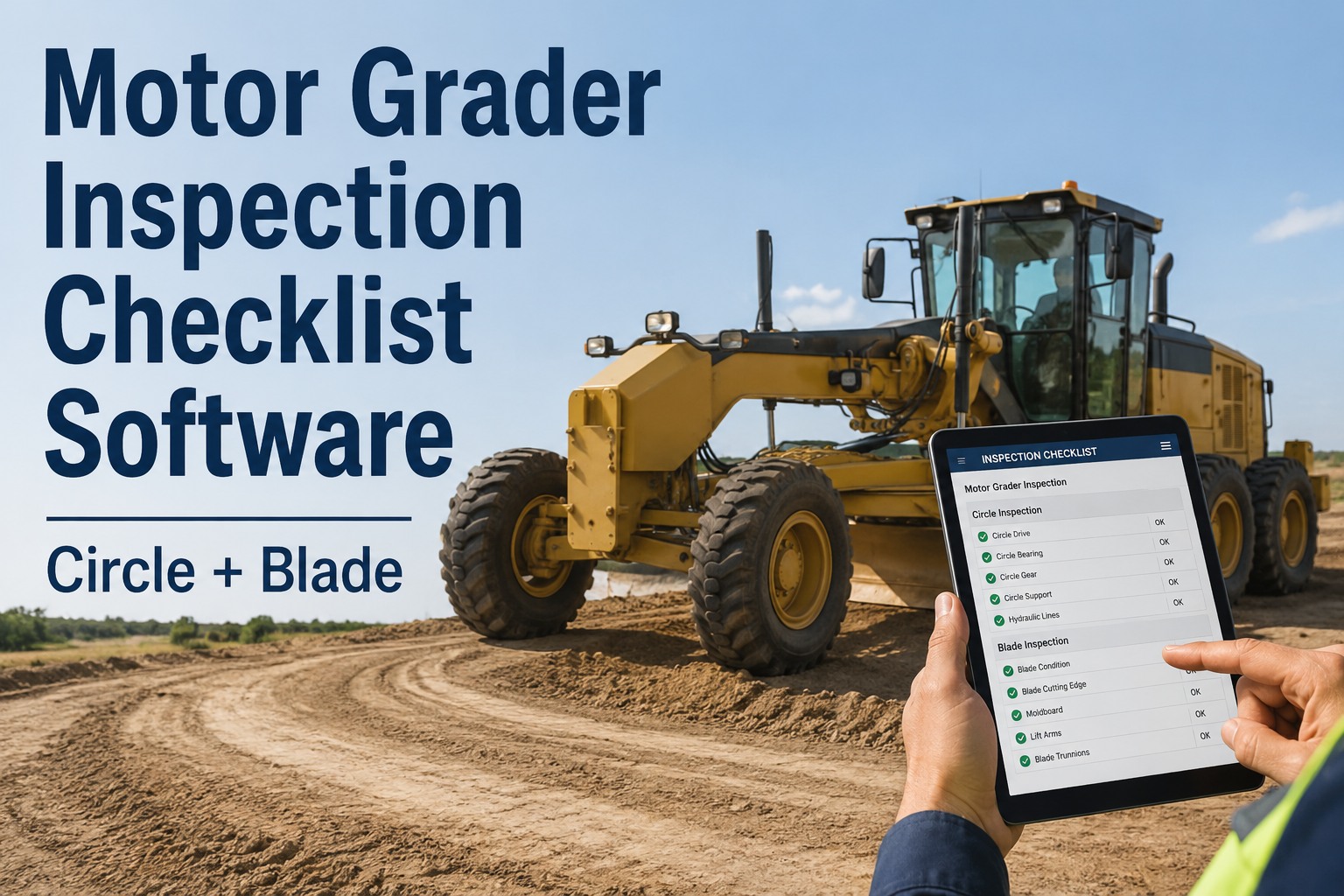
It is 6:40 in the morning and your grader operator is standing at the circle with a grease gun in one hand and a paper checklist in the other, trying to remember whether the circle drive got greased yesterday or the day before. That small uncertainty is exactly why a proper motor grader inspection checklist matters: graders work slopes and finish grade, which puts them in a high rollover-risk category, and the circle drive is one of the most expensive rebuilds on the machine. A daily walk-around that covers the moldboard, circle, articulation joint, hydraulics, all six tires and the ROPS takes about 15 minutes, yet it is the difference between a $40 grease cartridge and a five-figure circle rebuild. This page gives you the full checklist, the wear indicators that matter, and how fleets run it digitally with photo proof and automatic work orders. If you want to see it running on your own units, you can book a 30-minute walkthrough for your grader fleet and we will build a template with you live.
The 15-minute pre-shift that protects a $25,000 circle drive
A digital grader daily inspection covering moldboard, circle drive, articulation, hydraulics, six tires, ROPS and cab - with photo proof, grease tracking and instant defect-to-work-order on any phone.
Four numbers every grader fleet should know
Motor grader pre-shift inspection: the seven zones that matter
A grader carries more inspection points than most machines in your yard. These are the seven zones a proper grader operator checklist covers every shift, in the order most operators walk the machine.
Moldboard and Cutting Edge
Check the cutting edge against the wear indicator marks - most edges are done at around 75% wear, and running past that starts eating the moldboard itself. Look for cracks at the end bits, loose or missing bolts, and slide rail wear that lets the blade chatter on finish passes.
Circle Drive and Rotation
Rotate the circle through its full range and listen. It should turn smooth and quiet - grinding, catching or dead spots mean worn teeth or a dry circle. Confirm the grease schedule was actually done, because circle life is decided by grease, not by luck.
Articulation Joint
Check pin play at the articulation joint by watching for movement while the operator articulates against the stops. Excess play shows up as wander on grade and accelerates wear through the whole center section. Grease the joint pins and note any metal-on-metal noise.
Hydraulic System
A grader carries more hydraulic circuits than almost anything else on site - blade lift, circle turn, articulation, lean, steering, scarifier. Walk every hose and cylinder looking for weeping fittings, chafed lines and wet cylinders. A slow leak today is a hose burst on a slope tomorrow.
All Six Tires
Front tires and tandem rears run different pressures and wear differently. Check all six for pressure, cuts, sidewall damage and uneven wear - uneven tandem wear often points to chain or drive problems, not tire problems. A grader tire failure on a slope is a rollover setup.
ROPS and Cab
Graders work slopes and finish grade near edges, so ROPS integrity is non-negotiable. Check the structure for cracks, bends or unauthorized welds, confirm the seatbelt retracts and latches, and test every cab safety device - horn, wipers, mirrors, glass and door latches.
Lights, Alarm and Fluids
Test every work light, beacon, turn signal and the backup alarm - graders reverse constantly around ground crew. Finish with engine oil, coolant, hydraulic tank level and fuel, plus a look under the machine for anything that dripped overnight.
Run this checklist on any phone
HVI ships with configurable grader templates you can adapt to Cat, Deere, Komatsu or Volvo units in under 30 minutes. Start logging grader inspections free and your first checklist is live today.
Why circle grease compliance is worth tracking per operator
Ask any shop that rebuilds grader circles what killed the last one and the answer is almost always the same: it ran dry. Circle greasing is a five-minute task with a grease gun, but it sits low on the machine, it is awkward to reach, and on paper there is no proof it happened. That combination makes it the single most-skipped maintenance task on a motor grader - and the most expensive one to skip.
Paper log reality
- Operator initials a weekly grease sheet from the cab seat
- No photo, no timestamp, no way to verify the circle got grease
- Skipped intervals only surface when the circle starts grinding
- Rebuild lands as a surprise five-figure work order
Digital tracking reality
- Hour-based PM trigger fires the grease task at the exact interval
- Operator photographs the grease point - proof with a timestamp
- Completion rate per operator visible on the fleet dashboard
- Missed intervals flag overdue before damage starts, not after
A county road crew running four graders tracks circle grease compliance per operator for one quarter. Two operators sit at 95%+ completion; one sits at 61%. That operator's unit is the one with measurable circle pin wear at the next service. Catching it means a shim and adjustment - a few hundred dollars. Missing it means a circle drive rebuild that shops routinely quote in the $20,000-plus range, plus two to three weeks of lost grading during the season you can least afford it. You can see per-operator grease tracking in a live demo with your own intervals loaded.
Grader blade inspection: what to measure and when to act
The difference between a checklist that protects the machine and one that just gets signed is specific pass/fail criteria. These are the wear points your grader daily inspection should measure, not just glance at.
| Component | What the operator checks | Act when | Cost if ignored |
|---|---|---|---|
| Cutting edge | Wear against indicator marks; bolt tightness | ~75% worn or bolts loosening | Moldboard damage - edge is cheap, moldboard is not |
| Circle drive | Rotation smoothness, noise, grease evidence | Grinding, catching, or dry grease points | Circle rebuild commonly quoted at $20,000+ |
| Articulation joint | Pin play at the joint, grease, noise | Visible movement against the stops | Center section wear, poor grade accuracy |
| Hydraulic hoses | Weeping fittings, chafing, wet cylinders | Any active leak or rubbed-through outer layer | Burst hose on a slope, fire risk, cleanup cost |
| Tires (all six) | Pressure per position, cuts, uneven tandem wear | Pressure off spec or sidewall damage | Blowout on slope - a leading rollover setup |
| ROPS structure | Cracks, bends, unauthorized welds, seatbelt | Any structural defect - machine stands down | Unprotected rollover; liability that dwarfs repair cost |
In HVI each of these rows becomes a checklist item with its own pass/fail criteria and photo option, so a new operator inspects to the same standard as your best veteran. If you want that standard on your units, walk through a grader template on a demo call and we will map your wear limits into it.
Stop guessing whether the circle got greased
Photo-proofed daily inspections, hour-based grease triggers and per-operator completion rates - live on your graders this week.
Built for the way grader fleets actually work
Four capabilities that turn the checklist above from a paper exercise into proof - on any phone, in any yard, on any remote site.
Grader templates in under 30 minutes
Start from a motor grader template and tune it to your Cat, Deere, Komatsu or Volvo units - your wear limits, your grease points, your wording. No IT project, no consultant.
Hour-based PM triggers
Circle grease intervals run on engine hours, not calendar guesses. HVI fires the task at the right hour, flags it overdue, and shows completion per operator on the fleet dashboard.
Offline photo capture
Remote pit or dead-zone site, the inspection still works. Photos of the cutting edge, circle and tires sync when the signal returns - timestamped and attached to the asset record.
Automatic work orders
A failed item - say, articulation pin play - becomes a work order the moment the operator submits. The shop sees the photo, orders the parts, and nothing waits for a paper form to travel.
What a motor grader inspection checklist really buys you
A grader is a precision finish machine working in rollover terrain, and its most expensive component lives or dies on a five-minute grease task. The checklist itself is not the hard part - the hard part is knowing it actually happened, every shift, on every unit, by every operator.
Measure, don't glance
Cutting edges, circle rotation and articulation pin play all have observable limits. Build those limits into the checklist so pass/fail is a fact, not an opinion.
Track grease like money
Circle grease compliance per operator is the single highest-value metric on a grader. A photo and a timestamp turn the most-skipped task into the most-verified one.
Close the loop to the shop
An inspection that ends in a binder changes nothing. Defect-to-work-order in one step is what converts a 15-minute walk-around into uptime you can count.
Fleets that digitize the grader daily inspection typically see the payoff in the first avoided circle or hydraulic failure - one event covers years of subscription. If you run mixed plant alongside your graders, the same platform covers trucks, trailers and shop equipment too. Book a demo and bring your toughest grader - we will show you its checklist live.
"I used to find out the circle was dry when the operator radioed in that the blade wouldn't rotate on a finish pass. Now I open the dashboard on Monday and see grease completion by operator - anyone under 90% gets a conversation before it becomes a rebuild. We haven't touched a circle drive in two seasons, and I check that number more often than I check fuel."
Motor grader inspection FAQs
What should a motor grader daily inspection include?
How often should a grader circle be greased?
When is a grader cutting edge worn out?
Can I build a grader checklist for Cat, Deere, Komatsu and Volvo units in one system?
Does the inspection app work at remote sites with no signal?
Put every grader on a checklist that proves itself
Digital pre-shifts, circle grease tracking, photo evidence and automatic work orders - for graders and every other asset in your fleet.
Free to start - Works on any phone - No card needed