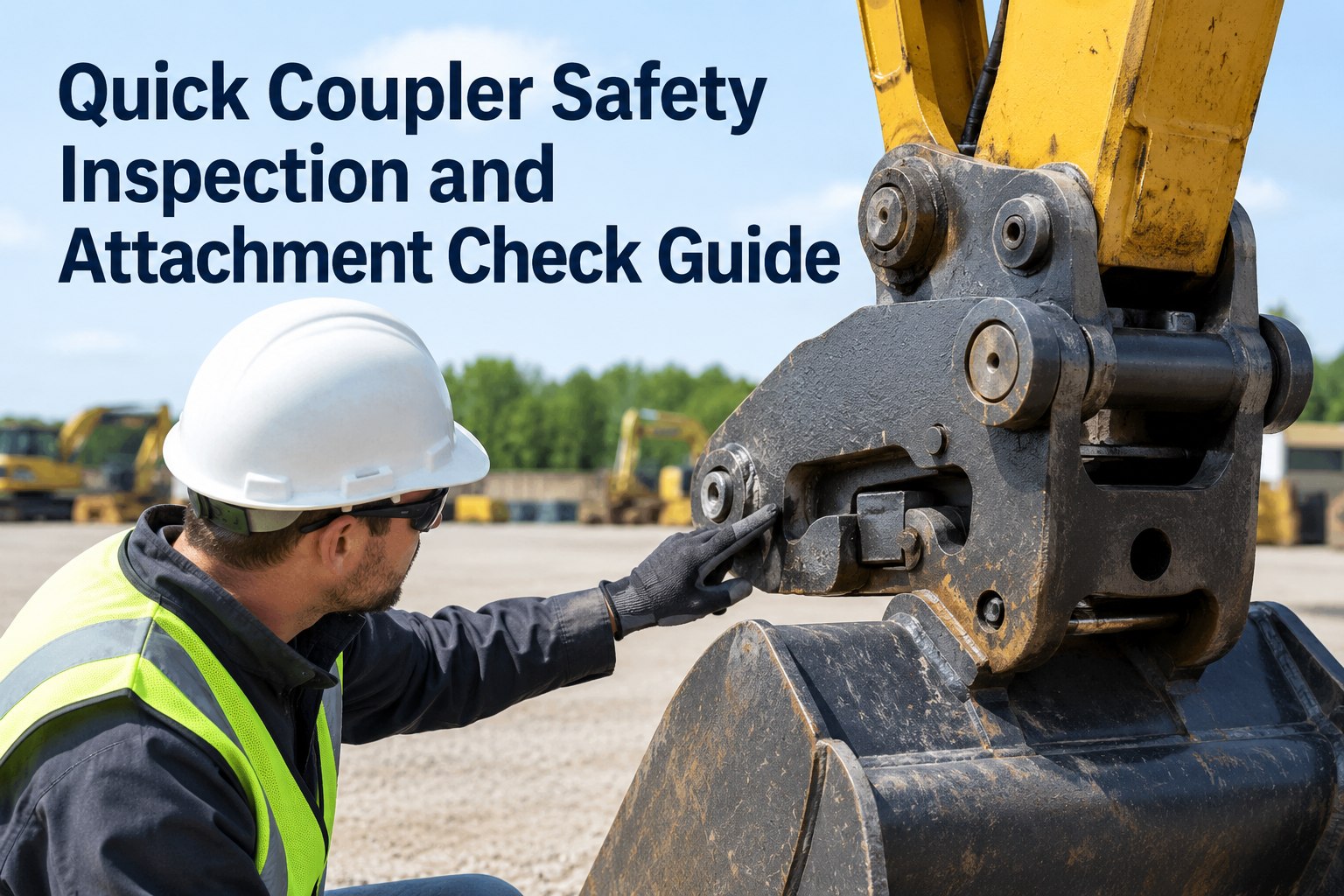
The operator changed the bucket, glanced at the coupler, saw the pins line up, and swung the arm over the trench where the crew was working. It looked locked. It wasn't — the attachment had only partially engaged, and it dropped. That gap between "looks locked" and "is locked" is exactly what a quick coupler inspection exists to close. Book a demo to make the safety check non-skippable.
A Quick Coupler Inspection Is the Check Between a Bucket Change and a Fatality
Quick couplers change attachments in seconds — and when one isn't fully engaged, the attachment drops. Regulators have documented the deaths. Every one traces back to a verification step that was skipped.
Quick couplers let an excavator swap buckets, breakers and grapples in seconds, which is why they're everywhere on construction sites — and why they're one of the most dangerous components when neglected. A coupler that isn't fully engaged can release its attachment suddenly, and regulators have linked these failures to worker deaths. The reassuring part is that these failures are preventable: nearly every one comes down to a verification step skipped or a worn component missed. This guide covers why couplers fail, the connection-check protocol that prevents releases, the wear points to inspect, and how to make the safety check impossible to skip.
Why quick couplers failpartial engagement is the killer, not total failure
The mental model most operators carry is wrong in a dangerous way. They picture a coupler either holding the attachment or dropping it — a clean pass or fail. The reality is a treacherous middle state: partial engagement, where the attachment is hooked enough to lift and work normally for a while, but the locking mechanism never fully seated. It looks connected. It works connected. Then a shift in load, a bump, or a swing lets it go.
"The pins lined up and it picked up the bucket, so it's locked."
Visual alignment is not engagement. Dirt in the locking area, a skipped confirmation step, or a mismatched attachment can leave a coupler partially locked while looking and lifting completely normal."The lock is fully seated, the safety pin is in, and I've run the connection test the manufacturer specifies."
Full engagement is confirmed, not assumed — and confirmed the same way every single time an attachment changes, before the load ever leaves the ground.This is why quick coupler safety hinges on confirmation, not observation — every one of those failure modes produces a coupler that passes a glance and fails under load. Book a demo to build the confirmation step into every attachment change
Coupler lock verification protocolthe connection-check sequence that prevents attachment releases
Every safety authority that has studied quick coupler fatalities converges on the same protocol. It's not complicated — it's just non-negotiable, and it must run every time an attachment is connected, not once a shift. These are the steps that close the partial-engagement gap.
- 1Clean the locking area firstDirt and grease accumulation is a leading cause of couplers not seating. Clear the locking mechanism and coupler faces before connecting anything.
- 2Engage and visually confirm the lockConnect per the manufacturer's procedure and check the visual indicator or lock position — but treat this as necessary, not sufficient.
- 3Install the safety locking pinWhere the manufacturer requires it, the safety pin must be in place before the attachment is lifted off the ground. It's the backup if the primary lock fails.
- 4Run the connection testPerform the manufacturer's connection test — typically curling the attachment and applying down-pressure against the ground — to prove it's fully seated before any real work.
- 5Stay out of the line of fireEven with every check done, never let anyone work directly under or in the swing radius of a raised attachment. If a lock ever fails, no one should be where it lands.
The last step matters even when the first four are perfect. Safety authorities are explicit: keep workers out of the swing radius and never directly beneath a raised attachment, even when safety pins are installed. The verification prevents the release; the line-of-fire discipline is what keeps a failure from becoming a fatality.
None of these steps take long — the whole sequence adds seconds to an attachment change. The danger isn't that the protocol is hard; it's that it's easy to skip when a site is running hot and the operator has done a hundred changes without incident. Start free and turn the connection check into a required, logged step
Excavator coupler inspection: the wear pointsthe coupler components that lead to a dropped attachment
Beyond the per-change connection check, the coupler itself is a wear component that needs regular coupler maintenance and inspection — because a worn coupler is one that stops seating reliably. An excavator coupler inspection should treat the device as the critical safety part it is, not a convenience feature. Here's what to look for.
Any of these found in a bad state is a reason to pull the machine from service, not finish the shift — a coupler is the one component where "serviceable for now" doesn't apply. Photograph the defect, tag it, and route it before the attachment is used again. Book a demo to give operators a photo-based coupler check on their phone
Making attachment safety inspection non-skippableturning the coupler check into a step that can't be bypassed
Here's the hard truth about coupler safety: the protocol is well known, and workers still die. The gap is never knowledge — it's enforcement. A check that depends on an operator choosing to do it, on a busy day, after a hundred uneventful changes, is a check that eventually gets skipped. The fix is to remove the choice.
This is the difference between hoping the protocol is followed and knowing it was. When the check is guided, photo-verified and backed by an out-of-service control, the partial-engagement gap closes not because everyone remembers, but because the system won't let the machine work until the coupler is proven safe. Start free and make coupler verification a required, documented step
From a site safety supervisor
We had a near miss that still keeps me up — a grapple that came loose during a swing. Nobody was under it, thank God, but it landed maybe six feet from a groundsman. When we pulled the coupler apart, the locking mechanism was packed with clay and had never fully seated. The operator swore it looked locked, and honestly, it probably did.
That's when I stopped trusting "looked locked." Now every attachment change is a guided check on the phone — clean it, engage it, pin it, connection-test it, and photograph the pin seated before the machine's cleared. If the check isn't done, the machine shows out of service. It adds thirty seconds. After what I saw, thirty seconds is nothing.
The takeaway
Quick coupler failures have killed workers — and the cause is almost always partial engagement, where an attachment looks and lifts locked but never fully seated.
A proper quick coupler inspection confirms, never assumes: clean, engage, pin, connection-test — every attachment change — and keep everyone out of the line of fire regardless.
Knowledge isn't the gap — enforcement is. Guided steps, photo proof of the seated lock, and an out-of-service lockout on a failed check are what make the protocol actually happen.
A quick coupler is a genuine time-saver, and it's also the one attachment component where a skipped step has cost lives. The protocol to prevent that is simple and well established — confirm full engagement every change, install the safety pin, run the connection test, and never stand in the line of fire. What fails is human, not technical: the check gets skipped on a busy day. Build the verification into a guided, photo-backed inspection that locks the machine out until it's done, and you close the gap between "looked locked" and "is locked" for good. Book a demo to improve equipment safety inspections with HVI
Frequently asked questions
Why are quick couplers a serious safety hazard?
Quick couplers let an excavator swap attachments in seconds, but a coupler that isn't fully engaged can release its attachment suddenly, dropping a heavy object without warning. Safety authorities have documented this as a fatal hazard: reviewing its accident data, OSHA identified 15 incidents since 1998 involving the unanticipated release of excavator buckets from quick couplers, and eight workers died in those incidents, and NIOSH has since issued fact sheets to help prevent these struck-by fatalities. The danger is amplified because the attachment is heavy and falls fast, couplers are often used near workers in trenches or on foot, and the failure mode is deceptive — a partially engaged coupler can look connected and lift normally before letting go under load or during a swing. The reassuring side is that these incidents are overwhelmingly preventable, tracing back not to sudden mechanical failure but to a verification step being skipped, a worn component being missed, or a worker standing in the line of fire of a raised attachment.
How do you verify a quick coupler is fully locked?
Verification means confirming full engagement rather than assuming it from appearance, and it follows a specific sequence every time an attachment is connected. First, clean the locking area, because dirt and grease accumulation is a leading cause of couplers failing to seat. Second, engage the coupler per the manufacturer's procedure and check the visual indicator or lock position — but treat this as necessary, not conclusive, since visual alignment is not the same as full engagement. Third, install the safety locking pin where the manufacturer requires one; it must be in place before the attachment is lifted off the ground and acts as the backup if the primary lock fails. Fourth, perform the manufacturer's connection test, which typically involves curling the attachment and applying downward pressure against the ground to prove it is fully seated before any real work. Finally, even after all of that, keep everyone out of the swing radius and never let anyone stand directly beneath a raised attachment. The first four steps prevent the release; the last one ensures a failure never becomes a fatality.
What causes a quick coupler to release an attachment unexpectedly?
The overwhelming cause is partial engagement — a state where the attachment is hooked enough to lift and operate but the locking mechanism never fully seated. Several conditions produce it. Dirt, clay or grease packed into the locking area can physically prevent the lock from seating while the coupler still appears connected. An operator skipping the confirmation step or connection test, often to save time, leaves engagement unverified. A worn coupler — particularly worn pins and bushings — may no longer seat reliably, and allows movement that accelerates further wear. An attachment that doesn't correctly match the coupler can create a near-fit that holds temporarily but isn't truly locked. On hydraulic couplers, a loss of hydraulic pressure from a leak can release the lock. In almost every case the coupler looks and behaves normally until a change in load, a bump, or a swing releases the attachment — which is why confirmation through a connection test, rather than visual observation, is the essential safeguard.
How often should a quick coupler be inspected?
On two levels. The connection check — clean, engage, pin, connection-test — must be performed every single time an attachment is connected, not once per shift, because engagement has to be verified for each specific connection. Separately, the coupler should be part of the daily pre-operation walk-around, checking the locking mechanism, safety pin, visual indicator and general condition before work begins; OSHA requires pre-shift inspection of construction equipment by a competent person. Beyond the daily check, the coupler is a wear component needing periodic deeper inspection — commonly monthly for the locking mechanism and at scheduled service intervals for pins, bushings, hydraulic circuit and structural condition — with worn pins greased and replaced once wear exceeds safe limits. A quick coupler is a critical safety component, not a convenience feature, so it warrants both the per-change verification and the routine wear inspection, documented ideally with photos.
Do you still need to install the safety pin if the coupler locks hydraulically?
Yes, wherever the manufacturer specifies one. The safety locking pin is a deliberate redundancy: it's the backup that holds the attachment if the primary locking mechanism — hydraulic or mechanical — fails or releases. Hydraulic couplers rely on the machine's hydraulic system keeping the internal cylinder locked, which means a hydraulic pressure loss from a leak or hose failure can potentially release the lock; the safety pin is what stands between that failure and a dropped attachment. This is why safety authorities are consistent that, where required, the pin must be installed before the attachment is lifted off the ground, every time. It's also why the safest modern couplers build in multiple layers of protection, but even those don't remove the need to follow the manufacturer's pin and connection-test procedures. And critically, installing the pin does not change the line-of-fire rule: workers should never stand under or in the swing radius of a raised attachment even with the safety pin in place, because layered protection reduces risk but never makes it acceptable to be where a falling attachment would land.
Close the gap between "looked locked" and "is locked"
HVI turns the quick coupler check into a guided inspection every operator must complete before a machine is cleared — clean, engage, pin, connection-test, with a photo of the seated lock as proof. A failed check routes to a work order and can put the machine out of service, so a partially-engaged coupler never goes back to work. The safety protocol stops depending on memory and starts being enforced. Live on your equipment in under two weeks.
No hardware · Photo verification on every check · Out-of-service controls built in