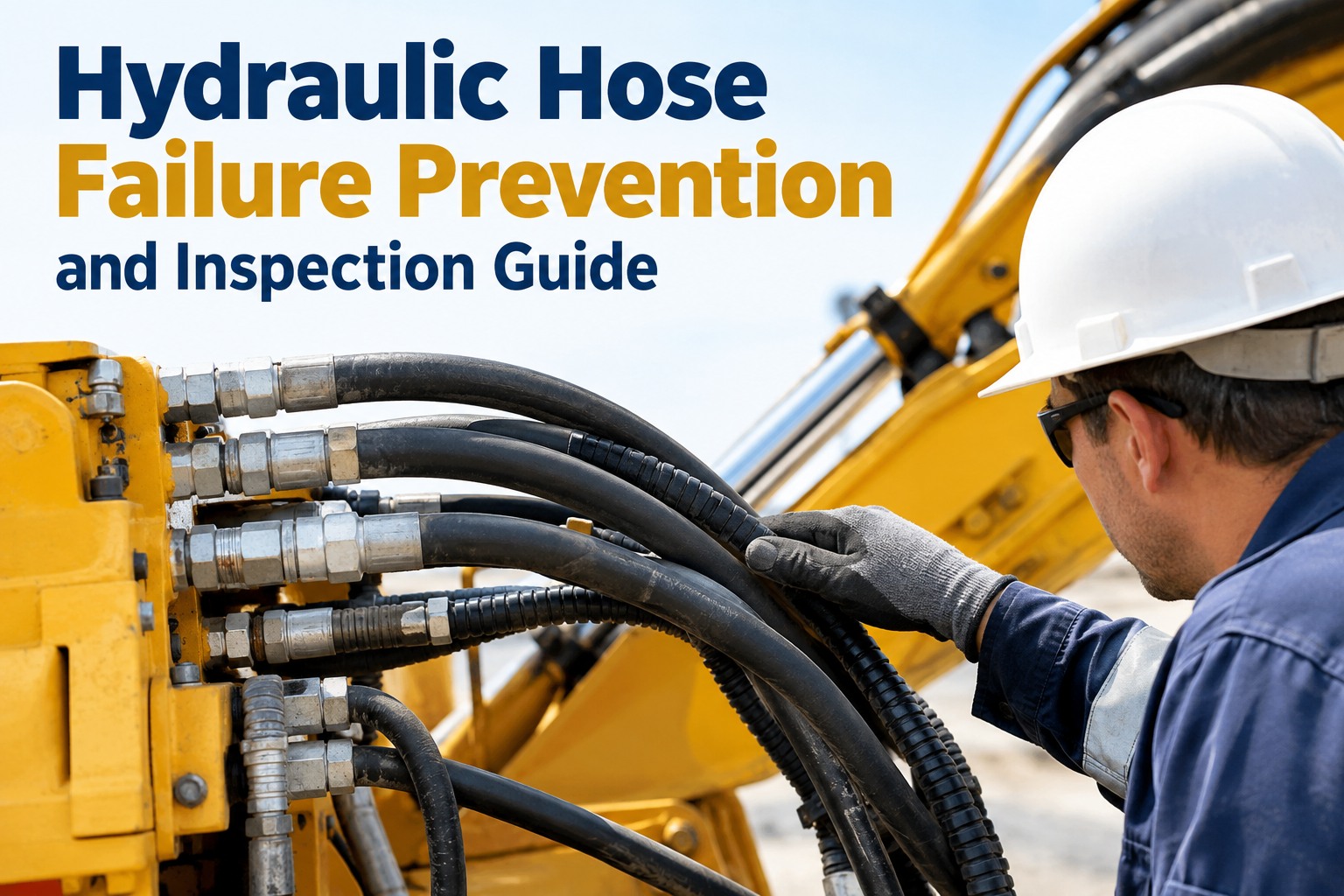
You replaced that hose last month. This morning the excavator is down again — same line, same spot, blown at 3,000 PSI mid-dig. The hose wasn't the problem; the sharp bracket edge sawing through it was, and nobody logged it. Hydraulic hose failure prevention isn't about swapping the burst part faster — it's about finding the cause so the replacement doesn't blow too. Book a demo to catch repeat defects early.
Hydraulic Hose Failure Prevention Starts With One Number: 80%
Hose manufacturers estimate around 80% of failures come from external physical damage — abrasion, kinking, crushing, pulling. Not the hose. The environment around it. That's the good news: most of it is preventable.
A burst hydraulic hose is dangerous, expensive and — most of the time — avoidable. Fluid at 3,000 to 5,000 PSI can inject through skin, a burst line can drop a loaded boom, and every failure is downtime on a machine that costs a fortune to have sitting idle. Yet the same hoses fail in the same places over and over, because crews treat the symptom (replace the hose) and never the cause (the edge that chafed it). This guide covers why hoses really fail, the five causes worth knowing, what to look for before a hose lets go, and how tracking defects turns a recurring problem into a solved one.
The repeatwhy the same hydraulic hose keeps failing
Here's the pattern every fleet knows and few break: a hose blows, a tech fits a new one, the machine runs, and weeks later that exact line fails again. It reads like bad luck or a bad batch of hose. It's almost never either. It's an unaddressed root cause — a contact point, a tight bend, a heat source — still doing to the new hose exactly what it did to the old one.
"The hose burst, so we replaced the hose. Back in service."
The chafe point, sharp bend or heat source is untouched. The new hose starts wearing the moment it's installed — and fails again on the same cycle. You pay twice, plus the second downtime."The hose burst because it was rubbing a bracket. We fixed the routing and added a sleeve, then replaced the hose."
The cause is gone, so the new hose lives its full life. One repair, done once — and the defect stops showing up in the failure log.This is why hydraulic hose failure prevention is a data problem as much as a mechanical one. If nobody records where and why each hose failed, the pattern stays invisible and the cycle repeats. Catch that the same machines lose the same line every quarter, and the fix becomes obvious. Book a demo to see repeat hose defects trended by machine and location
5 causeswhat kills a hydraulic hose — from abrasion to fitting leaks — and the fix for each
Nearly every hose failure traces to one of five causes. Knowing which one you're looking at is the difference between a repair that holds and one that fails again. Ranked roughly by how often they show up in the field.
Abrasion
The #1 killer. The cover rubs a bracket, another hose, a sharp edge or the frame until the reinforcement is exposed — then failure is imminent. Fix: hose abrasion prevention means routing for clearance (aim for about an inch), adding nylon or spiral sleeving at unavoidable contact points, and clamping to stop movement.
Tight bend / bad routing
Bending a hose tighter than its minimum bend radius shifts the reinforcement layers and creates a weak point. Fix: respect the minimum bend radius — typically 6 to 12 times the hose outer diameter — and use elbow fittings or live swivels instead of forcing the hose to turn.
Heat exposure
Heat — from the environment, a nearby manifold, or the fluid itself — bakes the rubber compound until it hardens, cracks and fails early. Fix: route away from heat sources, add heat sleeving where you can't, and keep fluid temperature in range.
Fitting & assembly faults
Wrong fitting, bad crimp, over-torqued or under-torqued connections, or a hose twisted during install — all show up as hydraulic fitting leaks or blowouts at the ends. Fix: match fittings to hose, crimp with proper dies, and never let the hose twist — watch the layline.
Fluid & contamination
An incompatible or contaminated fluid attacks the inner tube from the inside — swelling, softening, or breaking it down until it leaks. Fix: use only the manufacturer-specified fluid, keep it clean, and don't mix fluid types.
Notice that four of the five are about the world around the hose, not the hose itself — which is exactly why the 80% figure holds. Get the routing, protection and assembly right and most failures never happen. Start free and tag each hose failure to its cause for the first time
Warning signswhat a hydraulic hose inspection should catch before it blows
A hose rarely fails without warning — it telegraphs trouble for days or weeks first. The point of a hydraulic hose inspection is to catch these signs while the machine is parked, not discover them when the line lets go under load. Here's what every walk-around should look for.
A critical rule that never bends: never check for a leak with your hand. Fluid at operating pressure can inject through skin without breaking it and cause a life-threatening injury. Use a piece of cardboard, depressurise first, and treat any hose weep as a potential hospital visit.
Spot any of these and the machine comes out of service — a hose showing exposed wire or a bulge is not a "finish the shift" item. And never field-repair a damaged hose with tape or a clamp; the only safe fix is a proper replacement. Book a demo to give every operator a photo-based hose check on their phone
Break the cyclehow defect tracking turns prevention into a system
Knowing the causes is one thing; making sure they actually get fixed, machine after machine, is another. That's where hose failure stops being a mechanic's judgement call and becomes a managed process. The loop is simple, and each step depends on the last.
- 1Capture with a photoThe operator flags the worn hose on a digital inspection and photographs the wear point — the cause is now on record, not in someone's memory.
- 2Route to a work orderThe defect auto-creates a work order that includes the photo, so the tech fixes the routing or heat source, not just the hose.
- 3Log the cause & partsRecord why it failed and the hose and fittings used, drawing from parts inventory so the right stock is on the shelf next time.
- 4Trend & targetFailure analytics reveal the repeat offenders — the machine, the location, the cause that keeps recurring — so you fix the pattern, not just the part.
That fourth step is where prevention pays off. When a hose routing inspection and failure data show three excavators lost the same boom line to abrasion this quarter, you stop guessing — you sleeve or re-route that specific run across the fleet and the failures disappear. Prevention isn't a slogan; it's what the data lets you do. Start free and turn hose failures into a trend you can act on
From a heavy-equipment shop foreman
We were burning through boom hoses on a couple of our excavators and just kept fitting new ones. It was costing us a fortune in hose and, worse, in downtime — a machine down for a blown line in the middle of a job.
When we started photographing the failures instead of just replacing, the cause jumped right out: a factory clamp had shifted and the hose was riding a weld seam on both machines. Ten-dollar fix each. We'd spent hundreds on hoses chasing a problem a photo would've solved in a week. Now every hose defect gets a picture and a cause code, and I can pull up which machines are repeat offenders. Cut our hydraulic line failures roughly in half.
The takeaway
Around 80% of hydraulic hose failures are external physical damage — abrasion, tight bends, crushing — which means the hose usually isn't the problem, and most failures are preventable.
Real hydraulic hose failure prevention means fixing the cause, not the symptom — the chafe point, the bad routing, the heat source — or the new hose fails on the same cycle.
A photo, a cause code and failure trending turn recurring hose failures into a short, targeted punch list — and never check a pressurised hose with your hand.
Every burst hose is a safety risk, a cleanup and a machine sitting idle — and most are the same few failures repeating because nobody recorded the cause. Treat hydraulic hose failure prevention as finding and fixing root causes, back it with photo-documented inspections and failure-trend data, and the recurring blowouts stop being background noise you budget for. Fix the cause once and the hose lasts — that's the difference between reacting to failures and preventing them. Book a demo to improve equipment inspection and maintenance with HVI
Frequently asked questions
What is the most common cause of hydraulic hose failure?
External physical damage, and abrasion in particular. Hose manufacturers estimate that around 80% of hydraulic hose failures are caused by external factors — abrasion, kinking, crushing and pulling — rather than a defect in the hose itself. Abrasion is the single most common: the outer cover rubs against a bracket, the frame, a sharp edge or another hose until it wears through to the reinforcement layer, at which point failure is imminent. This is actually encouraging, because external causes are largely preventable through proper routing, abrasion protection and correct installation. It also means that when a hose fails, the smart response is to look at the environment around the hose — the contact point, the bend, the heat source — rather than assuming the hose was simply defective. The remaining roughly 20% of failures come from causes like excessive heat, fluid incompatibility or contamination, assembly and fitting faults, and normal age-related degradation. Identifying which category a failure falls into is the key to fixing it so it doesn't recur.
How do you prevent hydraulic hose abrasion?
Abrasion prevention works in three layers. First, routing: run the hose so it maintains clearance from any surface it could contact during operation, equipment movement or maintenance access — roughly an inch of clearance is a good target where space allows, away from sharp edges, moving parts and other hoses. Second, protection where clearance isn't possible: in tight installations you can't always keep a hose clear of everything, so add protective sleeving — nylon or spiral wrap — at the contact points to take the wear instead of the hose cover. Third, securing: use clamps and slings to stop the hose from moving and rubbing in the first place, and to support long or heavy runs. It's worth remembering that routing which looked perfect at installation can develop new wear points months later as the equipment vibrates, shifts and gets worked on, so abrasion protection needs to be re-checked on inspections. Catching a developing wear point early, before the reinforcement is exposed, is what keeps an abrasion issue from becoming a failure.
How often should hydraulic hoses be inspected?
It depends on how critical and how hard-worked the system is, but the framework is layered. High-pressure hoses and any lines whose failure poses an immediate safety risk — steering, braking, and the main working circuits on equipment like excavators — warrant a visual check as part of every daily walk-around, looking for leaks, abrasion, bulges and damage. Beyond the daily visual, a more thorough hydraulic hose inspection is commonly done around every six months or 1,000 operating hours under normal conditions, with pressure testing and closer examination of fittings and hard-to-see runs. Severe-duty conditions — high heat, heavy abrasion environments, constant flexing — call for shorter intervals. Because hoses can also fail from internal damage you can't see, such as fatigue from millions of pressure cycles, many programs also replace critical hoses on a scheduled basis by age or service hours rather than waiting for visible damage. The most reliable approach combines daily operator visual checks, periodic detailed inspections, and scheduled replacement of critical lines, all documented so wear patterns are visible over time.
What is the minimum bend radius for a hydraulic hose?
The minimum bend radius is the tightest curve a hose can take without damage, and bending tighter is a common cause of early failure because it shifts the internal reinforcement layers and creates a weak point. As a general rule of thumb, minimum bend radius is often 6 to 12 times the hose's outer diameter, but this varies significantly by hose construction and pressure rating, so the authoritative figure is always the one in the manufacturer's product literature or the relevant SAE specification for that hose. The routing implications are straightforward: don't force a hose into a tighter turn than its rating allows, and where a system needs a sharp change of direction, use an elbow fitting or a live swivel to make the turn rather than bending the hose itself. Leaving a little slack helps too — a hose that's too short is forced into tension and tight bends, while one routed with a gentle curve absorbs movement and vibration without stress. Checking bend radius is a standard part of a routing audit and a good hose inspection.
Why is a hydraulic hose leak so dangerous?
Because hydraulic systems operate at extreme pressure — commonly 3,000 to 5,000 PSI on construction equipment — a leak is far more hazardous than the mess it makes. The most serious risk is fluid injection injury: a pinhole leak can eject a fine, high-velocity stream that penetrates skin without an obvious wound, injecting hydraulic fluid into the body. This is a genuine medical emergency that can lead to tissue death or amputation if not treated immediately, which is why you must never run a hand along a hose to find a leak — use a piece of cardboard or paper, and depressurise the system first. Beyond injection, a burst hose can cause a loaded boom or bucket to drop suddenly, creating a crushing hazard, and leaked fluid creates slip, fire and environmental risks. This is why any active hydraulic leak or burst is an immediate out-of-service condition, not something to nurse to the end of a shift, and why temporary field repairs with tape or clamps are never acceptable — the only safe response is to depressurise, tag the machine out, and fit a properly made replacement hose.
Stop replacing the same hose. Fix why it keeps failing.
HVI gives every operator a photo-based hydraulic hose check on their phone, auto-routes each defect to a work order with the wear point attached, links the fix to parts inventory, and trends failures by machine and cause — so recurring blowouts become a short punch list instead of a standing budget line. Catch abrasion before it's a rupture. Live on your equipment in under two weeks.
No hardware · Photo evidence on every defect · Failure-trend analytics built in