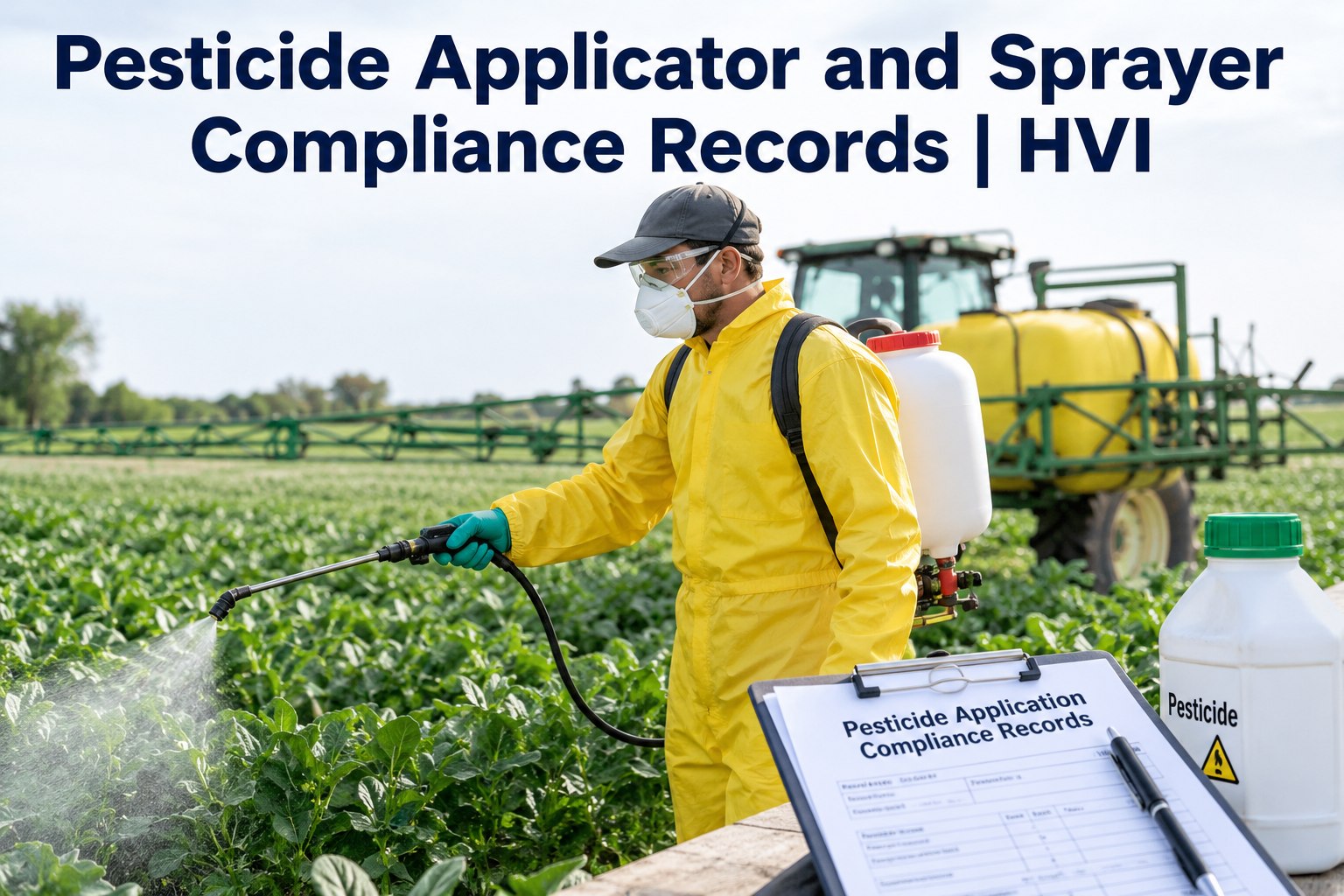
It's 6:40 on a Tuesday morning, the wind is finally under 10 km/h, and your sprayer operator is asking a question you can't answer: "Where did we put the calibration sheet from March?" Pesticide applicator records are the most audited paperwork in agriculture, and the folder on the office shelf rarely survives contact with a real inspection. Between application logs, weather readings, certification cards, re-entry notices and nozzle checks, the average spray season generates hundreds of individual records per machine — and one missing page can turn a routine audit into a formal finding. The frustrating part is that most of it already exists somewhere: a notebook in the cab, a photo on someone's phone, a spreadsheet only one person understands. If you'd rather see how this looks when it all lives in one place, you can book a 30-minute walkthrough of digital spray records and judge it against your current binder.
Every spray pass leaves a paper trail. Is yours audit-ready or cab-ready?
Application logs, calibration evidence, applicator certification and worker protection records all get checked — and the sprayer's own maintenance history sits right alongside them. Here's what auditors actually ask for, and how to keep it all in one place.
What spray record keeping actually costs a farm
Nobody budgets for paperwork, but the hours, the gaps and the audit risk add up to real money every season.
The five pesticide applicator records every audit asks for
Whether it's a state inspector, a buyer's assurance scheme or your own insurance review, the request list barely changes. These are the five folders that get opened first.
The application record itself
Date and time, product name and registration number, rate per hectare, total volume, the block or field treated, crop stage, and who did the work. Most jurisdictions also want wind speed, wind direction and temperature at the time of spraying — the drift evidence. Miss the weather line and the whole record can be treated as incomplete, even if everything else is perfect.
Applicator certification and licence tracking
Every person who mixes, loads or applies needs current certification on file, and restricted use products demand a higher licence class in most regions. The trap is the renewal cycle: cards run three to five years, lapse silently, and the first time anyone notices is when an auditor asks. Certification tracking with expiry alerts is the single cheapest compliance win on this list.
Worker protection: training, notification, PPE
Worker protection standard requirements cover annual handler training, central posting of recent applications, re-entry interval (REI) notification to workers, and documented PPE issue for anyone handling concentrates. The records that fail here aren't missing — they're verbal. "I told the picking crew on Tuesday" is not a notification record.
Sprayer calibration records
Calibration is where compliance and efficacy meet. If the applied rate doesn't match the label rate, you're off-label — full stop — and you've also wasted chemical or under-dosed the crop. Auditors increasingly ask for dated calibration evidence: nozzle output tests, pressure gauge checks, speed verification. A sprayer that was "calibrated at the start of the season" with no paperwork is a sprayer that was never calibrated.
The sprayer's own maintenance file
This is the one farms forget. Nozzle wear logs, pump service history, hose and seal replacements, pressure gauge swaps — the maintenance record proves the machine was capable of applying the rate you recorded. When a drift complaint or residue test lands, the first question after "what did you spray" is "show me the machine was fit to spray it."
Mapping sprayer compliance documentation to what you actually keep
The gap between "required" and "filed" is where findings come from. This is the honest version of where each record usually lives on a working farm.
| Requirement | What the auditor wants | Where it usually lives | Where it should live |
|---|---|---|---|
| Application log | Full record per pass, incl. weather | Cab notebook, half-filled | Mobile entry at the boom, timestamped |
| Certification | Current card per applicator | Wallet, office drawer | Digital copy with expiry alerts |
| Handler training | Annual, signed, dated | Toolbox talk, no signature | Logged session with attendee list |
| REI notification | Posted notice + acknowledgement | Verbal at smoko | Digital notice with read receipt |
| Calibration | Dated output and pressure tests | "Done in March sometime" | Scheduled check with photo evidence |
| Nozzle & pump service | Wear and replacement history | Memory of the operator | Work orders against the sprayer asset |
The right-hand column isn't a fantasy — it's what a guided demo of HVI's inspection templates looks like running on the phone already in your operator's pocket.
How nozzle wear quietly breaks your spray records
Here's the worked example that convinces most farm managers the maintenance file matters as much as the application log.
One season, one boom, no calibration checks
New nozzle set, calibrated at 200 L/ha. Records are accurate. Chemical bill matches the label.
Nozzle wear plus a drifting pressure gauge: real output is now ~218 L/ha. Every record since says 200.
On 800 sprayed hectares, that's roughly 14,400 extra litres of mix — product you paid for, applied off-label, with records that say otherwise.
The fix isn't more spraying discipline — it's a scheduled nozzle-output check every 50–100 engine hours, logged against the machine, with worn tips swapped on a work order instead of "when we get to it."
See your whole spray season in one audit-ready timeline
Book a 30-minute demo and we'll build one of your sprayers live — calibration checks, certification alerts and application records included.
A spray compliance calendar that runs itself
The farms that pass audits without stress don't work harder at paperwork — they front-load it. This is the rhythm that keeps chemical use documentation current all season.
Machine and people, both certified
Full calibration with dated output tests per nozzle section. Pump, hoses, filters and pressure gauges inspected and logged. Every applicator's certification checked against the renewal date — anyone inside 90 days gets booked for renewal now, not in July. Handler training session run and signed.
Record at the boom, not at the kitchen table
The application record is completed on the phone in the cab while the details are true: product, rate, block, weather at start and finish, operator identity. REI notices go out the same hour, not the next morning. Photos of the product label and the weather reading attach automatically.
Nozzle output and pressure re-check
A ten-minute jug test per section catches wear before it moves your rate. Anything outside tolerance triggers a work order for tip replacement — and that work order becomes part of the sprayer's compliance file, proving the recorded rates stayed honest.
Winterise, archive, review
Tank and lines decontaminated and logged. The season's records export as one audit-ready package: applications, calibrations, training, notifications, maintenance. Next season's certification renewals and calibration schedule are already set with alerts.
Four HVI tools that carry the sprayer compliance load
Sprayer inspection templates
Pre-built checks for calibration, nozzle condition, hose and seal integrity, and gauge verification — completed on any phone, with photos and timestamps baked in. No paper form survives a wet cab; this does.
Certification expiry alerts
Every applicator's licence lives against their profile with automatic reminders at 90, 60 and 30 days. The quiet lapse — the one auditors love finding — stops being possible.
Defect-to-work-order flow
A worn nozzle found on a check becomes a work order in one tap, tracked to completion against the sprayer asset. Your maintenance file builds itself as a by-product of fixing things.
Audit-ready record export
When the inspector, buyer or insurer asks, you pull the sprayer's full history — inspections, calibrations, work orders, certifications — in seconds, not a weekend of digging through the office. You can start building that record free before the season starts.
Pesticide applicator records: the short version
The sprayer is part of the record
Application logs prove what you intended to apply. Calibration and maintenance records prove the machine actually did it. Auditors want both, and one without the other is a half-answer.
Certification lapses are silent
Three-to-five-year renewal cycles guarantee nobody remembers. Expiry alerts are the cheapest insurance on this entire page.
Verbal doesn't count
Training, notification and PPE issue all need a signature, a timestamp or an acknowledgement. If it isn't written down, under worker protection rules it didn't happen.
Confirm your local requirements
Retention periods, restricted use rules and notification specifics vary by state, province and country. Check current requirements with your pesticide regulatory authority — then make meeting them automatic instead of heroic.
The pattern underneath all four: records made at the moment of work survive audits, and records reconstructed at the kitchen table don't. If you want to see the moment-of-work version, walk through it on your own sprayer fleet before you commit to anything.
The audit that changed how I run spray season wasn't even about drift — the inspector asked for our calibration dates and my operator's card was six weeks expired. Nobody's fault, it just lived in his wallet. Now every cert and every nozzle check is on the phone with alerts, and I track one number: days since last calibration. If it hits 60, the sprayer doesn't leave the shed.
Sprayer compliance and record keeping FAQs
How long do I need to keep pesticide application records?
What has to be in a compliant spray application record?
Does the sprayer's maintenance history really matter for compliance?
How do I stop applicator certifications from lapsing?
Can I run spray records on a phone instead of paper?
Make this the last season you rebuild records at the kitchen table
Calibration checks, certification alerts, work orders and audit-ready exports — all on the phone your crew already carries. See it on your own sprayers in 30 minutes.
Free to start — Works on any phone — No card needed