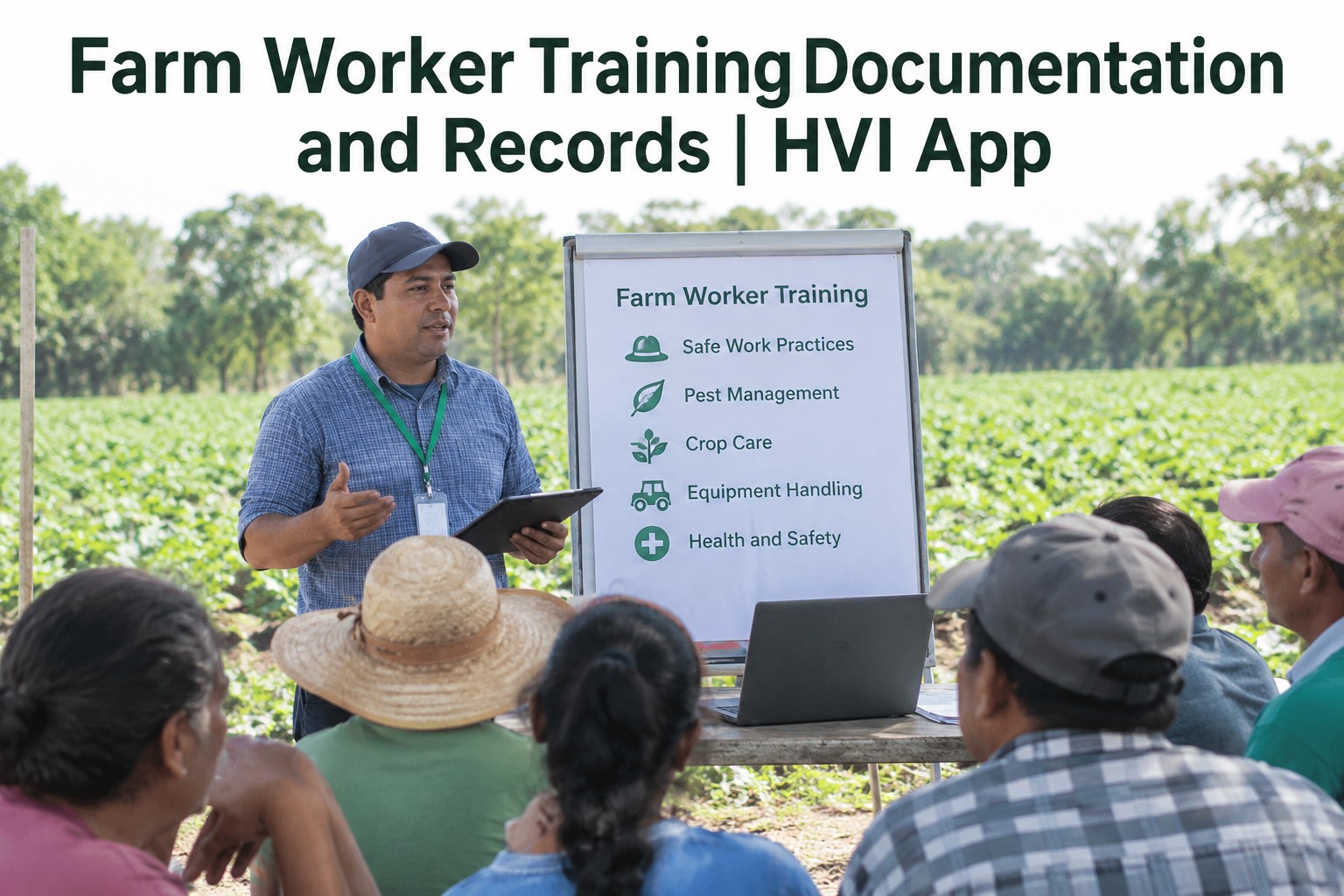
Every farm has had the conversation: a seasonal hand is shown the controls of a tractor for ten minutes, told to be careful, and sent out to disk a field. The training probably happened, and it was probably good enough — but six months later, when an adjuster, a compliance officer or a plaintiff's attorney asks you to prove the operator was competent on that specific machine, you have nothing in writing. That gap between training delivered and training documented is what costs farms real money, and it is exactly what proper farm worker training records exist to close. If you are still keeping training evidence in a paper binder or a spreadsheet someone built in 2016, you can see how that holds up under pressure by booking a walkthrough with our team.
A tractor is not a combine. Your training records should know the difference.
Training delivered is not training proven. HVI gives every operator a competency record tied to the specific machine they run — with 90, 60 and 30-day expiry alerts so no card lapses silently. Audit-ready in seconds, not hours.
Four numbers that explain why training documentation matters
These are not abstract benchmarks. A 40-tractor operation running three seasonal crews can easily have 60 or more training events in a year — tractor orientation, sprayer calibration, combine harvest prep, ROPS instruction, chemical handling refreshers. If you are tracking them on paper, you are betting the operation that the right sheet is in the right binder at the right moment. A single missing record after an incident can be the difference between a clean investigation and a finding of negligence.
Farm worker training records: what each entry must contain
A sign-in sheet with a scrawled signature is not a training record. An investigator, insurer or auditor looking at agricultural training documentation wants to see five specific data points on every entry — miss one and the record is weak evidence. The same logic applies whether you are running grain carts in Saskatchewan or sprayers in South Australia: the record has to tell a complete story. You can see exactly how HVI structures these entries without changing the way your crew already works.
Who was trained
Full name, employee or contractor ID, and date of hire or seasonal start. If it is a returning seasonal worker, the record should link back to prior years so you can see their full competency history on your fleet at a glance.
On what equipment or task
Not "tractor" — the specific unit or at least the specific model and configuration. Operating a 150-hp utility tractor with a loader is a different competency from running a 400-hp articulated tractor pulling a chisel plow. The record has to reflect that.
Who delivered the training
Name and role of the trainer — whether that is the farm manager, a senior operator, a dealer service tech or a third-party instructor. If the trainer's own qualification has an expiry, that should be traceable too.
When it happened
Dated and, ideally, timestamped. A date on a clipboard sheet can be backfilled; a timestamped digital entry created on a phone in the yard at the moment training ended is far harder to challenge. HVI locks that automatically.
What content was covered
The actual topics — safe operation, pre-operational checks, hitching, PTO guards, hydraulic safety, emergency stop, road travel rules. Not a tick box that says "trained" but a checklist of the specific competencies demonstrated.
Why tractor operator training is not the same as combine or sprayer training
The most common documentation failure on farms is treating "trained on equipment" as a single checkbox. It is not. Operating a combine and operating a sprayer draw on completely different skill sets, present different hazards, and require separate instruction — and a serious record reflects that. A worker cleared on a tractor is not automatically cleared on a self-propelled sprayer, and an auditor who knows agriculture will look for that distinction.
| Machine | Key competency elements to document | Common hazard focus | Refresh cadence |
|---|---|---|---|
| Tractor (ROPS-equipped) | Safe operation instruction per 1928.51(d), PTO guard check, hitching, three-point hydraulics, road travel and SMV emblem | Rollover, PTO entanglement, runover | Annually + at hire |
| Self-propelled sprayer | Calibration, boom fold, chemical handling, drift management, PPE, emergency spill response, tank rinse procedure | Chemical exposure, boom contact, drift onto non-target areas | Seasonally |
| Combine harvester | Header engagement, unloading auger, fire extinguisher check, grain tank entry rules, field-to-road transition | Entanglement, fire, grain engulfment | Pre-harvest annually |
| Skid steer / telehandler | Load chart reading, attachment securement, lift capacity, sight-line check, pedestrian exclusion zone | Crush, drop load, rollover on uneven ground | Annually |
| ATV / UTV | Helmet use, load securement, slope travel, low-pressure tyre check, passenger rules | Rollover on slopes, thrown from vehicle | At hire + seasonal |
If your current system is a single sheet that says "trained on farm equipment" with one signature, you have a documentation gap — and the fix is not more paper. A platform like HVI ties each competency to the specific asset, so when a worker scans a QR code on a sprayer, the system knows instantly whether they hold a current sprayer competency or not. You can walk through the machine-assignment logic on your own fleet before you commit to anything.
Seasonal worker training: onboarding that happens six times a year, not once
A seasonal crew arrives, works for roughly six weeks, and leaves. Three weeks later a new crew arrives for the next crop. If your onboarding process was designed for permanent hires — a half-day orientation once a year — it will break under seasonal volume. You either skip the documentation to save time, or you spend hours re-creating records that should have been templates from the start.
Crew arrives
Worker profile created in HVI from a phone — name, ID, role, language preference. Prior seasonal history pulled up if the worker is returning, so you can see what they were already cleared on.
Safety orientation delivered
General farm induction, hazard communication, emergency procedures, PPE issue. Recorded against the worker profile with trainer name and timestamp — no clipboard, no sheet to file later.
Machine-specific instruction
Tractor ROPS instruction, sprayer calibration walk-through, combine harvest prep — each logged as a separate competency tied to the specific asset. Worker cannot be assigned to a machine without a matching record.
Crew departs — records retained
Worker profile set to inactive but retained. If the same hand returns next season, their full competency history is one tap away. No re-onboarding from scratch — just a refresher and an updated sign-off.
The retention question is the quiet part that bites farms. Most regulators expect training records to be retained for a period that can run several years — long after a seasonal worker has moved on. If your records live on a paper sheet that got wet in the cab, or on a laptop that a former office manager took with them when they left, you have nothing. HVI keeps every record in the cloud, tied to the worker and the asset, retrievable in seconds three years later. If that sounds like the kind of thing you want running before the next crew arrives, you can start logging training records free and see the workflow on your own people.
Language and verification: a signature is not proof of understanding
A worker who signs a training sheet they cannot read has given you a signature, not proof of comprehension. In mixed-language crews — common across agriculture in the US, Canada, the UK, Australia and the UAE — comprehension matters more than attendance. A record that says "attended training" is weak; a record that shows the worker was assessed and demonstrated competence is strong. If you want to tighten this up on your operation, you can book a short demo and see how HVI handles language and verification flags.
What strong verification looks like
- Trainer confirms the worker demonstrated the task, not just watched it
- Language of delivery noted on the record — interpreter used if applicable
- Worker signs or marks the record in their own hand or via phone PIN
- Photos of the worker performing the task attached to the entry
- Trainer's own competency is current and on file
What will not hold up under scrutiny
- A sign-in sheet with a single "trained" tick box
- Records backdated after the fact to meet a deadline
- No distinction between machines the worker was cleared on
- Training delivered in a language the worker does not speak fluently
- Records kept only on a single laptop with no backup
Always confirm specific requirements with OSHA or your local regulator — this page reflects general good practice, not legal advice. But the principle holds everywhere: a documented competency that can be retrieved and understood by a third party is worth ten times a paper sheet in a filing cabinet.
How HVI turns farm training records into audit-ready evidence
HVI is a cloud and mobile CMMS built for fleet-heavy operations — and on a farm that means tractors, sprayers, combines, trucks, trailers and shop equipment all in one platform. Training records are tied to the worker and the asset, not floating in a separate system. Here is what that looks like in practice.
Per-person training records with expiry alerts
Every worker has a competency profile. HVI fires 90, 60 and 30-day alerts before a training record lapses, so a refresher gets scheduled — not missed. No more finding out a competency expired the week after an incident.
Machine assignment tied to trained operators
HVI blocks a worker from being assigned to a machine they are not trained on — or flags the gap for a supervisor to override with reason. The system enforces your competency policy instead of hoping a foreman remembers it.
Audit-ready retrieval in seconds
When an auditor, insurer or client asks to see training proof for a specific worker on a specific machine, you pull it up on a phone — timestamped, trainer-signed, photo-backed. No binder, no panic, no back at the office.
Photo-backed competency evidence
Trainers can attach photos of the worker performing the task — hitching, calibrating, operating — directly to the training entry. It is the kind of evidence that turns a he-said-she-said into a closed file.
If you want to see this running on your own machines with your own crew list, the fastest way is to book a 30-minute demo and we will show it live.
What every farm should have locked down before the next audit
If you take one thing from this page: training happened is not the same as training is documented. The record is what an investigator, insurer or auditor actually asks to see — and a paper sheet that says "trained" with a signature is not going to carry the weight you need it to. Strong farm worker training records capture who was trained, on what specific equipment, by whom, when, and what content was covered. They treat tractor, sprayer and combine as separate competencies. They handle seasonal crews as a recurring onboarding process, not a once-a-year event. They account for language and comprehension. And they are retained, searchable and retrievable long after the crew has left. If your current system cannot do all of that, it is worth seeing what a proper CMMS setup looks like before the next season starts.
"The worst call I ever took was from an adjuster asking for a sprayer training record on a guy who'd worked two seasons for us. I knew he was trained — I'd done it myself. But I couldn't put my hands on the sheet. We spent three hours looking and never found it. After that, everything went digital. Now if someone asks, I can pull it up on my phone before they finish the sentence."