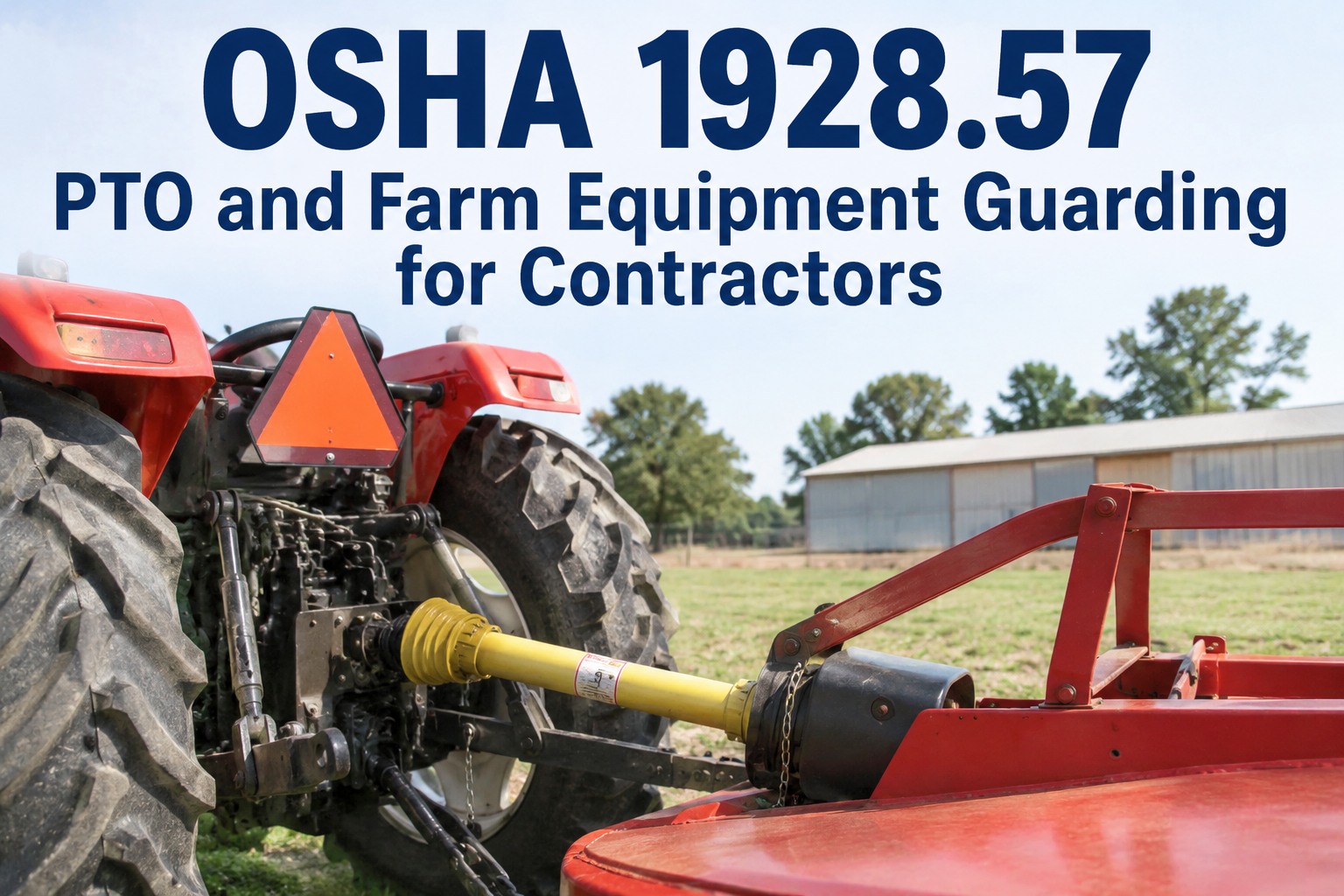
A PTO shaft spinning at 540 rpm wraps clothing or a limb in under a second, and the shield that should prevent that entanglement is usually the same one someone unbolted last season for easier access to a grease fitting and never put back. OSHA 1928.57 guarding requirements exist precisely because of that pattern. The standard covers moving machinery parts on farm field equipment, farmstead equipment, and cotton gins, and it places the obligation on the employer to make sure driveline shields, master shields over the PTO stub, and implement guards stay in place during operation. If you are running mixed fleets that include tractors, pull-behind implements, or farmstead material handlers, you can walk through the inspection points on your own units in a short demo to see where the gaps are.
OSHA 1928.57 GUARDING
The guard someone removed in June is the one that causes the entanglement in October
Driveline shields get unbolted for a grease fitting, a hitch adjustment, or a quick repair. They sit in the shop corner. The machine runs. The stub spins. 1928.57 puts the obligation on the employer to verify, not assume, that every guard is in place and rotating freely before operation starts.
THE COST OF A MISSING GUARD
What a removed PTO shield actually costs you
A missing or seized driveline shield is not a cosmetic defect. It is an OSHA violation, a workers' compensation exposure, and a downtime event waiting for the next operator who reaches across a running shaft.
GUARD REQUIREMENTS
What OSHA 1928.57 actually requires you to guard
The standard is specific about three guard types. Each protects a different pinch point, and each has its own failure mode in the field.
Driveline shield
The tubular or bell-shaped guard covering the PTO shaft between the tractor and the implement. It must rotate freely on its bearing. If it spins with the shaft, the bearing has seized and the guard is effectively dead metal.
Master shield
The guard over the tractor PTO stub itself, where the driveline connects. It protects the operator from the exposed stub when no implement is attached and from the universal joint when one is.
Implement guards
Guards on the towed or mounted equipment itself, covering input shafts, chain and belt drives, augers, and any other moving part an operator could contact during hookup, adjustment, or operation.
FAILURE MODE
How a guard ends up in the shop corner instead of on the shaft
The path from a compliant shield to a missing shield is predictable. It rarely starts with a decision to remove it. It starts with a seized bearing, a damaged tube, or a missing clip, and the guard comes off for access. Then it stays off.
Bearing seizes or shield cracks
A driveline shield that no longer spins freely on its bearing is worse than no shield, because it can throw debris or catch on the shaft. The operator notices it spinning with the shaft and flags it.
Guard removed for access
To grease a universal joint, adjust a hitch, or clear a crop wrap, the shield is unbolted. The intent is to refit it. The bolts go in a coffee can. The shield leans against the wall.
Machine returns to service ungoverned
Without a pre-start checkpoint that specifically asks whether the driveline shield is present and rotating freely, the unit goes back to the field. The master shield over the stub is the next one to go the same way.
Entanglement exposure opens
The operator who hooks up the implement next is working against an exposed shaft spinning at 540 or 1000 rpm. If you want to see how a digital pre-start checklist catches this before the unit leaves the yard, book a 30-minute walkthrough on your own equipment.
INSPECTION POINTS
PTO shield inspection checklist before the unit leaves the yard
These are the points a pre-start inspection should verify, not assume. Each one takes seconds to check and seconds to photograph, but only if the checklist actually asks for it.
Driveline shield present
Confirm the tubular shield covers the full length of the PTO shaft between tractor and implement. No exposed universal joints.
Shield rotates freely
Spin the shield by hand with the shaft stationary. If it turns with the shaft, the bearing is seized and the guard is not functioning.
Master shield intact
Verify the guard over the tractor PTO stub is bolted in place, not cracked, and covers the stub and universal joint area.
Implement guards fitted
Check that input shaft guards, belt covers, and auger shields on the towed implement are in place, not zip-tied or wired open.
No shield held by wire or tape
A shield wired in place is not a guard. If the original hardware is missing, flag it as a defect and route a work order for proper bolts and clips.
Photo captured and timestamped
A photo of the fitted shield, attached to the inspection record, is the evidence you need during an OSHA review or an insurance audit after an incident.
REQUIREMENT-TO-RECORD MAPPING
From OSHA 1928.57 requirement to evidence in your CMMS
The standard requires that guards be maintained and not removed during operation. Proving you did that is a different problem. This is how each requirement maps to a record HVI creates automatically.
| 1928.57 Requirement | What you must verify | HVI record created |
|---|---|---|
| Driveline shield in place | Shield covers full PTO shaft length | Pre-start checklist item with pass/fail and photo |
| Shield maintained in operating condition | Shield rotates freely on bearing | Defect flagged, work order auto-created for bearing service |
| Master shield over PTO stub | Guard present, intact, bolted | Checkpoint with timestamp and operator ID |
| Guards not removed during operation | No field removal without reinstallation | Post-operation inspection confirms refit before parking |
| Implement guards on towed equipment | Input shaft, belt, auger guards fitted | Implement-specific template applied per asset |
| Employer obligation to maintain | Recurring verification, not one-time | Scheduled preventive maintenance with due and overdue alerts |
DO / DON'T
Common practices that create entanglement risk
Two habits account for most of the missing-guard incidents on mixed fleets. One is a shortcut. The other is an inspection gap.
Don't
- Wire or zip-tie a seized shield in place and call it guarded
- Remove the driveline shield to grease a U-joint and refit later
- Run a pre-start checklist that asks only "PTO OK?" with no photo
- Assume the implement guards are fitted because the unit was serviced
- Let a damaged master shield ride because the stub is rarely exposed
Do
- Spin the shield by hand to confirm the bearing is free before each shift
- Photograph the fitted shield and attach it to the inspection record
- Route a work order the moment a shield is flagged seized or missing
- Use an implement-specific template so every guard is a named checkpoint
- Verify refit on the post-operation inspection before the unit parks
HOW HVI HELPS
How HVI closes the PTO guard verification gap
HVI turns 1928.57 guarding from a paper assumption into a timestamped, photo-backed record. PTO is a named checkpoint, defects route to work orders automatically, and implement templates mean the right guards are checked for each asset. You can start logging guard inspections free or see the full workflow in a 30-minute demo.
PTO named as a pre-start checkpoint with photo capture
Every pre-start inspection includes a PTO shield checkpoint. The operator captures a photo of the fitted guard. That image is stored against the asset record, timestamped, and impossible to backdate.
Automatic defect routing to work orders
When a shield is flagged seized, cracked, or missing, HVI creates a work order automatically. No phone call, no text message, no sticky note. The defect is tracked from flag to fix with parts and labor attached.
Implement-specific inspection templates
A baler, a pull-type sprayer, and a farmstead grinder-mixer have different guard points. HVI applies the right template per implement, so the operator checks the guards that actually exist on that machine.
Scheduled PM for shield bearing service
Set preventive maintenance by engine hours or calendar date to service driveline shield bearings before they seize. Due and overdue alerts keep the recurring verification 1928.57 expects from falling through the cracks.
KEY TAKEAWAYS
What to remember about OSHA 1928.57 guarding
Three guard types, one obligation
Driveline shields, master shields, and implement guards are all required under 1928.57. The employer obligation is to maintain them and ensure they are not removed during operation.
Free rotation is the real test
A shield that spins with the shaft is not a shield. Verify free rotation by hand. If the bearing has seized, the guard is dead metal and must be serviced or replaced before the unit runs.
Removal for access is the top failure mode
Guards come off for greasing, hitch adjustments, and crop-wrap clearance. Without a post-operation refit check, they stay off. That is how entanglement exposure opens.
Verification, not assumption
A checklist that asks "PTO OK?" without a photo proves nothing. A named checkpoint with a timestamped image is the record that holds up in an OSHA review or an insurance audit.
Digital records close the loop
HVI turns guard checks into evidence: photo capture, defect routing, implement templates, and scheduled PM. The standard expects recurring verification. The software delivers it. See the full PTO inspection workflow in a demo.
Always confirm specific guarding requirements with OSHA and your local safety authority. This page is a practical guide, not a legal interpretation of the standard.
The PTO shield is never missing when you ask. It is always missing when you go look. We stopped asking and started requiring a photo. That one change found three seized bearings and two shields sitting in the shop in the first week.
FREQUENTLY ASKED