The combine throws a code mid-harvest, the dealer pulls the engine hours, and three weeks later the claim comes back denied — not because the part wasn't covered, but because nobody could prove the 250-hour service ever happened. Farm equipment warranty claims get denied on paperwork more often than on the actual failure. Here is what OEMs are really checking, and the record trail that gets a claim approved instead.
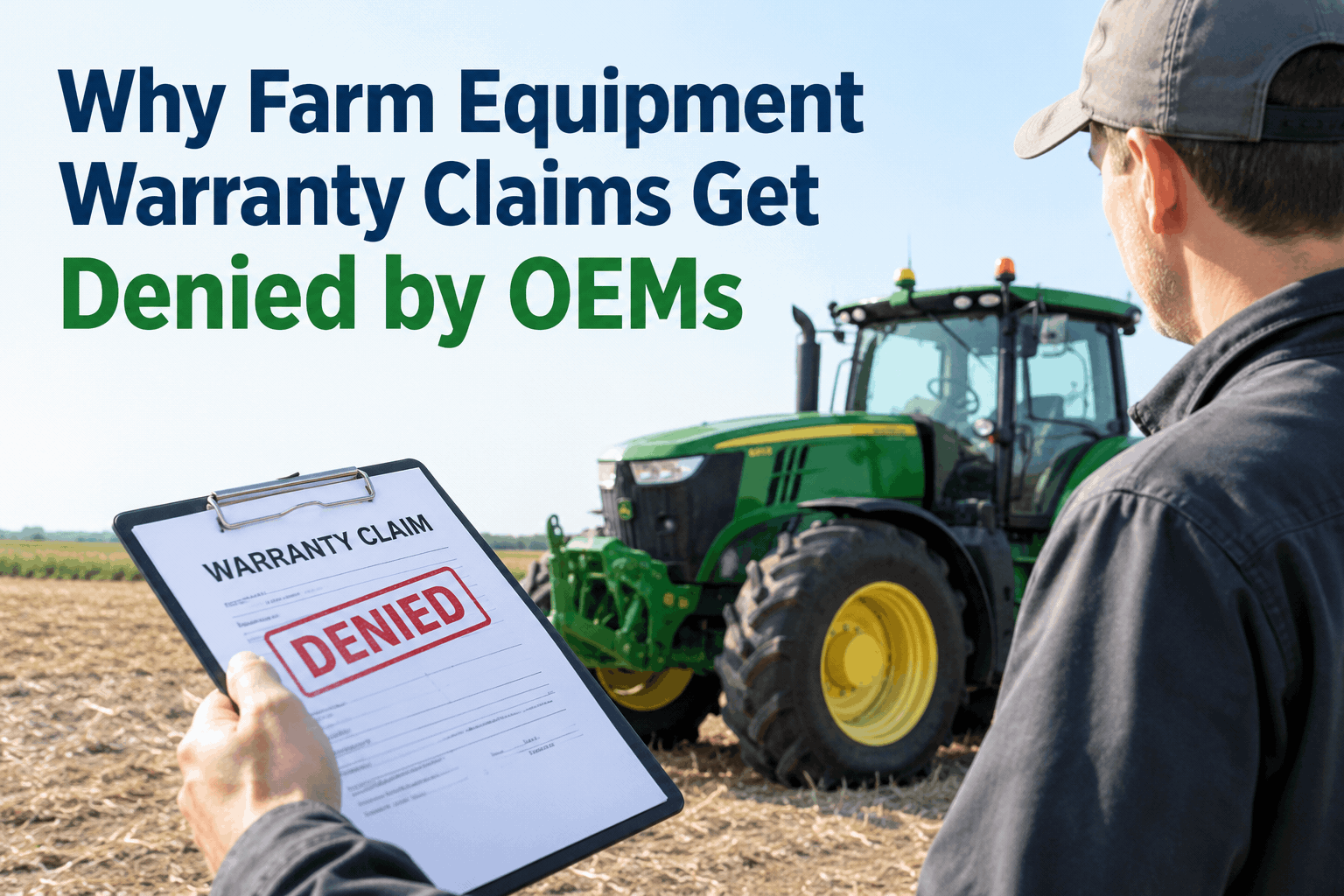
Why Farm Equipment Warranty Claims Get Denied by OEMs
A denied claim almost never starts with the part that failed. It starts three steps earlier, with a service interval nobody logged and a dealer who can't take your word for it.
Why Farm Equipment Warranty Claims Get Denied More Than the Failure Alone Explains
Most owners assume a warranty claim rises or falls on the part. In practice, the first thing a dealer or OEM claims reviewer checks is whether the service schedule was followed and whether anyone can prove it — before the failed part is even inspected. Start free and see what a claims-ready service record actually looks like for one of your own tractors.
The Top Reasons Farm Equipment Warranty Claims Get Deniedranked by how often each one actually sinks a claim
Book a demo and we'll check these five gaps against your own fleet's current records before walking through the ranking below.
The 250-hour or 500-hour service happened, but it lives in someone's memory, not a dated record tied to the asset.
The claim names the wrong part number or can't confirm which physical unit actually failed.
The failure was caught in time; the paperwork wasn't, and the dealer-agreement clock had already run out.
Using an independent shop is protected by law — not telling anyone what work was done on that system isn't.
Hours were tracked for a while, then stopped being logged right around when the problem started.
What Magnuson-Moss Actually Protects — and What It Doesn't
This law gets quoted constantly and misunderstood just as often. It's worth separating the two halves before your next service decision.
Using an independent mechanic or non-OEM parts for routine service — an OEM can't void your warranty just for that choice alone.
Skipping the scheduled service itself, or being unable to show it happened when the failure is tied to that exact system.
In short: book a demo and we'll show you how a digital service log satisfies both sides of this law at once — your choice of shop, and proof the work got done.
Build the Claim File Before You Ever Need One
A claim file assembled after a failure is a scramble. One built as the machine runs is just an export. Start free and turn on these six items for every tractor and combine in the fleet.
Every tractor and combine logged by make, model, and component serial numbers, not a nickname.
Not a date on a sticky note — the actual hour-meter reading at the moment of service.
A photo attached at the time beats a description written from memory a month later.
Logged the moment the code appears, not reconstructed from what the operator recalls.
What was done, when, and by whom — even when it's your own crew, not the dealer.
The entire service record for one asset, ready the same day the dealer asks for it.
A Denied Claim Folder vs. an Approved One
Same failure, same machine, two completely different outcomes — book a demo and we'll pull a mock claim file for one of your own units to show which side it lands on today.
What a denied claim usually looks like
What an approved claim usually looks like
From an Operations Manager Who Fought a Denial and Won the Next One
Our first transmission claim got kicked back because we couldn't show the 500-hour service had happened — it had, I just had no paper to prove it. That appeal took six weeks and cost us the combine during harvest.
The second time a transmission on a different unit threw the same code, I exported the service log in about two minutes — every hour, every date, photos attached. Approved on the first pass. Same failure, completely different outcome.
One dashboard, every asset's full claim file ready — book a demo and pull up a sample export for your own fleet.
Frequently Asked Questions
Does using an independent mechanic void a farm equipment warranty?
Not by itself. The Magnuson-Moss Warranty Act protects your right to use independent service or parts for routine maintenance. What still matters is proving the required maintenance was actually performed, regardless of who did it.
What documentation do OEMs usually require for a warranty claim?
Most claim reviews look for the service history tied to the asset's serial number, the engine hours at each service and at the point of failure, photos of the issue, and any diagnostic failure codes. Missing any one of these is a common reason claims stall.
How long do I have to file a farm equipment warranty claim?
It varies by OEM and dealer agreement, but a 30-day window from when the failure is discovered is common. A late claim can be denied even with perfect maintenance records, so filing promptly matters as much as the paperwork itself.
Can a warranty claim be denied even if the maintenance was actually done?
Yes — a claims reviewer can only act on what's documented. If the service happened but was never logged with a date and engine-hour reading, there's often nothing on file to point to, which functions the same as if it never happened.
Should I track engine hours separately from the OEM's own meter?
It's worth keeping your own log tied to each service record rather than relying only on the machine's built-in meter. A separate, dated record makes it far easier to show exactly when a service happened relative to the hour count at the time.
Farm equipment warranty claims get denied on missing proof more often than on the failure itself. Log every service against engine hours, attach photos and serial numbers as you go, and the claim file is already built the day you need it.
Stop losing warranty claims to missing paperwork, not bad parts
HVI logs every inspection and service against the asset's serial number and engine hours, attaches photos and failure notes automatically, and exports a complete claim-ready history the same day a dealer asks for one.
- Service logged against serial number & hours
- Photos & failure codes attached automatically
- Independent repairs documented, not just done
- Full history exported in minutes, not days
No credit card · Works on the phone your operators already carry · Every asset's claim file, ready on day one