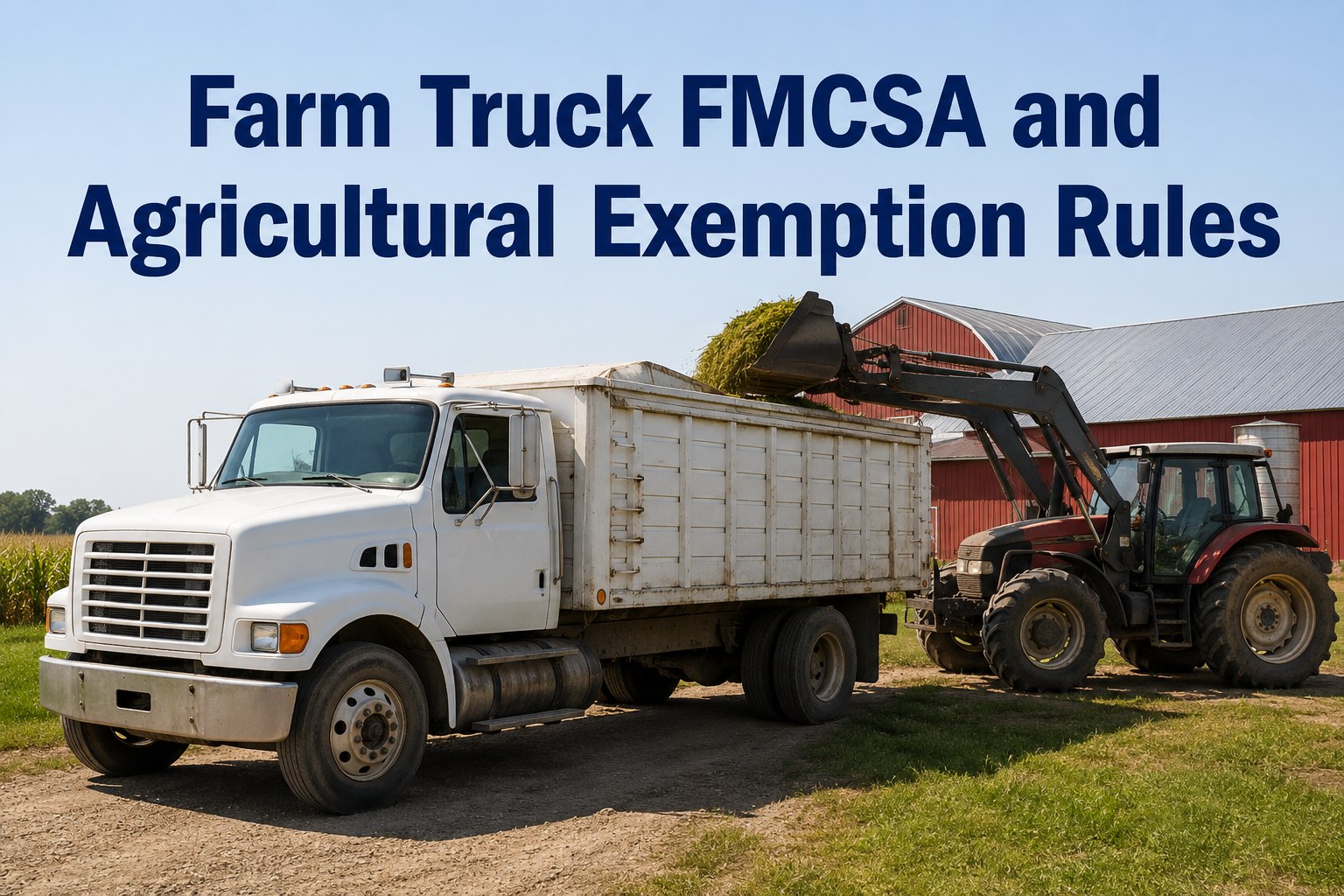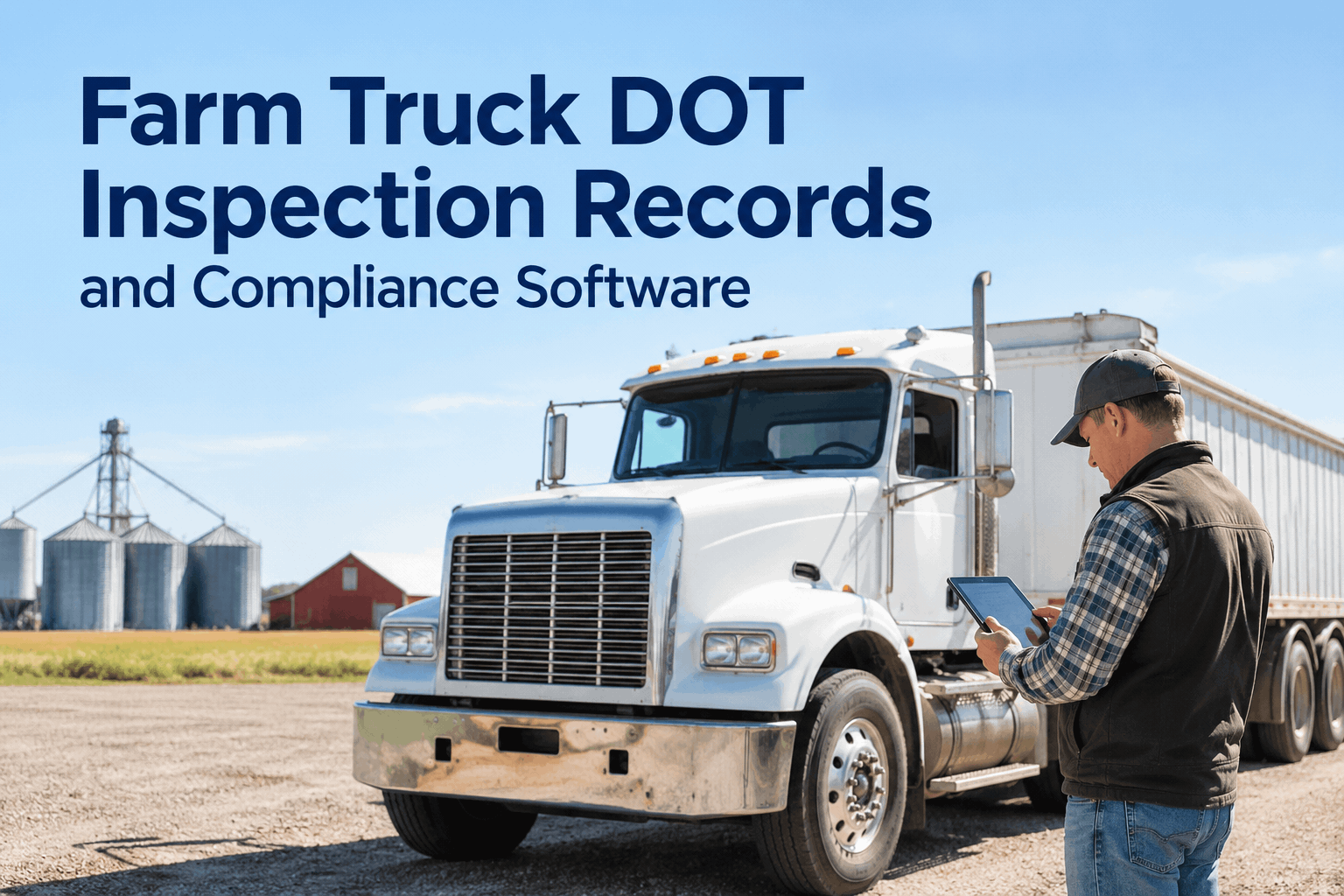
The question that ends a roadside stop badly is rarely "is your grain truck exempt." It is "show me the records." An officer can place an unsafe truck out of service however far you are from the farm — brakes, lights and coupling have no agricultural exemption. Farm truck DOT inspection records prove the condition was checked, the defect fixed, and the paper still on file. Here is what records you owe and how long to keep them — and book a demo to see them kept audit-ready.
Farm Truck DOT Inspection Records and Compliance Software
Keep DVIRs, annual inspection reports and defect-to-repair records organized, timestamped and retention-tracked — so the file is ready before the auditor asks, not scrambled together after.
There are two separate questions farm trucking keeps blurring together: whether federal rules apply to you, and whether your records prove you followed the ones that do. This page is only about the second. If you still need to work out eligibility, start with whether your farm truck is exempt — then come back here for the records you keep once any rule applies. Note upfront: this is general guidance, not legal advice, and record rules vary by interstate versus intrastate operation and by state, so confirm the current 49 CFR and your state requirements.
No exemption from conditionwhy a farm truck still owes DOT inspection records
The agricultural exemptions people lean on cover things like CDL, medical cards and hours of service. They do not cover the truck being safe to drive — and that is where records come in.
- CDL requirement for a qualifying farm driver
- Medical card, within the covered-farm-vehicle conditions
- Hours-of-service limits within the ag source radius
- Brakes, tires, lights, steering and coupling condition
- Keeping records that the condition was inspected
- An out-of-service order when a defect is found
An officer does not need to prove you are a for-hire carrier to pull a truck with a cracked brake line out of service. The condition obligation stands on its own, and the record is how you show you were on top of it. Explore digital DOT inspections that build the record as the check happens.
Three records, three clocksthe farm truck DOT inspection records that have to exist
Each record answers a different question, must contain different things, and has its own retention clock under 49 CFR Part 396. Mixing them up is where audits go wrong. Figures below are the federal baseline — verify against current 49 CFR and your state rules.
| Record | What it answers | Must contain | Keep for |
|---|---|---|---|
| Driver vehicle inspection report (DVIR) | Was the truck checked, and any defects reported? | Vehicle ID, defects found or none, and the carrier's certification that each was repaired or repair was unnecessary | 3 months |
| Annual / periodic inspection | Did the truck pass a full yearly inspection? | Inspection to the minimum periodic standards (Appendix G), inspector and report details | 14 months |
| Roadside inspection report | What did an officer find, and was it fixed? | The officer's report plus carrier certification that violations were corrected, signed and returned within 15 days | 12 months |
| Maintenance & repair records | What was serviced, and when is the next due? | Vehicle ID, the schedule of required inspections, and a dated record of inspections, repairs and maintenance (396.3) | Per 396.3 |
The pattern across every row is the same: the inspection is only half the job — the retained, certified record is the other half, and it is the half roadside audits actually test. Book a demo to see each record filed and retention-tracked automatically.
The DVIR, start to filehow a farm truck defect becomes a closed, certified record
A DVIR is not done when the driver reports a defect — it is done when the repair is certified and the paper is retained. That full loop is exactly what trips up paper systems, and exactly what software closes.
Defect reported
Driver logs the inspection, notes any defect that could affect safe operation, and the report carries the truck ID, date and a photo.
Work order raised
The defect becomes a work order routed to the mechanic — so the repair is tracked, not left on a sticky note on the dash.
Repair certified
The carrier certifies the defect was repaired, or that repair was unnecessary — the signature that turns a report into a compliant record.
Retained on file
The closed DVIR is held for its retention window and surfaces instantly in an audit export — no box of folded sheets to sort.
That certification step is the one most farms miss on paper, and the one an auditor looks for first. Explore digital DVIR reporting that forces the loop closed before the record is filed.
The audit-ready checklistwhat a farm truck compliance file needs before an inspection
Run this before the season, not during a roadside stop. If every line is checked and the record exists on file, a compliance review is a non-event. Each item is something an auditor can actually ask to see.
- DVIRs on file for the retention window, with defects and certifications
- Current annual / periodic inspection report for each truck
- Any roadside inspection reports signed and returned within 15 days
- Every reported defect traceable to a dated, certified repair
- Maintenance log showing schedule, due dates and work done
- Photos or invoices attached where they back up the repair
- Each record held for its own retention period, not deleted early
- Records organized per truck, retrievable in minutes
- A clean export ready to hand to an auditor on request
If any line is a maybe, that is the gap an audit finds. Sign up free and build your farm truck compliance file so every line is a yes.
Audit-ready, by defaulthow HVI keeps farm truck compliance records straight
The records already have to exist — the only question is whether they are organized or scattered. Four capabilities map directly to the Part 396 record problem.
Digital DVIR with certification
Drivers file the inspection on a phone; the repair-certification step is built in, so the record is complete before it is stored.
Defect-to-work-order flow
Every flagged defect becomes a tracked work order, so the repair trail that proves compliance writes itself as the work happens.
Retention tracked per record
DVIRs, annual reports and roadside reports each carry their own retention window, so nothing is purged early or kept as clutter.
One-tap audit export
Pull a clean, per-truck record set for any date range — the difference between a two-minute export and a weekend in the filing cabinet.
HVI does not decide your exemption status or file anything with FMCSA — it keeps the inspection and repair records that prove condition compliance organized and retrievable. Explore compliance reporting to see the audit export in action.
From a farm transport manager who got audited
We always did the checks — we just couldn't prove it fast. When the review came, it wasn't the trucks that stressed me, it was finding three months of DVIRs in a glovebox and the cab of whoever drove last. Now every report is filed under the truck with the repair signed off, and I pulled the whole file in about two minutes. The inspection was never the problem; the paper always was.
Farm truck DOT inspection records, answered
Do farm trucks need DOT inspection records if they're ag-exempt?
The agricultural exemptions cover things like CDL and hours of service, not the truck's safe condition. Equipment-condition rules and the records proving them still apply once any federal rule is triggered. This is general guidance, not legal advice. Book a demo to see records kept audit-ready.
How long do I have to keep a farm truck DVIR?
Under 49 CFR Part 396 the original DVIR is generally kept for 3 months; annual inspection reports for 14 months; roadside inspection reports for 12 months. Verify against current 49 CFR and your state. Explore digital DVIR or book a demo to track retention automatically.
Is HVI a DOT or FMCSA filing service?
No — HVI does not determine exemption status or file anything with regulators. It keeps your inspection, defect and repair records organized, certified and retention-tracked so they are ready when an auditor asks. Sign up free to organize your records.
What makes a defect record actually compliant?
The certification. A reported defect becomes a compliant record only when the carrier certifies it was repaired, or that repair was unnecessary, and the report is retained. Software builds that step into the flow. Book a demo to see certified DVIRs.
Can records be pulled quickly for an audit?
Yes — records sit per truck and export as a clean set for any date range, so a review is a quick export rather than a search through gloveboxes and folders. Book a demo to see a one-tap audit export on your fleet.
Keep every farm truck record audit-ready
DVIRs, annual inspections and certified repairs filed per truck, retention tracked, and ready to export the moment an officer or auditor asks. No gloveboxes, no missing certifications.
Free to start · Works on any phone · No card needed
- Digital DVIR with repair certification
- Annual inspection reports on file per truck
- Retention tracked for every record type
- One-tap audit-ready export