Harvest is three weeks out, the grain truck needs a brake chamber, and someone in the shop asks the question that decides your whole compliance picture: does this truck even need a DOT number? Farm truck FMCSA rules are full of real exemptions — but they are narrower than most operators assume, and they hinge on four things most people have never actually checked: who is driving, what is on the trailer, how far from the farm you are, and how much the rig weighs. Get one of those wrong and the exemption you thought you had does not exist. Meanwhile the brake chamber still needs fixing either way, because no exemption in the book excuses a defective vehicle. This guide walks through the covered farm vehicle rules, the agricultural hours-of-service exemption, the exact points where a farm truck falls outside them, and the equipment obligations that never go away — plus how to keep the records straight without adding office work. If you want to see how farms are handling this on their own trucks, book a 30-minute walkthrough on your own units and bring your questions.
Is your grain truck actually exempt — or do you just think it is?
The agricultural exemptions are real, but every one of them has a distance line, a weight line, a commodity line and a "who's driving" line. Cross any one of them and you are a fully regulated motor carrier with none of the paperwork in place.
Four numbers that decide your farm truck compliance picture
Each of these figures is a line in the regulations. On one side you are exempt from a rule; on the other side you are fully subject to it, often without realising the trip changed your status.
What is a covered farm vehicle — and what disqualifies yours?
A covered farm vehicle (CFV) gets relief from CDL requirements, medical cards and some other federal rules — but only while every condition below is true at the same time. Think of it as four gates, not one.
Who is operating it
The driver must be the farm owner or operator, a family member, or a direct employee of the farm. A hired driver from a trucking company, or a neighbor running trips for a fee, does not qualify — and the exemption dies with that one fact.
What it is carrying
Agricultural commodities, livestock, machinery or supplies going to or from the farm. The moment the load is someone else's freight moved for payment, you are for-hire carriage — a different regulatory world with a DOT number, authority and full driver qualification files.
How far it travels
The CFV definition holds within 150 air-miles of the farm. Beyond that radius, or across a state line in some configurations, the relief narrows fast. A grain run to a distant terminal can quietly be an interstate commercial trip.
How heavy the rig is
Weight changes everything. Under 26,001 lb the picture is one thing; over it, another; and a plated combination well above that can lose CFV relief entirely depending on how it is registered and used. Check your actual plated weight, not the number you remember.
The practical test: before harvest, write down each truck's plated weight, its typical loads, its longest regular trip and who actually drives it. Four lines per truck. If any line fails a gate, that truck needs the full compliance file — and that is exactly the kind of per-unit status you can track when you walk through a demo with your fleet list in hand.
How the agricultural HOS exemption actually works
The hours-of-service agricultural exemption suspends HOS limits for drivers hauling agricultural commodities from the source — but only inside the 150 air-mile radius, and in many states only during planting and harvest periods the state has formally declared.
Load at the source
The exemption attaches to movements of agricultural commodities from the farm, field or elevator of first receipt. Inside the 150 air-mile bubble, HOS limits do not apply to that driver on that trip.
Watch the radius line
Cross 150 air-miles and HOS rules switch on for the rest of that trip — and the driver must have hours available from that point. If nobody has been tracking anything, there is nothing to switch on to.
Check the season
Many states limit the exemption to declared planting and harvest windows. Hauling grain in February under "the harvest exemption" is a violation with a date on it.
State lines change the math
Interstate movement can pull the trip under federal rules regardless of distance. A 90-mile run that crosses a state line is not the same trip as a 90-mile run that does not.
Worked example: a three-truck grain operation runs 14-hour days through a six-week harvest. Inside the radius that is legal. One truck then takes a backhaul of fertilizer for a neighbor at $180 a load, 170 air-miles out. That single trip is for-hire, beyond the radius and possibly interstate — the driver needed a log, the truck needed a DOT number, and the operation had neither. One $180 load created the exposure. This is why fleets that start logging trips and inspections free per unit catch the status change before a roadside officer does.
Where farm truck exemptions end completely
Three moves take a farm truck fully outside agricultural relief. Once any of them happens, the truck is a regulated commercial motor vehicle in every respect.
| Trigger | What changes instantly | What you would need in place |
|---|---|---|
| Hauling for hire — moving anyone else's goods for payment | You are a for-hire motor carrier; farm relief does not apply to the trip | USDOT number, operating authority, driver qualification file, HOS compliance, drug and alcohol program |
| Crossing state lines in a qualifying vehicle | Federal interstate rules govern the trip regardless of farm plates | USDOT number, IFTA and IRP where applicable, full inspection and maintenance records |
| Beyond the 150 air-mile radius or outside the declared season | HOS and related exemptions switch off mid-trip | Logs or ELD for that driver, available hours, supporting documents |
| Weight or registration mismatch — plated combination outside CFV limits | CDL and medical requirements attach to the driver | Correct licence class, medical certificate, vehicle records |
Farm plates do not create the exemption — the four gates do. A truck with farm plates running a for-hire load is simply an unregistered for-hire carrier. Rules also differ by state, so confirm the current position with FMCSA and your state authority before the season, not after a stop. If you want a second set of eyes on how your units are classified, book a demo and bring your truck list — the per-unit record structure makes the gaps obvious in minutes.
Exempt from paperwork is not exempt from brakes
Whatever your regulatory status, every truck still needs to be safe, inspected and provably maintained. See how farms run that on HVI — trucks, semis and service trucks alongside the machines.
Equipment condition: the obligation with no agricultural exemption
A brake defect is a brake defect whether the truck has farm plates or a DOT number. Vehicle-condition rules follow the vehicle, and roadside officers can place any unsafe truck out of service on the spot — harvest schedule or not.
What "she'll be right" costs
- A truck placed out of service at the scale sits until repaired — during the six weeks you cannot spare a single truck-day
- A crash in an unmaintained truck with no inspection records is a liability file with nothing in your defence
- Insurance claims get contested when there is no evidence the vehicle was roadworthy
- One in five trucks inspected in CVSA roadcheck blitzes is typically placed out of service for vehicle defects — brakes and tires lead the list every year
What documented condition buys you
- A timestamped, photo-backed inspection history that answers any officer, adjuster or lawyer in seconds
- Defects caught in the yard at $90 for a gladhand seal instead of $900 for a roadside callout plus a lost day
- PM intervals tracked by date, mileage or engine hours so the grain truck is serviced in the off-season, not discovered broken at first load
- A defensible position even when your operation is fully exempt — proof you ran safe equipment by choice
The arithmetic is simple: a pre-harvest inspection day across four trucks costs a few hours and maybe $400 in parts. One truck down for two days mid-harvest, with a custom-hire crew standing at $1,500 a day, costs ten times that — before any fine. Fleets that see the inspection workflow on a live demo usually recognise their own busiest week in it.
Farm truck compliance and condition, handled in one app
HVI covers your farm trucks, semis and service trucks alongside tractors and machines, with configurable inspection templates for each. Four capabilities do the heavy lifting for agricultural operations.
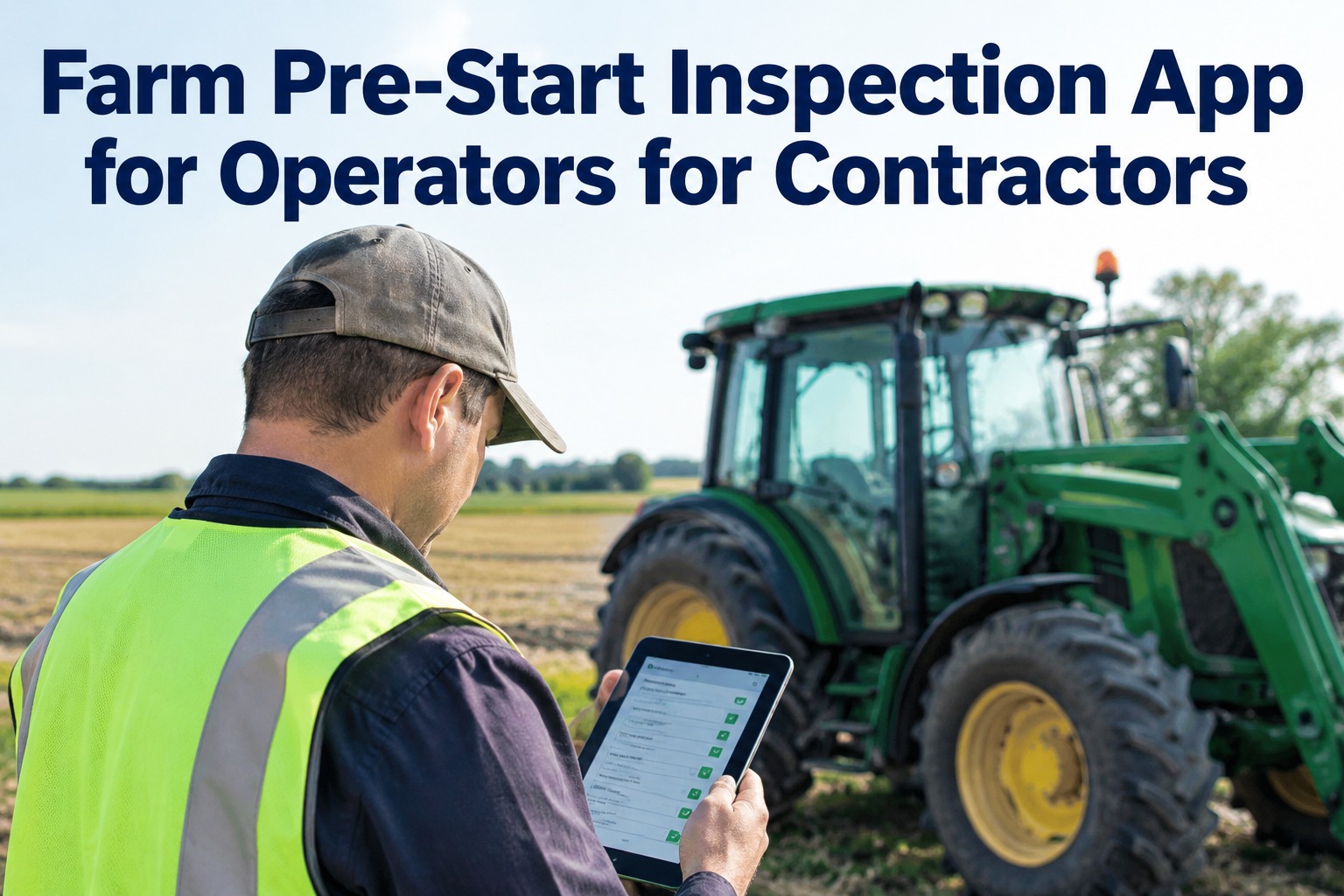
Digital inspections on any phone
Drivers run a pre-trip or pre-harvest check on the phone already in their pocket, with photos and defect capture. No paper binder in the grain truck cab, no text-message photos lost in a group chat.
Defect-to-work-order in one tap
A flagged brake chamber becomes a work order instantly, assigned with parts and priority. Nothing waits for someone to read a notebook — the repair is tracked to done before the truck rolls.
PM scheduling by date, miles or hours
Preventive maintenance triggers off odometer, engine hours or calendar, with due and overdue alerts. The off-season service list builds itself instead of living in one person's head.
Audit-ready records in seconds
Every inspection, repair and service is timestamped and photo-backed. When an officer, insurer or attorney asks, you pull the unit's history on the spot — sign up free and log your first inspection today to see the record it builds.
Farm truck FMCSA rules: what to do before first load
The exemptions are worth real money — but only if you know exactly which trucks and trips they cover. Five moves put you on solid ground.
Classify every unit: plated weight, typical load, longest trip, regular drivers — four lines per truck tells you which gates each one passes.
Map your radius: measure 150 air-miles from the farm and mark which elevators, terminals and customers sit outside it.
Confirm the season: check your state's declared planting and harvest windows with the state authority and FMCSA before relying on the HOS exemption.
Refuse casual for-hire loads unless you are set up as a carrier — one paid backhaul reclassifies the whole trip.
Document condition regardless: inspect, repair and record every truck so a defect never becomes a roadside stop, a claim denial or an unanswerable question.
Put it in a system, not a drawer: farm truck FMCSA status and maintenance records belong where you can produce them in seconds — book a demo to see your fleet set up that way.
We ran exempt for years and honestly never checked the details. Then a driver took a paid load of seed for a neighbour, got stopped 40 miles past our radius, and we had nothing — no log, no inspection record, no file. Now every truck gets a five-minute walkaround on the phone each morning of harvest, and I track one number: zero units rolling with an open defect. We have held that for two seasons.
Dale Kessler — Operations Manager, family grain and trucking operation, 2,400 acres and 6 trucks
Farm truck FMCSA and agricultural exemption FAQs
Does a farm truck need a DOT number?
What is the 150 air-mile agricultural exemption?
Do farm truck drivers need a CDL?
Are farm trucks exempt from vehicle inspection and maintenance rules?
Can I haul a neighbor's grain under the farm exemption?
Know your status. Prove your condition. Run your harvest.
HVI keeps every farm truck, semi and service truck inspected, maintained and documented — exempt or not — on the phones your crew already carries. See it on your own fleet in 30 minutes.
Free to start - Works on any phone - No card needed