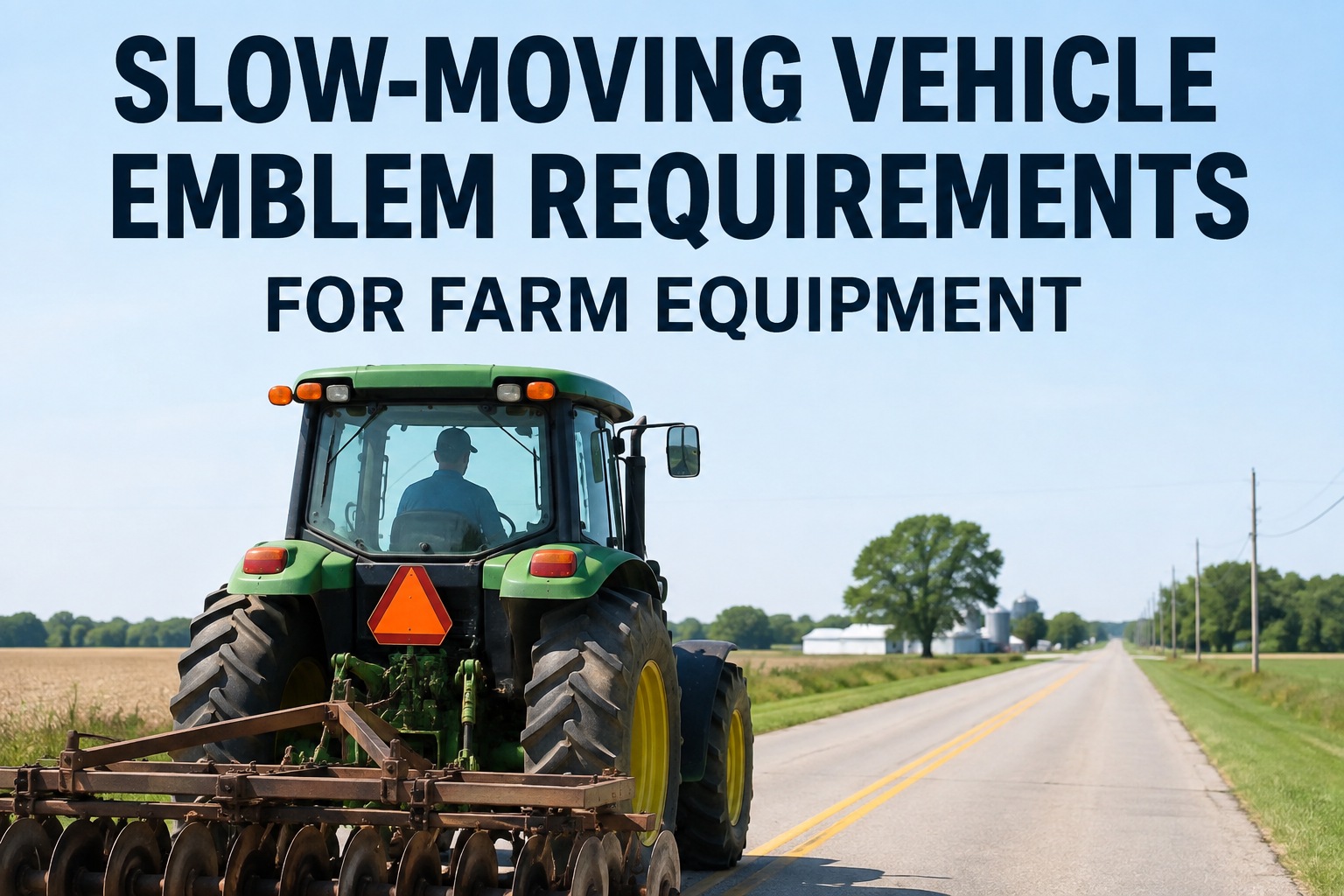
It is 6:40 on a Tuesday evening in late October. Your combine is coming home on a two-lane highway, traffic is doing 55 behind it, and the orange triangle on the back is the same one that went on six seasons ago - faded to a pale peach, half-covered in dust. That slow-moving vehicle emblem is the only thing telling a tired driver closing at 45 mph faster than you that something big and slow is ahead. SMV signs cost almost nothing, take minutes to mount, and are the single most common visibility failure on farm equipment that travels public roads. This guide covers what the emblem requirement actually says, how lighting and marking rules apply to tractors and towed implements, what changes state to state, and how to build a pre-road-move check that catches a dead triangle before it becomes a collision report. If you want to see how that check runs on a phone with photo evidence, book a short walkthrough on your own units.
A faded orange triangle is invisible at dusk. Is yours?
The SMV emblem is a $15 part that carries the entire visibility burden when a 20 mph tractor meets 55 mph traffic. Here is what the requirement says, where emblems fail, and how to check every machine before it touches a public road.
What a missing SMV sign actually costs you
Road transport is one of the highest-risk activities in agriculture, and the numbers below are the ones that end up in incident reports, insurance claims and court files - not in abstract safety posters.
What the slow-moving vehicle emblem requirement actually says
The SMV emblem standard is referenced in OSHA's specifications for accident prevention signs and tags at 29 CFR 1910.145(d)(10), which points to the ASAE S276 design: a fluorescent red-orange triangle with a dark red reflective border. The rule is short. The practical detail is in how it is mounted and maintained.
Position and mounting
The emblem mounts at the rear of the machine, point up, as close to the centreline as practical. Bottom edge typically 2 to 6 feet above the ground so it sits in a following driver's sightline. On towed implements, the emblem goes on the implement - the tractor's own triangle must be covered or removed so a following driver reads one clear shape, not two.
Condition and reflectivity
The standard expects the emblem to be clean, unfaded and reflective. That is where most farms fail. UV exposure bleaches the fluorescent orange to pink within a season or two, mud and harvest dust kill the reflectivity, and a triangle that looks fine in the yard at noon is effectively invisible at dusk - which is exactly when most road moves happen.
Where it applies
The emblem identifies any vehicle designed to travel 25 mph or less on a public road - tractors, combines, sprayers, self-propelled forage harvesters, and the implements behind them. It is not a decoration and it is not optional equipment. It is the legal marker that tells every other road user what they are closing on.
Tractor road transport: lighting rules for machines and towed implements
The SMV triangle is the baseline, not the whole job. Self-propelled machines and towed implements carry different lighting and marking expectations, and the gap between them is where most farm road incidents start. Requirements vary by state and province, but the pattern below holds across most US and Canadian jurisdictions.
| Item | Self-propelled machine | Towed implement |
|---|---|---|
| SMV emblem | Rear, centreline, point up, clean and reflective | On the implement rear; tractor emblem covered or removed |
| Headlamps | Two white headlamps, working, aimed for road use | Not required - the towing machine's lamps lead |
| Tail / rear lamps | Red tail lamps visible to the rear at night | Rear red lamps or reflectors if the implement obscures the tractor's lights |
| Flashing amber warning | At least one flashing amber lamp visible front and rear during road travel | Amber flashers or reflectors if the unit extends beyond the tractor's lighting |
| Turn signals | Required on most modern self-propelled machines for road use | Signal extenders or lamps where the implement blocks the tractor's signals |
| Reflectors / extremity marking | Red rear reflectors; amber side reflectors on wide machines | Reflectors or conspicuity tape at the widest points and rear corners |
The towed-implement column is where farms get caught. A 30-foot cultivator or a grain cart behind a tractor hides the tractor's own lights and signals completely. If the implement carries no lamps, reflectors or emblem of its own, a following driver at night sees nothing until they are inside the stopping distance. Walk through a lighting and marking check on your own fleet and you will see how a photo-backed template catches a dead flasher before the machine leaves the yard.
Wide load farm equipment: extremity marking and escort rules
Once a machine or implement exceeds the standard lane width - typically anything over 8.5 feet - a second layer of marking and movement rules applies. These vary more than any other part of farm road law, so treat the list below as the common pattern and confirm your own state's thresholds.
Mark the extremities
Flags by day, lamps or reflectors by night, at the widest points of the load - the outer edge of a header, the end of a folded boom, the corner of a wide cultivator. A following driver judges width by what they can see; unmarked extremities are invisible until contact.
Check escort thresholds
Many states require one or two escort vehicles above a set width - commonly 12 to 14 feet - with specific lamp, sign and spacing rules for the escort itself. The threshold and the escort spec differ state to state, so a move that is legal in one county can need an escort ten miles down the road.
Respect time-of-day limits
Some jurisdictions restrict wide or slow farm moves to daylight hours, prohibit them during peak traffic windows, or require permits above certain dimensions. A move that is routine at 10 a.m. can be a violation at 5 p.m. on the same road.
Confirm before every move
State and local rules change, and county roads often carry their own restrictions. Confirm current requirements with your state DOT or the relevant authority before the season's first road move - not after a stop or a collision.
See the pre-road-move check running on your own machines
Book a 30-minute demo and we will load your tractors and implements into HVI so you can watch a lighting, marking and SMV check run with photo evidence - before your next road move.
Why closing speed, not speed, causes farm road incidents
Most farm-equipment collisions on public roads are not caused by the tractor doing something wrong. They are caused by the difference in speed between the machine and the traffic behind it - and by the following driver misjudging that difference until it is too late.
At a 35 mph closing speed, a car that spots a tractor 400 feet ahead has about eight seconds to react, brake or pass. If the tractor's SMV emblem is faded, its flashers are dead, or its wide implement is unmarked, that eight seconds shrinks to four or five - inside the window where most drivers cannot stop. Rear-end collisions and sideswipe-during-pass are the two dominant crash types, and both trace directly back to how early the machine was seen. That is why visibility devices are not a compliance box-tick; they are the entire safety margin.
A worked example from a mixed fleet
A 2,000-acre operation runs four tractors, a combine, a sprayer and six towed implements. That is 11 SMV emblems, 40-plus lamps and flashers, and dozens of reflectors to keep road-legal. At $15 per emblem and a few dollars per lamp, full replacement of every faded or broken visibility item is under $400. One rear-end collision involving a tractor and a car routinely runs into five or six figures once you count equipment damage, liability, legal cost and downtime during the season you can least afford it. The math is not close - the only hard part is remembering to check before every move, which is exactly what a free HVI account with a pre-transport template is built to enforce.
The pre-road-move check: 8 items before any machine leaves the yard
This takes under five minutes per machine and catches every common visibility failure. Run it before the first road move of the season and before any move after a machine has been sitting, washed, repaired or fitted with a different implement.
SMV emblem present and unfaded
Orange is still fluorescent, border still reflective, no cracks. If it looks pink in daylight, it is already dead at dusk.
Emblem mounted correctly
Rear, point up, near centreline, 2 to 6 feet up. On a towed implement, the tractor's emblem is covered or removed.
Headlamps and tail lamps working
Both headlamps lit, rear red lamps lit, lenses clean. Harvest dust on a lens cuts output as surely as a dead bulb.
Flashing amber warning lamps on
At least one flasher visible front and rear, actually flashing, not just powered. Test them, do not assume them.
Turn signals visible past the implement
If the towed unit blocks the tractor's signals, the implement needs its own lamps or extenders. Check from behind, not from the cab.
Reflectors and extremity marking in place
Red rear reflectors, amber side reflectors, flags or lamps at the widest points of anything over standard lane width.
Escort, permit and time-of-day confirmed
Width checked against state escort thresholds, permits in hand if required, move planned inside allowed hours.
Photo evidence captured
A photo of the rear of each machine and implement, timestamped, so you can prove condition if there is ever an incident or a stop.
Turn the pre-road-move check into a 5-minute phone habit
HVI puts the lighting, marking and SMV check on the phone your operator already carries, with photo capture, defect-to-work-order and a timestamped record for every machine - no paper, no group-chat photos, no guessing.
Pre-start and pre-transport templates
Lighting, marking and SMV checks built into digital inspection templates your operator runs on any phone or tablet. Every item answered, every photo timestamped, every record audit-ready.
Photo evidence on every defect
A faded emblem or dead flasher is photographed on the spot and attached to the machine's record. No more text-message photos that vanish, no more "it looked fine last week" arguments after an incident.
Defect to work order in one tap
A failed flasher becomes a work order the moment it is flagged, with the photo attached. The part gets ordered, the fix gets scheduled, and the machine does not go back on the road until it is closed out.
Compliance record for every unit
Every inspection, photo and repair lives on the asset's timeline. If there is a stop, an incident or an insurance review, you pull the machine's full road-readiness history in seconds instead of digging through binders.
If you want to see this running on your own tractors and implements before the season starts, book a 30-minute demo and we will load your units live.
What to do before the next road move
Farm equipment on public roads is exposed in a way it never is in the field. The slow-moving vehicle emblem, the lighting and the extremity marking are the only things standing between a routine move and a closing-speed collision. None of it is expensive. All of it has to be checked, not assumed.
Walk every machine and implement this week. Look at each SMV emblem in daylight. If the orange is faded to pink or the border no longer reflects, replace it - it is already invisible at dusk.
Check lighting from behind, not from the cab. Flashers, tail lamps and turn signals that work on the tractor may be completely hidden by the implement behind it.
Confirm your state's escort, permit and time-of-day rules with the relevant authority before the season's first wide move - they vary more than any other part of farm road law.
Make the check a recorded habit, not a memory. A five-minute phone-based pre-road-move check with photo evidence costs almost nothing and gives you a defensible record if anything ever goes wrong. Start logging inspections free and the first template is ready before your next move.
"I lost count of how many times I found a dead flasher or a faded triangle the hard way - after the machine was already on the road. Now I make the guys photograph the back of every unit before it leaves the yard. Takes four minutes. Last season we caught eleven dead lamps and three emblems that were basically white. That's eleven times we didn't have a car in our rear end at 55."
SMV emblem and farm road transport FAQs
What is the slow-moving vehicle emblem requirement?
How often should I replace an SMV emblem?
Does a towed implement need its own SMV emblem and lights?
Do wide farm machines need an escort vehicle on public roads?
How do I prove my equipment was road-legal if there is an incident?
Make every road move a checked, photographed, five-minute habit
HVI puts the SMV, lighting and marking check on any phone, turns defects into work orders, and keeps a timestamped record for every tractor and implement - so the next time a machine hits a public road, you know it can be seen.
Free to start - Works on any phone - No card needed