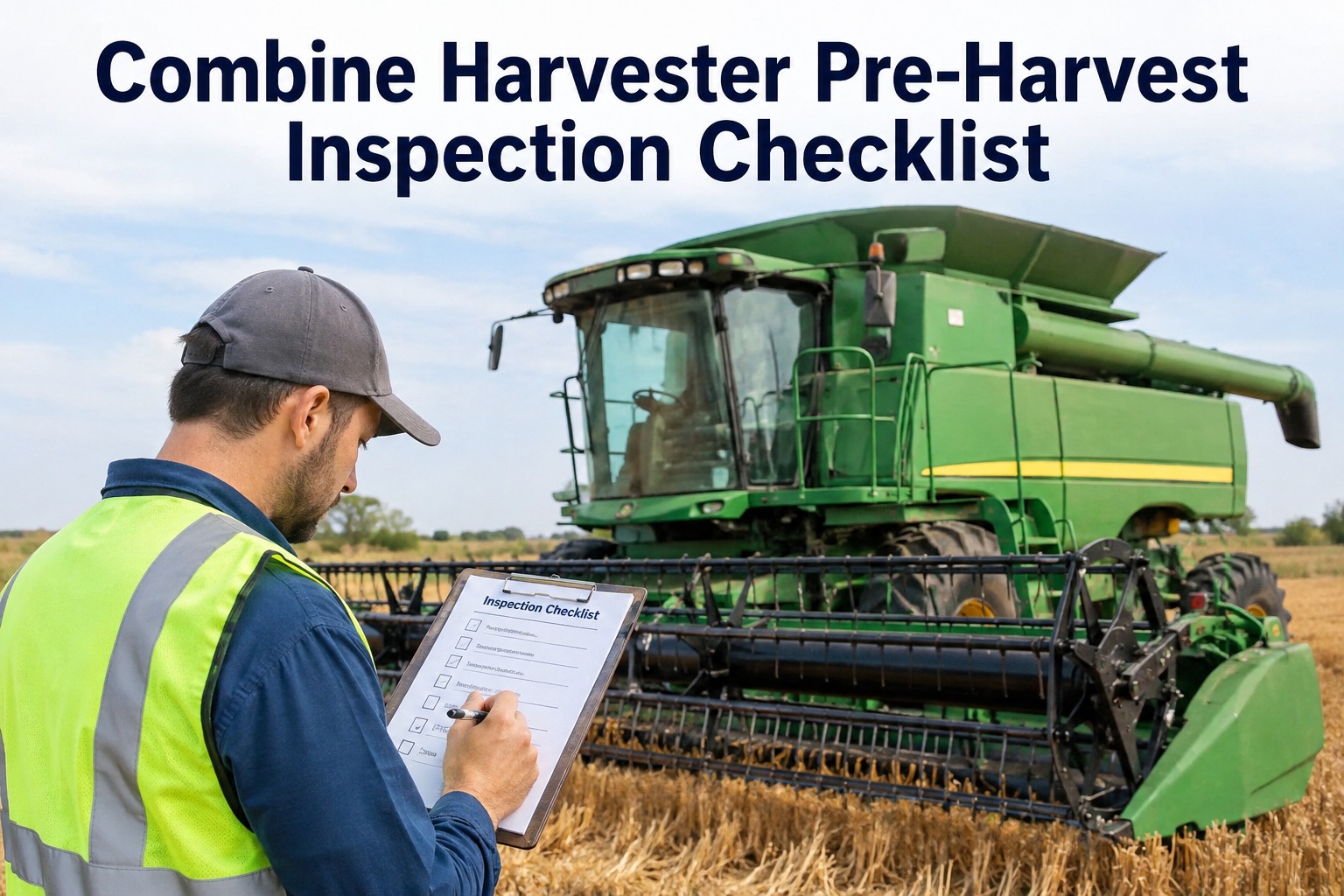
Your combine sits in the shed for ten months, then you ask it to run eighteen-hour days through the only weather window that matters. A proper combine pre harvest inspection is the difference between cutting 400 acres a day and standing in a half-cut field waiting on a belt that every dealer within two hundred miles is also out of. Everything that fails during harvest was findable in the shed beforehand - the cracked belt, the rough bearing, the concave that drifted out of spec. This checklist walks through the pre-season overhaul, the daily in-season checks, and the parts you should have on the shelf before the first pass, and shows how farms running HVI keep it all on engine-hour triggers instead of memory. If you want to see the whole system on your own machines, book a 30-minute walkthrough and we will load a combine template live.
Is your combine actually ready - or just parked and hopeful?
Ten months of storage hides cracked belts, seized bearings and mouse damage. The pre-season inspection below finds them while parts are still on the shelf and the shop has time.
- Belts, chains and bearings - the three failures that stop most combines mid-field
- Rotor and concave clearance set before the first bushel, not after the first complaint
- Daily in-season checks that take ten minutes and catch chaff fires before they start
- A parts staging list so critical spares are on your shelf, not backordered
The math of a mid-harvest stop
A combine does not fail on a schedule. It fails at hour fourteen of a sixteen-hour day, in the best weather of the week, with grain at moisture you cannot get back.
Combine harvester checklist: the pre-season overhaul
Start this four to six weeks before first cut. That gives the shop time to order parts, and gives you time to find the problems that take a day to fix instead of the ones that take a week. Work through the machine system by system.
Belts and chains
- Every belt for cracks, glazing, frayed edges and separation - flex each one by hand
- Belt tension and alignment; a squealing belt at idle is a slipping belt under load
- Chain stretch, stiff links and worn sprockets - hooked teeth mean replace both
- Idler pulleys spin free with no wobble or roughness
Bearings across every shaft
- Spin-test every bearing on the feeder house, rotor, shoe, augers and elevator
- Feel for heat after a short run - a warm bearing in the shed is a failed bearing in the field
- Grease until fresh grease purges, then log the points that took abnormal amounts
- Check seals for dust and chaff ingress from last season
Rotor and concave clearance
- Measure concave clearance at front, middle and rear against the book spec
- Inspect rasp bars and concave wires for wear, bends and broken sections
- Check rotor balance - vibration at speed wears bearings and cracks welds
- Verify zero and calibration on the cab display before the season, not during it
Sieves and cleaning system
- Chaffer and sieve for broken vanes, holes and blocked sections
- Cleaning fan blades for wear and the fan drive belt for condition
- Grain elevator chains, paddles and the clean grain auger for wear-through
- Tailings system for last season's compacted residue
Header and attachment points
- Knife sections, guards and hold-downs - one broken guard streaks a whole pass
- Reel tines and bearings; auger fingers extend and retract cleanly
- Quick-attach pins, hydraulic couplers and wiring connectors for wear and corrosion
- Header height sensors and auto-header controls calibrated
Engine, hydraulics and cab
- Oil, filters, coolant and fuel filters changed on hours, not on memory
- Hydraulic hoses for chafe points and weeping fittings - a burst hose is a fire risk
- Batteries load-tested after storage; terminals cleaned
- Fire extinguisher charged and reachable from the cab step
In HVI this entire overhaul lives as an annual pre-season PM template tied to each combine. Every item gets a photo, a name and a timestamp, and any defect converts straight into a work order with the part attached. Farms that see the template running on a demo call usually have it loaded on their own machines the same week.
The daily combine inspection during harvest
Once harvest starts, the pre-season work is done and the daily check takes over. This is a walk-around, not a teardown - ten minutes with grease gun in hand before the header drops. It catches the failures that develop under load, and it is your first line of fire defence.
Knife, guards, reel and driveline
Look for broken sections and bent guards from yesterday's last pass. Check the reel for wrapped crop and the header drive for noise. A knife problem found at 6am costs ten minutes; found at 2pm it costs a field.
Listen before you look
Run the machine at idle and listen. A new rattle, a bearing chirp or a belt squeal is the machine telling you what will fail this afternoon. Check the rotor area for lodged material and yesterday's tailings.
Fluids, filters and the hour meter
Oil, coolant, fuel and hydraulic sight checks. Blow out the radiator and rotary screen - a plugged screen overheats the engine and bakes the chaff sitting on it. Log the engine hours: at 16-18 hours a day you can pass a 250-hour service interval in a fortnight, and HVI's engine-hour triggers are what keep that service from slipping past unnoticed.
Heat is the early warning
After shutdown, walk the machine and feel for hot bearings and smell for slipping belts. A belt that ran hot yesterday is a belt that fails today. Mark it, and it becomes a work order before it becomes a stop.
Warnings, glass and the extinguisher
Clear every warning light before accepting it as normal. Clean the glass and mirrors, test the lights for the night shift, and confirm the extinguisher is charged and the pin is in. The daily check in HVI is a five-tap DVIR on the operator's phone - start logging them free and the record builds itself.
Chaff fires: the harvest risk that starts in the engine bay
Dry crop residue plus hot surfaces plus wind is the recipe behind most combine fires, and harvest-season fire callouts spike every year in dry conditions. The fire does not start in the field - it starts in the chaff packed around the exhaust manifold, turbo and engine bay that nobody blew out this morning.
Do, every day
- Blow out the engine bay, exhaust area and deck at least once a day - twice in dry, windy conditions
- Check around the turbo and manifold for packed chaff after shutdown
- Fix hydraulic and fuel weeps immediately - oil-soaked residue ignites fast
- Carry two charged extinguishers: one in the cab, one reachable from the ground
- Log the clean-down in the daily DVIR so it is a habit with a record, not a favour
Don't, ever
- Run with a known bearing running hot "until the field is done"
- Ignore a slipping belt smell - the smoke comes after the smell
- Let chaff build up over multiple days because the weather is good
- Pressure-wash near hot exhaust components mid-day
- Assume the extinguisher from three seasons ago still holds charge
A combine fire is not a repair bill - it is the machine, the standing crop around it, and the rest of your season. The clean-down line item in HVI's daily template takes one tap to confirm and creates the timestamped record your insurer will ask for if the worst happens. If you want to see how the fire-check workflow sits inside the daily inspection, walk through it on a demo with your own machine list.
The shelf that saves your harvest
At peak season, the part you need is the part every farm in the district needs. The dealers run out of the common belts and bearings first, because those are what fail. Staging your own critical spares before first cut turns a three-day wait into a forty-minute swap.
| Stage on the shelf | Why it fails | Cost of waiting |
|---|---|---|
| Full belt set (rotor, fan, header drive) | Dry-rot from storage, heat and load | 2-3 days backordered at peak; a stopped machine |
| Common bearings (feeder house, shoe, augers) | Dust ingress, grease washout, long hours | Secondary damage to shafts and housings if it runs to failure |
| Knife sections, guards and hold-downs | Rocks, stumps and wear | Streaked cutting and lost grain every pass until fixed |
| Filters (oil, fuel, air, hydraulic) | Two service intervals can pass in a fortnight | Engine wear or a derate in the middle of the window |
| Chain and connector links | Stretch and sprocket wear | An elevator or auger down at full hopper |
HVI's Parts and Inventory module tracks these spares by bin location, flags low stock before the season, and attaches the exact part number to the work order when a belt does let go - so the person fetching the part brings the right one the first time. Farms running mixed fleets use the same system across trucks, tractors and harvesters, and most book a demo to see the parts workflow after their first contested-part wait.
See the pre-harvest checklist running on your own combines
A 30-minute demo loads your machines, the annual overhaul template and the daily DVIR - before you spend a cent.
A combine service schedule that runs on hours, not the calendar
Here is the worked example that catches most farms out. Your combine's engine service is due every 250 hours. In the off-season that is months away. In harvest, at 16 to 18 engine hours a day, you burn through 250 hours in about fourteen days. A calendar reminder set for "every three months" misses two full services in a six-week harvest.
One 250-hour service interval gone in a fortnight. Miss two of those and you are running the hardest weeks of the year on old oil and loaded filters - the exact conditions engines fail under.
This is why combine maintenance schedules belong on engine-hour triggers, not dates. HVI pulls hours from the daily inspection or a telematics feed, counts down to each service, and alerts you before it goes overdue - not after the oil sample comes back bad. The same trigger logic runs your grease intervals, belt checks and the annual overhaul, so the combine PM schedule manages itself while you manage the harvest. You can set up hour-based triggers free and have the first machine tracking today.
Built for the machine that only works six weeks a year
HVI is cloud + mobile inspection and maintenance software (CMMS) for fleet-heavy operations - one platform across combines, tractors, trucks and the shop itself.
Annual pre-season overhaul template
The full checklist above - belts, bearings, header, rotor clearance, sieves - as a repeatable digital inspection with photo capture. Every defect becomes a work order instantly, with the part attached.
Engine-hour PM triggers
Services, grease intervals and belt checks count down by hours pulled from the daily DVIR or telematics. Due and overdue alerts mean hour compression never quietly eats a service again.
Parts and inventory staging
Critical belts, bearings and knife sections tracked on your shelf with low-stock flags before the season. When something fails, the work order carries the exact part number and bin location.
Audit-ready daily records
Every daily check, clean-down and repair is timestamped, photo-backed and searchable in seconds - the record your insurer, your safety audit and your own memory will all want later.
What a ready combine actually looks like
Inspect weeks out, not the night before
The pre-season combine inspection needs four to six weeks of lead time so parts arrive and the shop has hours to fix what it finds. The night before harvest is when you grease, not when you discover a worn concave.
Belts, chains and bearings first
They are the most common failures and the cheapest to catch early. A hand-flex on every belt and a spin-test on every bearing finds most of what would stop you in the field.
Ten minutes a day beats three days down
The daily in-season check - header, rotor, engine, belts, cab - catches what develops under load and keeps chaff off hot surfaces. It is the cheapest insurance in the operation.
Run the schedule on hours
At 16-18 hours a day, a combine passes a 250-hour service interval in a fortnight. Engine-hour triggers with due and overdue alerts are the only combine maintenance schedule that keeps up with harvest.
None of this needs a bigger workshop or a longer off-season - it needs the checklist, the triggers and the parts list in one place instead of in three notebooks. That is exactly what HVI was built for, and the combine pre harvest inspection above is a template you can load today.
The number I watch is belts changed in the shed versus belts changed in the field. Before we ran the pre-season checklist properly it was about one to four - one in the shed, four standing in a crop. Last harvest it was seven to zero. My other rule is the hour meter photo every morning, because a combine will eat a service interval in two weeks and nobody's memory catches that. The checklist is not the work. The checklist is what makes the work happen in October instead of January.
Dale Kowalski - Maintenance Manager, 4,800-acre mixed grain operation
Combine pre-harvest inspection FAQs
When should you do a pre-harvest combine inspection?
What are the most common combine breakdowns during harvest?
How often should a combine be serviced during harvest?
What spare parts should you keep on hand for harvest?
How do you prevent combine fires during harvest?
Run this harvest on checklists, not luck
Load the pre-season overhaul, daily DVIR and hour-based service triggers on your combines today - and stage the parts before the district runs out.
Free to start - Works on any phone - No card needed