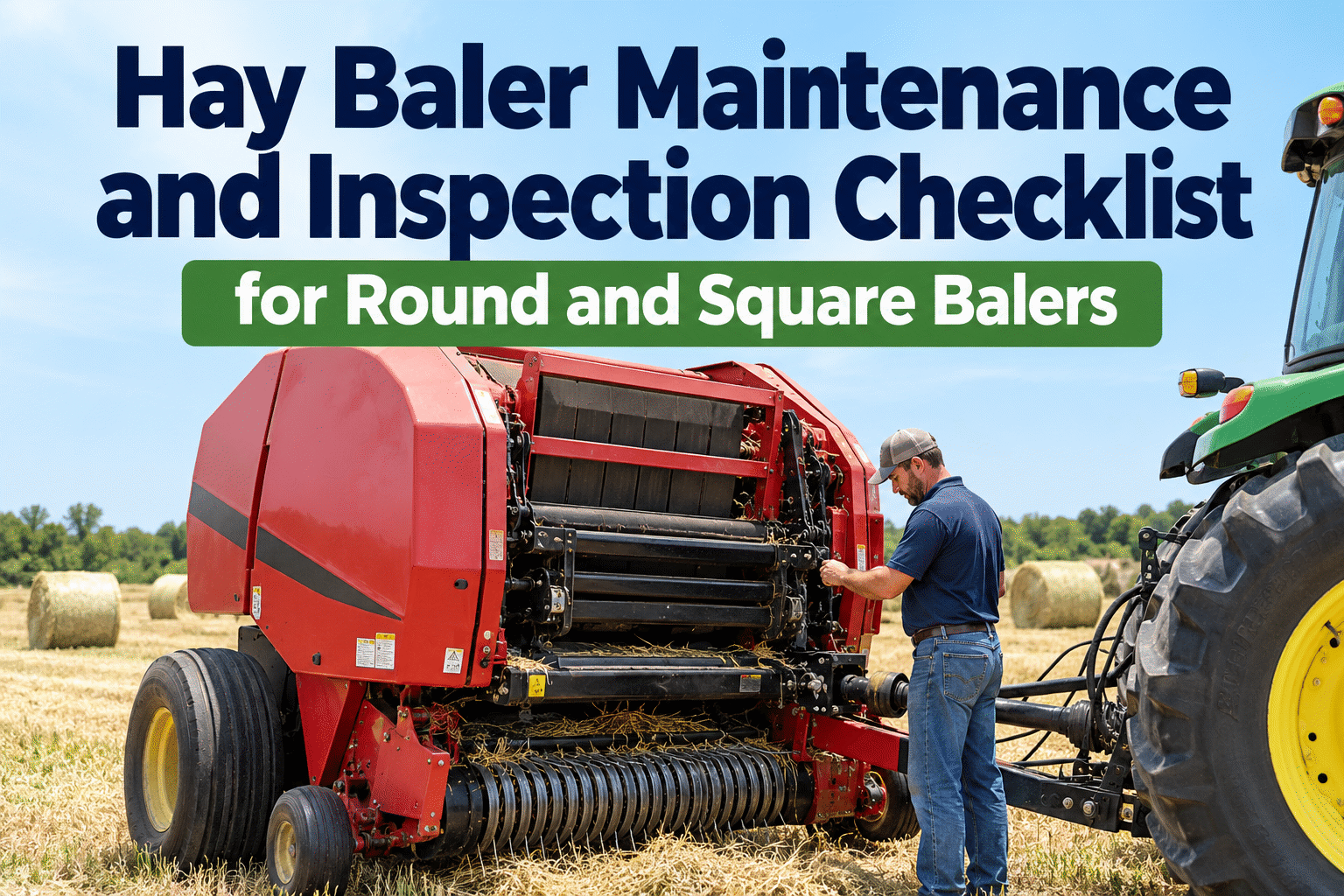
Hay baler maintenance should start before the first windrow reaches the pickup. A consistent hay baler maintenance checklist helps operators find worn tines, damaged belts, loose bearings and tying-system faults before they interrupt harvest. Use the inspections below for round and square balers, then record defects and repairs so the next operator knows the machine is ready.
Hay Baler Maintenance Checklist: Round & Square Balers
Catch pickup, belt, bearing and tying-system problems before they become missed bales and lost harvest hours.
Start with the four systems that stop baling
The exact inspection points depend on the model. Use the manufacturer’s manual for access, adjustment, lubrication and service intervals.
Pickup & feed
Check tines, guards, cam tracks, pickup height and crop-flow obstructions.
Drive & bearings
Inspect chains, sprockets, gearboxes, belts, rollers and lubrication points.
Tying & wrapping
Inspect net wrap or twine on round balers and knotters on square balers.
Safety & running gear
Check PTO shielding, hydraulics, tires, lights, guards and fire hazards.
Use Start Free to organize baler inspection records before the first harvest shift.
Pre-harvest hay baler inspection checklist
Walk through the machine while it is parked, secured and isolated in accordance with the operator manual. Never reach into moving components.
| Inspection area | What to check | Applies to |
|---|---|---|
| PTO and guards | Shield intact; driveline secure; safety decals readable | Both |
| Pickup tines and guards | Bent or missing tines, fasteners, pickup bearings | Both |
| Belts, rollers and tracking | Cracks, fraying, tension and alignment per OEM | Round |
| Net wrap / twine feed | Feed path, cutter, guides and correct routing | Round |
| Knotters / needles | Wear, timing, twine discs and needle protection per OEM | Square |
| Chains, bearings and gearbox | Lubrication, leaks, heat signs and excessive play | Both |
| Hydraulic hoses and couplers | Abrasion, leaks, routing and secure connections | Both |
| Tires, hubs and lights | Pressure, sidewalls, wheel fasteners and transport lights | Both |
| Crop residue and fire risk | Chaff near bearings, belts, exhaust and electrical areas | Both |
Record any defect, attach photos where useful, and keep the machine out of service when a safety-critical item is unresolved. Book a Demo to see inspection and repair workflows.
Round baler vs square baler: where the checks differ
Both machines share PTO, hydraulic, tire and bearing checks—but bale formation and tying systems need separate attention.
Prioritize belts, rollers and wrapping
Inspect belt wear and tracking, roller bearings, chamber buildup, net-wrap or twine routing, and tailgate safety devices.
Prioritize knotters and bale chamber
Inspect knotter assemblies, needles, twine tension, plunger-related components and chamber wear using OEM procedures.
Turn pre-harvest checks into a repeatable routine
Keep inspection findings, repair actions and parts needs connected to the right baler—not scattered across notebooks and messages.
A practical inspection rhythm for harvest
Use a simple schedule, then adjust frequencies to machine age, duty cycle, conditions and OEM recommendations.
Before season
Full condition inspection, service, adjustments and test operation per manual.
Before each shift
Guards, visible leaks, pickup, tires, debris, fire controls and known defects.
During operation
Watch for abnormal noise, vibration, poor bale formation and tying failures.
After each shift
Shut down safely, remove residue per OEM instructions and log follow-up work.
Use HVI digital checklists to standardize shift reports across operators and machines.
Decide whether to run, repair or stop
A short defect-priority framework keeps small maintenance tasks from hiding urgent hazards.
Stop and isolate
Missing PTO guarding, unsafe hydraulic condition, fire or severe mechanical hazard. Follow site and OEM lockout guidance.
Repair before production
Damaged pickup parts, unreliable knotting or belts showing concerning wear. Assess before the next run.
Monitor and schedule
Non-critical observations within manufacturer limits. Assign an owner and a review date.
Example: one baler defect from inspection to closeout
A documented handoff helps prevent a damaged component from being missed between shifts.
With HVI, teams can organize equipment inspections, maintenance history and parts records. Book a Demo to discuss your baler maintenance process.
Keep commonly needed parts ready
Inventory planning is most useful when it is tied to inspection findings and machine-specific part numbers.
Wear parts
Pickup tines, guards, chains and other frequently replaced items as specified by the OEM.
Tying supplies
Correct twine, net wrap and approved knotter or wrap-system components for the model.
Service supplies
OEM-approved lubricants, filters and maintenance consumables for scheduled service.
Avoid ordering by appearance alone: match exact model and serial details. Start Free to connect parts needs with inspection notes.
Build a harvest-ready maintenance record
Keep a record that another operator or mechanic can act on without guessing.
Every inspection should identify
- Baler asset ID, model and date
- Operator and machine hours where available
- Checklist result and photo evidence
- Defect severity and next action
Every completed repair should capture
- Issue and diagnosed cause
- Labor, parts and repair notes
- Functional checks and safety verification
- Person responsible for return to service
Frequently asked questions
Quick answers for farm managers and operators preparing round and square balers for harvest.
What should be included in a hay baler maintenance checklist?
Include PTO and guards, pickup tines, bearings, drive chains, belts or knotters, hydraulics, tires, lights, crop residue and the machine-specific checks in its operator manual.
How often should a hay baler be inspected?
Perform a full pre-season inspection and a pre-use walkaround each shift. Follow manufacturer service intervals and add checks when conditions are dusty, wet or unusually demanding.
What is different about round baler maintenance?
Round balers typically need particular attention to belt condition and tracking, rollers, bale chamber cleanliness and net-wrap or twine systems.
What is different about square baler maintenance?
Square balers require careful inspection of knotters, needles, twine delivery and bale chamber or plunger components, with timing and adjustment performed per OEM instructions.
Can HVI help document baler maintenance?
HVI can support digital inspection records, maintenance follow-up and parts inventory. Confirm the exact workflow for your operation during a product demonstration.
Keep your balers harvest-ready with HVI
Replace disconnected paper checks with organized inspection findings, maintenance records and parts follow-up. Start free or book a walkthrough of the workflow.