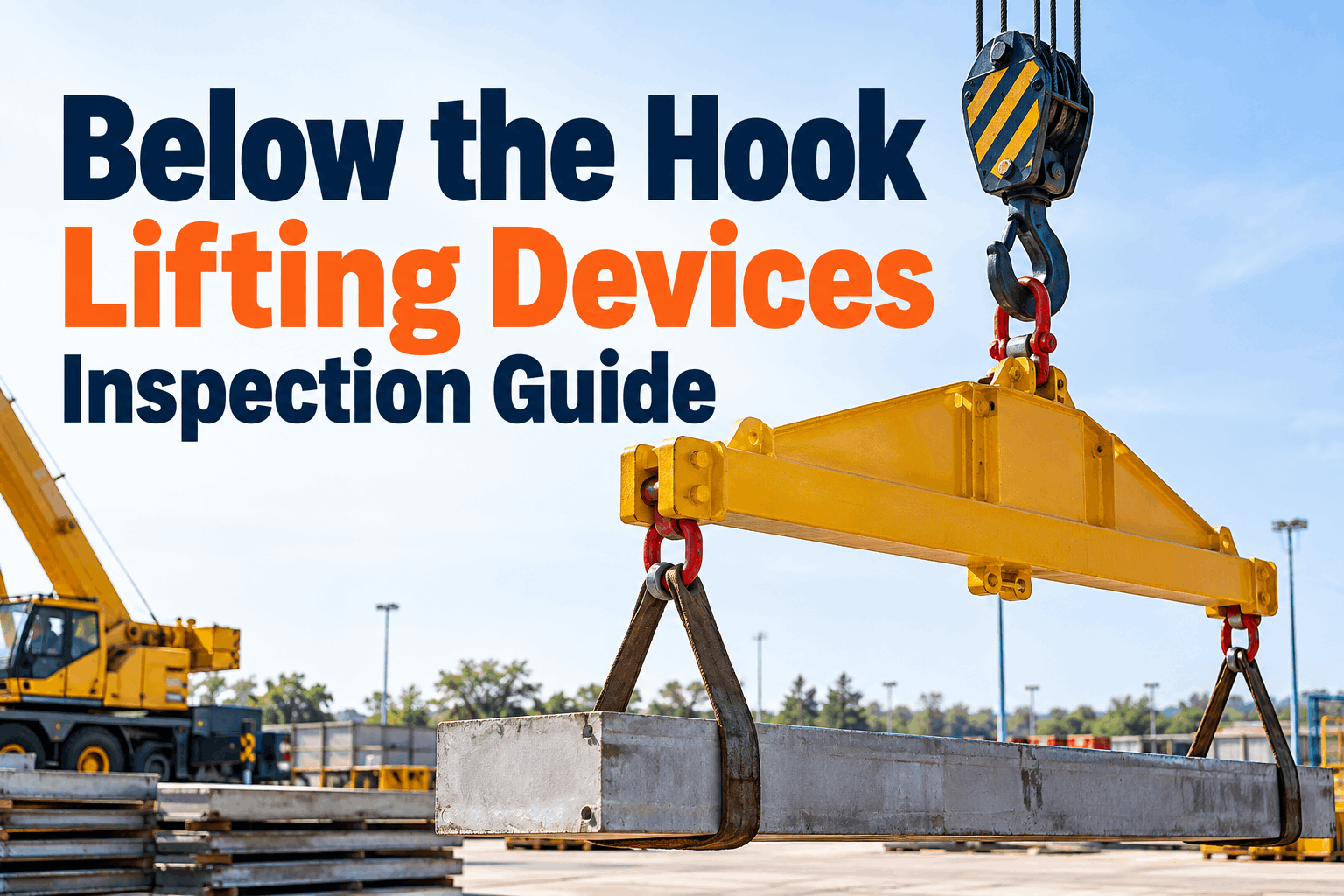
Below the hook lifting devices — the beams, spreader bars, magnets and clamps that sit between the crane hook and the load — are easy to treat as dumb steel, right up until one bends, drops a load, or turns out to have no legible capacity marking during an audit. They're engineered, rated equipment, and they need their own inspections and records. Here's how below the hook lifting device inspection works, and how to keep every device on one register — or start a free trial.
Everything below the hook is rated equipment — and gets inspected like it.
A spreader bar or lifting magnet carries the same load as the crane, but it's the piece most likely to be uninspected, unmarked or missing from the register. Treating it as engineered gear — with its own checks and records — is the whole game.
The honest boundary first: HVI doesn't design, load-rate, proof-test or certify below the hook lifting devices. The rated capacity comes from the manufacturer and the design standard (ASME BTH-1); the proof test and the periodic certified inspection come from a qualified person under ASME B30.20. What HVI does is manage everything around that — a digital inspection checklist for each device, a complete lifting-equipment register with capacities and due dates, defect tracking, and storage of the certificates. It runs on the same inspection and safety management backbone as the rest of HVI. Start a free trial to put your devices on it.
What counts as a below the hook lifting devicethe engineered gear between the hook and the load
Below-the-hook devices aren't slings or shackles — they're the engineered attachments that handle the load itself. Each type wears differently, so each needs its own inspection points.
Lifting beam
Carries the load in bending from a top bail. Inspect the beam for bend and cracks, the lugs and the welds.
Spreader bar
Works in compression between two slings. Check the end fittings, pins and bar straightness.
Lifting magnet
Permanent, electro or battery. Check the contact face, battery and charge, controls and alarms.
Vacuum lifter
Pads lift sheet, glass or panels. Check seals, gauge and reserve, leak-down and filters.
C-hook / coil lifter
Handles coils and rolls. Inspect the throat for cracks, wear and any deformation.
Plate / beam clamp
Grips a plate or beam edge. Check jaw and cam teeth, spring, hinge pins and the working range.
A lifting beam bends and a spreader bar compresses — different forces, different failure points, so never swap one checklist for the other. Start a free trial to build a checklist per device type.
What a below the hook inspection checksthe five points on every lifting beam and spreader bar
Whatever the device, an inspection lands on the same load-bearing fundamentals. Here they are on a lifting beam.
- 1Top bail / lifting lug — the attach point to the hook; check for wear, elongation and cracks.
- 2Main structure — the beam or bar itself, for bends, cracks and deformation.
- 3Load-bearing welds — at every connection, for cracks and undercut.
- 4End fittings, pins & shackles — for wear, elongated holes and the right pins in place.
- 5Capacity (WLL) marking — present, legible and matching the register.
Missing or illegible capacity markings are one of the most common findings — and one of the easiest to fix before an audit. Start a free trial to standardize the checks.
The lifting equipment registerasset management for below the hook lifting devices
Inspection runs in tiers — an initial check before first use, frequent visual checks in service, and periodic documented inspections by a designated person. A register is what ties them together: one line per device, always current.
Illustrative register — a device past its next-due date is flagged and taken out of service until inspected.
That one view answers the question every supervisor asks before a pick: is this device safe and in date? Book a demo of the lifting-equipment register.
Where HVI fits below the hook lifting device safetythe features behind digital lifting-device inspection
HVI manages the inspection and the records — not the engineering. Five features carry it.
Asset management
Every device on one register with its capacity, serial, location and inspection history.
Digital inspection checklists
A checklist built to each device type — beam, magnet, clamp — run on a phone with photos.
Equipment maintenance records
Inspections, repairs and certified reports kept per device — the full history in one lookup.
Defect tracking
A cracked lug or worn clamp jaw becomes a tracked work order — and the device tagged out.
Safety documentation
Every inspection and proof-test certificate stored and signed — audit-ready at any moment.
It's the same backbone behind HVI's crane work, like the mobile crane pre-lift checklist. Book a demo of digital lifting-device inspection.
From a lifting equipment safety manager
The cranes get all the attention; the spreader bars and magnets live in a yard and get forgotten. Our wake-up call was an auditor asking for the inspection record on a lifting beam, and nobody could find one — or the capacity plate on the beam. We built a register: every device tagged, its WLL, its last and next inspection, all on one screen. Now a rigger can't grab a device that's out of date, because it's flagged, and when the auditor comes back the answer is one click, not a week of digging.
Below the hook lifting devices — FAQs
What are below the hook lifting devices?
They're the engineered attachments that connect between the crane hook and the load and handle the load directly — lifting beams, spreader bars, lifting magnets, vacuum lifters, C-hooks, and plate or coil clamps. They're distinct from slings and rigging hardware, and they're designed and rated as equipment in their own right (to ASME BTH-1, operated and inspected under ASME B30.20). Each must be marked with its rated capacity and carry its own inspection and maintenance records.
Does HVI design, rate or certify lifting devices?
No. HVI doesn't design, load-rate, proof-test or certify below the hook lifting devices — the rated capacity comes from the manufacturer and the design standard, and the proof test and periodic certified inspection come from a qualified person. HVI's role is to manage the inspection and the records: a digital checklist per device type, a complete lifting-equipment register with capacities and due dates, defect tracking, and storage of the certificates so the full history lives in one place.
How often should below the hook lifting devices be inspected?
Inspection runs in tiers under ASME B30.20: an initial inspection before first use or after any modification or repair, frequent inspections (visual, from each use up to monthly depending on service), and periodic inspections (documented, typically one to twelve months apart) by a designated person. Severe service shortens the intervals. The manufacturer's instructions and your local regulations set the specifics, so the device's own data and your lifting-equipment program should define the schedule.
What's the difference between a lifting beam and a spreader bar?
They solve the same problem differently. A lifting beam carries the load in bending from a single top bail, which keeps the pick points close together and the headroom low. A spreader bar works in compression, held between two slings that run from the hook to its ends, which spreads the pick points wide to stop a load crushing or tipping. They fail in different ways — a beam from bending, a spreader from buckling or end-fitting wear — so they need their own inspection criteria rather than a shared checklist.
Why keep a lifting equipment register?
Because it answers the only question that matters before a pick: is this device rated for the load, inspected, and in date? A register holds one line per device — capacity, serial, location, last and next inspection, and status — so an out-of-date or defective device is flagged and taken out of service automatically. It also makes an audit a single lookup instead of a hunt through paperwork, and it's the practical core of managing below the hook lifting devices at scale.
Put every below the hook lifting device on one register
Leave the design, rating and certification to the manufacturer and the qualified person — and put the inspections, the capacities, the due dates and the defect history on one system. Below the hook lifting devices then stop being the forgotten gear in the yard and become equipment you can prove is safe.
Device register · checklists per type · defect tracking · certificate storage