The crane operator finishes his pre-shift check, ticks the OSHA 1926.1412 boxes on a paper card, and drives the same road-going crane ten miles down the highway to the next pour. Nobody told him the truck chassis under that crane also needed an FMCSA 396 DVIR, and nobody told the shop that ASME B30.5 wanted its own documented inspection trail. That is the real problem construction fleet compliance software has to solve: one machine can sit under three regulators at once, and gaps open in the intersections where nobody owns the overlap. Contractors rarely fail compliance because they ignore the rules. They fail because a dump truck, a lowboy and a rough-terrain crane each carry a different stack of obligations, and the binder system in the site trailer cannot keep the stacks straight. This page maps exactly which standards hit which equipment class, shows the overlap cases in detail, and explains how one correctly built digital inspection can satisfy every applicable regulation without duplicate work. If you want to see your own fleet mapped this way, you can book a compliance-map demo and walk through it on your actual units.
Construction fleet compliance software
Which of your machines answer to three regulators at the same time?
A road-going crane sits under OSHA 1926.1412, FMCSA Part 396 and ASME B30.5 simultaneously. A dump truck hauling aggregate on public roads answers to FMCSA on the road and OSHA on the site. HVI maps every asset to every applicable standard automatically, so the intersection is owned by the system instead of falling between your safety manager and your shop foreman.
What the overlap actually costs
The price of a compliance gap, in numbers your CFO understands
Regulators raised their penalty ceilings again for 2026, and every figure below lands on a specific line of your budget: fines, downtime, insurance, or lost bids.
Regulatory mapping by equipment class
Which regulation applies to which machine: the compliance matrix
Most compliance failures happen because someone assumed a machine had one regulator when it had three. This matrix is the starting point HVI builds automatically for every asset type you add.
| Equipment class | OSHA (29 CFR 1926) | FMCSA (49 CFR) | ASME / ANSI | Overlap risk |
|---|---|---|---|---|
| Road-going mobile crane | 1926.1412 inspections, 1926.1427 operator cert | 396 DVIR, 393 parts & accessories | B30.5 mobile & locomotive cranes | High — 3 regimes |
| Dump truck / mixer on public roads | 1926.601 motor vehicles on site | 396 DVIR, 390–399 full CSA stack | — | High — dual regime |
| Rough-terrain crane (site only) | 1926.1412, 1926.1427 | — (never on public road) | B30.5 | Medium — 2 regimes |
| Excavator / dozer / loader | 1926.20 general duty, 1926.602 material handling | — | Manufacturer PM schedules | Medium — PM-driven |
| Lowboy + prime mover | Site rules when working | 396 DVIR, 393, 396.17 annual inspection | — | Medium — road regime |
| Aerial lift / telehandler | 1926.453 aerial lifts, 1926.602 | Only if road-registered | ANSI A92 / manufacturer | Lower — but PM-heavy |
The trap is the middle column: the moment a machine touches a public road, FMCSA attaches to it no matter how "off-road" it feels. HVI tags every asset with its road status and applies the right stack automatically — you can see the mapping run on your own equipment list in a 30-minute session.
The overlap cases in detail
OSHA, FMCSA and ASME B30 compliance on one machine: how the overlap works
Two machine types cause almost all multi-regulation failures. Here is exactly what each regulator wants from them, and where contractors drop the ball.
The road-going crane
- OSHA 1926.1412 wants a documented shift inspection of controls, safety devices, wire rope and hydraulics — every shift, every crane, kept on record.
- FMCSA 396 wants a driver vehicle inspection report on the carrier chassis — brakes, lights, tires, coupling — because it drove on a public road to reach the pour.
- ASME B30.5 wants periodic and frequent inspection categories with defined intervals and competent-person sign-off.
Where it fails: the operator does the OSHA card, the shop assumes the crane crew handled the DVIR, and the annual B30.5 periodic inspection lives in a different binder. Three records, three owners, zero intersection.
The dump truck that works the site
- FMCSA 396.11 requires the DVIR before the truck rolls on public roads, with defect repair certification before the next dispatch.
- OSHA 1926.601 layers site-side requirements on top — working brakes, backup alarms, secured loads, cab glass — the moment it enters the work zone.
- Your client increasingly demands proof of both before the truck is allowed through the gate, especially on DOT and infrastructure work.
Where it fails: the driver does the DVIR on a paper book in the cab, the site check happens verbally at the gate, and neither record meets the other regulator's format when an auditor asks.
The pattern is always the same: each individual record exists somewhere, but nobody can prove the intersection was covered on a specific Tuesday in March. Auditors do not audit your binders — they audit a date, a machine and a person. If those three do not line up in one record, the gap is yours.
One inspection, every standard
How one combined inspection satisfies OSHA, FMCSA and ASME without duplicate work
The fix is not more checklists — it is one correctly built template whose items are tagged to every standard they satisfy. The operator walks the machine once; the system files the evidence three ways.
Asset is classified once
You add a 90-ton road-going crane. HVI tags it as mobile crane + road-registered, and automatically attaches OSHA 1926.1412 shift items, FMCSA 396 DVIR items and the ASME B30.5 frequent-inspection set. No one has to remember the stack.
Operator runs one merged checklist
Brakes, lights and tires (FMCSA) sit beside control function, safety devices and wire rope (OSHA) and hook, boom and outrigger items (B30.5) in a single phone-based walk-around. Overlapping items — like brake function — appear once, not three times.
Defects route by regulator
A failed brake item flags the FMCSA repair-certification workflow and blocks dispatch until sign-off. A wire rope defect flags the OSHA/B30.5 path and triggers a work order with photos attached. Each defect follows the rule that governs it.
Evidence files itself three ways
The single timestamped, photo-backed record satisfies the DVIR retention rule, the OSHA shift-inspection documentation requirement and the B30.5 frequent-inspection trail simultaneously. When an auditor picks a date and a machine, you pull one report in seconds — start building combined templates free and test it on your hardest unit.
Worked example — one 12-machine spread
A site running 2 road-going cranes, 6 dump trucks, 2 excavators, a telehandler and a lowboy needs 12 daily inspections. On paper with separate cards per regulation, the cranes and trucks generate roughly 20 separate documents a day — about 100 a week to file, chase and reconcile. With combined digital templates it stays at 12 inspections a day, each one auto-filed against every applicable standard. That is roughly 8 hours a week of admin recovered for the site supervisor, before you count a single avoided fine.
How HVI helps
Construction regulatory compliance, handled by the system instead of your memory
Automatic regulation mapping
Every equipment type you add is mapped to every applicable standard — OSHA, FMCSA, ASME B30, plus regional regimes. The compliance matrix builds itself and updates when you add or reclassify a machine.
Combined inspection templates
Single templates merge OSHA pre-shift items, FMCSA DVIR items and ASME B30 crane items, so the operator completes one inspection that satisfies all regulations. No duplicate cards, no skipped overlaps.
Gap alerts before inspectors find them
Missed shift inspections, expiring operator certifications, overdue B30.5 periodic inspections and unsigned DVIR repairs surface on one compliance dashboard, ranked by exposure — not buried in a spreadsheet.
Audit-ready evidence in seconds
Every record is timestamped, photo-backed and tied to an asset, an operator and a standard. Pull a machine's full compliance history for any date range while the inspector is still standing at your desk.
Multi-region by design: the same mapping engine covers the USA under OSHA and FMCSA, India under the Factories Act and IS standards, and the UAE under OSHAD requirements — so a contractor running projects across regions keeps one system and one evidence standard. Book a demo and watch the mapping run on your fleet mix.
Find your overlap gaps before an inspector does
Send us your equipment list and we will map every unit to every applicable standard live on a 30-minute call — you keep the compliance matrix either way.
Running it day to day
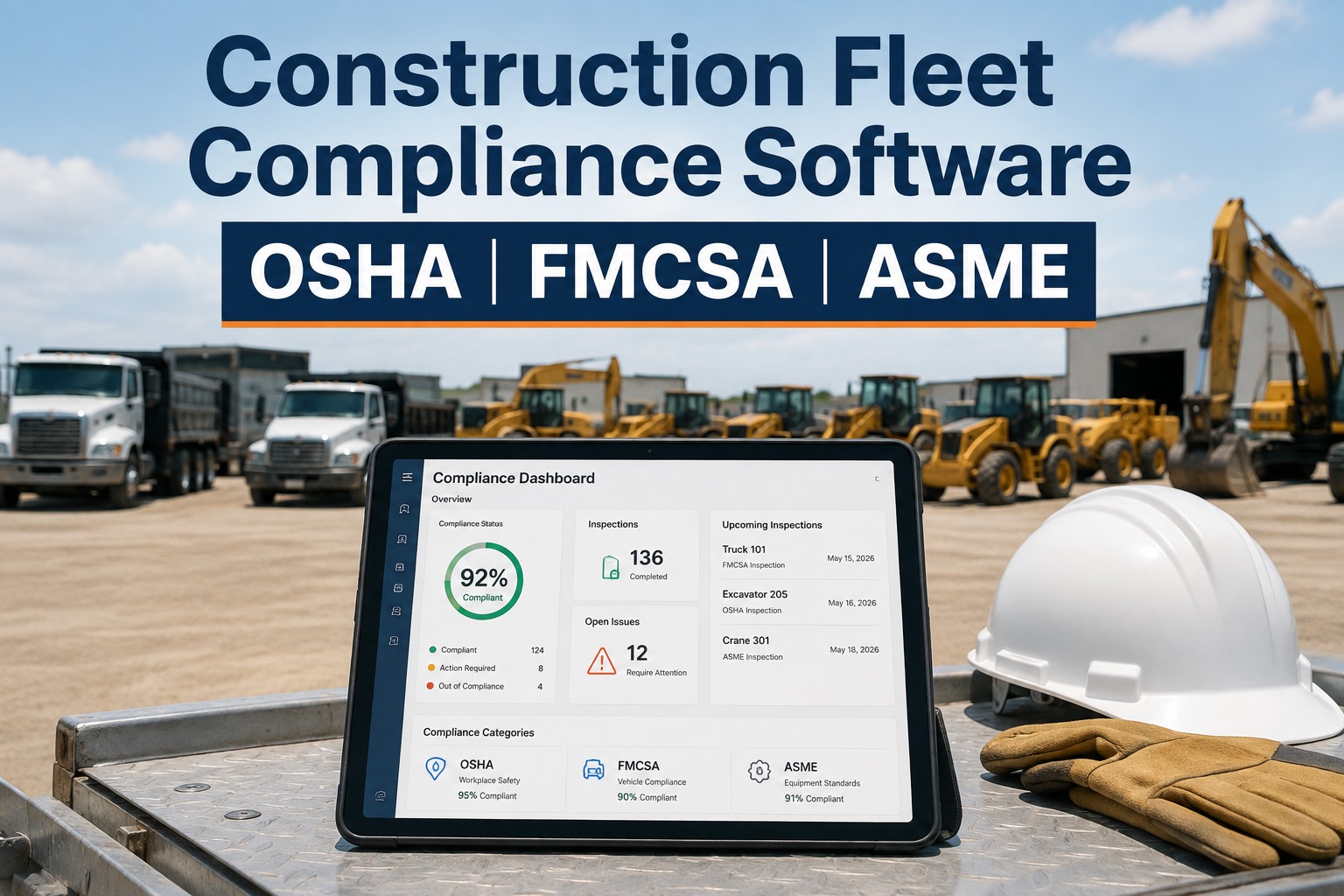
What a compliance dashboard looks like when the mapping is done for you
Once assets are mapped, compliance stops being a filing exercise and becomes a morning number. These are the four readings a safety manager checks before the first pour.
Fleet compliance rate
Share of assets with every required inspection current — DVIRs, shift checks, periodic B30.5, annual 396.17. One number, per site, per region, per project.
Open gaps, ranked
A crane 4 days from its periodic inspection deadline, one unsigned brake repair, one operator card expiring Friday — each with an owner and a due date, not a vague flag.
Audit retrieval time
Pick a machine, pick a date, export the full evidence pack — inspection, photos, defect, work order, repair sign-off. That is the whole audit response.
Defect-to-work-order closure
Every failed item becomes a tracked work order automatically. Nothing lives in a text message or a grease-stained note on the foreman's dash.
Teams that move their equipment compliance tracking into HVI typically ask for the dashboard walkthrough first — it is the fastest way to see what your Monday morning looks like without the binder chase.
Key takeaways
The bottom line on multi-regulation compliance
You do not have a paperwork problem, you have an intersection problem. Road-going cranes and site-working trucks sit under multiple regulators at once, and the gaps open exactly where two rulebooks overlap and nobody owns the seam.
The compliance matrix is the foundation. Until every asset class is mapped to every applicable standard — OSHA, FMCSA, ASME B30, or your regional equivalent — you are relying on individuals remembering stacks of rules per machine.
One combined inspection beats three separate cards. A merged digital template satisfies every applicable standard from a single walk-around, files the evidence against each regulation, and routes defects down the right legal path automatically.
2026 penalty ceilings make the math simple. With OSHA serious violations at $16,550 and willful repeats at $165,514, a single missed inspection on a single crane can cost more than years of software. Construction fleet compliance software is not an admin upgrade — it is the cheapest insurance line you will add this year.
"My Friday ritual used to be calling three foremen to ask whether the 80-ton crane's cards were current, and getting three different answers. The crane had an OSHA card in the cab, a DVIR book somewhere in the truck shop and a B30 file in my office — and none of them agreed. Now I open one screen, filter by that crane, and I see every inspection against every standard on one timeline. The number I watch is open gaps over seven days old. If it is not zero by Friday lunch, I know exactly whose desk it is sitting on."
Daniel Reyes — Safety & Compliance Manager, heavy civil and infrastructure contractor, 140+ assets across road and site plant
Common questions
Construction fleet compliance software: frequently asked questions
Does one inspection really satisfy OSHA, FMCSA and ASME B30 at the same time?
Which construction equipment actually falls under FMCSA rules?
How does HVI handle fleets working in different countries or states?
What happens when an operator finds a defect during a combined inspection?
How long does it take to move off paper binders and spreadsheets?
Get your compliance map before your next audit does it for you
See every asset mapped to every applicable standard — OSHA, FMCSA, ASME B30 and your regional regime — running on your own equipment list in a 30-minute demo.
Free to start — Works on any phone or tablet — No card needed