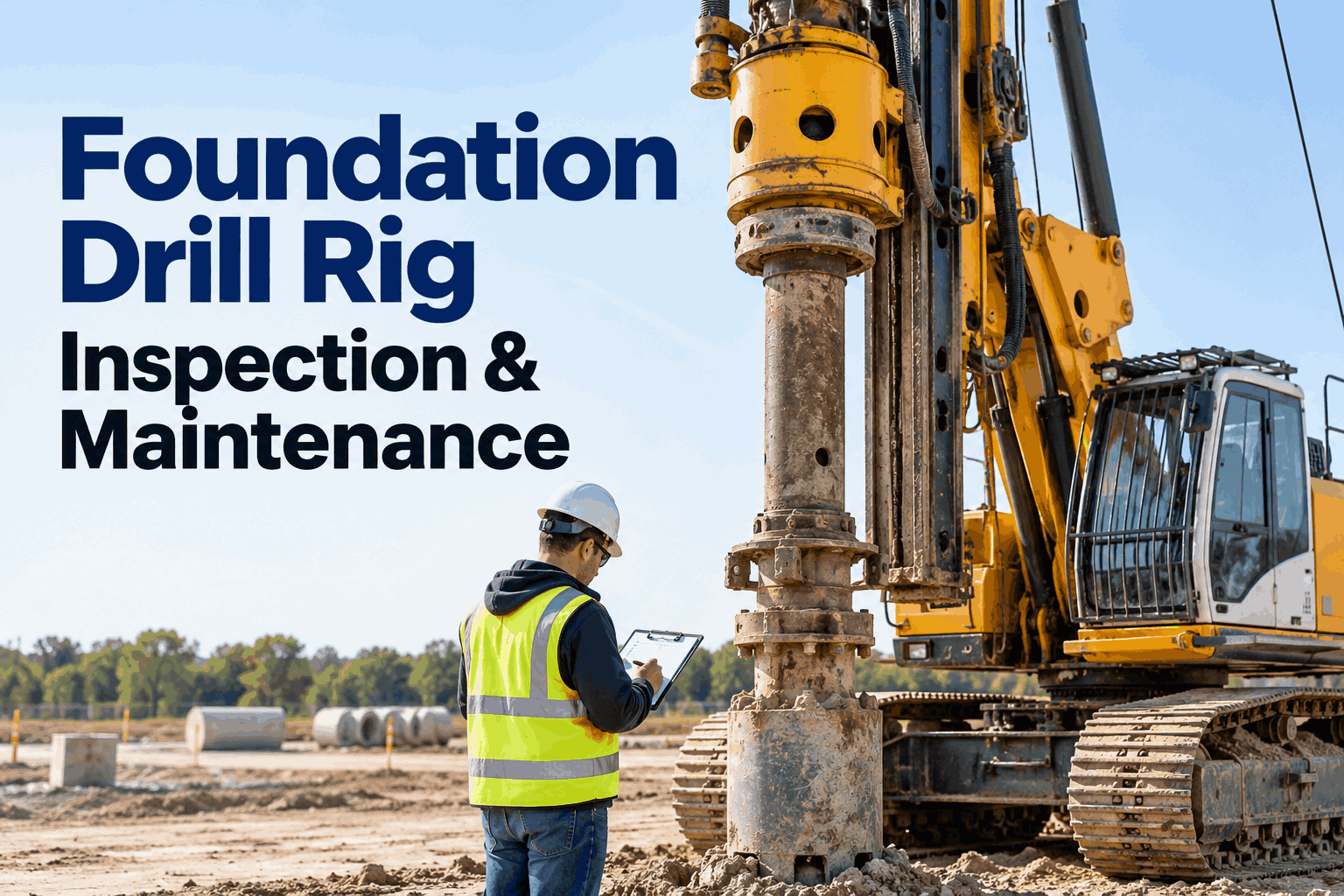
Foundation drill rig inspection and maintenance is not the kind of program you can run from memory or a clipboard. A single Kelly bar carries the full drilling torque down every bore, a hidden fatigue crack can end in a dropped tool or worse, and the rig itself is a seven-figure asset earning only when it turns. The components that fail wear by operating hours, not calendar or mileage — which is exactly why a real preventive maintenance system beats a paper checklist. Book a demo to see it run on hours.
One Missed Inspection Can Cost a Rig
Foundation rigs run high-torque, high-consequence components on hours-based service intervals. Track them properly and the rig stays on the bore; miss one and a crack becomes a catastrophic failure.
Below is the program a maintenance manager actually needs — the critical components to inspect, the hours-based intervals they run on, why a paper checklist can't keep up, and how HVI's preventive maintenance holds it all together.
The critical componentswhere a foundation rig actually fails
A foundation drill rig inspection isn't a generic walkaround — it's a focused check of the few systems whose failure stops the job or endangers the crew. Each one has its own wear pattern and its own tells, and each earns a place on the schedule because the cost of missing it is so high.
Kelly bar
CriticalInspect for fatigue cracks, keyway and drive-key wear, straightness and interlock condition. The bar takes the full drilling torque, so a hidden crack is the highest-consequence defect on the rig.
Rotary / power head
CriticalCheck gearbox oil, seals, bearing noise and torque output. The power head delivers rotation to the bar and drops the whole bore if it fails mid-drill.
Wire rope & crowd
CriticalInspect main and crowd ropes against discard criteria — broken wires, diameter loss, corrosion, crushing. Ropes have defined retirement points, not "run to failure."
Hydraulics
MajorCheck pumps, cylinders, hoses and fluid for leaks, pressure drop and contamination. Hydraulic health drives crowd force, mast movement and every powered function.
Mast & undercarriage
MajorInspect mast structure and pins, track tension, rollers and drive for wear and cracks. Stability under drilling loads depends on both holding true.
Controls & safety
MajorVerify sensors, fault codes, e-stops, guards and load indicators. On a modern rig the electronics catch problems the eye can't — if they're working.
The three critical systems — Kelly bar, power head and ropes — are where a lapse turns into a dropped load or a stopped job. Book a demo to see each one on a scheduled, recorded inspection This goes deeper than a generic drill rig inspection checklist by tying each component to its interval.
Everything runs on hours, not milesthe interval ladder a rig program is built on
A foundation rig barely moves — it tracks to a bore and drills for hours. So its service triggers are operating hours, not odometer miles or the calendar. Miss the hour count and you're either servicing too early and wasting shop time, or too late and risking the failure you were trying to prevent.
These are typical ranges — your rig and Kelly bar OEM set the exact figures, so always schedule against their manual. Start free and load your OEM hour intervals into a PM schedule
Why a paper checklist can't run thiswhere a clipboard program quietly breaks down
Every rig fleet starts with a binder or a spreadsheet, and it works right up until it doesn't. The problem isn't the checklist itself — it's that a static list can't track hours, can't remind anyone, and can't prove a check happened. For a seven-figure asset on hours-based intervals, that gap is where failures hide.
- Hours tracked in someone's head or a separate log
- No reminder when a Kelly bar interval comes due
- A skipped check leaves no trace — until it fails
- Records scattered, hard to produce for an audit
- PM scheduled to each component's OEM hour interval
- Automatic prompt before every service is due
- Photo-verified record proves every check was done
- Full history searchable in one place for any audit
The checklist becomes a living schedule instead of a static page. Book a demo to see your rig program move off the clipboard
Wire rope: the one with hard discard rulesrope doesn't run to failure — it retires
Of every component on the rig, wire rope is the one with the clearest line between safe and scrap. Ropes have defined discard criteria, and once a rope crosses one it comes off — no judgement call, no "one more bore." A PM program's job is making sure someone actually measures against those criteria on schedule.
Confirm the exact discard limits against the rope OEM and the standard your region enforces. Book a demo to see rope checks scheduled with the criteria built in
From a foundation contractor's maintenance manager
With two rigs on hourly intervals and a Kelly bar you do not want to gamble on, the spreadsheet just wasn't enough — someone was always doing the hour math in their head. The first time a rig went down for a bar crack we should have caught, that was it. We moved the whole program onto scheduled PM by hours with a photo on every critical check. Now the interval finds us, not the other way around, and I can prove every inspection to a client on the spot.
How HVI runs your rig programschedule by hours, record every check, route every defect
The whole point of a foundation drill rig maintenance program is that the critical checks happen on time, every time, with proof. That's exactly what HVI's preventive maintenance is built to do for high-value assets.
Schedule PM by operating hours
Load each component's OEM hour interval and HVI counts up and prompts the service before it's due — no manual hour math.
Record every critical check
A dated photo on the Kelly bar, ropes and power head turns each inspection into a defensible, client-ready record.
Route defects to work orders
A flagged crack or worn rope becomes a work order and can take the rig out of service until it's cleared.
See how rig PM, inspection records and defect repair live on one screen inside HVI's preventive maintenance, and how it fits the wider heavy equipment fleet program. Line it up in a quick demo
Foundation drill rig maintenance: quick answers
What does foundation drill rig inspection and maintenance cover?
It focuses on the high-consequence systems: the Kelly bar (cracks, keyway and interlock wear), the rotary or power head, the main and crowd wire ropes against discard criteria, the hydraulics, and the mast and undercarriage, plus controls and safety devices. Each is scheduled on its own operating-hour interval rather than a generic walkaround.
How often should a Kelly bar be inspected?
By operating hours, and it depends on type. Interlocking Kelly bars typically need closer checks around 400–600 hours because the locking segments fatigue faster, while friction bars fall nearer 800–1,000 hours, with a major structural inspection at 5,000–8,000 hours. Always confirm the exact intervals against your bar and rig OEM.
Why schedule rig maintenance by hours instead of the calendar?
A foundation rig hardly travels — it drills. Its wear tracks the hours it turns under load, not distance or the calendar. Scheduling by operating hours matches service to actual use, so a hard-working rig gets attention before it fails and a lightly used one isn't serviced needlessly.
When does a drill rig wire rope need to be replaced?
When it meets any discard criterion: too many broken wires in a set length or single strand, diameter loss past the limit, significant corrosion, or crushing, kinks or birdcaging. Rope retires on the criteria, not on judgement, so the job of the program is making sure it's measured on schedule.
How does HVI help manage drill rig maintenance?
HVI's preventive maintenance schedules each component by its OEM operating-hour interval, prompts the service before it's due, captures a photo record of every critical check, and routes defects to work orders. It replaces the hour-math-in-your-head spreadsheet with a schedule that finds you, and keeps a full audit-ready history.
Put your foundation rigs on a maintenance program that runs itself
HVI schedules Kelly bar, power head, rope and hydraulic PM by operating hours to each OEM's interval, prompts every critical check before it's due, keeps a photo record you can show any client, and turns a flagged defect into a work order. The highest-value assets in your fleet stop riding on memory. Live in under two weeks.
No credit card · Rig PM schedule ready on day one · Photo records built in