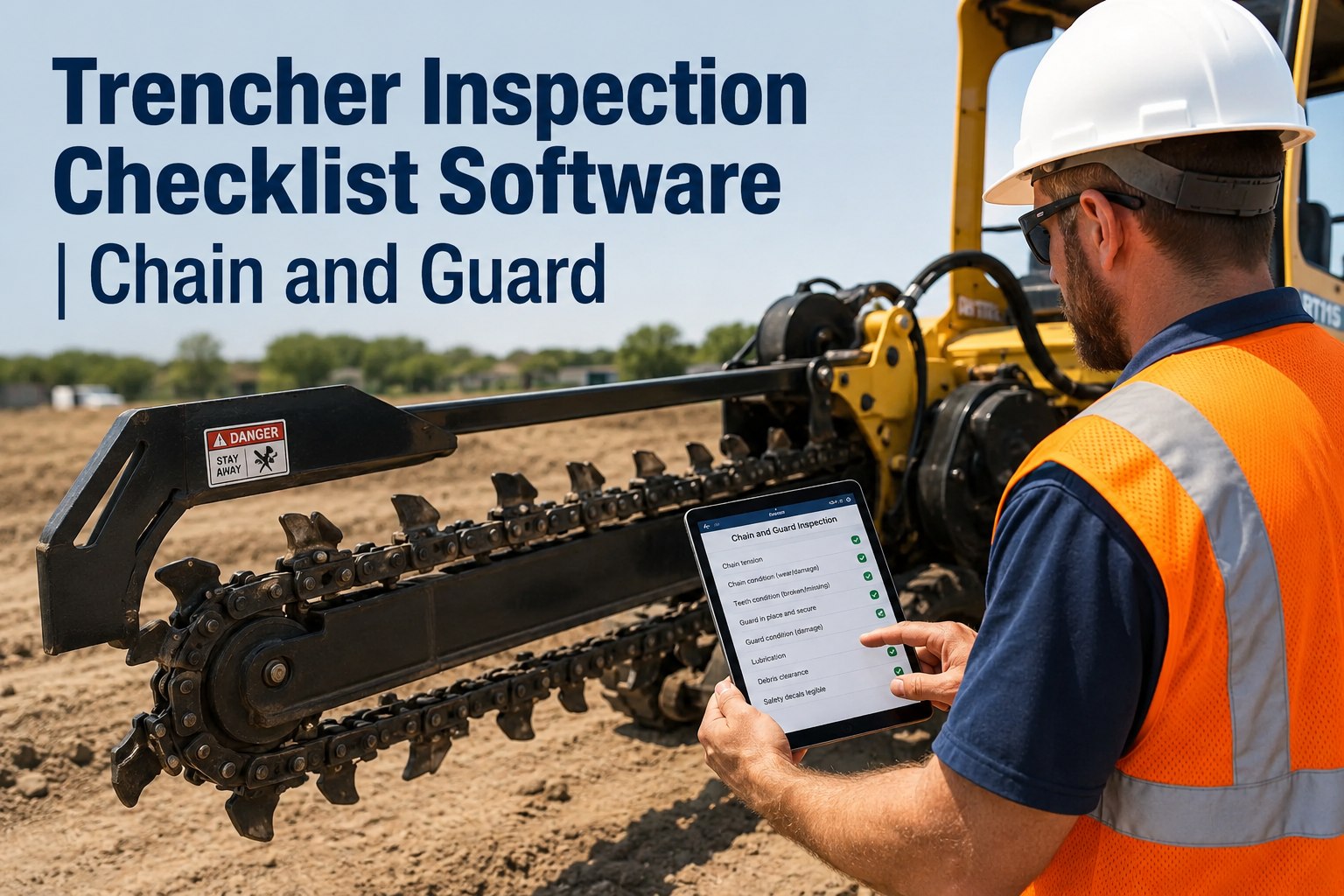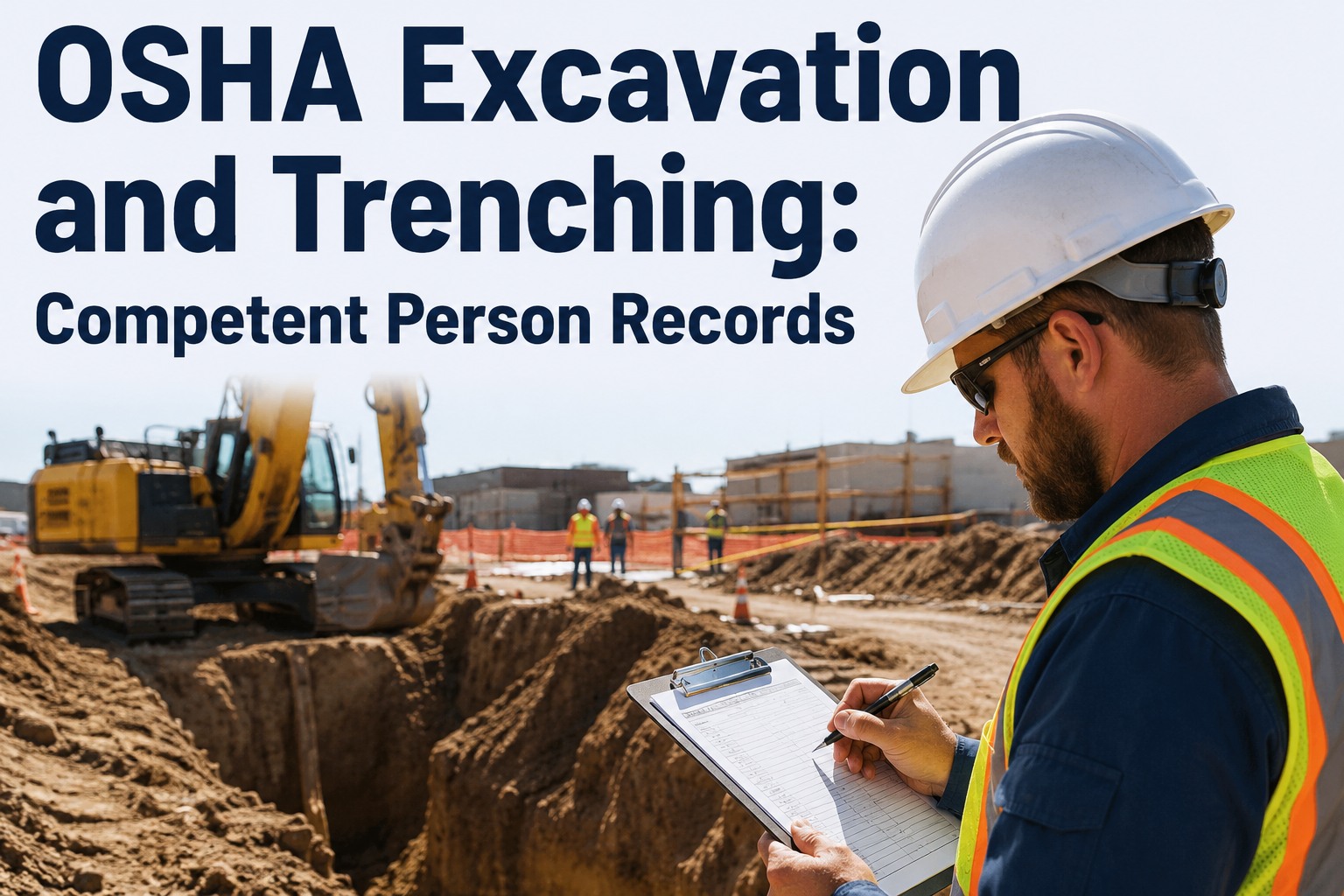
It is 6:40 on a Tuesday morning, the rain that hammered the site all night has just stopped, and your crew is standing at the edge of a 2.4-metre utility trench waiting for a decision. Under OSHA excavation and trenching rules, that trench must be re-inspected by a competent person before anyone climbs back in — not because the schedule says so, but because the weather changed. Daily inspections are the part most contractors get right; the weather-triggered re-inspection after rain, freeze-thaw or nearby vibration is the part that quietly goes undocumented, and it is exactly where excavation audits fall apart. If your competent person records live in a binder in the site trailer, this page shows you what the standard actually demands, where documentation fails, and how digital capture closes the gap — you can even see it working on a live trench inspection in a 30-minute demo before your next pour.
The trench was inspected yesterday. Was it inspected after last night's rain?
One cubic yard of soil can weigh as much as a car. Cave-ins kill fast, and OSHA's excavation standard is built around one person — the competent person — whose inspections must exist on paper (or on screen) every single day and after every hazard-changing event. Here is what your records must prove.
Excavation citations are severe, not frequent — because the failure mode is a fatality
Trenching rarely generates the citation volume of fall protection or lockout/tagout, but when it does appear on an inspection report the consequences sit at the top of the severity scale. These four numbers frame what is at stake for your crews and your compliance file.
When does OSHA require a protective system in a trench?
The 5-foot rule is the line everyone quotes, but the standard is more layered than a single number. Your competent person needs to know all three thresholds and what each one triggers.
Under 5 feet
No protective system required only if the competent person has examined the ground and found no indication of a potential cave-in. Water accumulation, vibration from adjacent plant, or previously disturbed soil can push a 4-foot trench straight into protective-system territory.
5 feet or more
A protective system is mandatory: sloping, benching, shoring or shielding, designed from the soil classification. The only exception is an excavation made entirely in stable rock. This is the threshold where your trench inspection records must name the system in use.
20 feet or more
The protective system must be designed or approved by a registered professional engineer. Tabulated data and manufacturer specs no longer suffice on their own. At this depth, your documentation must include the engineer's design, not just the daily checklist.
Add the access rule on top: trenches 4 feet or deeper need a ladder, ramp or stairway within 25 lateral feet of every worker. Spoils must sit at least 2 feet back from the edge. Both belong on the same daily checklist your competent person signs.
Soil classification decides your protective system — and only a competent person can call it
OSHA does not let the crew vote on soil type. Classification must be performed by a competent person using at least one visual test and one manual test, and the result drives every sloping, benching and shoring decision that follows.
| Soil type | What it looks like | Max allowable slope | What it means for your crew |
|---|---|---|---|
| Stable rock | Solid mineral matter that stays vertical when excavated | Vertical (90°) | No sloping needed, but verify it is genuinely undisturbed rock, not fractured face |
| Type A | Cohesive clay; no fissures, no water, not previously disturbed | 3/4 : 1 (53°) | The best case — but one rain event or nearby vibration can reclassify it downward |
| Type B | Angular gravel, silt, or previously disturbed Type A soils | 1 : 1 (45°) | Most common classification on utility and roadwork sites; plan your layback before you dig |
| Type C | Granular sand, gravel, submerged soil or free-standing water | 1.5 : 1 (34°) | Worst case — wide sloping eats your right-of-way, so a trench box or shoring usually wins |
A competent person is someone who can identify existing and predictable hazards, has the authority to stop work, and knows the standard. That person can be your site supervisor — but only if they have had specific training in soil analysis and protective systems. When you book a walkthrough of HVI's excavation templates, you will see how the soil classification, the tests performed and the competent person's name are captured as mandatory fields, not afterthoughts.
Sloping, benching, shoring or shielding: the four ways to stop a cave-in
There is no single correct answer — there is a correct answer for your soil, your depth, your available width and your schedule. Your records should show which system was chosen and why.
Sloping
Cut the walls back at the angle your soil type allows. Cheapest in material, most expensive in space — a 10-foot trench in Type C soil needs roughly 15 feet of layback each side. Best for open greenfield work.
Benching
Step the walls into a series of levels. Only permitted in Type A and Type B soil — never Type C. Same space appetite as sloping, with stricter geometry rules your competent person must verify.
Shoring
Hydraulic, pneumatic or timber supports that actively brace the walls. Installed from the top down, removed from the bottom up. The go-to for tight urban corridors where sloping is physically impossible.
Shielding
Trench boxes that protect workers inside without preventing a collapse outside. Workers must enter, work and exit within the shield. Boxes must be rated for the depth and soil — check the manufacturer's tabulated data.
Selection logic in one line: if you have the room and stable soil, slope it; if you are in a roadway or beside a live utility, shore or shield it. Whatever you choose, photograph it in place before entry — that photo is the difference between a defensible record and a memory.
Weather-triggered re-inspection: the requirement nobody schedules
The daily pre-entry inspection lives in everyone's routine. The re-inspection after rain, freeze-thaw, or nearby vibration lives in nobody's calendar — and that is precisely why it fails audits. You cannot schedule a storm, so the trigger has to live in your process, not your planner.
Rainfall or water accumulation
Overnight rain saturates trench walls and changes soil strength within hours. Before any worker re-enters, the competent person must re-examine the excavation, re-check the protective system, and log the result. No log, no defence.
Freeze-thaw cycles
In Canadian, northern US and UK winters, a frozen face can look rock-solid at 7 a.m. and slough by noon as it thaws. Each thaw event is a new hazard condition requiring a fresh inspection record.
Adjacent vibration or surcharge
A new crane set up beside the trench, haul traffic rerouted past the edge, or spoils pushed closer than 2 feet — any change in loads or vibration voids the morning's inspection and demands another one.
Any hazard-increasing change
The standard's wording is deliberately broad: inspections continue "as needed throughout the shift" whenever conditions change. If your competent person noticed something and acted, that action needs a timestamped record.
A worked example: the Tuesday nobody logged
Your crew inspected a 6-foot utility trench at 6:30 a.m. Monday and signed the paper form. Rain started at 4 p.m. and stopped at 3 a.m. Tuesday. The crew re-entered at 7 a.m. Tuesday on Monday's signature. If an inspector arrives at 9 a.m., your file shows the last inspection predates a documented weather event — and in an audit, an unlogged re-inspection is treated as an inspection that never happened. One missed form just converted a routine dig into a serious citation conversation. Teams that start logging inspections free in HVI close this gap because the re-inspection is a two-minute phone task, not a trip back to the trailer.
Stop trusting trench records to a binder in the site trailer
HVI captures daily and weather-triggered inspections with GPS, timestamp, photos and competent-person sign-off — even offline at remote digs. See it on your own excavation workflow.
Trench safety documentation that survives an audit, built for the field
HVI is a cloud and mobile inspection and maintenance platform built for fleet-heavy and plant-heavy operations. Four capabilities map directly onto the excavation documentation problem.
Customisable excavation templates
Build your daily trench checklist once — depth, soil type, protective system, ladder access, spoils setback, utility clearance — and deploy it to every site. Outcome: every competent person inspects against the same standard, not their own memory.
Ad-hoc capture with GPS and timestamp
Weather-triggered re-inspections are unscheduled by nature, so HVI lets any authorised supervisor fire an ad-hoc inspection on the spot. GPS coordinates and time attach automatically. Outcome: the re-inspection after last night's rain is provable to the minute and the metre.
Photo evidence and digital signature
Photograph the trench box in place, the ladder within 25 feet, the spoils 2 feet back — then the competent person signs on screen. Outcome: photo-backed, signed records that answer an inspector's first question before it is asked.
Offline mode and audit-ready retrieval
Remote pipeline digs and rural utility work often have no signal — HVI captures everything offline and syncs when coverage returns. When an audit lands, you pull any trench's full history in seconds. Outcome: no dead zones, no lost forms, no scrambling.
The same platform runs your DVIRs, preventive maintenance, work orders and parts inventory across trucks, trailers and off-road plant — so excavation safety lives inside your wider fleet compliance system, not in a separate silo. If you want to see how the excavation template sits next to your vehicle inspections, book a demo and walk through both on one screen.
OSHA excavation and trenching compliance, in five lines
Protective systems are mandatory at 5 feet, engineered at 20 feet, and access is required at 4 feet — three numbers your competent person must know cold.
Soil classification is a competent-person duty using visual plus manual tests, and it drives every sloping, benching, shoring and shielding decision.
The daily pre-entry inspection is necessary but not sufficient — rain, freeze-thaw and vibration each trigger a fresh, documented re-inspection.
Weather-triggered inspections fail audits because nobody schedules them; the fix is a process where the trigger itself generates the task and the record.
Digital capture with GPS, timestamp, photos and signature turns trench safety documentation from a binder you hope is current into a record you can prove is current.
None of this requires new people or new hardware — it requires moving the inspection habit onto the phones your supervisors already carry. You can sign up free and build your first excavation template today, or bring your toughest site scenario to a demo and see it handled live.
"My gripe was never the morning inspection — the lads did that religiously. It was the re-inspection after a night of rain. Nobody's calendar pings you because it rained at 3 a.m. I started tracking it: across eleven active digs one winter, we had forty-some weather events and I could find maybe nine re-inspection forms. Nine. Now the rule is simple — rain stops, phone comes out, two minutes, photo and signature, done before anyone's back in the hole. When the client audited us in March I pulled every record off the system while they watched. That meeting used to take me a week of ringing supervisors."
— Darren Kelleher, Safety & Compliance Manager, civil utilities and drainage contractor
OSHA excavation and trenching questions, answered straight
How often does OSHA require trench inspections?
Who qualifies as a competent person for excavation work?
At what depth is a trench box or shoring required?
What records should we keep for trench inspections?
Does rain really require a new trench inspection?
Make every trench inspection — scheduled or storm-triggered — provable in seconds
Join the contractors and fleet operators who replaced trailer binders with timestamped, photo-backed, GPS-stamped excavation records. Book a 30-minute demo and we will load your own trench checklist into HVI before the call.
Free to start — Works on any phone, even offline — No card needed