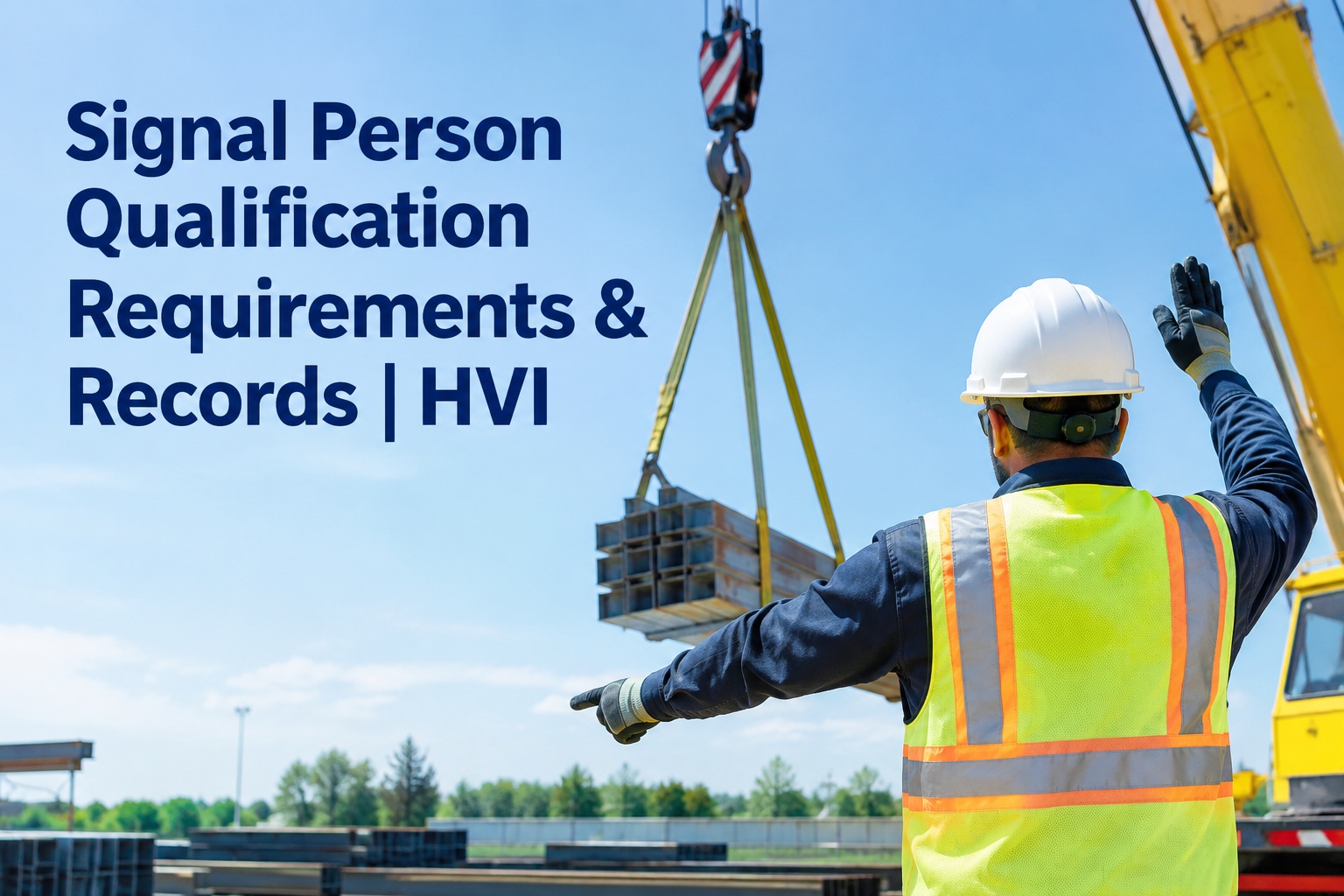
The pick went fine. Load landed clean, the crew broke for lunch, nobody got hurt. Then the compliance officer asked one question — can I see the signal person's qualification documentation? — and the job stopped, because the answer was a binder in an office forty miles away.Signal person qualification is the requirement that feels handled right up until someone asks you to prove it. OSHA doesn't want to hear that your guy has been calling loads for fifteen years and never dropped one. It wants a record, on site, naming who evaluated him, on which types of signals, and when. See crew qualifications tracked alongside the crane's own records
Four Signal Persons. Which Ones Are Actually Qualified Today?
All four have real experience. All four are working a crane right now. Pick one and see how the rule reads their situation.
The portable route — it follows him to any employer
Documentation from a third-party qualified evaluator travels with Mike, so a new employer can rely on it rather than re-testing him. Two conditions still bite: the document has to be available at the site while he's working for you, and it has to cover the type of signaling today's lift actually uses.
1926.1428(a)(1) — Option 1, third party qualified evaluatorValid for your jobs only, and it dies at the gate
An assessment by your own qualified evaluator is a fully legitimate route, and documented properly it holds up in an inspection. What it doesn't do is travel. The sub down the road who borrows Dale for one afternoon lift cannot lean on your paperwork — they have to qualify him themselves, or he can't give a signal.
1926.1428(a)(2) — an employer's assessment is not portableHand-signal qualification doesn't cover a headset
The record has to specify each type of signaling the person is qualified for — hand, radio, voice. Ray's arms are excellent and irrelevant here: he's behind a building on a blind pick, calling distances into a radio, and nobody has ever assessed him on that. Different signaling method, different assessment.
1926.1428(a)(3) — documentation specifies each signaling typeA record you can't produce isn't a record
The employer has to make the documentation available at the site for as long as the signal person is employed there. OSHA's own guidance says that can be paper or electronic — which is the whole argument for a record a supervisor can pull up on a phone at the gate, instead of one sitting in a drawer two counties away.
1926.1428(a)(3) — available at the site, paper or electronicThose numbers are why OSHA treats signaling as a licensed skill rather than a favour you ask the nearest labourer. Below: when a signal person is legally required, the five things they have to prove, the two routes to qualification and which one survives a change of employer, and the documentation rule that fails more crews than the test ever does.
When a signal person is required on site
This isn't a judgement call about how busy the site feels. OSHA names three situations, and the moment any one of them is true, the person waving at the operator is doing regulated work and everything in this article applies to them.
The point of operation is out of view
The load travel path, or the area at or near where the load is being placed, isn't in full view of the operator.
The travel path is blocked
The operator's view is obstructed in the direction the equipment is travelling — a common one on tight urban sites and around stockpiles.
The crew calls for one
Either the operator or the person handling the load decides site-specific safety concerns mean a signal person is needed. No further justification required.
Most contractors get this part right by instinct. Where programmes come apart is the next question: the person who stepped up to signal — can you show, on the day, that they were qualified to do it? Book a demo to see how a signal person's record attaches to the lift and the crane.
The five signal person qualification requirements OSHA actually tests
There is no such thing as an OSHA-issued signal person licence. The standard sets out five things the person must be able to demonstrate, and leaves it to your evaluator — or a third party — to confirm them. Miss any one and the qualification doesn't stand up.
- 1
Knows and understands the signals in use
If hand signals are used, that means the Standard Method — the chart in Appendix A of Subpart CC, drawn from ASME B30.5 — not a set of gestures a crew invented between themselves.
- 2
Is competent in applying them
Knowing the chart and calling a load under pressure are different skills. Competence is about clean, unambiguous signals when the wind is up and the operator is working blind.
- 3
Understands how the machine behaves
A basic grasp of equipment operation and limits, including the crane dynamics involved in swinging and stopping loads, and boom deflection under load. This is what separates a signal person from someone with good arms.
- 4
Knows the relevant rules
Sections 1926.1419 through 1926.1422 and 1926.1428: when a signal person is required, radio and electronic signal rules, the three-part structure of a voice signal, and the hand signal chart requirement.
- 5
Proves it by test — both kinds
An oral or written test and a practical test. Not one or the other. Evaluators consistently report that candidates lose it on the written half, not the arm motions — the crane knowledge underneath the signals is where the gaps show.
Every one of those five is a line you should be able to point to in a record later. A qualification that lives only in someone's memory of a good afternoon on the yard isn't defensible, which is why the assessment belongs in your safety management records alongside incidents and toolbox talks. Book a demo to see an evaluation logged against a named crew member.
Two routes to signal person qualification — only one travels with the worker
OSHA gives you a choice of how to get there, and contractors treat the two as interchangeable. They are not. The difference shows up on the day you hire someone, or the day someone else hires your guy.
Third-party qualified evaluator
- Who assesses
- An independent evaluator with the credentials and experience to test and confirm the five requirements.
- Travels with the worker
- Yes — a new employer can rely on it
- What you hold
- The third party's documentation, on site, naming the signaling types covered.
- Best for
- Travelling crews, short-term hires, and anyone who signals across multiple contractors.
Your own qualified evaluator
- Who assesses
- Your in-house qualified evaluator, assessing the individual against the same five requirements.
- Travels with the worker
- No — other employers can't use it
- What you hold
- Your own signed determination, on site, naming the signaling types covered.
- Best for
- Directly employed crews on your own cranes, where you control the whole programme.
The trap sits on hire day. A new signal person walks on with a card from a previous employer's in-house assessment, and everyone assumes it counts. It doesn't — not for you. The same split applies right across a crane crew, which is why tracking which credentials are portable and which expire with the last payslip matters more than tracking dates alone. Half of what a new hire brings covers you; the other half is your problem to rebuild before their first lift.
The documentation rule that fails more crews than the test does
Here's the part people underestimate. Whichever route you used, the employer has to make that documentation available at the site for as long as the signal person is employed — and it has to state each type of signaling the person is qualified for. A generic certificate that says someone attended a course, with no signaling types named and no way to produce it on site, does not meet the rule. This is what a complete record carries:
Note the third row from the bottom. Naming the signaling types is the single most-skipped field, and it's the one that turns a valid record into a citation when the crew switches from hand signals to radios halfway through a shift. If you're rebuilding your paperwork from scratch, start free and build the qualification record digitally so it's retrievable from any phone on site rather than living in a truck cab. Our checklist centre covers the crane-side paperwork that sits beside it.
One bad call and the qualification stops counting
This clause catches people out because it has no calendar attached. If a signal person's own actions show they don't actually meet the requirements — a sloppy swing call, a stop given too late, a radio instruction with no distance in it — you cannot let them keep signalling. The rule is a hard stop, then a rebuild.
In practice this only works if the near-miss is written down somewhere that connects to the person's file. A supervisor who mentions a bad call at the end of a shift and nothing more has created no trail at all — and if the same signal person is involved in an incident three months later, that silence is the problem. Book a demo to see a near-miss report flag the signal person's record for re-assessment.
Your signal person qualification checklist before the next lift
Six things to confirm before a crane leaves the ground. Run it on your current crew and see what's missing — or set it up free so every crew member's record answers it automatically.
Every signaller has a record
Nobody is giving signals on reputation, seniority, or because they did it on the last job.The route is recorded
Third-party or in-house is written down, so you know at a glance whose qualification is portable.Signaling types are named
Hand, radio, voice — each one the person was assessed on is listed explicitly on the record.Both tests are evidenced
The oral or written test and the practical test are each dated and attributed to a named evaluator.It's retrievable on site
Anyone supervising can produce it at the gate in under a minute, from a phone or an on-site computer.Signal method is agreed pre-lift
Operator, signal person and lift director agree the method and the radio channel before the first pick, and the radios get tested on site.What a safety manager learned the hard way
We had a client audit on a tower job and they asked for signal person qualifications for three guys. Two I had within a minute. The third was a sub's employee we'd been using for six weeks, and what he had was an in-house assessment from the company he worked for before that one. Nobody had ever looked at it. He was good — that wasn't the point. On paper he was an unqualified man calling loads over an occupied walkway.
Now every signaller on my sites has a record with the signal types written on it, and I can see who's third-party qualified and who only counts for us. It sounds like admin until the day someone asks, and then it's the only thing in the conversation.
Frequently asked questions
What is a qualified signal person under OSHA?
Under 29 CFR 1926.1428, a qualified signal person is someone who knows and understands the signals in use (the Standard Method hand signals, if hands are used), is competent in applying them, has a basic understanding of equipment operation and limitations including crane dynamics in swinging and stopping loads and boom deflection, knows the relevant requirements of 1926.1419 through 1926.1422 and 1926.1428, and has demonstrated all of that through an oral or written test plus a practical test. The employer must ensure this before the person gives any signals.
Does OSHA require signal person certification or qualification?
Qualification, not certification. Unlike crane operators, signal persons don't need an accredited certification card. OSHA gives employers two routes: documentation from a third-party qualified evaluator, or an assessment and written determination by the employer's own qualified evaluator. A third-party credential such as an NCCCO signal person card is one common way to meet the first route, but it isn't the only legal path — a properly documented in-house assessment is equally valid for that employer.
Is signal person qualification portable between employers?
Only if it came from a third-party qualified evaluator. OSHA states plainly that an assessment made by an employer's own qualified evaluator is not portable — other employers are not permitted to rely on it. So a new hire arriving with an in-house qualification from a previous company is, for your purposes, unqualified until you either assess them yourself or they obtain third-party documentation. This is one of the most common gaps found during crane crew audits.
What signal person qualification documentation must be kept on site?
The employer must make the documentation for whichever route was used available at the site while the signal person is employed there, and it must specify each type of signaling — hand, radio, voice — that the person is qualified for. OSHA guidance confirms it can be held in paper or electronic form, so a digital record retrievable from a phone or an on-site computer satisfies the requirement. A certificate that names no signaling types, or one that can't be produced on site, doesn't meet the standard.
When is a signal person required on a construction site?
Under 1926.1419, a signal person is required when the point of operation — the load travel path or the area at or near load placement — is not in full view of the operator, when the operator's view is obstructed in the direction the equipment is travelling, or when the operator or the person handling the load determines one is needed because of site-specific safety concerns. Once any of those applies, the person signalling must meet the qualification requirements before giving a single signal.
Signal person qualification is a record, not a reputation
Nothing in this standard asks you to doubt your people. The best signaller on your site is probably the one who's been doing it longest. But OSHA's question isn't is he good — it's can you show, at this site, today, that someone competent assessed him on the signals he's actually using. That's a documentation problem, and it's solvable in an afternoon.
Three habits cover almost all of it: record the route so you always know whose qualification is portable, name the signaling types on every record, and keep the whole thing somewhere a supervisor can open on a phone at the gate. Do that and the audit stops being an event. It becomes a thirty-second conversation while the crane keeps working — which is exactly what a compliance programme is supposed to buy you.
Put every signal person's qualification one search away
HVI keeps crew qualifications, signaling types, evaluator details and re-assessment dates against each person — sitting alongside the crane's inspections, work orders and safety reports in one system. Flag a near-miss and the signal person's record flags with it. Walk on site with an auditor and produce the whole crew's paperwork from a phone.
Crew qualification tracking · Crane inspection records · Safety & incident reporting