Your site supervisor just told the OSHA inspector that Dave is "the competent person" on this job. The inspector nods, then asks which tasks Dave is designated for, where the written designation is, and who covers excavation when Dave is on the other site. Silence. That silence is where citations live. An OSHA competent person is not a badge one person wears for the whole project - it is a task-specific designation that must be separately established, trained and documented for excavation, cranes, scaffolds and fall protection, each with its own inspection duties and its own paper trail. Contractors lose this argument every week not because their people are incapable, but because the designation, the training records and the proof of authority were never written down in a way that survives an audit. This page breaks down what the designation actually requires, how it differs from a qualified person, and how to build a designation matrix that holds up when an inspector, a client auditor or an insurer starts asking questions - the same records you can see working live in a 30-minute demo on your own crew list.
One person cannot be "the competent person" for the whole jobsite
Excavation, cranes, scaffolds and fall protection each demand their own designated competent person - with proven hazard-identification capability, written authority to stop work and correct hazards, and training records to back it. Treat it as a job title and you are one inspection away from a citation.
The common mistake
- One name on a clipboard covers every high-risk task
- No written designation per task, per site
- Training cards expired or sitting in a truck cab
- Inspections done but never signed or filed
What compliance looks like
- A named, trained designee for each regulated task
- Written designation with authority to correct hazards
- Current training records with expiry alerts
- Signed, timestamped inspection records on demand
The price of getting the competent person designation wrong
Misreading this one definition is among the most reliable ways to turn a routine site visit into a penalty, a shutdown or a lost bid. Here is what is actually at stake.
What OSHA 1926.32 actually requires of a competent person
Under OSHA 1926.32(f), the definition has two halves, and both must be true at the same time. Most contractors only deliver the first.
Half 1: Capability to identify hazards
The person must be capable of identifying existing and predictable hazards in the surroundings, or working conditions that are unsanitary, hazardous or dangerous to employees. This is knowledge built from training and experience specific to the task - soil classification for excavation, load charts for cranes, erection sequences for scaffolds.
Half 2: Authority to correct them
The person must have authorization to take prompt corrective measures to eliminate those hazards. If your designee has to phone a project manager for permission to stop a lift or barricade a trench, they fail the definition on paper - no matter how experienced they are.
The practical test an inspector runs: "Show me who is designated for this task, show me their training, and show me the last inspection they signed." If any leg of that tripod is missing, the designation does not exist as far as the citation is concerned. This is exactly the gap a digital system closes - you can book a walkthrough of how designation records work before your next audit does it for you.
A competent person designation matrix for the four big tasks
The same individual can be competent for scaffolds and completely unqualified for excavation. Competence follows the task, not the person. Use this matrix to map who covers what on each site.
| Task | What the competent person must know | Key inspection duty | Record to keep |
|---|---|---|---|
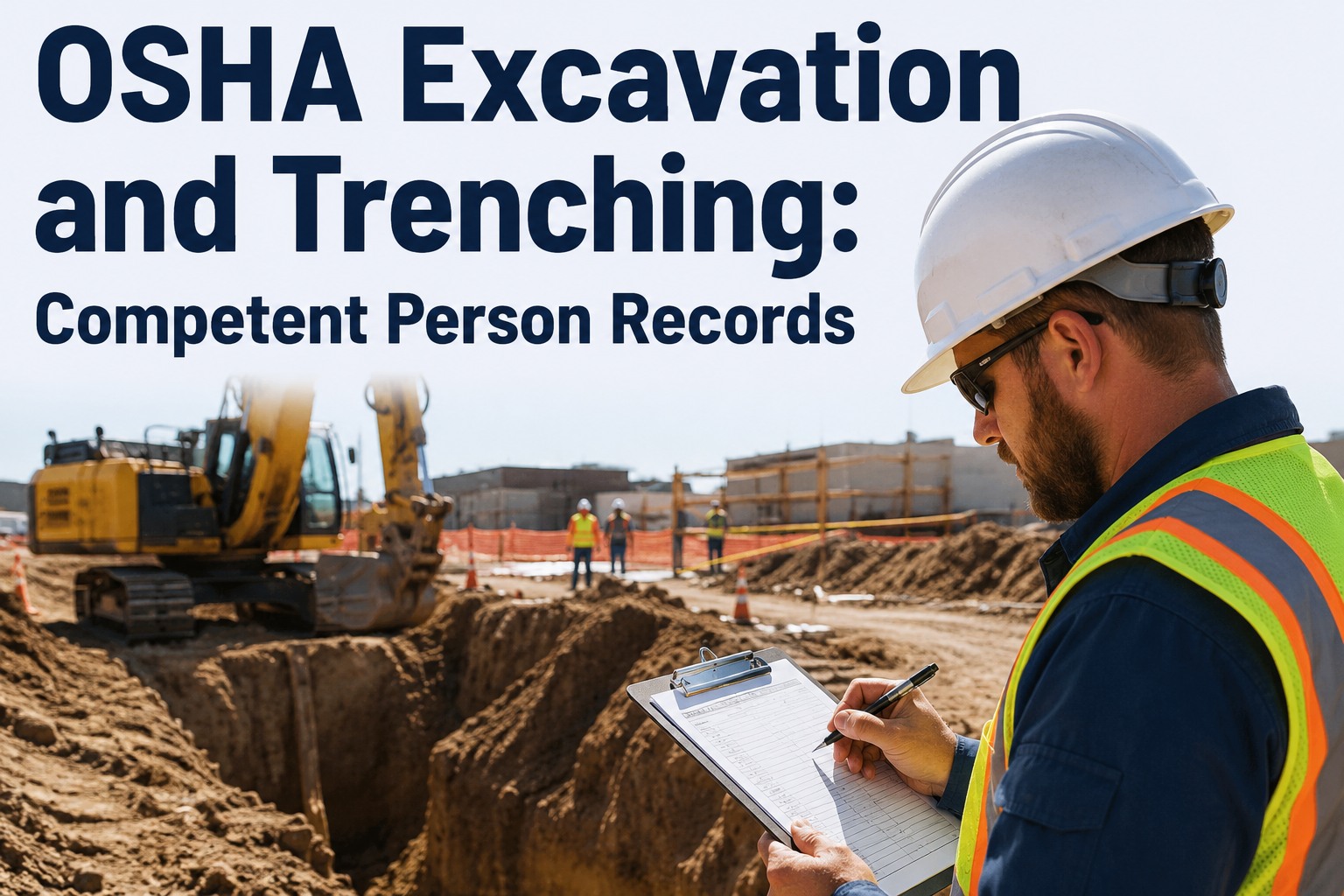
| Excavation & trenching | Soil classification, protective systems, atmospheric hazards, water accumulation | Inspect the trench daily and after any condition change, before worker entry | Daily signed trench inspection with photos of protective systems |
| Cranes & lifting | Load charts, rigging, ground conditions, assembly and disassembly supervision | Shift inspections of equipment; oversee critical lifts and assembly | Shift inspection logs; annual inspection by a qualified person filed separately |
| Scaffolds | Load capacity, erection and dismantling sequences, fall and falling-object protection | Inspect before each work shift and after any event that could affect integrity | Pre-shift scaffold inspection tagged to the structure, signed by the designee |
| Fall protection | Anchorage ratings, harness inspection, rescue planning, leading-edge rules | Inspect systems before use; monitor the site for unprotected edges | Equipment inspection records plus documented site monitoring |
Build this matrix per site, not per company. When your excavation designee is off-site, the matrix must name a trained alternate - otherwise work in the trench stops or continues illegally. Contractors who set up their crew designations in HVI free can see coverage gaps across every site from one screen instead of ringing five foremen.
Competent person vs qualified person: the difference inspectors check
These two designations are not interchangeable, and mixing them up is a direct citation path - especially around cranes, where both roles exist side by side.
Competent person
- Basis: demonstrated capability plus written authority - no specific credential required
- Scope: task-specific - scaffolds, excavation, fall protection, crane operations
- Duty: frequent and daily inspections, hazard correction on the spot
- Proof: written designation, training records, signed inspection logs
Qualified person
- Basis: a recognised degree, certificate or professional standing, or extensive proven knowledge
- Scope: technical obligations - design, engineering judgement, annual crane inspection
- Duty: periodic, technical assessments rather than daily checks
- Proof: credentials, certifications and the reports they sign
Where this bites hardest: the annual crane inspection must be performed by a qualified person, while shift-level checks fall to the competent person. If your records show the same signature doing both with no credential on file for the annual, you have just documented your own violation. Keep the two roles in separate record streams - a distinction you can see handled cleanly in a demo of HVI's inspection records.
Competent person documentation: the five records that survive an audit
OSHA does not cite you for lacking talent; it cites you for lacking proof. These five records are what turn a verbal designation into a defensible one.
Written designation per task, per site
A short document naming the person, the task, the site and the date, signed by someone with authority to grant it. Verbal designations evaporate the moment the foreman who made them leaves the project.
Training and certification records per person
Course certificates, toolbox-talk attendance, equipment-specific training - all filed against the individual, not stuffed in a site trailer. Expiry dates matter: a lapsed trenching card quietly voids the designation.
Signed inspection records with names attached
Every daily trench check, pre-shift scaffold check and crane shift inspection must show who performed it, when, and what was found. An unsigned checklist proves the form exists - not that the inspection happened.
Evidence of corrective authority
Stop-work events, hazard corrections and defect escalations logged against the designee's name. This is the proof of the second half of the definition - authority exercised, not just claimed.
Audit-ready retrieval
All of the above retrievable in seconds, filtered by person, task, site or date range. If producing last month's scaffold inspections takes an afternoon of phone calls, your system is the finding.
Stop guessing who is designated for what
See HVI holding designations, training records and signed inspections for your own crew - in a live 30-minute walkthrough.
What one missing designation actually costs: a 25-person site
Run the numbers on a mid-size civil contractor with one excavation crew, two tower-crane days a week and scaffold on three elevations.
Now flip it. The same site with designations, training cards and signed daily inspections held digitally: the foreman opens a phone, filters by "excavation," and shows the inspector a current designation, a valid training record and 30 consecutive signed trench logs with photos. The visit lasts twenty minutes. That is the entire business case - not software for its own sake, but the difference between a citation and a shrug. You can walk through that exact retrieval on a demo call using your own task list.
Four HVI capabilities built for competent person compliance
Role-based designations
Assign competent-person roles per task and per site, so your matrix lives in the system instead of a spreadsheet. Coverage gaps across crews show up before an inspector finds them.
Training records with expiry alerts
Certifications and training held per person, with automatic alerts at 90, 60 and 30 days before expiry. A lapsed trenching card never quietly voids a designation again.
Signed, photo-backed inspections
Every trench, scaffold and crane check captured on any phone with photos, timestamps and a digital signature showing exactly who performed it - no more unsigned paper gaps.
Audit-ready retrieval in seconds
Filter by person, task, site or date and hand an inspector a complete record set on the spot. The same trail serves DOT, client, safety and insurance audits without extra work.
Competent person compliance in five lines
It is a designation, not a title
Competence attaches to the task. One person can hold several designations, but each must be separately established, trained and documented.
Authority is half the definition
Capability without written authority to correct hazards fails the OSHA 1926.32 test. Put the authority in the designation letter.
Qualified is a different lane
Annual crane inspections and engineering judgements belong to credentialed qualified persons. Keep the two record streams separate.
Unsigned inspections are missing inspections
Daily checks only count if they show who did them, when, and what was found. Digital signatures close the gap paper leaves open.
Retrieval speed is the audit
The competent person requirement is won or lost on how fast you produce proof. If it takes an afternoon, the system is the finding - and it is fixable this week when you start your free HVI account and load your first crew.
"My gripe was never finding good people - it was proving it. I had a scaffold foreman with fifteen years on structures, and an auditor still wrote us up because his designation letter named the wrong site and his card had expired the month before. Now I track one number: days to the nearest training expiry across my designees. If that number drops under 30, my phone lights up. I have not chased a paper signature since."
Marcus Delaney - Safety Manager, civil and utilities contractor running 6 active sites
Competent person requirements: your questions answered
Can one person be the competent person for multiple tasks?
Yes - one individual can hold several designations at once, but each must be separately established. Being competent for scaffolds says nothing about excavation: the person needs task-specific knowledge, a written designation for each task, and training records covering each one. The designation matrix should also name trained alternates, because a designation that walks off-site at lunch leaves the task uncovered.
What is the difference between a competent person and a qualified person?
A competent person is defined by demonstrated capability to identify hazards plus written authority to correct them - no specific credential is required. A qualified person holds a recognised degree, certificate or professional standing and handles technical obligations like the annual crane inspection. The roles overlap on cranes but are not interchangeable, and inspectors check that the annual inspection carries a qualified person's credentials.
Does a competent person need a certification or card?
OSHA does not require a specific competent person certification - the standard demands capability and authority, not a card. In practice, though, training certificates are how you prove capability when challenged, and many clients and general contractors require them contractually. Keep every certificate filed per person with expiry alerts at 90, 60 and 30 days; you can see how those alerts run in a quick demo.
How often must a competent person inspect an excavation or scaffold?
Daily, and after any event that could change conditions. Excavations require inspection before worker entry each day and after rain, vibration or other hazard changes. Scaffolds require inspection before each work shift and after any occurrence that could affect structural integrity. Each inspection needs a signed, dated record - an unsigned checklist proves the form exists, not that the check happened.
What documentation should we keep for a competent person audit?
Five records: the written designation per task and site, training and certification records per person, signed inspection logs showing who performed each check, evidence of corrective authority being exercised, and the ability to retrieve all of it fast. Digital systems make the retrieval leg trivial - sign up free and you can have your first designations and inspection forms live the same day.
Make every designation audit-proof before the next site visit
Designations, training records, signed inspections and instant retrieval - all on the phones your crews already carry. See it on your own task list in 30 minutes.
Free to start - Works on any phone - No card needed