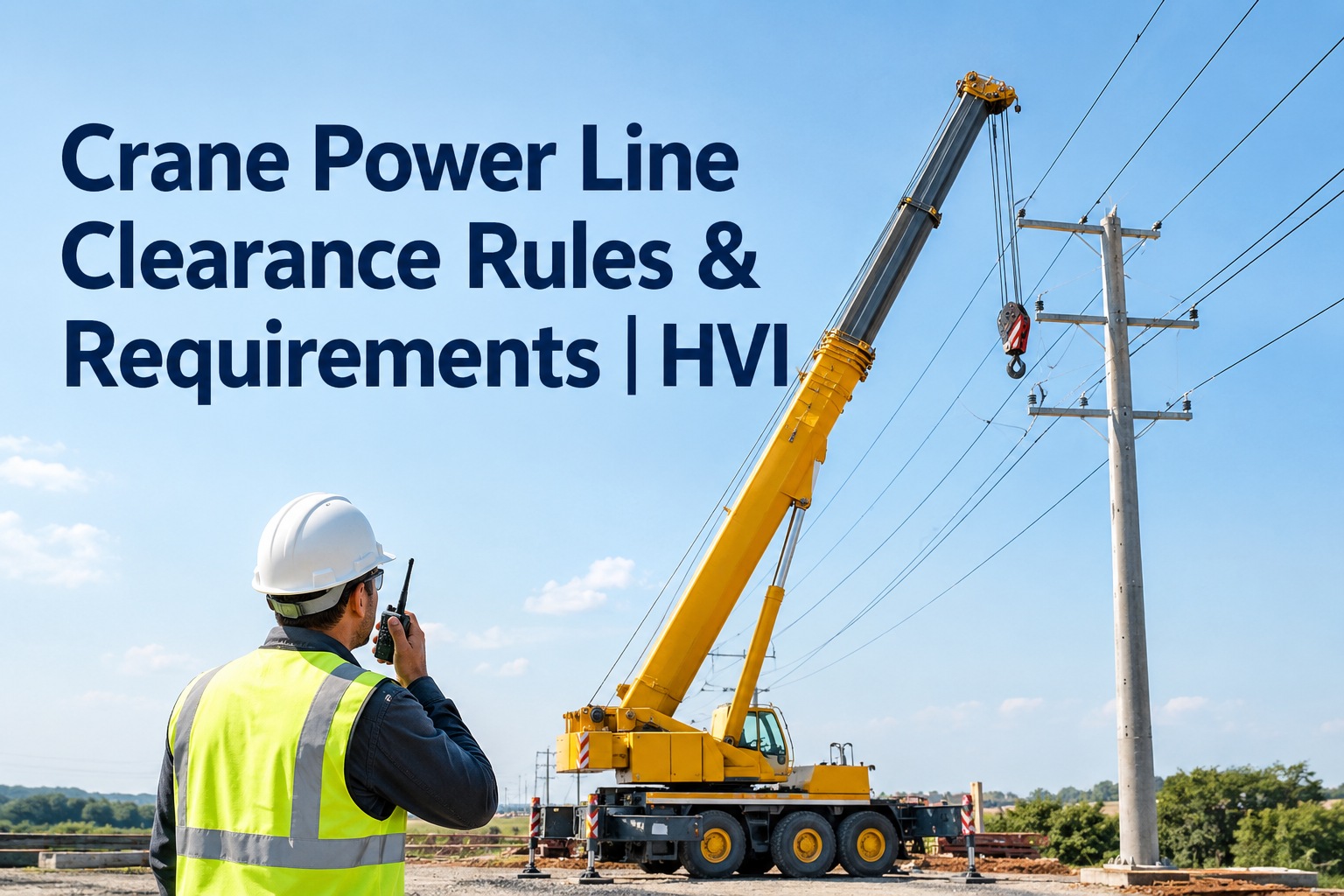
The boom comes up, the load swings out, and someone says it looks like plenty of room. Crane power line clearance is the one call on site nobody should make by eye. OSHA turned it into a measured distance with a decision tree behind it. Book a demo to see power line planning recorded per lift
How Close Can the Boom Get? Pick the Voltage.
Clearance is set by the line's voltage — and the bar below is drawn to scale, so 10 feet and 50 feet look as different as they are.
Distribution lines along a street sit in this band. Ten feet is the closest any part of the crane, load line or load may come — and only once you have confirmed the voltage.
Sub-transmission voltage. Fifteen feet applies to every part of the equipment at full working radius, not just the boom tip.
At this band the Table A distance and the default 20-foot rule meet. If you never confirmed the voltage, 20 feet is what you hold.
Above 350 kV the rules change: wherever the standard says 20 feet, 50 feet is substituted for lines up to 1,000 kV.
No table value exists. The utility owner or a registered professional engineer qualified in power transmission must establish the distance for the site.
Read that middle number again. The people most often killed by crane power line contact are the ones holding the tag line, not the one holding the joystick. Below: the 20-foot test, the three compliance options, the encroachment measures, and the presumptions crews get wrong.
The 20-foot question that starts every crane power line clearance plan
Before equipment operations begin, you define the work zone. OSHA gives two ways to do it, and the one you choose changes how much ground the rule covers.
Demarcate the boundaries
Mark the limits with flags, or a range limit or range control warning device, and prohibit the operator from working past them. Tighter zone, but the boundary has to hold.
Take the full 360 degrees
Define the work zone as everything 360 degrees around the crane, out to its maximum working radius. Simpler to apply, and it pulls far more of the site into scope.
Then comes the single question the whole standard turns on: operated to its maximum working radius inside that zone, could any part of the equipment, load line or load get closer than 20 feet to a power line?
That answer depends on boom length, radius and rigging — which is why it belongs in a written plan rather than a conversation at the gate. Book a demo to see the pre-lift power line check recorded against the crane.
Three ways to comply once the answer is yes
Each option is complete on its own. They aren't a preference order in the text, but they are in practice — only one of them removes the hazard instead of managing it.
De-energize and ground
Confirm with the utility owner or operator that the line has been de-energized and visibly grounded at the worksite. The hazard is gone rather than managed.
Hold 20 feet
Keep every part of the equipment, load line and load outside 20 feet, using the encroachment measures below. No voltage information needed.
Work to Table A
Determine the line's voltage, apply the Table A minimum approach distance, and run the same encroachment measures. Buys you room on lower-voltage lines.
Option 3 has a clock attached that most sites don't know about. Where you use it, the utility owner or operator must supply the voltage information within two working days of your request.
Until that information arrives, the line is presumed energized and 20 feet is the number you work to. Book a demo to track voltage requests and lift approvals in one place.
The crane power line clearance measures that come with Options 2 and 3
This is where most programmes fall apart, because the requirement has two halves. Three measures are mandatory every time, and then you add at least one more from a list of five. Book a demo to see these measures built into a pre-lift checklist.
A planning meeting
With the operator and everyone who will be near the equipment or load, covering where the lines are and how encroachment will be prevented.
Non-conductive tag lines
If tag lines are used at all, they must be of the non-conductive type. No exceptions, no improvised rope off the truck.
An elevated warning line
A flagged warning line, barricade or line of signs in the operator's view, set at 20 feet or the Table A distance. If the operator can't see it, a dedicated spotter is added on top of one of the five measures.
Proximity alarm
Set to warn the operator in time to prevent encroachment.Dedicated spotter
In continuous contact with the operator, with a visual aid such as a painted line or line-of-sight landmarks, positioned to gauge the distance.Automatic warning device
A range control warning device that tells the operator when to stop movement.Range limiting device
A device that automatically limits range of movement, set to prevent encroachment.Insulating link
Installed at a point between the end of the load line, or below, and the load.A spotter is the most-chosen measure and the easiest to get wrong. The standard is specific: continuous contact, a visual aid to judge the distance, a position that lets them actually gauge it, and timely information to the operator.
Travelling with no load uses a different clearance table
Tracking a crane across site with the boom down is a separate rule with its own distances. Shorter ones — but they come with conditions that bite at dusk.
| Line voltage (nominal, kV AC) | Minimum clearance |
|---|---|
| Up to 0.75 | 4 ft |
| Over 0.75 to 50 | 6 ft |
| Over 50 to 345 | 10 ft |
| Over 345 to 750 | 16 ft |
| Over 750 to 1,000 | 20 ft |
| Over 1,000 | Set by the utility or a qualified RPE |
Boom lowered
The boom or mast and its support system are lowered enough to meet the clearance.
Speed and terrain
Their effect on machine and boom movement must be considered so the distance isn't breached.
Spotter inside 20 feet
If any part will get closer than 20 feet while travelling, a dedicated spotter in continuous contact is required.
Night and poor visibility
Lines must be illuminated or otherwise identified, and a safe path of travel identified and used.
Travelling with a load is not covered here at all — that falls back under the operations rules and their longer distances. Book a demo to see site movement checks captured on a phone.
Four crane power line clearance rules crews break without knowing
None of these are obscure. They're the assumptions that feel like common sense on site and are the opposite of what the standard says.
Every line is energized until proven otherwise
Presume energized unless the utility confirms the line has been, and continues to be, de-energized and visibly grounded at the worksite. A phone call last week isn't confirmation today.
Every line is uninsulated until proven otherwise
Black covering on a conductor means nothing. Presume uninsulated unless the utility or a qualified registered engineer confirms otherwise.
Nothing goes below a live line
No part of the equipment, load line or load is allowed below a power line unless it's de-energized and visibly grounded — with narrow exceptions based on boom height at true vertical.
After contact, the operator stays in the cab
Training must cover step potential, the danger of touching the machine and ground at once, and the safest way to evacuate only if fire or explosion forces it. Crew must not approach or touch the crane or load.
Rule four is why a contact incident kills bystanders. Everyone's instinct is to run toward the machine, and the ground around it is the hazard. That belongs in your safety training and incident records, not just in a toolbox talk nobody logged.
These four fit on a single laminated card in the cab and cost nothing to enforce. Sign up free and build them into your pre-lift checklist.
From a safety manager who watched a near-miss
We had a 65-tonne all-terrain setting roof units on a retail build. The distribution line ran behind the store and everybody had walked past it for three weeks without registering it, because it was behind the crane, not in front of it.
The operator swung wide to clear a skip and the boom tip went inside twenty feet. Nobody touched anything. But my work zone was defined as 360 degrees and that line was in it, and I had no warning line up on that side. We stopped for the afternoon and did it properly.
Frequently asked questions
What is the minimum clearance distance for a crane near power lines?
The default is 20 feet for lines up to 350 kV. Confirm the voltage and Table A applies instead: 10 feet up to 50 kV, 15 feet over 50 to 200 kV, 20 feet over 200 to 350 kV, 25 feet over 350 to 500 kV, 35 feet over 500 to 750 kV, 45 feet over 750 to 1,000 kV. Above that, the utility or a qualified RPE sets it.
What are the three options under OSHA 1926.1408?
Once any part of the equipment, load line or load could get within 20 feet of a line, you must use one of three: confirm the utility has de-energized and visibly grounded it; maintain 20 feet of clearance with the required encroachment measures; or determine the voltage and work to the Table A distance with those same measures.
Is a dedicated spotter always required near power lines?
Not always. A spotter is one of five measures, of which you must implement at least one — the others being a proximity alarm, an automatic warning device, a range limiting device, or an insulating link. A spotter becomes mandatory where the operator cannot see the elevated warning line, and while travelling with no load within 20 feet of a line.
Can a crane operate directly below a power line?
Not unless the employer has confirmed the utility de-energized and visibly grounded the line at the worksite. Narrow exceptions exist — mainly where the uppermost part of the equipment, boom at true vertical or fully extended, would sit more than 20 feet or the Table A distance below the plane of the line.
How do you find out a power line's voltage?
You request it from the utility owner or operator. Where you use the Table A option, the utility must provide the voltage information within two working days of your request. Until it arrives, the line is presumed energized and you work to the 20-foot default, not an assumed Table A distance.
Crane power line clearance is a plan, not a judgement call
Every part of this rule is designed to take the decision away from the person looking up at the sky. Define the zone, run the 20-foot test, pick an option, put the measures in, and write down that you did.
The reason it's worth the twenty minutes is in the data. The workers most often killed by crane power line contact are the ones on the ground with a hand on the load — people who never got to make a judgement call at all.
Make the power line check part of the lift, not an afterthought
HVI puts the power line assessment into your pre-lift checklist, logs who attended the planning meeting, captures photo evidence of the warning line and spotter position, and tracks any finding through to closure — on the same asset file as the crane's inspections.
No credit card · Pre-lift checklists & photo evidence · Safety records per crane