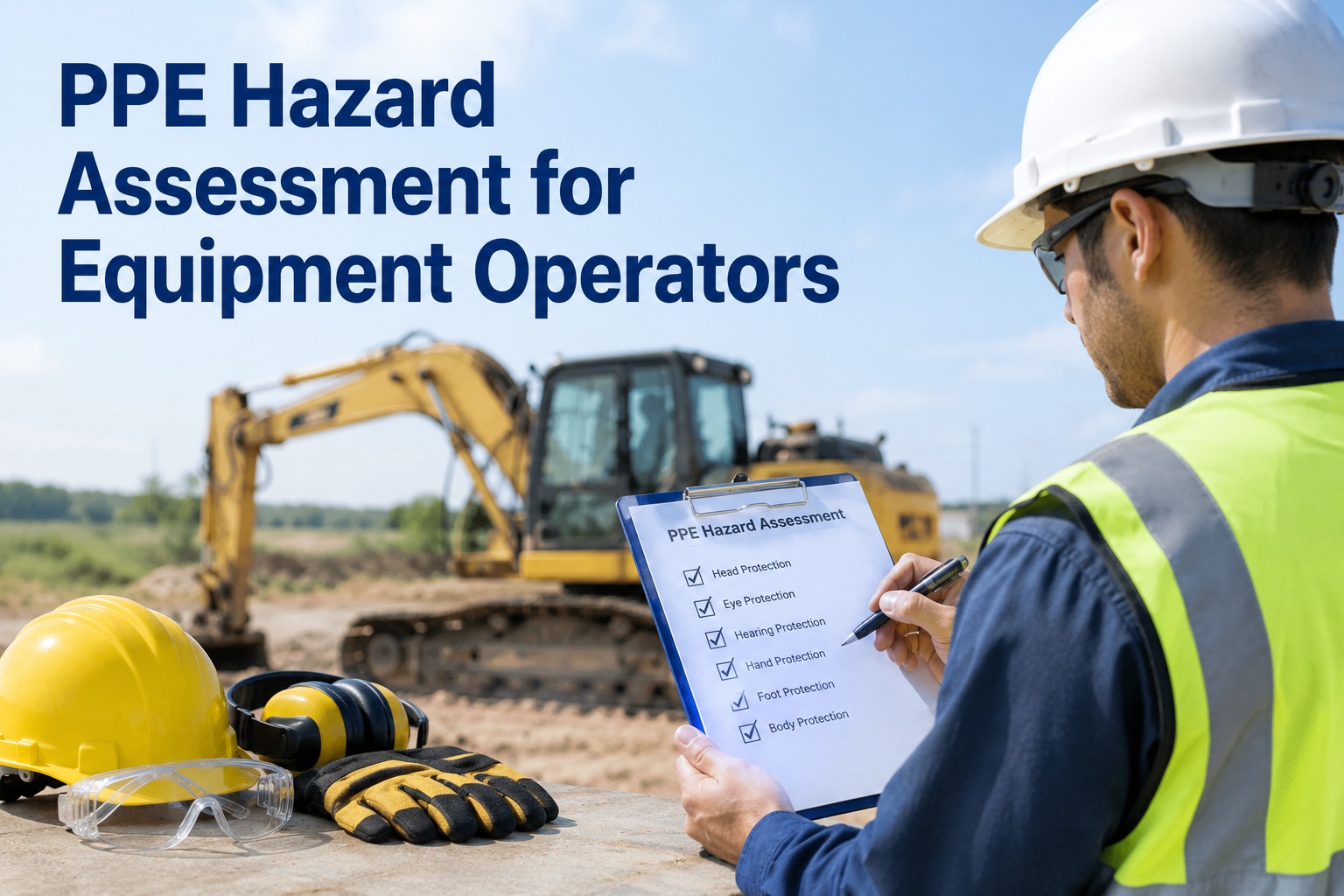
An inspector doesn't start by checking whether your crew is wearing hard hats and safety glasses. They start by asking for the paper that says why — the written hazard assessment that justifies each piece of PPE your equipment operators are wearing. No assessment on file, and every training record and every piece of gear on the jobsite suddenly looks like a guess instead of a documented decision. A ppe hazard assessment isn't a checklist you fill out once and forget; it's the evidence that your PPE choices were reasoned, not assumed.
PPE Hazard Assessments for Equipment Operators: What OSHA Actually Wants to See
Selecting the right gear is half the job. Documenting why you selected it is the half that holds up during an inspection.
Why This Is a Specific Requirement, Not Just Good Practice
Under 29 CFR 1910.132(d), employers have to assess the workplace for hazards that call for PPE, then select gear that addresses what was actually found. That part surprises fewer safety managers. What catches people off guard is 1910.132(d)(2): the assessment itself has to be verified in writing, and that written certification has to identify the workplace or task evaluated, the person who performed the assessment, the date it was done, and explicitly label the document as a hazard assessment certification. Miss any one of those four elements and the paperwork doesn't count as compliant, even if the assessment itself was thorough.
Construction employers should confirm which standard applies to their specific work — general industry PPE requirements sit in 1910.132, while construction has its own related provisions under 29 CFR 1926. When PPE-related citations do land, eye and face protection alone accounted for nearly 2,000 violations in FY2025, and a missing or incomplete hazard assessment is a common thread behind many PPE findings — inspectors typically ask for the certification before they even look at training records. Book a demo to see how HVI builds the required certification elements into every assessment automatically, so nothing gets left off the form, or start a free trial to try it on one crew first.
One Assessment Per Task, Not One Per Site
A single "PPE hazard assessment" covering your whole yard doesn't hold up, because equipment operators rarely face one uniform set of hazards. A forklift operator, a grinder, and someone doing ground-level loading work are exposed to different things — which means each distinct task generally needs its own assessment, mapped to its own hazards and its own required gear.
Forklift & powered equipment operation
Hazards: Impact, crush, struck-by
Typical PPE: Hard hat, high-visibility vest, safety-toe footwear
Grinding & cutting
Hazards: Flying debris, sparks, noise
Typical PPE: Face shield over safety glasses, hearing protection, gloves
Loading & material handling
Hazards: Compression, strain, pinch points
Typical PPE: Cut-resistant gloves, safety-toe footwear, back support as applicable
Fueling & fluid service
Hazards: Chemical splash, skin contact
Typical PPE: Chemical-resistant gloves, splash goggles, apron
These are illustrative examples, not a substitute for your own site-specific assessment — actual hazards and required PPE depend on the equipment, environment, and task as evaluated at your location. Book a demo to see task-specific assessment templates you can configure per role instead of building one generic form.
The Hazard Types That Drive PPE Selection
OSHA's non-mandatory Appendix B to 1910.132 frames the assessment around specific hazard categories — thinking in these terms, rather than "what gear do we usually issue," is what actually produces a defensible assessment.
For each task, the assessment should note which of these hazard types are actually present, then select PPE that addresses that specific hazard — not PPE selected because it's what's already in the supply closet. Respiratory and electrical protective equipment are generally governed by their own separate OSHA standards, so those hazards should still be evaluated, just tracked outside the 1910.132(d) hazard assessment itself.
Where Assessments Fall Apart: Common Gaps That Trigger Findings
The same handful of gaps show up repeatedly when a PPE program gets scrutinized. None of them require bad intent — they're almost always a documentation habit, not a safety failure.
- No assessment on file at all — PPE gets issued based on habit or supervisor judgment, with nothing written down to explain why.
- Missing certification elements — an assessment exists, but it's not dated, not signed, or not clearly labeled as a hazard assessment certification.
- Training that doesn't match the assessment — the assessment calls for one type of PPE, but training or actual practice reflects something different.
- One assessment covering many different tasks — a blanket "site assessment" that doesn't reflect what a specific operator's job actually exposes them to.
- No update after a process or equipment change — new equipment introduces a new hazard, and the assessment never gets revisited to reflect it.
From Paper Checklist to a Record That Holds Up
Most of the gaps above trace back to the same root cause: the assessment lives on paper, in a binder, disconnected from the training records and the PPE that's actually issued day to day. A digital, task-specific inspection template closes that gap by keeping the assessment, the certification, and the PPE issued to each operator tied together from the start — searchable the moment an inspector, or an internal audit, asks for it. Book a demo to see how offline inspections and safety records work together on jobsites where signal isn't reliable but documentation still has to be complete.
What a Safety Manager Actually Deals With
We had PPE assessments, technically — three-ring binders at each site, half of them undated, none of them tied to who was actually trained on what. An inspector asked for the certification for one crew and it took us two days to even locate the right binder.
Now every task has its own digital assessment, signed and dated the moment it's done, sitting right next to that crew's training record. When someone asks, I pull it up in under a minute instead of promising to send it later.
Frequently Asked Questions
What is a PPE hazard assessment and is it legally required?
A PPE hazard assessment is a documented evaluation of a workplace or task to determine whether hazards are present that require personal protective equipment, and if so, which equipment addresses those specific hazards. It is a legal requirement under 29 CFR 1910.132(d) for general industry employers, with related requirements applying to construction under 29 CFR 1926. The assessment must also be verified through a written certification under 1910.132(d)(2) — an informal or undocumented evaluation does not satisfy the requirement.
Does OSHA require a written hazard assessment for every job task?
OSHA generally expects a hazard assessment for each distinct job or task that may expose workers to hazards requiring PPE, rather than a single broad assessment covering an entire worksite. Common examples include separate assessments for operating powered equipment, welding, grinding, and material handling, since each task typically presents different hazards and requires different PPE. A single blanket assessment that doesn't reflect the specific tasks performed is a common gap that can be flagged during an inspection.
What must a PPE hazard assessment certification include?
Under 29 CFR 1910.132(d)(2), the written certification must identify the workplace or task that was evaluated, name the person who performed the assessment, record the date or dates the assessment was conducted, and clearly identify the document as a certification of hazard assessment. Missing any one of these elements means the documentation does not meet the requirement, even if a thorough hazard evaluation was actually performed.
How often should a PPE hazard assessment be updated?
OSHA's standard doesn't specify a fixed review interval, but a hazard assessment should generally be revisited whenever the task, equipment, materials, or work environment changes in a way that could introduce new hazards or make previously selected PPE inadequate. Many employers build a periodic review into their safety program in addition to change-triggered reviews, to catch gaps that might otherwise go unnoticed for an extended period. Confirm your specific review practices align with current OSHA guidance and any applicable state plan requirements.
What are the most common PPE hazard assessment mistakes that lead to OSHA citations?
The most frequent gaps include having no hazard assessment on file at all, an assessment that's missing required certification elements like a date or signature, training records that don't match what the assessment actually calls for, a single generic assessment used across many different tasks, and assessments that were never updated after equipment or process changes introduced new hazards. Most of these stem from documentation habits rather than an actual failure to select appropriate PPE, which is why keeping the assessment, certification, and training tied together in one record tends to prevent them.
Book a demo to see PPE hazard assessments done right, every time
HVI's configurable inspection templates capture task-specific hazard assessments and certifications in the field — offline where you need it — and keep every safety record ready to produce the moment it's requested.
No credit card · No hardware · Assessments ready to configure on day one