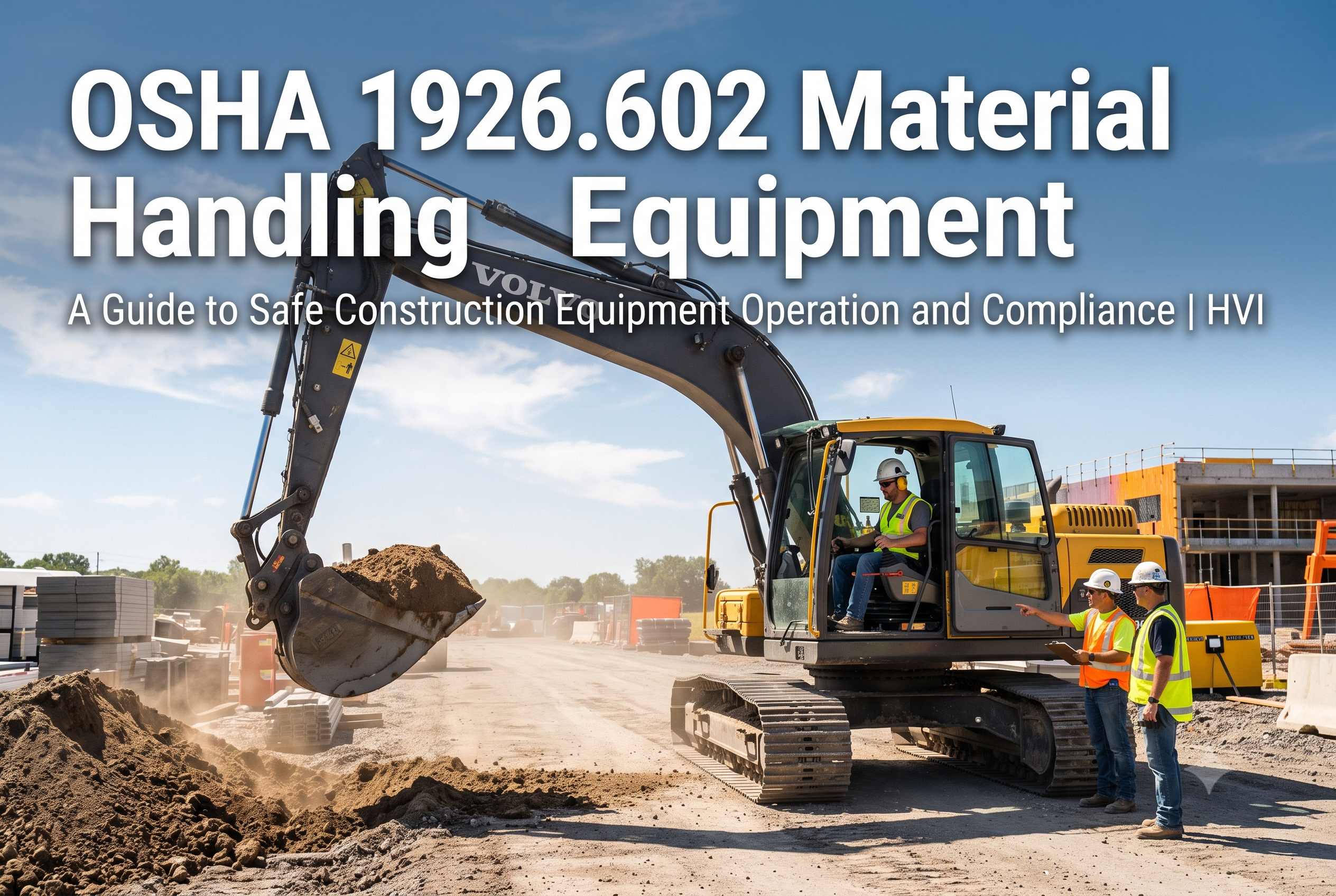
If you run earthmoving equipment on a construction site, OSHA 1926.602 is the standard that governs how those machines have to be built, equipped and operated — and it's one of the most-cited references in the trade. It bundles the everyday safety essentials into one rule: seat belts, brakes, audible alarms, access roads, and more, across the loaders, dozers, scrapers, and graders that move most of the dirt on a jobsite. See how the 1926.602 essentials land on the daily inspection
One Standard Covers How Your Earthmoving Fleet Has to Be Equipped
Seat belts, brakes, alarms, access roads — 1926.602 bundles them together. Tap a requirement to see what it demands.
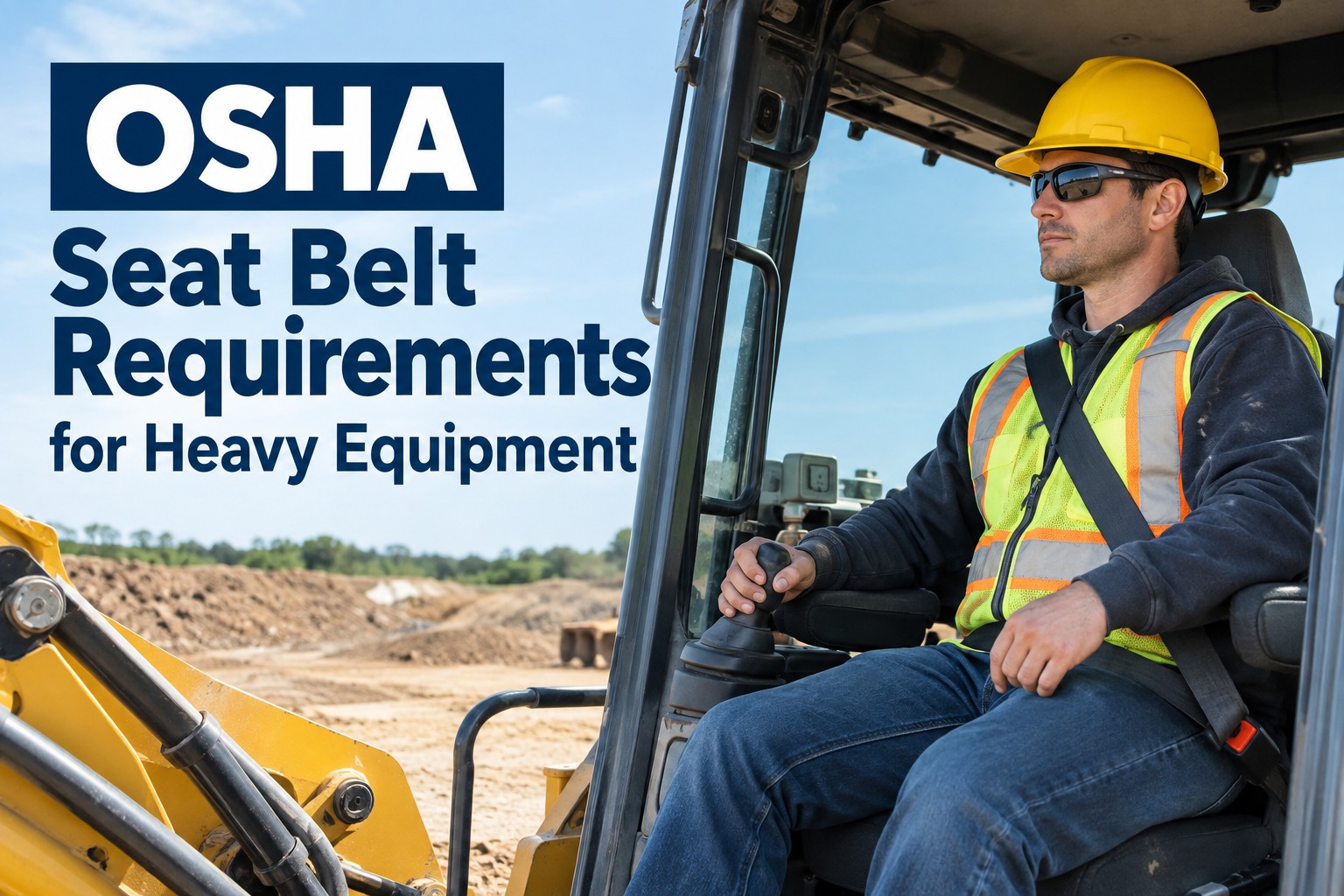
Seat belts must be provided on all covered earthmoving equipment, meeting the applicable SAE standard — with narrow exceptions for stand-up-only machines and equipment with no ROPS or canopy. On a seated, ROPS-equipped machine, the belt keeps the operator inside the protected space in a rollover.
All covered earthmoving equipment must have a service braking system capable of stopping and holding the machine fully loaded, meeting the relevant SAE performance criteria. Brakes that can stop but not hold, or hold but not stop under load, don't meet the standard.
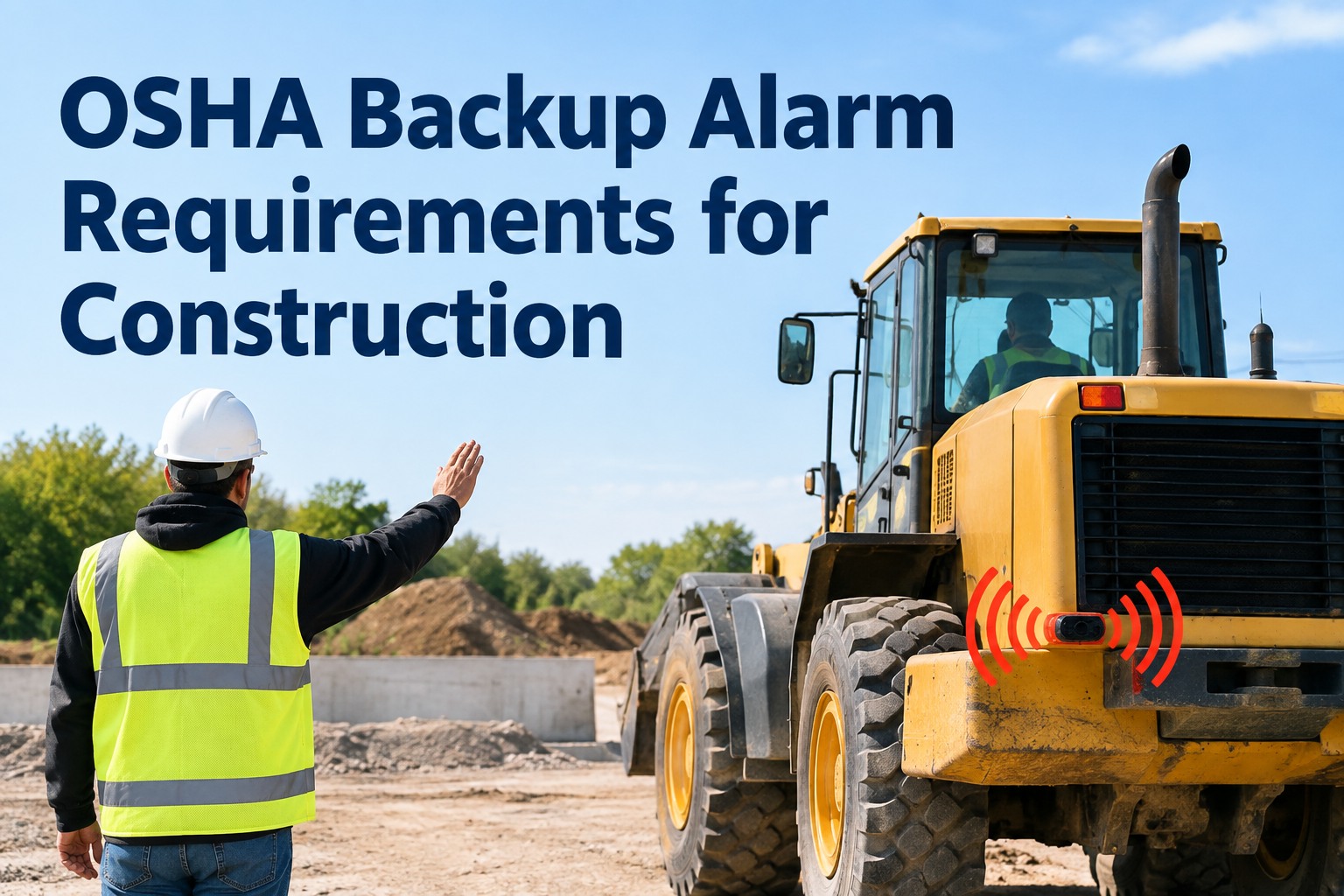
All bidirectional machines — rollers, compactors, front-end loaders, dozers — must have a horn distinguishable from surrounding noise. And equipment with an obstructed rear view needs a reverse signal alarm audible above the noise, or a spotter, before it backs up.
Equipment can only be moved on access roads and grades built and maintained to safely accommodate it — and every emergency access ramp and berm must be built to restrain and control a runaway vehicle. The ground the machine runs on is part of the standard, not just the machine.
The value of understanding 1926.602 as a whole is that its requirements don't live in isolation — they're the checklist of what makes a piece of earthmoving equipment safe to operate. Below is what the standard covers, its core equipment requirements in plain terms, and how a single daily inspection keeps a machine compliant with all of them at once.
What 1926.602 covers
The standard applies to material handling equipment on construction sites, and its heart is the earthmoving fleet — the machines that shape the site. Knowing what's in scope is the first step to knowing which requirements apply to which machine.
Earthmoving equipment — §602(a)
Scrapers, loaders, crawler and wheel tractors, bulldozers, off-highway trucks, graders, agricultural and industrial tractors, and similar equipment — the general rules that carry most of the standard.
Excavating & other equipment — §602(b)
Tractors used with backhoe, breaker, or similar attachments keep their earthmoving requirements — and grader scissor points must be protected. The rules follow the machine, not just its base configuration.
Lifting & industrial trucks — §602(c)–(d)
Lifting and hauling equipment and powered industrial trucks carry their own requirements, including operator training — so forklifts and similar machines aren't left out of the picture.
The takeaway is breadth: 1926.602 isn't a single-topic rule, it's the equipment-safety baseline for the whole mechanized side of a construction site. That's why treating it as one connected checklist — rather than chasing individual line items — is the practical way to stay compliant. Start free and track 1926.602 items per machine.
The core equipment requirements
Strip 1926.602 down and most of it is a set of requirements about what a machine must have and that those things must work. These are the ones that matter every day, and each maps directly to an item you can check before the machine runs.
Brakes that stop and hold
A service braking system able to both stop and hold the equipment fully loaded. On a grade with a full bucket, a brake that only slows the machine isn't compliant — and isn't safe.
Horns & reverse alarms
Bidirectional machines need a horn distinguishable from site noise; equipment with an obstructed rear view needs a reverse alarm or a spotter. See our guide to backup alarm requirements.
Seat belts with ROPS
Belts on covered seated machines keep the operator inside the rollover structure. See our guide to seat belt requirements on heavy equipment.
ROPS & overhead protection
Rollover protective structures and overhead protection are required per Subpart W — the structure that makes the seat belt's protection possible in a tip-over.
One note worth knowing on scope: the standard's fender requirement for fast pneumatic-tired haulage equipment has been suspended pending reconsideration, so that specific item isn't currently enforced — but the brakes, alarms, belts, and ROPS requirements very much are. When in doubt, treat a safety device as required and verify it works. Start free and put the 1926.602 essentials on every check.
The part people forget: access roads and grades
It's easy to think of 1926.602 as purely a machine standard, but it also governs the ground those machines travel. A well-maintained machine on a badly built haul road is still an incident waiting to happen, and the standard treats the roadway as part of the safety system.
Access roads and grades must be built and maintained to safely accommodate the equipment using them — and emergency access ramps and berms must be able to restrain and control a runaway vehicle. The condition of the haul road is a compliance item, not just a convenience.
This matters most on grades, where a brake failure or a lost load turns into a runaway, and the berm or ramp is the last line of defense. Building and maintaining those features — and inspecting them as conditions change — is as much a part of 1926.602 compliance as the machines themselves. Book a demo to log haul-road and berm condition checks.
How one inspection covers most of the standard
Here's what makes 1926.602 manageable rather than overwhelming: the companion inspection rule pulls nearly all of its equipment requirements into a single start-of-shift check. Rather than tracking each requirement separately, you verify them together, before the machine goes to work.
Check the safety-critical items
Service and parking brakes, emergency stop, tires, horn, steering, coupling devices, seat belts, operating controls, and safety devices — the start-of-shift inspection list.
Correct defects before service
Any defect that could cause failure in use is corrected before the machine is placed in service — not deferred to later in the day.
Record the inspection
Log the check and any defect found and fixed — the documentation that proves the machine was verified compliant with 1926.602 that day.
That's the practical heart of it: nearly every equipment requirement in 1926.602 — brakes, horn, seat belt, steering, safety devices — appears on that one daily inspection. Do the inspection well and record it, and you're meeting the bulk of the standard as a matter of routine, with the proof to show for it. Start free and turn 1926.602 into one daily inspection.
Operators and training
Equipped machines still need capable operators, and the standard reflects that — particularly for powered industrial trucks, where operator training is an explicit requirement. Across all covered equipment, a competent, trained operator is the difference between the safeguards working and being bypassed.
The practical program pairs the equipment side with the human side: the machine is inspected and compliant, and the operator is trained on it, aware of its hazards, and using its safety devices as intended. Keeping training records alongside inspection records gives a complete picture — the machine was safe and the person running it was qualified — which is exactly what stands up in an audit or after an incident. Documenting both is what turns 1926.602 from a set of rules into a demonstrable safety program. Book a demo to keep operator training and equipment records together.
The OSHA 1926.602 compliance checklist
Use this to confirm your earthmoving fleet meets the standard's core requirements and keeps the proof. Use this 1926.602 checklist online free, with each equipment item recorded on the pre-shift inspection.
-
Brakes stop and hold fully loaded
Service braking able to stop and hold the machine loaded, including on grades — verified each shift. -
Horn and reverse alarm work
A horn on bidirectional machines and a reverse alarm or spotter for obstructed-rear-view equipment, tested and audible. -
Seat belts present and worn
A belt on every covered seated machine, in good condition, and a policy that it's actually used. -
ROPS and overhead protection intact
Rollover protective structures and overhead guards in place and undamaged per Subpart W. -
Access roads, grades and berms maintained
Haul roads built and maintained for the equipment, with emergency ramps and berms able to restrain runaways. -
Inspect, train and document
A start-of-shift inspection, trained operators, and records of both — correcting defects before service.
From a fleet manager who made the standard routine
For a while I treated 1926.602 as this intimidating block of regulation — brakes here, alarms there, seat belts somewhere else — and every OSHA visit felt like a scramble to prove we were on top of all of it. The thing that clicked was realizing almost all of it comes down to one question: does this machine's safety equipment work, and did we check it?
We built the whole standard into a single pre-shift inspection — brakes, horn, reverse alarm, seat belt, steering, the works — and now compliance is just a daily habit with a record behind it. When an inspector asks about 1926.602, I don't dig through binders; I pull up the machine and show every check. Same rules, a fraction of the stress.
Frequently asked questions
What is OSHA 1926.602?
29 CFR 1926.602 is OSHA's construction standard for material handling equipment, part of Subpart O. Its core is earthmoving equipment — scrapers, loaders, tractors, bulldozers, off-highway trucks, graders, and similar machines — and it sets requirements for how those machines must be equipped and operated: seat belts, service brakes, audible alarms and horns, rollover protective structures, and safely built access roads and grades. It also covers excavating equipment, lifting and hauling equipment, and powered industrial trucks. In short, it's the equipment-safety baseline for the mechanized side of a construction site.
What equipment does 1926.602 apply to?
The general earthmoving rules in §602(a) apply to scrapers, loaders, crawler and wheel tractors, bulldozers, off-highway trucks, graders, agricultural and industrial tractors, and similar equipment. Section 602(b) covers excavating and other equipment, including tractors fitted with backhoe or breaker attachments, which keep their requirements. Sections 602(c) and (d) address lifting and hauling equipment and powered industrial trucks, which carry additional requirements including operator training. So the standard reaches most of the mobile mechanized equipment on a construction site, not just classic earthmovers.
What are the main requirements under 1926.602?
The core equipment requirements are: service brakes able to stop and hold the machine fully loaded; a horn on bidirectional machines and a reverse alarm (or spotter) for equipment with an obstructed rear view; seat belts on covered seated equipment, working with rollover protective structures; and ROPS and overhead protection per Subpart W. It also requires access roads and grades built and maintained for the equipment, with emergency ramps and berms able to restrain runaways. A fender requirement for fast haulage equipment exists in the text but is suspended pending reconsideration.
Does 1926.602 require equipment inspections?
The equipment requirements in 1926.602 pair with a companion inspection rule in the same subpart requiring a start-of-shift inspection of construction vehicles — service and parking brakes, the emergency stop, tires, horn, steering, coupling devices, seat belts, operating controls, and safety devices. Any defect that could cause failure in use must be corrected before the machine is placed in service. Because nearly every 1926.602 item appears on that inspection, a thorough, recorded pre-shift check is the practical way to meet and demonstrate compliance day to day.
What do the brake requirements in 1926.602 mean?
Under §602(a)(4), all covered earthmoving equipment must have a service braking system capable of both stopping and holding the machine when fully loaded, meeting the applicable SAE criteria. The key phrase is stop and hold: a machine on a grade with a full load must both come to a stop and stay stopped, so brakes that slow it but can't hold it loaded on a slope don't satisfy the rule. It's why brake function should be verified in the daily inspection, especially for equipment on grades where a brake failure becomes a runaway.
Turn OSHA 1926.602 into a daily check you can prove
HVI puts the 1926.602 essentials — brakes, horn, reverse alarm, seat belt, steering, safety devices — on the pre-shift DVIR for every machine, flags defects before the machine runs, and retains each check with operator training records for an OSHA review. So the whole standard becomes one daily inspection with the proof attached, instead of a scramble to show you were compliant.
No credit card · 1926.602 items on every DVIR · Audit-ready inspection & training records