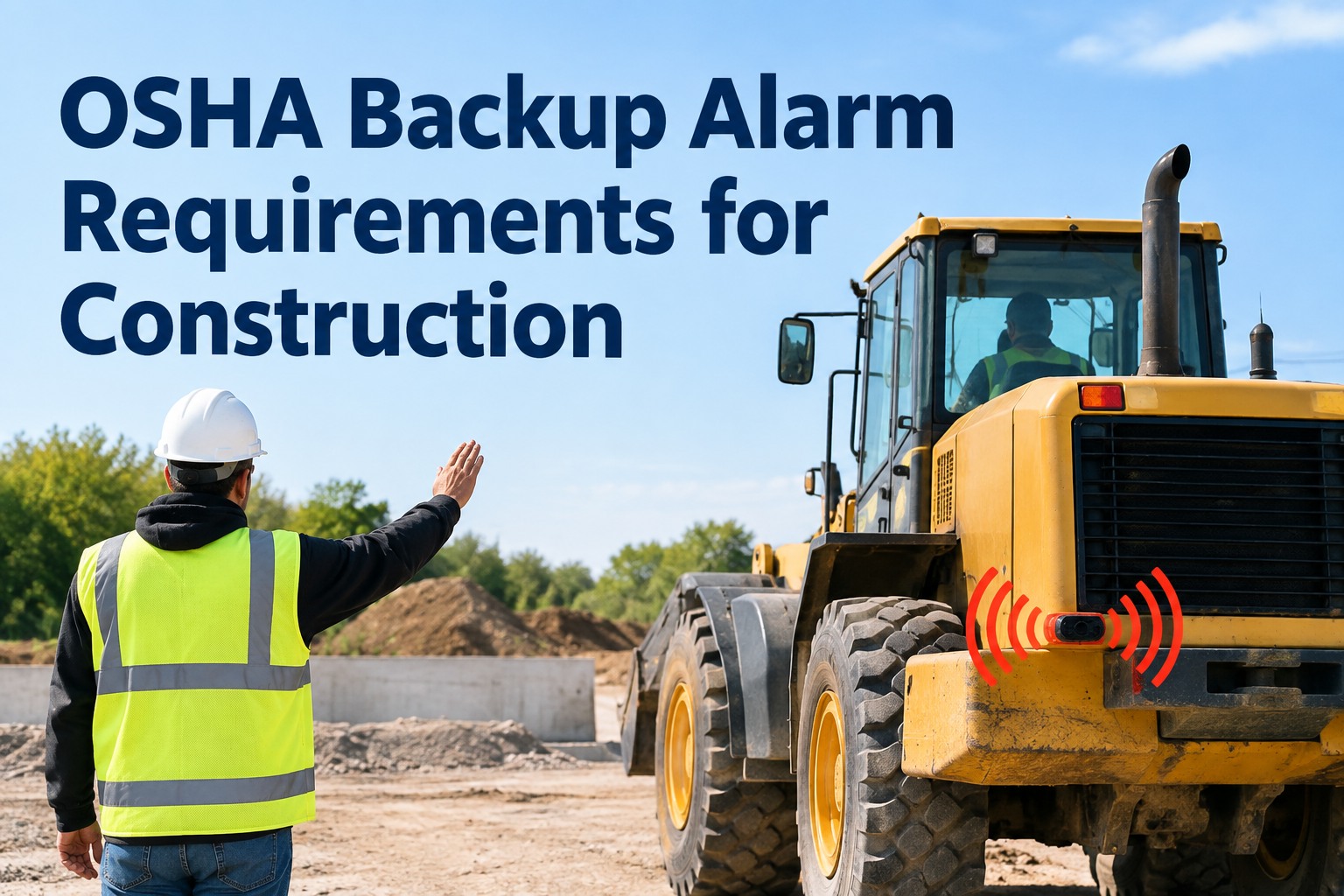
The rule sounds simple — put a beeper on the truck — but OSHA's backup alarm requirements are more specific than most crews realize, and getting them wrong is a common citation. The requirement only kicks in when the rear view is obstructed, the alarm has to be audible above the site's noise, and an alarm isn't even the only way to comply. Understanding exactly what the standard says, and what counts as meeting it, is the difference between a compliant backing operation and a back-over waiting to happen. This guide walks the requirement, the compliant options, and the daily check that proves it. See how a working backup alarm gets verified every shift
When the Rear View Is Blocked, OSHA Gives You Three Ways to Comply
The standard is an either/or, not just "install an alarm." Tap a compliant option to see exactly what it requires.
A reverse signal alarm that is audible above the surrounding noise level — loud and distinct enough to warn workers in and near the vehicle's path in time to move. It doesn't have to be a single-tone beeper; broadband or other alarms qualify if they're shown to be effective.
The vehicle is backed up only when an observer signals that it is safe to do so. A trained spotter is frequently the more reliable choice, since workers can grow deaf to constant alarms — and many contractors use a spotter and an alarm together.
A rear camera can substitute if it gives a clear, continuous, unobstructed view of the whole path behind the vehicle. Radar and proximity systems can also qualify — but only where they genuinely warn in time, not as a box-ticking add-on.
Backing a machine you can't see behind is one of the most dangerous routine actions on a jobsite, which is why OSHA regulates it precisely. Below is exactly when the requirement applies, what each compliant option demands, and how a daily inspection keeps the safeguard real — because an alarm only protects anyone if it actually works.
When the backup alarm requirement applies
The single most misunderstood part of the rule is when it's triggered. OSHA doesn't require a backup alarm on every vehicle in every situation — it requires a warning method when the operator's view to the rear is obstructed. That's the condition that turns the requirement on.
An obstructed view to the rear
If the operator can't see the area directly behind the vehicle — whether partly or fully blocked — the requirement is in effect and one of the compliant methods must be used.
Construction motor vehicles & equipment
The two standards cover motor vehicles used in construction and earthmoving or compacting equipment — the dump trucks, loaders, dozers, and rollers that back up around crews.
Used in reverse
The requirement is about backing specifically — the hazard is a machine moving toward a blind zone where a worker on foot can't be seen in time.
Once those conditions are met, the employer must use one of the compliant options — an audible alarm, a spotter, or an equivalent technology that genuinely warns. What the rule doesn't allow is backing a machine with an obstructed rear view and no method of warning at all. Book a demo to flag which machines need a backing safeguard.
Option A: what makes an alarm compliant
Most sites default to a reverse signal alarm, and the standard's language on it is short but exact: the alarm must be audible above the surrounding noise level. That phrase does more work than it looks — it's a performance requirement, not a checkbox for "has a beeper."
Audible above surrounding noise
The alarm has to be distinguishable from the site's noise — loud and distinct enough to actually warn workers in the vehicle's path, and those walking toward it, in time to get clear. On a loud site, a quiet alarm doesn't meet the standard.
A single-tone beeper
The rule doesn't mandate the classic single-tone alarm. Broadband "white noise" alarms and other designs are acceptable if they're shown to be effective — which can help with noise complaints from nearby residents while still complying.
The practical implication is that "audible above surrounding noise" is judged in context — the same alarm can comply on a quiet site and fall short on a loud one. And a compliant alarm that has failed is no alarm at all, which is why verifying it works is as important as having it. Start free and put the backup alarm on every pre-use check.
Option B and the alternatives: spotters, cameras, and radar
The alarm is only the first option. OSHA explicitly allows a spotter instead, and interpretation letters have accepted camera and radar systems as substitutes — giving contractors flexibility to pick the method that actually fits the work.
A spotter who signals it's safe
Backing only on a trained observer's signal fully satisfies the rule — and is often the more reliable control, since a spotter can see and think in ways a fixed alarm can't. It works only if the spotter stays in view and out of the path.
A rear camera — if it clears the view
A camera can substitute only if it provides a clear, continuous, unobstructed view of the entire path behind the vehicle, so the operator can see anyone in the danger zone. A partial or grimy view doesn't qualify.
Radar & proximity detection
Radar, sonar, and other discriminating systems that detect people or objects behind the machine and warn the operator can qualify — where they genuinely provide adequate warning in time to prevent a strike.
The common thread across all the methods is effectiveness, not the device: OSHA cares whether the chosen method actually warns in time to prevent a back-over. That's also why the strongest sites layer them — a spotter plus an alarm, or a camera plus an alarm — so one failing doesn't leave the blind zone unguarded. For how backing fits the wider picture, see our guide to struck-by prevention around heavy equipment. Book a demo to record spotter assignments alongside equipment checks.
The inspection that keeps the alarm real
A backup alarm is a safeguard that quietly fails — a blown fuse, a corroded connector, a speaker packed with mud — and nobody notices until it doesn't sound at the worst moment. That's why the requirement pairs naturally with the daily inspection: OSHA calls for a start-of-shift check on construction vehicles, and the backup alarm belongs on it.
Test the alarm each shift
Confirm the reverse alarm sounds and is audible above the day's noise — alongside brakes, horn, steering, mirrors, and cameras, as part of the pre-shift inspection.
Flag and tag a failure
An alarm that doesn't sound takes the machine out of backing service until it's fixed, or a spotter covers every reverse in the meantime — not "we'll get to it."
Record the check
Log that the alarm was tested and working — the proof that the safeguard was verified, which is exactly what gets examined after a backing incident or in an audit.
This is where the requirement meets daily reality: the rule is only as good as the last time someone confirmed the alarm worked. A documented pre-use inspection turns "there's an alarm on it" into "the alarm was tested and working this morning" — and after a back-over, that record is the difference between a defensible position and an indefensible one. Start free and keep a signed record of every alarm check.
The backup alarm compliance checklist
Use this to confirm your backing operations meet the standard and stay verified. Use this backup alarm checklist online free, with each machine's alarm check recorded on the pre-shift inspection.
Identify obstructed-rear-view machines
Know which vehicles and equipment have a blocked rear view and therefore trigger the requirement when backing.Choose a compliant method per machine
An audible alarm, a spotter, or an effective camera or radar system — and layer them where the risk is highest.Verify the alarm is audible above noise
Confirm the alarm is loud and distinct enough for the actual site conditions — not just present.Confirm cameras give an unobstructed view
If a camera is the method, ensure it shows the whole path behind clearly and continuously, and is kept clean.Test devices on the pre-shift inspection
Check the backup alarm and backing aids at the start of each shift, with a spotter covering any that fail.Record every check and defect
Keep a documented, retrievable record that the alarm was tested and working — and that failures were corrected.
From a fleet manager who caught the dead alarms
I assumed our backup alarms were fine because they came on the trucks and nobody had complained. Then we started actually testing them on the morning walkaround, and in the first month we found three that didn't sound at all — one had been dead long enough that nobody could say when it quit. Those machines had been backing around crews the whole time with no working warning.
Now the alarm is a line on the pre-shift inspection, it gets tested and logged every day, and any truck with a dead alarm gets a spotter on every reverse until it's fixed. It's a two-second check that closes a gap I didn't even know we had — and if OSHA ever asks, I can show every alarm was verified working, by machine, by day.
Frequently asked questions
When does OSHA require a backup alarm?
OSHA requires a backing safeguard when a construction motor vehicle or piece of earthmoving equipment has an obstructed view to the rear and is used in reverse. Under 29 CFR 1926.601(b)(4) and 1926.602(a)(9), the machine can't be backed unless it either has a reverse signal alarm audible above the surrounding noise level, or is backed only when an observer signals that it is safe to do so. The trigger is the obstructed rear view — if the operator can't see behind the vehicle, one of the compliant methods must be in use. The rule is an either/or, not a mandate for an alarm in every case.
Can a spotter be used instead of a backup alarm?
Yes. Both 1926.601(b)(4) and 1926.602(a)(9) explicitly allow backing a machine with an obstructed rear view when an observer signals that it is safe to do so, as a full alternative to an audible alarm. In practice a trained spotter is often the more reliable control, because workers can become desensitized to constant backup alarms across a busy site, while a spotter can actively see and stop a backing movement. The spotter only works if they stay in the operator's view and out of the vehicle's path, and the operator stops the moment they lose sight of them. Many contractors use both together.
Does the backup alarm have to be a single-tone beeper?
No. The standard requires a reverse signal alarm that is audible above the surrounding noise level, but it doesn't specify the type of alarm. OSHA interpretation letters have confirmed that broadband or "white noise" alarms and other designs can meet the requirement if they are shown to be effective — that is, audible above the site noise and able to warn workers in time to avoid the vehicle. This flexibility can also help reduce noise complaints from residents near a construction site, since some alternative alarms are less piercing than the traditional single-tone beeper while still complying.
Can a backup camera replace a backup alarm?
It can, but only under a specific condition: the camera system must give the operator a clear, continuous, and unobstructed view of the entire path behind the vehicle, so the operator can see whether anyone is in the danger zone. OSHA has accepted rear-view camera systems on that basis. A camera that shows only part of the path, or one that's dirty or intermittent, does not remove the obstruction and wouldn't satisfy the requirement. Radar and proximity-detection systems can similarly qualify where they genuinely warn the operator in time. The test is always whether the method effectively prevents a back-over.
Do backup alarms need to be inspected?
Yes, and it's essential. OSHA requires a start-of-shift inspection of construction vehicles covering safety-critical items, and the backup alarm belongs on that check because it's a device that can fail silently — a blown fuse or damaged speaker leaves it inoperative with no obvious sign. Testing the alarm each shift confirms it sounds and is audible above the day's noise; a machine whose alarm has failed should be taken out of backing service or covered by a spotter on every reverse until repaired. Recording each check also provides the documentation that proves the safeguard was verified working, which matters after any backing incident or during an audit.
Make sure the backup alarm works — and that you can prove it
HVI puts the backup alarm on the pre-shift DVIR for every machine, alongside brakes, horn, mirrors, and cameras — so a dead alarm is caught before the vehicle backs up, defects are flagged, and each check is retained and retrievable. So the safeguard that prevents a back-over is verified working every shift, and the record that proves it is one search away for an OSHA review.
No credit card · Backup alarm on every DVIR · Audit-ready inspection records