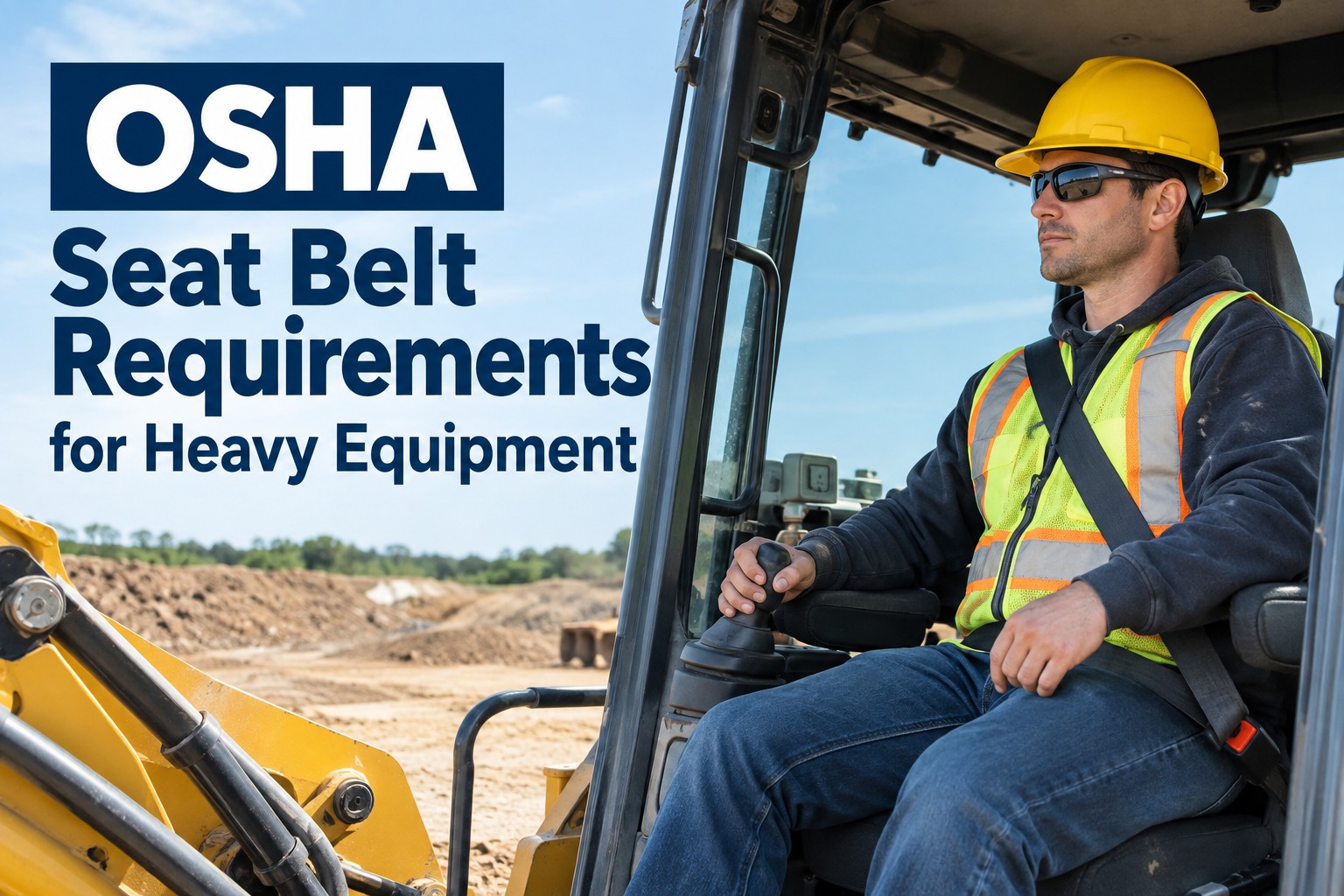
In an equipment rollover, the machine's rollover protective structure only saves the operator who's still in the seat when it stops — and the seat belt is the one thing keeping them there. Operators thrown from the cab during a tip-over are routinely crushed by the very machine meant to protect them. That's the whole logic behind OSHA's seat belt requirements for heavy equipment, and it's why a belt that's provided but never worn is a fatality waiting for the wrong slope. This guide covers which machines are covered, the exceptions, and how to run a seat belt policy that's actually enforced and documented. See how seat-belt checks land on the daily inspection
Not Every Machine Needs a Seat Belt — but Most of Yours Do
OSHA's rule has two narrow exceptions and one broad requirement. Pick a machine type to see the verdict and why.
Scrapers, loaders, tractors, bulldozers, off-highway trucks, graders, and similar machines are covered by §1926.602. A seat belt must be provided — and because the machine has a rollover structure, the belt is what keeps the operator inside that protected space in a tip-over.
Equipment designed only to be operated standing up doesn't require a seat belt — there's no seated position to restrain. This is a narrow exception tied to the machine's design, not a choice about whether to use a belt on a seated machine.
A seat belt need not be provided on equipment that has no rollover protective structure or adequate canopy — because with no protected space to keep the operator inside, the belt's rollover benefit doesn't apply. Where ROPS exists, though, the belt is essential.
Seat belts on heavy equipment are one of the clearest cases in construction safety where the rule and the physics agree completely. Below is why the belt and ROPS only work together, exactly what OSHA covers and exempts, the gap between providing a belt and actually using it, and how to build a policy that closes it.
Why the belt and ROPS only work together
The most important thing to understand about equipment seat belts is that they're not a standalone safety device — they're half of a system. A rollover protective structure creates a survival space around the operator, but that space only saves a life if the operator stays inside it when the machine goes over.
ROPS protects the space
The rollover structure is engineered to hold its shape and preserve a survival zone around the seat if the machine tips or rolls — a protected volume the operator can ride out the rollover inside.
The belt keeps you in it
Without a belt, a rolling machine throws the operator out of the seat and often out of the cab — into the path of the machine or the ROPS itself. The belt is the only thing that keeps them in the protected space.
This is why an unbelted operator in a ROPS-equipped machine is arguably in more danger during a rollover than they'd intuitively expect: the very structure meant to protect them can crush them if they're thrown partway out. ROPS without a worn belt is a half-built safety system. Start free and track that every ROPS machine has a working belt.
What's covered, and the two exceptions
OSHA's earthmoving equipment standard is specific about what's covered and what's exempt. The default is broad — most heavy equipment needs a belt — with only two narrow exceptions, both tied to the machine's design rather than the operator's preference.
The earthmoving fleet
Scrapers, loaders, crawler and wheel tractors, bulldozers, off-highway trucks, graders, agricultural and industrial tractors, and similar equipment — all require a seat belt. Tractors keep the requirement even when fitted with a backhoe or breaker attachment.
Stand-up-only equipment
Machines designed only to be operated standing up don't need a seat belt — there's no seated operating position to restrain in a rollover.
No ROPS or canopy
Equipment with no rollover protective structure or adequate canopy need not have a belt — without a protected space, the belt's rollover function has nothing to keep the operator inside.
The practical read: if a machine is seated, covered by the standard, and has a ROPS or canopy — which describes the large majority of a construction fleet — a seat belt is required. The exceptions are genuinely narrow, and none of them is "the operator finds it uncomfortable." Book a demo to see which machines carry the seat belt requirement.
Provided vs. used: where the real gap is
Here's the distinction that trips up a lot of contractors. The standard says a seat belt must be provided — but a belt bolted to a seat and never buckled saves no one. The question of whether it must be worn is answered by OSHA's PPE rule, and the answer is yes.
Providing the belt isn't enough — the employer is responsible for requiring it be worn. OSHA's personal protective equipment rule makes the employer responsible for requiring appropriate protective equipment wherever there's exposure to a hazard. For a seated ROPS machine, that means enforcing seat belt use, not just installing the belt.
This is the crux of a real seat belt program: the equipment side (a belt is present and works) is the easy half, and the behavior side (the operator actually wears it, every time) is where fatalities are won or lost. A belt that's provided but unenforced is a compliance gap and a genuine hazard at the same time — and enforcement is the employer's job, not the operator's discretion. Rollover is one of the caught-in/between mechanisms in OSHA's Focus Four hazards. Book a demo to document seat belt training and enforcement.
Building an enforceable seat belt policy
Closing the provided-versus-used gap takes a policy that's more than a line in a handbook. Four elements turn "we require seat belts" into a practice operators actually follow and you can actually prove.
A written, specific policy
State plainly that seat belts are mandatory on all covered seated equipment, with the narrow exceptions named — so there's no ambiguity about when the belt goes on.
Operator training & sign-off
Train operators on why the belt and ROPS work together and get a documented acknowledgment — understanding the rollover physics changes behavior more than a rule alone.
Consistent enforcement
Supervisors reinforce belt use in the field and apply the policy evenly — a rule that's enforced sometimes teaches operators it's optional the rest of the time.
Inspection & documentation
Check the belt's condition each shift and keep records of the policy, training, and checks — the proof the program is real if OSHA or an incident review asks.
The elements reinforce each other: training explains the why, the written policy sets the expectation, enforcement makes it stick, and documentation proves it happened. Drop any one and the program weakens — an untrained crew ignores the policy, an unenforced policy gets forgotten, and an undocumented program can't be demonstrated. Start free and keep the whole seat belt policy on record.
The inspection that keeps the belt trustworthy
A seat belt is only as good as its condition, and belts on heavy equipment take a beating — sun, grit, hydraulic fluid, and constant use fray webbing, seize retractors, and crack buckles. A belt that won't latch or a frayed strap that will tear on impact is no protection at all, which is why the belt belongs on the daily inspection.
Check webbing & buckle
Inspect the belt for frayed or cut webbing, a buckle that latches and releases cleanly, and a retractor that works — part of the start-of-shift equipment check.
Flag a defective belt
A damaged or non-functional belt takes the machine out of service until it's replaced — a torn belt is a false sense of safety, not a working one.
Record the check
Log that the belt was inspected and sound — documentation that the safeguard was verified, and part of the record that shows the policy is enforced.
Together the equipment check and the policy make a complete program: the inspection guarantees the belt works, and the policy and enforcement guarantee it's worn. Neither alone is enough — a perfect belt nobody buckles, or a diligent operator with a broken belt, both end the same way in a rollover. Recording both is what turns a good intention into a defensible, effective safeguard. Start free and add the seat belt to every pre-use inspection.
The heavy equipment seat belt checklist
Use this to confirm your seat belt program covers the equipment, the exceptions, and the enforcement. Use this seat belt policy checklist online free, with each belt check recorded on the pre-shift inspection.
Identify covered equipment
Know which seated, ROPS-equipped machines in the fleet carry the seat belt requirement — most of them.Confirm a belt on every covered machine
Every covered machine has a seat belt provided that meets the applicable SAE standard.Put the policy in writing
A clear, mandatory seat belt policy for covered equipment, with the narrow exceptions named.Train and get sign-off
Operators trained on the ROPS-and-belt logic, with a documented acknowledgment of the policy.Enforce use consistently
Supervisors reinforce belt use in the field and apply the policy evenly, every shift.Inspect the belt & record it
Check webbing, buckle, and retractor each shift, pull defective belts from service, and log the check.
From a safety manager who made it stick
We had the belts and we had a policy on paper, but if I'm honest, half the operators weren't buckling up and nobody was really pushing it. It took a rollover on another crew — operator lived only because he happened to be belted that day — to make it real for everyone. The difference between him and a fatality was a two-second habit.
What changed it wasn't a harsher rule, it was showing operators the physics: the ROPS only works if you stay inside it. Once they got that, belt use went way up. Now the belt's checked every morning, the training's on file, and supervisors treat an unbelted operator like any other stop-work item. It's the same belt that was always there — we just finally made sure it's worn and can prove it.
Frequently asked questions
Does OSHA require seat belts on heavy equipment?
Yes. Under 29 CFR 1926.602(a)(2), seat belts must be provided on all covered earthmoving equipment — scrapers, loaders, tractors, bulldozers, off-highway trucks, graders, and similar machines — meeting the applicable SAE standard. There are two narrow exceptions: equipment designed only for stand-up operation, and equipment that has no rollover protective structure or adequate canopy. For the large majority of a construction fleet, which is seated and ROPS-equipped, a seat belt is required. The belt works together with the ROPS: the structure protects the operator's space in a rollover, and the belt keeps the operator inside it.
Are equipment operators required to wear the seat belt, or just have one?
Both. The earthmoving standard requires that seat belts be provided, and OSHA's personal protective equipment rule makes the employer responsible for requiring appropriate protective equipment be worn wherever there's exposure to a hazard. So on a seated, ROPS-equipped machine, the employer must both provide the belt and enforce its use. A belt that's installed but never worn doesn't meet the intent of the requirement and leaves the operator exposed to the deadliest rollover outcome, ejection. Enforcement is the employer's responsibility, not left to operator preference.
What equipment is exempt from the seat belt requirement?
There are two exceptions in the standard, both tied to the machine's design. First, equipment designed only for stand-up operation doesn't need a seat belt, because there's no seated operating position to restrain. Second, equipment that has no rollover protective structure or adequate canopy protection need not have a belt provided, since without a protected survival space the belt's rollover function has nothing to keep the operator inside. Neither exception is about operator comfort or preference — a seated machine with a ROPS or canopy requires a belt regardless of how the operator feels about wearing it.
How do seat belts and ROPS work together?
They're two halves of one rollover protection system. A rollover protective structure is engineered to hold its shape and preserve a survival space around the operator's seat if the machine tips or rolls. But that space only saves the operator if they stay inside it — and a rolling machine will throw an unbelted operator out of the seat, often out of the cab and into the path of the machine or the ROPS itself. The seat belt is the only thing that keeps the operator within the protected zone. ROPS without a worn belt is a half-built system, which is why the two are required and used together.
Should seat belts be part of equipment inspections?
Yes. Seat belts on heavy equipment endure sun, grit, hydraulic fluid, and constant use, which fray webbing, seize retractors, and damage buckles — and a belt that won't latch or has torn webbing offers no protection in a rollover. Including the belt in the start-of-shift equipment inspection catches these problems before the machine runs: check the webbing for fraying or cuts, confirm the buckle latches and releases cleanly, and verify the retractor works. A defective belt should take the machine out of service until replaced. Recording the check also documents that the safeguard was verified and supports the enforcement side of the policy.
Make the belt worn, working, and provable — on every machine
HVI puts the seat belt on the pre-shift DVIR for every covered machine, keeps operator training and policy sign-offs on record, and retains every check for an OSHA review. So the belt that keeps an operator inside the ROPS is verified working each shift, the policy behind it is documented and enforced, and the proof is a search away if a rollover or an audit ever tests it.
No credit card · Seat belt on every DVIR · Policy, training & inspection records