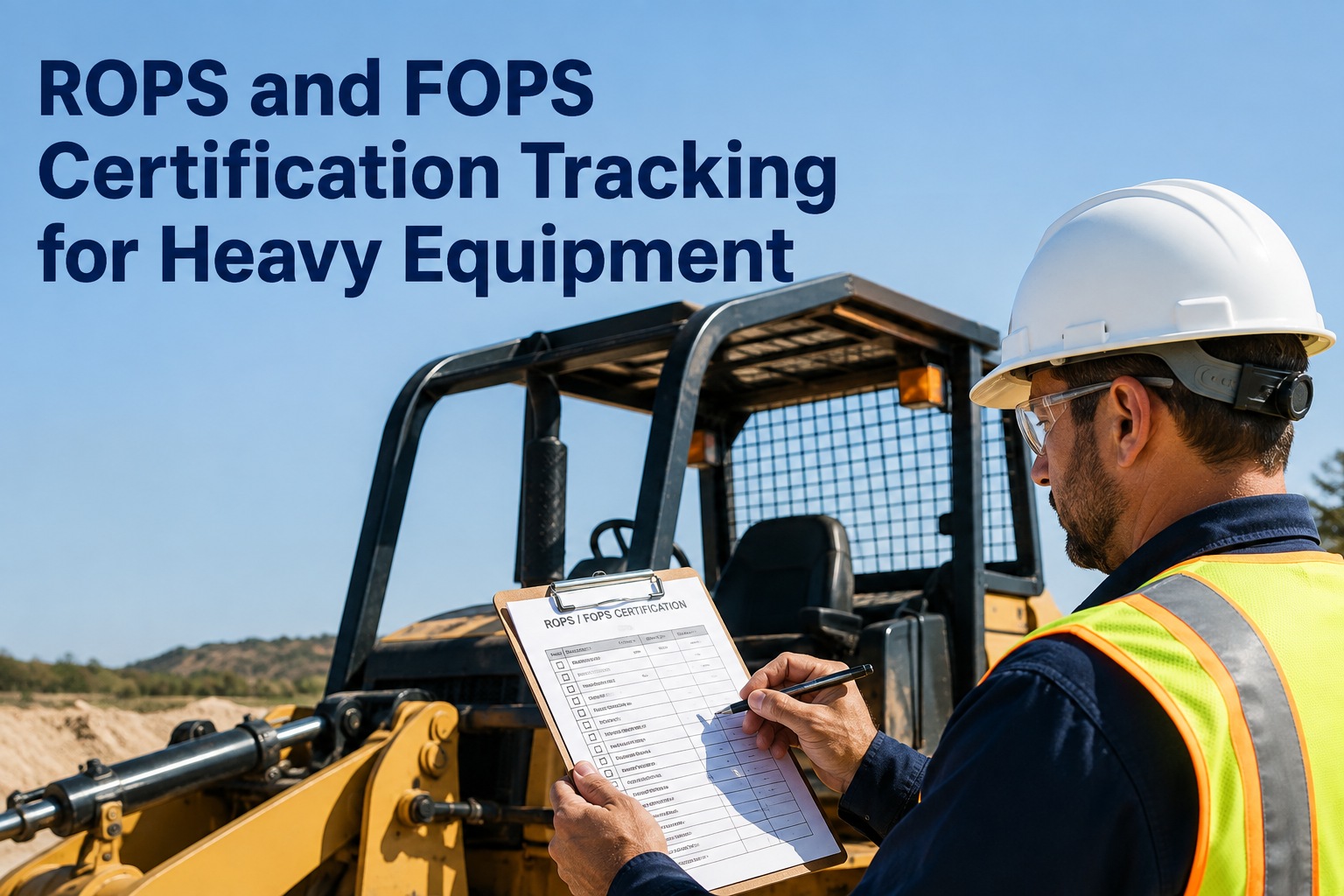
The excavator comes back from the weekend job with a dent in the canopy rail and a fresh set of holes someone drilled to mount a work light, and now your site supervisor is asking the question nobody wants to answer: is this machine still legal to run? ROPS certification is not a sticker you buy once and forget - it is a structural guarantee tied to that exact machine's mass, and the moment the structure is bent, drilled or field-welded, that guarantee is gone. Most crews find this out the expensive way, after a well-meaning welder has "fixed" a cracked rollover protective structure and quietly voided the certification, leaving you with a machine that looks repaired and is legally scrap until a manufacturer-authorised shop recertifies or replaces it. This page breaks down what ROPS and FOPS certification actually covers, when damage takes a machine out of service, why the seat belt is half the system, and how to keep certificates, damage photos and out-of-service work orders in one audit-ready place. If you want to see this running on your own units, you can book a 30-minute walkthrough of ROPS tracking in HVI and test it against your worst-case machine.
One drilled hole can take a $400,000 machine out of service
ROPS and FOPS certification lives or dies on structural integrity. Track every tag, every dent and every repair decision before a well-intentioned weld turns into an uninsurable liability.
What a damaged ROPS actually costs you
The structure itself is rarely the big number. The big number is the machine sitting idle while you argue about whether it is safe to run.
What ROPS and FOPS certification actually covers
A ROPS is not a strong-looking frame. It is an engineered structure tested to absorb a specific energy load for a specific machine mass - which is why you cannot swap, modify or weld one without consequences.
ROPS - rollover protective structure
The cab, canopy or frame engineered to keep a survivable space around the operator if the machine rolls. It is tested against the machine's gross mass, so a ROPS certified for a 12-tonne excavator is not certified for a 20-tonne one, even if it bolts on.
FOPS - falling object protective structure
The overhead guard that protects the operator from rocks, debris and loads dropping from height - critical on demolition, quarry, forestry and waste-handling work. FOPS carries its own test levels, and a ROPS tag does not automatically mean FOPS compliance.
The certification tag
Every certified structure carries a plate or tag showing the manufacturer, the standard it was tested to, the machine model and the maximum machine mass it covers. If the tag is missing, illegible or does not match the machine, treat the structure as uncertified until proven otherwise.
The mass-specific point is the one that catches mixed fleets. When you move a cab or canopy between machines, or buy a used unit with a "similar" ROPS fitted, the certification only holds if the tag's rated mass covers the machine it is bolted to. Keeping that tag data on file per asset - instead of climbing over the machine with a torch at audit time - is exactly the kind of record you can hold when you start logging equipment records free in HVI.
When ROPS damage puts a machine out of service
The out-of-service rule is simple to state and brutal in practice: any structural damage, deformation or unauthorised modification means the certification is in question - and a machine with a questionable ROPS does not operate with an operator in the seat.
Dents, bends or cracks in any structural member
A ROPS works by deforming in a controlled way under a load far beyond normal use. A member that is already bent or cracked has used up part of that capacity. There is no "small dent" exemption - the structure needs assessment before the machine works again.
Holes drilled for accessories
This is the certification-voiding event that happens constantly: beacon brackets, radio aerials, fire suppression lines, camera mounts, extra lights. Every drilled hole is a stress riser the structure was never tested with, and it voids the tag the moment the drill bit touches the member.
Any weld, cut or heat applied in the field
ROPS steels are specified and welded under controlled procedures. A field weld changes the metallurgy, creates brittle heat-affected zones and - critically - is performed by someone with no authority to recertify. The repair looks solid and is legally worthless.
Missing, painted-over or mismatched certification tag
If you cannot prove what the structure is rated for, you cannot prove the operator is protected. Treat an unreadable or mismatched tag the same as damage: park the machine until the paperwork or the structure is resolved.
The practical problem is not knowing the rule - it is catching the event. A dent picked up on a Monday walkaround becomes a photo, a flagged defect and an out-of-service work order before the machine gets dispatched again. That capture-to-work-order loop is what a guided demo of HVI's defect workflow shows on a live asset.
ROPS repair certification: the only two paths that count
Once a structure is damaged, you have exactly two defensible options. Everything else is a liability dressed up as a repair.
| Decision point | Manufacturer-authorised repair | Full ROPS replacement | Field weld (never) |
|---|---|---|---|
| Who does the work | Shop authorised by the OEM, working to the original procedure | OEM or approved supplier fits a new certified structure | Whoever has a welder on site |
| Certification after work | Recertified with documentation from the authorised shop | New tag and certificate issued with the structure | None - certification stays void |
| Typical cost position | Lower parts cost, but assessment and labour add up | Higher upfront cost, cleanest paper trail | Cheap today, uninsurable tomorrow |
| Downtime profile | Days to weeks depending on shop queue and transport | Depends on parts availability - plan for weeks on older models | Zero until someone asks a question - then indefinite |
| Audit and insurance position | Defensible with the recertification document on file | Defensible with the new certificate on file | Undefensible - you own the modification |
A 14-tonne excavator takes a dent in the canopy rail on a demolition job. The operator reports it with two photos through the pre-start check. The machine is parked Monday instead of running three more shifts. The authorised shop assesses it Wednesday, recertifies the repair the following week, and the certificate lands in the asset file. Total lost time: six working days at roughly $1,500 a day in job revenue - about $9,000. The alternative was a field weld on Tuesday morning: the machine "back at work," the certification void, and a rollover in month four with no defensible record. The $9,000 was the cheap option.
The seat belt requirement ROPS depends on
A ROPS only protects an operator who stays inside it. The structure and the seat belt are one system, and one of them gets checked far less often than the other.
What the ROPS does
Maintains a survival space around the seat during a rollover, absorbing energy through controlled deformation. It assumes the operator is held in that space.
- Tested against machine mass
- Certified as a complete structure
- Voided by drilling, welding, cutting
What the belt does
Keeps the operator inside the survival space instead of being thrown under the machine or the structure itself. An ejected operator gains nothing from the strongest ROPS ever built.
- Webbing frays, cuts and UV-degrades
- Retractors jam with dust and mud
- Buckles fail quietly - nobody tests them
This is why belt condition and belt use belong on the same daily check as the structure. A frayed belt or a dead retractor is a defect with the same weight as a cracked rail, and it deserves the same photo, the same work order and the same close-out record. Fleets that walk through HVI's inspection templates on a demo call usually add belt checks to every ROPS-equipped unit within the first week.
ROPS certification tracking built into the daily workflow
HVI is cloud plus mobile inspection and maintenance work order software for mixed fleets - trucks, trailers and off-road plant on one platform. Here is what that means for protective structures specifically.
Structural checks in every template
ROPS and FOPS condition, tag legibility and seat belt checks are embedded in the excavator, dozer, loader and roller inspection templates - so the operator on any phone captures them every pre-start, not when someone remembers.
Certificates held per asset
Certification tags, recertification documents and replacement certificates attach to the asset record. When a client, insurer or auditor asks, you pull the file in seconds instead of ringing three people.
Damage events with photo evidence
A dent or drilled hole becomes a timestamped photo defect that generates an out-of-service work order automatically. The machine cannot quietly return to the dispatch board while the structure is in question.
Audit-ready history
Every check, defect, work order and certificate is timestamped and photo-backed. You can prove what was found, when it was found and what you did about it - the three questions every incident investigation asks.
See your own fleet's ROPS records in one place
Bring your worst machine - the one with the drilled canopy and the missing tag - and we will show you how its record should look.
A ROPS inspection checklist your operators will actually complete
Structural checks fail when they live in a binder. These six checks take under two minutes on a phone and catch every certification-voiding event on this page.
Certification tag present and legible
Tag matches the machine, rated mass covers the unit, no paint or damage hiding the data.
No dents, bends or cracks
Walk every structural member including the rear posts and the canopy rails - the spots loaders and branches actually hit.
No drilled holes or add-on brackets
Any new hole, clamp mark or welded tab is a stop-work event until it is explained.
Mounting bolts and isolators intact
The structure is only as good as its mounts. Check for loose, missing or elongated bolt holes at the frame.
Seat belt webbing, retractor and buckle
Pull the full belt out, check for fraying and cuts, test the retractor lock and click the buckle twice.
FOPS guard condition where fitted
Screens, guards and overhead protection checked for impact damage on demolition, quarry and forestry units.
Each failed item captures a photo and raises a defect on the spot. Fleets moving off paper pre-starts usually sign up free and run this checklist on one machine for a week before rolling it across the fleet.
ROPS compliance is a record-keeping problem, not an engineering problem
The engineering was settled when the structure left the factory. What decides your exposure is whether you can prove the structure stayed intact, and what you did the day it did not.
- Certification is mass-specific and tag-dependent. Know what each structure is rated for and keep the proof on the asset file, not in someone's memory.
- Damage, drilling and field welding all void the tag. Treat any of the three as an out-of-service event until a manufacturer-authorised shop says otherwise.
- Only two repair paths exist. Authorised repair with recertification, or full replacement with a new certificate. Everything else is liability.
- The seat belt is half the system. Check it with the same discipline as the structure, every pre-start.
- ROPS certification tracking lives or dies on daily capture. Photos, defects, work orders and certificates in one system beat a binder every audit.
If you want to pressure-test this against your own fleet before committing to anything, a 30-minute demo focused on your protective-structure records is the fastest way to see the gaps.
The argument I used to have every quarter was whether a dent was "bad enough" to park a machine. Now there is no argument - the photo goes in, the work order says out of service, and the certificate goes back on file when the authorised shop is done. I track one number: how many machines are running with an unresolved structural defect. It has been zero for over a year, and my insurer noticed before my directors did.
Darren Whitfield - Safety & Compliance Manager, civil earthworks contractor running 60+ items of mobile plant
ROPS and FOPS certification FAQs
Does drilling a hole in a ROPS really void the certification?
Can a damaged ROPS be repaired, or does it have to be replaced?
How do I prove ROPS compliance during an audit or after an incident?
Is a ROPS still effective if the operator is not wearing the seat belt?
How often should ROPS and FOPS structures be inspected?
Never wonder whether a machine is legal to run again
Structural checks in every pre-start, certificates on every asset, out-of-service work orders the moment damage is found. That is ROPS certification tracking done properly.
Free to start - Works on any phone - No card needed