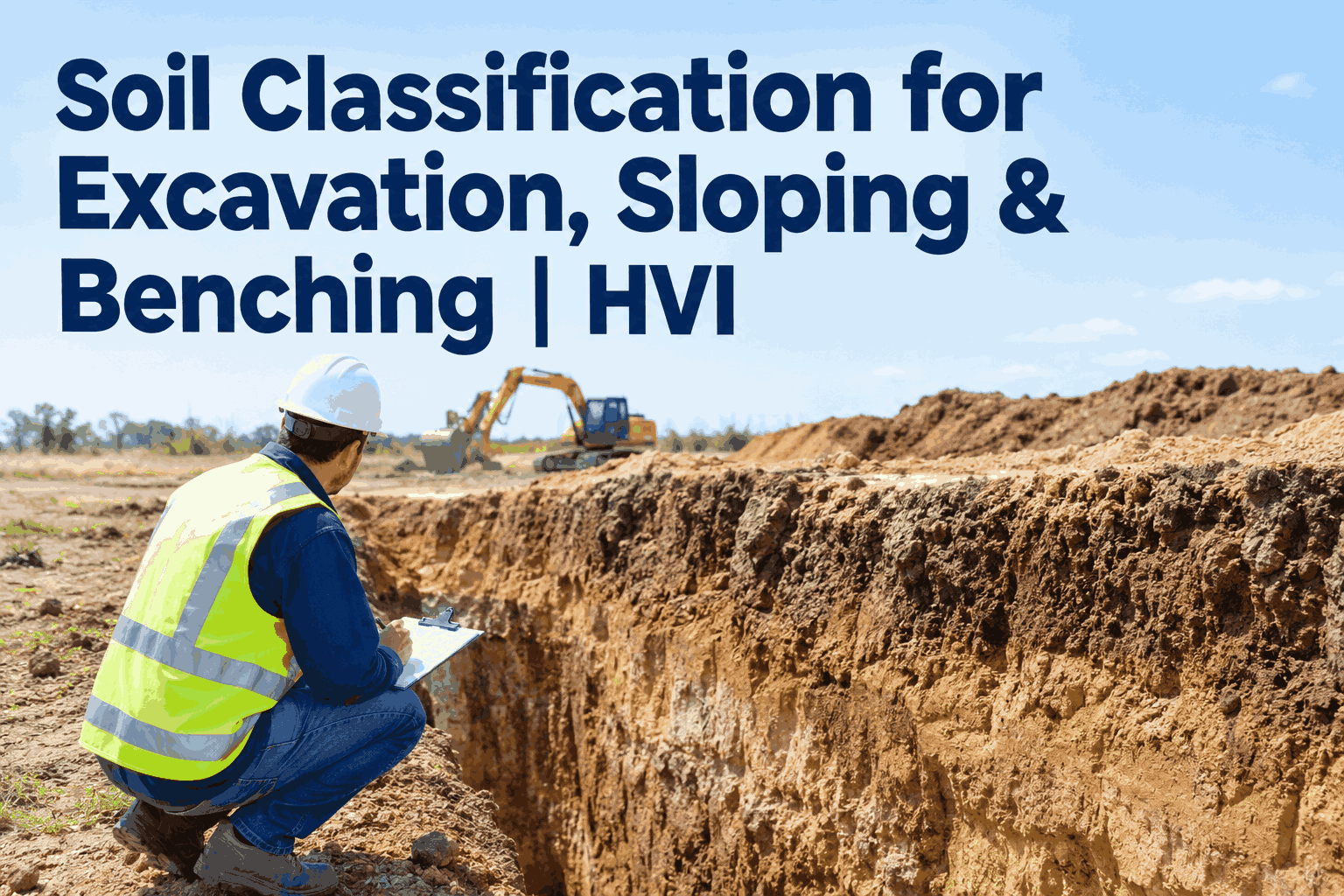
Soil classification for excavation is the call that decides whether your trench walls stand or bury someone — and OSHA says only a competent person can make it, using real field tests, not a glance. Get the type wrong and it isn't a paperwork error; it's a cave-in. This page covers how to actually classify soil in the field, the slope and bench angles each type allows, and what downgrades a soil mid-dig. Book a demo to see soil classification captured per trench.
Every Trench Starts With One Question: What Soil Is This?
Soil type sets the slope angle, the bench rule, and whether a trench box is optional or mandatory. Read it right and the wall holds; read it wrong and the standard has already told you what happens. Here's the stability ladder every excavation is measured against.
The number of protective-system decisions that flow from soil type is what makes classification the most important two minutes on the site. Slope angle, whether benching is even allowed, how much right-of-way you'll eat, and whether you can skip a trench box — all of it hangs on getting the type right.
Why Soil Classification Decides Everything Downstream
A competent person doesn't classify soil to fill a form. The classification is the input to every cave-in-protection choice that follows — get it wrong and every downstream decision inherits the error.
Classify the soil
A competent person runs at least one visual and one manual test to call Stable Rock, Type A, B, or C.
Set the protection
The type dictates the slope angle, whether benching is allowed, and the shoring or shield rating needed.
Document & enter
The type, the tests, and the competent person's name go on record before any worker climbs in.
Because protection is mandatory at 5 feet and must be engineered at 20 feet, the classification isn't advisory — it's the load-bearing decision of the whole dig. This is where classification meets the competent-person documentation requirements that an audit checks first. Book a demo to see the classification drive the protective-system field.
How a Competent Person Actually Tests the Soil
OSHA requires at least one visual and one manual test — a look isn't enough on its own. These are the field methods a competent person uses to put a number on the soil, no lab required.
Look at the site & spoil
Examine the excavated soil and trench sides: grain size, layering, existing fissures, standing or seeping water, and signs the ground was previously disturbed. Water or crack lines alone can push soil to Type C.
Thumb penetration
Press your thumb into a fresh soil sample. Type A resists and only dents with effort; Type C is penetrated easily to the full thumb. A fast, field-standard read on unconfined compressive strength.
Pocket penetrometer
A calibrated tool that reads unconfined compressive strength directly in tsf. Type A is 1.5 tsf or greater, Type B falls between 0.5 and 1.5, Type C is 0.5 or less — the numeric backbone of the call.
Plasticity / ribbon test
Roll a moist sample into a thread and try to ribbon it. Cohesive soil that holds a thin ribbon is clay-like and can be cohesive; granular soil that crumbles is not, and won't hold as Type A.
Dry strength
Break a dry clump. If it breaks into hard pieces that resist crumbling, it's cohesive. If it crumbles into individual grains with finger pressure, it's granular — and can't be Type A.
One visual + one manual
Never a single test, and never from the office. When results conflict or layers differ, the soil takes the lower, less-stable classification. When in doubt, classify down.
The tests are simple; the discipline is doing them every dig and recording which ones were run. A classification with no test behind it is exactly what an inspector treats as no classification at all. That's why HVI captures the tests performed as mandatory fields, not a free-text afterthought. Start free and record the tests behind every soil call.
Slope & Bench Angles by Soil Type
Once the soil is classified, the allowable geometry is set. These are the maximum slopes for excavations under 20 feet — the reference every competent person works from.
Two things trip crews up here. Benching is never permitted in Type C soil — it lacks the cohesion to hold a step. And a wide Type C slope eats right-of-way fast: a 10-ft trench needs roughly 15 ft of layback each side, which is why a trench box often wins in tight corridors. The angle isn't a suggestion; it's the line between a legal dig and a citation. Book a demo to tie the protective system to the soil type.
What Downgrades Soil Mid-Dig
Here's the part that catches experienced crews: soil isn't classified once. Conditions change through the shift, and each of these forces a competent person to reclassify downward — usually straight to Type C.
Water
Rain, seepage, or standing water in the trench. Submerged soil or soil with freely seeping water is Type C, full stop — and last night's storm can reclassify a Type A trench by morning.
Vibration
Heavy traffic, pile driving, or plant working nearby shakes cohesion out of the wall. Soil subject to vibration can't hold a Type A rating — it drops at least one class.
Previously disturbed
Ground that's been dug before — a backfilled utility trench, old excavation — can't be Type A. Previously disturbed soil is Type B at best, often C.
Fissures & layering
Visible cracks, or layered systems dipping into the trench at 4H:1V or steeper, both downgrade the soil. A fissured face that met Type A strength is Type B at most.
This is why the morning classification isn't the last word — it's the first. A competent person re-checks after rain, freeze-thaw, or new vibration, and if the soil dropped a class, the slope and protection must change with it. That re-check is the single most-missed excavation record, and the one an audit hunts for. Start free and prompt a re-check when conditions change.
The Soil Classification Documentation Checklist
A defensible classification captures more than a letter. This is what a competent person's record should show before the crew enters — the fields that turn a judgment call into proof.
- Soil type called: Stable Rock, A, B, or C
- At least one visual and one manual test performed
- Which tests were run, and their result, recorded
- Lower class chosen where layers or results conflict
- Slope angle or protective system matched to the type
- Benching used only in Type A or B, never Type C
- Depth checked against 5 ft and 20 ft thresholds
- Photo of the sloping, shoring, or box in place
- Competent person named with authority to stop work
- Date, time, and location captured
- Re-classification logged after rain, freeze-thaw, or vibration
- Any downgrade and its corrective action documented
The checklist isn't the hard part — running it every dig and after every condition change is. On HVI, the soil type, the tests, and the sign-off are required fields that can't be skipped, so the classification that decides the trench is documented the moment it's made, not reconstructed after an incident. That's what an audit checklist manager is built to enforce. Book a demo to see the classification checklist in the field.
From a safety manager who classifies soil for a living
The mistake I see most isn't calling the wrong type on day one — it's calling Type A on Monday and never re-checking it. Soil doesn't stay put. It rains, a roller works the shoulder, and the clay that held vertical Friday is sloughing by Tuesday.
What changed for us was making the classification a required field with the tests attached, and a prompt to re-check after weather. Now the soil call travels with the trench, the competent person's name is on it, and when a client asks how we sized the slope, I show them the record with the penetrometer reading right there. It stopped being an argument.
Frequently asked questions
What are the OSHA soil classification types?
OSHA's Subpart P recognizes four categories: Stable Rock (stays vertical, 90°), Type A (most stable cohesive soil like undisturbed clay, sloped to 53°), Type B (medium stability — silt, angular gravel, or previously disturbed Type A, sloped to 45°), and Type C (least stable — sand, gravel, or soil with seeping water, sloped to 34°). The classification sets the maximum allowable slope and which protective systems are permitted.
How do you test soil type in the field?
A competent person must run at least one visual test and one manual test. The visual test examines grain size, layering, fissures, water, and disturbance. Manual tests include thumb penetration, a pocket penetrometer reading unconfined compressive strength, a plasticity or ribbon test for cohesion, and a dry-strength test. A visual test alone is never sufficient, and when results conflict, the soil takes the lower classification.
Can you bench in Type C soil?
No. Benching is never permitted in Type C soil because it lacks the cohesion to hold a stepped wall. Benching is only allowed in Type A and Type B soils, with stricter geometry in Type B. In Type C, your options are sloping to the full 34° layback, or using shoring or a trench box — and in tight corridors, the box usually wins because a wide Type C slope consumes too much right-of-way.
Does rain change the soil classification?
Yes. Water is one of the fastest ways to downgrade soil. Submerged soil or soil with freely seeping water is automatically Type C, and overnight rain can reclassify a Type A trench by morning as it saturates the walls and reduces cohesion. That's why a competent person must re-classify after rain, freeze-thaw, or vibration before workers re-enter — the morning call doesn't survive a changed condition.
Who is allowed to classify soil for an excavation?
Only a competent person — someone trained in soil analysis and protective systems, able to identify hazards, and with the authority to stop work and correct them. It's a capability-and-authority role, not a job title; a site supervisor can fill it, but only with documented training. The crew doesn't vote on soil type, and the classification, the tests performed, and the competent person's name all belong on the record.
Make Every Soil Classification Provable in Seconds
A required excavation checklist on every phone: soil type, the visual and manual tests behind it, the slope or protective system chosen, competent-person sign-off, and a photo — timestamped and GPS-stamped, even offline. Re-classification prompts after rain or vibration, and an audit-ready history against every trench. Live in under two weeks.
No credit card · No hardware · Excavation & soil templates ready on day one