Government fleet digital transformation usually gets stuck in the same place: everyone agrees the clipboard and the shared spreadsheet have to go, and nobody wants to be the one who breaks a system that technically "works." Then the annual audit lands, a councilmember asks why three trucks were down for a month, and the fleet director spends a week reconstructing records from a filing cabinet. Public fleets don't get to move fast and break things — but they can't keep running on paper either. Book a demo of digital fleet inspections to see the low-risk path off paper.
Government Fleet Digital Transformation: From Paper to Proof
Paper inspections and department spreadsheets don't survive an audit, a budget review, or a records request. Here's how public fleets move to digital without the risk their procurement rules won't allow.
Government fleet digital transformation isn't a technology project — it's a records and accountability project that happens to use software. A municipal or agency fleet answers to auditors, budget committees, and the public in ways a private carrier never does, so the question isn't just "is digital better" but "can we switch without breaking compliance, blowing the budget, or losing a decade of history." Below is what paper actually costs a public fleet, the day-to-day difference digital makes, a migration path built for public-sector constraints, and how to know you're ready.
What Paper Actually Costs a Government Fleetthe invisible bill behind "it still works"
The clipboard feels free because no invoice ever arrives for it. But a paper-based public fleet pays constantly — in time, in risk, and in the questions it can't answer when it matters. Here's the itemized tab.
Add it up and "paper still works" quietly becomes the most expensive option on the lot. Digitizing inspections and records is where government fleet digital transformation pays back first, and it's why so many public fleets start with a single yard — a scope their procurement rules can actually approve. Book a demo to price out your own paper tab.
A Day in the Yard: Paper vs. Digitalthe same shift, two completely different records
The transformation isn't abstract — it's the difference between how one morning actually runs. Same trucks, same crew, same defects found.
- Operator fills a carbon-copy form, tosses the top sheet in a tray
- Defect noted — maybe — in handwriting nobody chases
- Form sits in the tray for days before anyone keys it in
- Supervisor has no idea what's wrong until a truck won't start
- Audit asks for last quarter's inspections; the hunt begins
- Operator taps through the inspection on a phone, signs it
- Defect photographed, flagged, routed to a work order instantly
- Supervisor sees the fault before the truck leaves the gate
- PM and history update against the unit automatically
- Audit pulls the full record by VIN in seconds, signed and dated
Same work, same people — one version leaves a trail you can defend and the other leaves a tray of paper. That daily shift is the whole point of digital inspections, and it's the same move behind paperless fleet management generally. You can sign up free and run one digital inspection to feel the difference.
The Government Fleet Modernization Roadmapfour steps that climb, each one approvable on its own
Public fleets don't do big-bang rollouts — and shouldn't. The path that works is a staircase: each step stands on its own, proves value, and earns the budget for the next. Here's the climb from paper to a fully digital fleet.
Replace paper DVIRs with signed mobile inspections in one yard. Lowest cost, fastest proof, nothing legacy to migrate yet.
Flagged defects become work orders automatically. Repairs, parts and labor start logging against the vehicle instead of a tray.
PM by meter or calendar across the fleet. The sticky note and the memory are retired; nothing slips through.
One dashboard of cost, downtime and compliance across departments — the fleet-wide visibility a budget committee actually asks for.
Each step is small enough to approve, prove, and build on — which is how government fleet digital transformation actually happens in the public sector, not in one unaffordable leap. Book a demo to map the staircase to your fleet.
Digital Fleet Inspections in Actionwhat step one looks like in a crew's hand
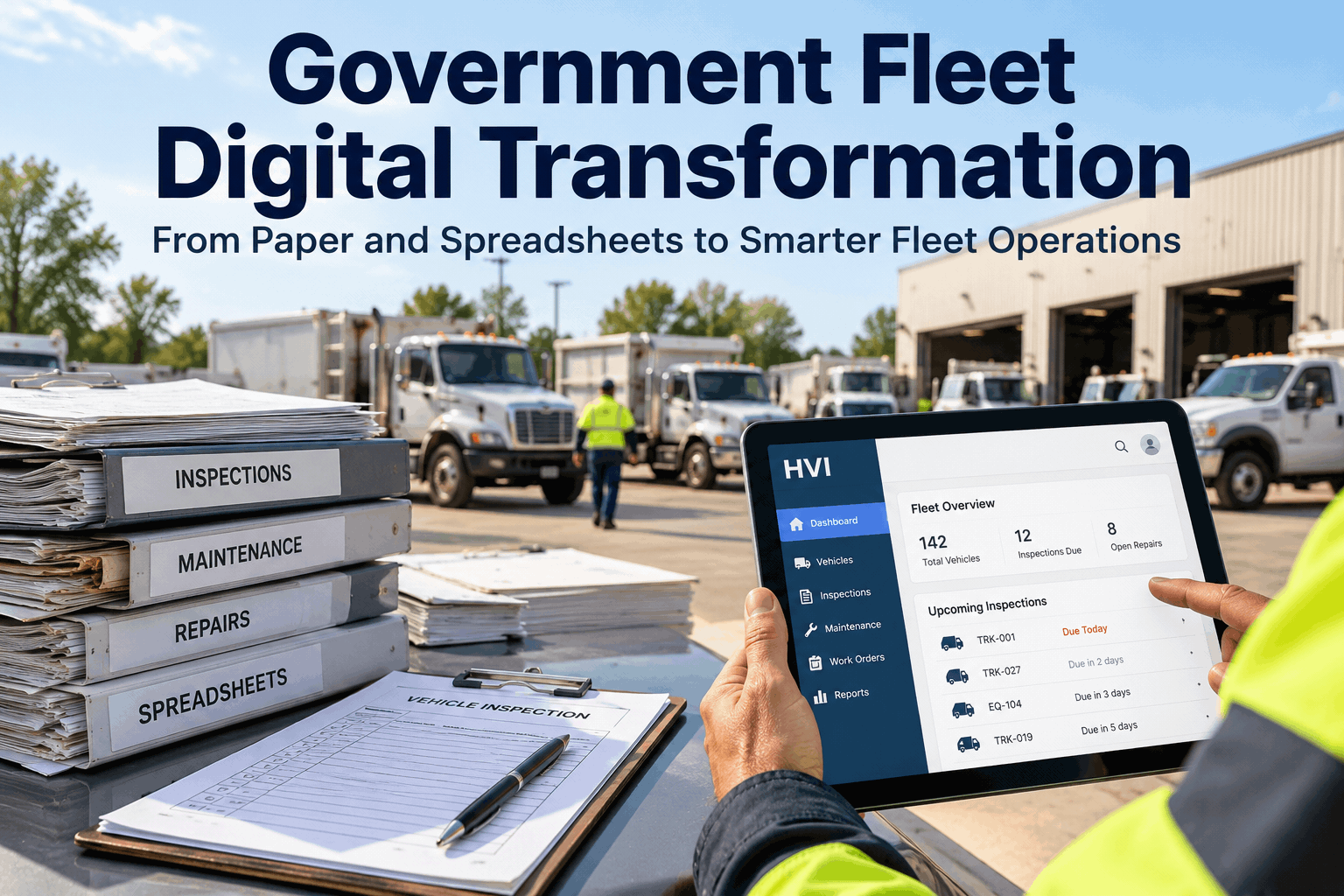
This is where the transformation becomes real — an operator completing an inspection on a phone, a defect flagged and routed before the truck moves. No tray, no delay, no lost sheet.
The defect is caught, documented with a photo, and turned into a work order before anyone reaches for a pen — and the whole thing lands in the vehicle's permanent record. That's the modernization in miniature, and it's the foundation the rest of the government fleet maintenance management picture is built on.
Is Your Fleet Ready to Go Digital?a readiness check before you write the pilot scope
Government fleet digital transformation goes smoothly when these are true before you start. Tick what already fits — the gaps are your pilot's job to close.
- A single yard or department picked for the pilot
- Success defined in records and uptime, not vague "efficiency"
- Procurement path for the pilot spend confirmed
- Operators have phones or tablets they already use
- Current paper inspection points documented to digitize
- A maintenance lead owns the rollout, not just IT
- Asset list (VINs, meters) available to load
- Decision made on how much history to migrate
- Reporting formats auditors expect are known
Most public fleets can tick the majority on day one — the rest is exactly what a well-scoped pilot sorts out. Book a demo to turn this checklist into a pilot plan.
A Municipal Fleet Director on Going Digitalwhy the pilot mattered more than the pitch
I'd sat through every "paperless fleet" pitch for years and never pulled the trigger — in government you can't afford a rollout that fails publicly. What finally worked was starting with one yard and one thing: digital inspections. Inside a month I could pull any unit's record for the auditor in seconds instead of sending someone to the filing cabinet. That one win got me the budget for the rest. The mistake is treating it as an IT project. It's a records project, and the records are what sell it upstairs.
Start your government fleet digital transformation this quarter
HVI replaces paper inspections, spreadsheets and the binder with signed digital inspections, connected work orders, PM scheduling and audit-ready reporting — scoped to pilot one yard and scale on your timeline. Live in under two weeks, no hardware.
No credit card · No hardware · Digital inspections ready on day one
Government fleet digital transformation — common questions
What is government fleet digital transformation?
It's moving a public-sector fleet off paper inspections and scattered spreadsheets onto digital inspections, connected work orders, PM scheduling and audit-ready records. For government fleets the real driver is accountability — records an auditor, budget committee, or the public can be shown on demand — not just efficiency.
How do government fleets move from paper to digital?
In stages, not one leap. Start by digitizing inspections in a single yard, then connect work orders, add PM scheduling, and finally fleet-wide reporting. Each step is small enough for public-sector procurement to approve and proves value before the next, which is why staged rollouts succeed where big-bang ones stall.
What does paper cost a public fleet that digital fixes?
Lost or unreadable inspection forms, days spent assembling records for audits, no fleet-wide visibility for budget decisions, and missed preventive maintenance that becomes downtime. None of it shows as a line item, which is why it persists — and why digitizing inspections and records usually pays back first.
Do we have to migrate years of paper records at once?
No. A common approach is to start fresh digitally from go-live and migrate only the history you genuinely need — current open issues, active assets, recent compliance records. Deciding how much legacy data to bring over is part of scoping the pilot, and it keeps the first step small and approvable.
How does HVI support government fleet modernization?
HVI digitizes inspections with signed mobile reports, turns defects into work orders, schedules preventive maintenance, and keeps audit-ready records and reporting per vehicle. It's built to pilot in one yard and scale, so a public fleet can modernize on its own timeline and within its own procurement rules.