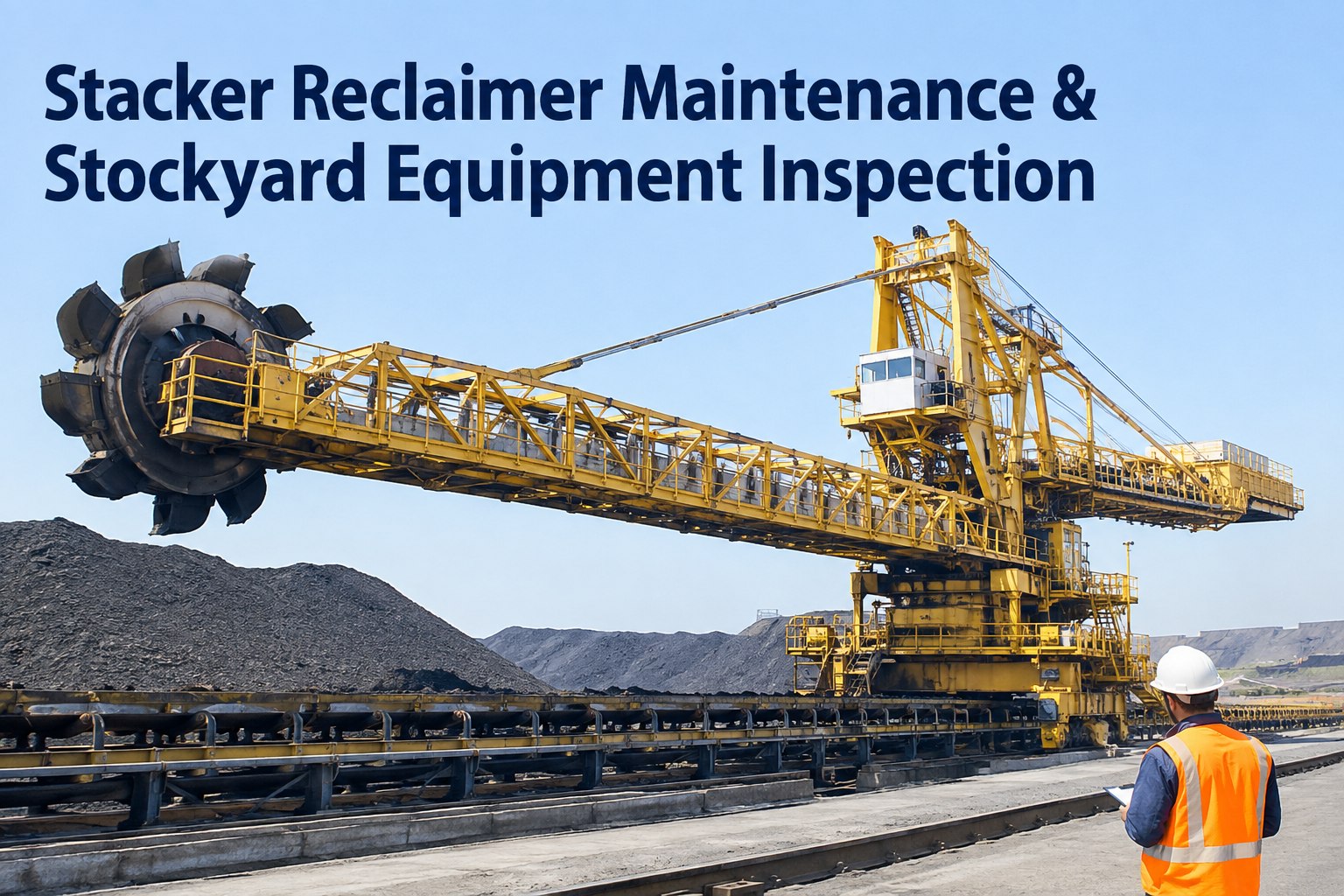
A stacker reclaimer looks like one machine, but it doesn't fail like one. The bucket wheel wears by the tonne, the travel wheels wear by the kilometre of rail, the slew bearing wears by the cycle — and somewhere on the boom, a weld is growing a fatigue crack you can't see from the ground. That's what makes stacker reclaimer maintenance different from almost anything else in the yard: the failure that ends the machine isn't the one that squeaks or leaks, it's the one that's silent until the structure lets go. This guide breaks the machine into the systems that actually fail and shows how a measured inspection becomes a planned repair instead of an outage. Book a demo to see it on your own units.
One machine, two ways it fails
Switch the view. See the mechanical wear points, then the structural fatigue zones the walk-around never catches.
- Bucket wheel: lip and tooth wear from direct abrasive contact with the material — the fastest, most predictable wear on the machine
- Travel wheels & rail: flange wear and rail alignment drift — ignore the rail and the replacement wheel wears out on the same clock
- Slew bearing: carries huge cyclic load every rotation; seal condition is the best predictor of its life
- Boom pivot welds: flex under every load cycle; a classic crack-initiation site
- Slew-bearing mounting ring: where imbalance concentrates fatigue stress
- Luffing cylinder brackets: repeated up-and-down loading works the weld toe
Mechanical wear tells you it's coming — noise, heat, a measurement trending down. Fatigue cracking gives almost no warning to a visual check, which is why the structural side needs measurement history and NDT, not a clipboard glance. Book a demo to see structural checkpoints tracked over time
A stacker reclaimer is usually the throat of the whole stockyard — everything upstream feeds it and everything downstream waits on it — so when it goes down unplanned, the cost isn't a repair bill, it's the material flow behind it. The way to keep it running isn't to inspect it harder; it's to inspect each of its very different systems on its own terms, and to trend the numbers so you see the failure forming instead of arriving.
Four systems, four different clocks
The single most useful thing to understand about stacker reclaimer maintenance is that the machine's major systems wear on completely different schedules and by completely different mechanisms. Treat them as one lumped "the reclaimer" and you'll over-service the slow ones and get ambushed by the fast ones. Here's how each earns its own cadence.
Bucket wheel & digging
Lip and tooth wear from direct contact with the material. The most predictable system on the machine — track lip thickness against a minimum and replace scraper plates before they're two-thirds gone, rather than waiting for a visible failure.
Travel gear & rail
Wheel flange wear, bogie condition, and travel-drive gearboxes — all tied to rail alignment. Investigate a gearbox failure without checking the full rail length and the replacement wears out on the same accelerated clock.
Slew & luffing
The slew bearing takes enormous cyclic load every rotation, and machine balance drives its life — an out-of-balance boom shortens bearing life and accelerates fatigue. Seal condition and grease-leak checks are shift-level items, not afterthoughts.
Conveyors, chutes & transfers
Belt tracking, splice condition, idler rotation, and chute wear plates where material drops onto the boom conveyor. Daily-level items — a mistracked belt or a worn transfer plate turns into spillage and a stoppage fast.
Match the inspection interval to the clock and the whole program gets cheaper and more reliable at the same time: the bucket wheel gets checked on a wear cadence, the rail on a travel cadence, the structure on a planned examination schedule. A single flat checklist can't do that. Start a free trial and each subsystem gets its own template and its own schedule.
Structural inspection: the one that measurement history actually saves you from
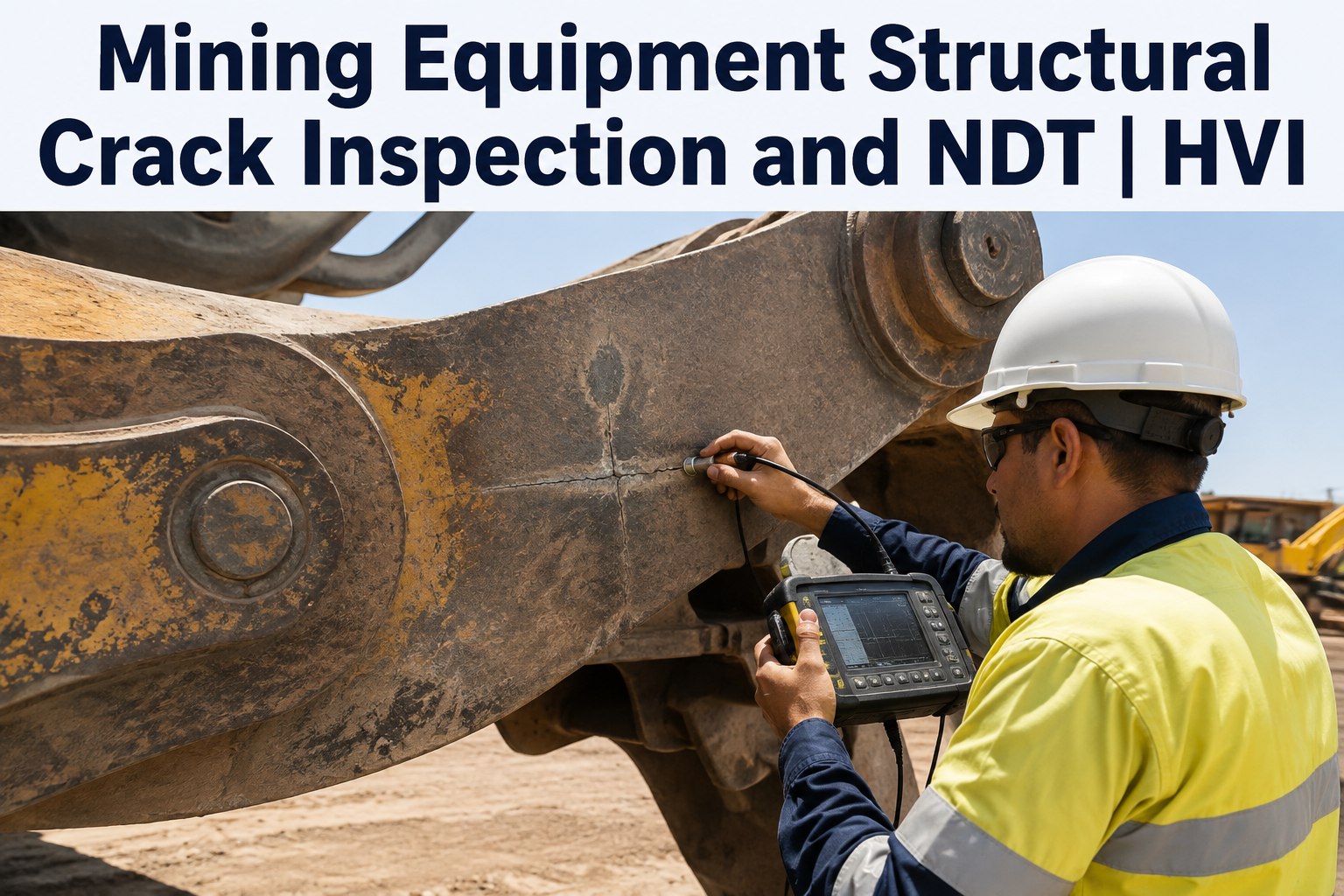
Here's the failure mode that keeps reliability managers up at night: a fatigue crack at a boom weld that no one saw grow. Structural failures on these machines are often the result of undetected weld fatigue, and they can be catastrophic — not a downtime event, a safety event. The problem is that a crack starts as something a walk-around will never catch, and by the time it's visible, it may already be serious.
This is exactly where a single-point inspection fails and a measurement record wins. A pass/fail check tells you the weld looked fine today. A measurement history tells you a monitored crack indication has grown two millimetres over three inspections — which is a planned outage and a repair, not a collapse. The known crack-prone zones (boom pivot welds, the slew-bearing mounting ring, luffing cylinder brackets) should be examined on a defined structural program with the findings measured and trended, and non-destructive testing applied where the equipment, your site engineering program, or the applicable inspection standard requires it. Confirm the structural examination scope, intervals, and NDT requirements for your machines with a qualified structural or mechanical engineer and the relevant standard — this guide is about managing the records, not defining the engineering. Book a demo to see measured structural findings trended over time
From measured finding to planned maintenance action
The point of all this measurement isn't the number — it's the decision the number lets you make early. A stacker reclaimer inspection is only worth the effort if a finding reliably becomes a scheduled action before it becomes an outage. That chain, on a machine this critical, has to be built into the record.
When a recurring chute failure or a travel-wheel that keeps wearing early shows up in the history, the pattern is the diagnosis — the third repeat of the same fault points at a root cause like rail misalignment or a balance problem, not three unrelated repairs. That's the difference between fixing the symptom and fixing the machine, and it only exists if the findings were measured and kept. Book a demo to see recurring-fault analytics per asset
From a reliability manager who lives on outage windows
We lost a travel gearbox on our biggest reclaimer, replaced it in an emergency window, and eight months later the new one was howling. Turned out the rail had a low spot we'd never surveyed — the gearbox was never the problem, the rail was. We'd have caught it years earlier if anyone had been trending wheel wear along the travel length instead of just replacing what broke.
Now every subsystem has its own record and its own readings. The boom weld checkpoints get measured on our structural program, bucket lip gets logged every campaign, and the rail gets surveyed on a cadence. When a number starts trending, it goes into the next planned outage. We've stopped being surprised, which on a machine this size is the whole game.
Stacker reclaimer maintenance FAQs
What are the main systems to inspect on a stacker reclaimer?
A stacker reclaimer combines several distinct systems that each fail differently, so the inspection should be organized by subsystem rather than as one walk-around. The major areas are: the structure (boom, portal, and counterweight assemblies, with particular attention to fatigue and crack-prone weld zones such as the boom pivot, slew-bearing mounting ring, and luffing cylinder brackets); the rail-mounted travel system (rail alignment and integrity, wheels, flanges, bogies, and travel drives); the slewing and luffing systems (slew bearing, drives, cylinders or winches, and seals); the bucket wheel and its cutting edges or teeth where fitted, or scraper and chain systems on scraper-type reclaimers; conveyors, chutes, and transfer points; cable reels or festoon power systems; and the automation, positioning, and limit systems including anti-collision and travel switches. Because each of these wears on a different schedule and by a different mechanism, matching inspection intervals to each system rather than applying one flat checklist is what makes the program both reliable and cost-effective.
Why is structural inspection so important on a stacker reclaimer?
Because the structural failure mode is the one that is both potentially catastrophic and nearly invisible until it is advanced. Stacker reclaimers carry large cantilevered booms and counterweights, and every luffing and slewing motion imposes fatigue stress on the steelwork, concentrated at weld joints. Structural failures on these machines are frequently traced to undetected weld fatigue, and an unmanaged crack can progress to a collapse rather than a simple breakdown. A routine visual walk-around will typically not catch a fatigue crack in its early, manageable stage. That is why the crack-prone zones should be examined under a defined structural inspection program, with findings measured and trended over time and non-destructive testing applied where the equipment, the site engineering program, or the applicable standard requires it. Machine balance matters here too—an incorrectly balanced machine amplifies fatigue stress and shortens component life. Operators should define the structural examination scope and intervals with a qualified engineer rather than treating structural condition as a checkbox on a general inspection.
Should stacker reclaimer PM be calendar-based or meter-based?
Most stacker reclaimer programs use both, because different systems are best governed by different triggers. Wear-driven systems like the bucket wheel, conveyors, and travel gear track most closely to usage—tonnes handled, throughput, or travel distance—so meter-based preventive maintenance keeps their service intervals aligned with actual wear rather than an arbitrary date. Other elements, particularly structural examinations and certain regulatory or standard-driven checks, are typically scheduled on a calendar or defined-interval basis regardless of utilization. A machine sitting through a low-throughput period shouldn't have its wear-item services forced early by the calendar, but its time-based structural and safety examinations still come due. The practical approach is a hybrid: meter-based intervals for the wear systems, calendar or engineering-defined intervals for structural and safety-critical examinations, all tracked against the same asset so nothing falls through the gap between the two schedules. Confirm the specific intervals with the equipment manufacturer and your site engineering program.
How does rail alignment affect stacker reclaimer reliability?
Rail alignment is one of the most under-appreciated drivers of reliability on a rail-mounted stacker reclaimer, because its effects show up as failures in other components. Misaligned or worn rail causes uneven wheel and flange wear, imposes side loads the travel drive was never meant to carry, and can drive premature travel-gearbox failure. The common trap is investigating a travel-drive failure in isolation—replacing the gearbox without surveying the full travel length—which usually results in the replacement wearing out on the same accelerated timeline as the original. Rail condition and alignment should be surveyed on a regular cadence and the readings trended, so that drift is corrected before it damages the running gear, and so that a recurring gearbox or wheel-wear problem points investigators toward the rail as a root cause rather than being treated as a series of unrelated component failures. On a machine that hauls hundreds of tonnes along that rail continuously, alignment is a reliability input, not a cosmetic detail.
What causes premature slew bearing failure on a stacker reclaimer?
Slew bearings on stacker reclaimers carry enormous cyclic loads every time the superstructure rotates, and several factors drive them to fail early. Machine balance and centre of gravity are critical: an overweight or incorrectly balanced machine pushes the bearing outside its design load envelope and amplifies the fatigue stresses from each luffing and slewing motion, shortening bearing life and hastening fatigue cracking at the mounting ring. Seal condition is another strong predictor—small relative to the machine, but a failing seal lets contamination into the bearing and is one of the best early indicators of trouble, which is why seal and grease-leak checks deserve attention every shift rather than being deprioritized. Inadequate or incorrect lubrication, and running with an undetected imbalance, both accelerate the same failure. Practically, that means monitoring balance, keeping the automatic lubrication system verified, checking seals and grease leakage frequently, and trending any bearing temperature rise or unusual vibration so a developing problem is caught while it is still a planned repair.
Make stacker reclaimer maintenance a trend line, not a guessing game
HVI puts subsystem-specific templates, structural inspection checkpoints, photo evidence, measurement and wear history, calendar and meter-based PM, and defect-to-work-order routing on one platform — so a boom crack indication, a bucket-lip reading, and a rail survey all trend on the machine's record, and a rising number becomes a planned repair instead of an unplanned collapse. See it on your own stockyard machines.
No credit card · Subsystem templates ready on day one · Measurement history built in