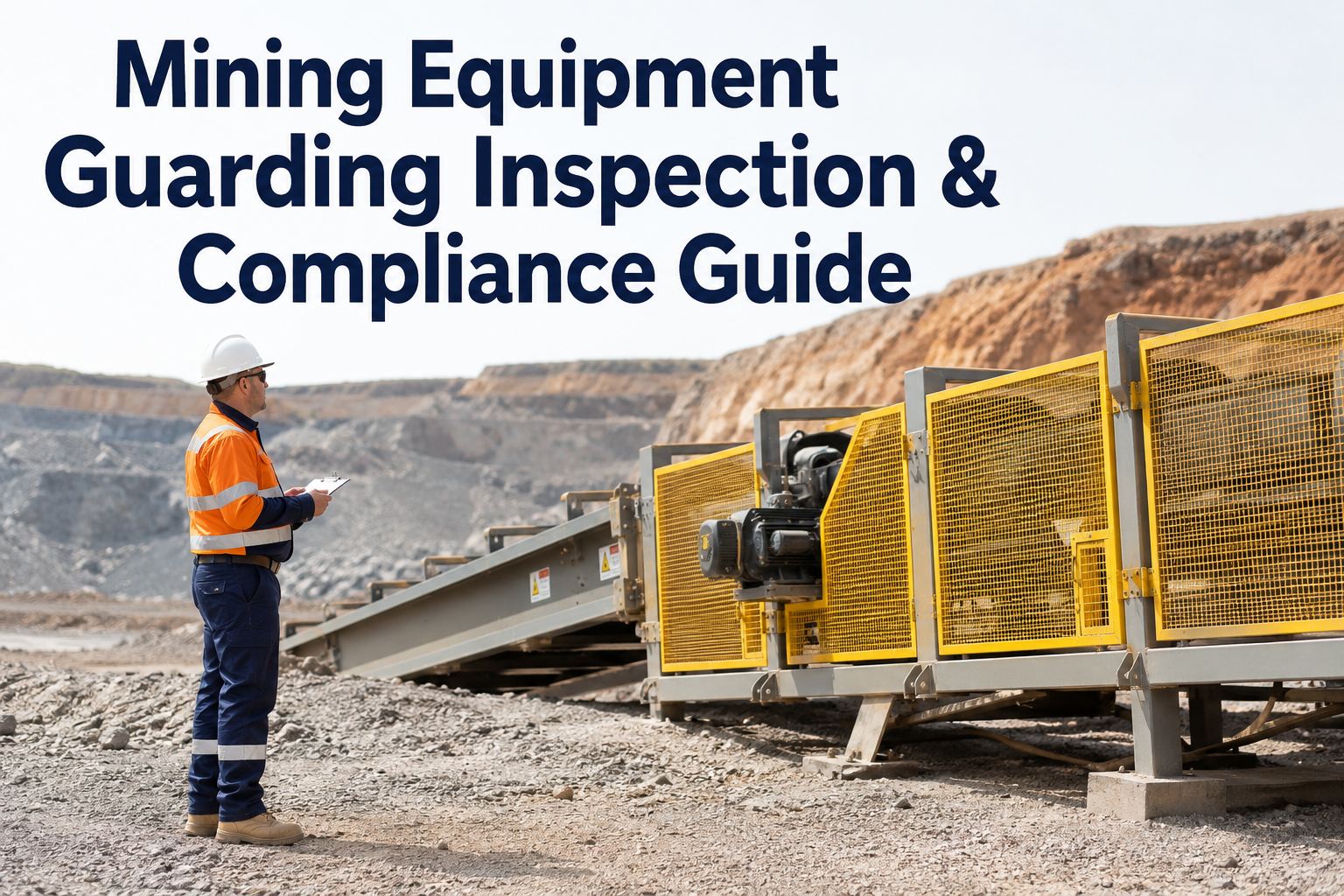
Most quarries don't fail an MSHA equipment-inspection citation because a walkaround got skipped. They fail because they can't prove it happened, or because a defect got written on a pre-op report and the machine rolled anyway. That's the quiet gap quarry equipment inspection software closes. Across loaders, haul trucks, excavators, crushers, screens, and conveyors, digital inspections capture what was checked, flag the defect with a photo, force the correction before dispatch, and keep the record audit-ready — turning "we inspect our equipment" into "we can prove it."
You Did the Inspection. Can You Prove It?
MSHA's mobile-equipment standard for surface mines isn't hard to do — it's hard to document. Citations come from the gap between the walkaround and the record.
If you run a quarry or aggregate operation, you already inspect your equipment — loaders and haul trucks get a walkaround, the plant gets looked over. The problem is proving it consistently across a busy site, on paper, in a way that holds up when an inspector arrives. Quarry equipment inspection software exists to make the inspection produce a defensible, connected record every time: the right checklist per machine, a photo on every defect, a correction tracked to closure, and years of history one search away. It doesn't replace the operator's eyes — it makes sure what those eyes saw is captured and acted on.
Six Machines, Six Checklistswhat gets inspected across a quarry fleet
A quarry runs a mix of self-propelled mobile equipment and fixed processing plant, and each machine has its own critical inspection points. A one-size checklist misses what matters; the right approach is a machine-specific checklist that loads for the unit in front of the operator.
The first three are self-propelled mobile equipment; the last three are fixed processing plant, and they're inspected under different standards and rhythms — a haul truck gets a pre-operation check each shift, while a conveyor's guarding and e-stops are examined as part of the working-place and equipment exams. A good system carries the right checklist for each, so nobody's running a haul-truck form on a crusher. Book a demo to load a machine-specific checklist by scanning each unit
What MSHA Actually Requires — and What It Doesn'tequipment inspection is not the same as Part 46 training
Two MSHA topics get tangled together at aggregate operations, and separating them is essential to getting compliance right.
Self-propelled mobile equipment must be inspected before being placed in operation each shift under §56.14100, with safety-affecting defects corrected in a timely manner and a record kept. Related standards cover brakes, steering, tires, guarding, and more. This is about the machine's condition.
Part 46 governs training for surface aggregate miners — new-miner hours, annual refresher, task training, and who may train. It is not an equipment-inspection rule. Confusing the two is common; they're separate obligations under separate parts.
So when someone asks "what does MSHA require for our equipment," the answer lives in the Part 56 equipment standards, not Part 46. And a crucial honesty point: the specific requirement isn't identical for every machine or every operation — a self-propelled loader, a fixed screen, and a portable plant don't carry the same rule, and intervals and criteria vary. The reliable path is to check the applicable standard for each piece of equipment and your specific operation rather than assume one blanket rule covers everything. Book a demo to see checklists mapped to the standard that governs each machine or start free to build your own.
Where the Citations Actually Come Fromthe lingering defect and the missing record
The standard for mobile equipment is short — inspect before the shift, correct safety defects, keep records — yet it generates one of the largest shares of mobile-equipment citations at surface mines and aggregate operations. Not because operators skip the check, but because of two failure modes.
The first is the lingering defect. An operator writes a safety-affecting defect on the pre-op report — a bad headlight, a soft brake — and the machine gets dispatched anyway. When an inspector later finds that same defect uncorrected next to a report that flagged it, that's the worst case: documented proof the operator knew and didn't act. The second is the missing record. The inspection happened, but there's no producible proof it did, or the paper is illegible, incomplete, or in a filing cabinet nobody can search fast. Both are documentation failures, and both are exactly what digital inspection prevents — by forcing the defect into a tracked correction and making every inspection an instantly retrievable record. Book a demo to block a machine from dispatch until its safety defect is signed off
How a Digital Inspection Actually Flowsscan, check, photo, correct, record
The value is in the workflow — each step closes a gap that paper leaves open. Here's what an operator's inspection looks like on a digital system, start to finish.
Step four is the one that changes compliance outcomes. On paper, a flagged defect relies on someone choosing to act; digitally, a safety defect can hold the machine out of service until it's fixed — which is exactly the removal-from-service behavior the standard expects, enforced by the system instead of by memory. Start free and run this whole flow on your first machine today
Multiple Sites, One Record Systemand audit-ready by default
Aggregate operators rarely run one pit. When you have several sites, paper means several disconnected filing systems, no consistent standard between them, and a scramble whenever any one site draws an inspection. Digital changes the shape of that problem.
With one system across every site, the same machine-specific checklists apply everywhere, so a loader inspection means the same thing at every pit. Inspection records, defects, and corrective actions roll up into one view, so a safety manager can see the whole operation's status without visiting each site or calling each foreman. And when MSHA arrives at any location, the records for that site — every inspection, every defect, every correction with its date and photo — export in a filtered search rather than a filing-cabinet dig. Add training records to the same platform and both halves of a site's compliance picture — equipment condition and miner qualification — live in one place, each producible on request. Book a demo to standardize inspections and records across every quarry site
From a quarry safety manager who went digital
We never had an inspection problem — my operators are good, they do the walkarounds. We had a proof problem. When MSHA showed up, we were flipping through binders trying to find the report for a specific loader on a specific day, and half the time a flagged defect had no follow-up we could point to.
The dispatch block was the game-changer. Now if someone flags a safety defect, that machine physically can't be assigned until a mechanic clears it — so we can never again have the situation where a truck ran with a known bad brake. And when an inspector wants ninety days of records on any unit, it's a filtered search on my phone. We stopped fearing the audit.
Quarry equipment inspection software: the takeaway
Quarry equipment inspection software isn't about inspecting more — it's about making every inspection you already do produce proof you can stand on. Load the right checklist for each loader, truck, excavator, crusher, screen, and conveyor; capture defects with photo evidence; force safety defects to a tracked correction before the machine moves; and keep every record instantly retrievable across all your sites. Do that and the walkaround your operators already perform becomes a defensible compliance record — and the MSHA visit stops being something you brace for and becomes something you're simply ready for. Book a demo to see quarry equipment inspections, defects, and records in HVI
Frequently asked questions
What is quarry equipment inspection software?
Quarry equipment inspection software is a digital tool that replaces paper checklists and spreadsheets for inspecting the equipment used in quarry and aggregate operations — loaders, haul trucks, excavators, crushers, screens, and conveyors. Instead of a paper walkaround form, an operator typically scans a QR code on the machine to load the correct machine-specific checklist, works through the inspection items (with critical items often requiring a photo to pass), and flags any defects with photo evidence. When a safety-affecting defect is found, the software creates a work order and can hold the machine out of service until a mechanic signs off the repair, and every inspection is stored as a retained, searchable record. The core value is proof and follow-through: it makes each inspection produce a defensible record that the check happened and that any defect was corrected, and it lets an operation retrieve those records instantly for an MSHA inspection rather than digging through filing cabinets. It does not replace the operator's inspection itself — it captures, enforces, and documents it.
What does MSHA require for quarry equipment inspections?
For surface metal and nonmetal operations, which includes most quarries and aggregate sites, the central equipment-inspection requirement is in 30 CFR Part 56. Under §56.14100, self-propelled mobile equipment such as loaders and haul trucks must be inspected before being placed in operation each shift, defects that affect safety must be corrected in a timely manner, and records must be kept. Related Part 56 standards address specific systems such as brakes, steering, tires, guarding, and warning devices. It's important to understand two things. First, this equipment-inspection obligation is separate from MSHA Part 46, which governs miner training, not equipment condition — the two are frequently confused but are different rules under different parts. Second, the exact requirement is not identical for every machine or every operation: self-propelled mobile equipment, fixed processing plant like crushers and conveyors, and portable plants are governed by different provisions with different criteria and rhythms. Because of that, operators should verify the specific standard that applies to each piece of equipment and their particular operation against the current regulation rather than assuming one universal inspection rule covers everything.
Why do quarries get cited if they already inspect their equipment?
Most equipment-inspection citations at aggregate operations don't come from skipping the inspection — they come from two documentation failures. The first is a lingering defect: an operator correctly notes a safety-affecting defect on a pre-operation report, but the machine is dispatched anyway and the defect isn't corrected. When an inspector later finds that same defect still present next to a report that flagged it, it's strong evidence the operator knew about the condition and failed to correct it in a timely manner, which is among the worst positions to be in. The second is a missing or inadequate record: the inspection genuinely happened, but the operation can't produce clear proof, whether because the paper is incomplete, illegible, or simply can't be found quickly. Both failures are about proof and follow-through rather than the physical act of inspecting. Digital inspection software addresses both directly by capturing a complete, timestamped record of every inspection, requiring photo evidence on critical and defective items, and routing any safety defect into a tracked correction that can hold the machine out of service until it's signed off — so a flagged defect can't quietly linger and a completed inspection is always retrievable.
How do you inspect a crusher or conveyor versus a haul truck?
They're different both in what you check and in how the requirement is structured, because a haul truck is self-propelled mobile equipment while crushers, screens, and conveyors are fixed processing plant. On a haul truck or loader, the pre-operation inspection focuses on the machine's ability to operate safely and mobile: service and parking brakes, steering, tires and wheels, lights and backup alarms, mirrors and cameras, seatbelt and ROPS, fluids, and hydraulics, checked before the equipment is placed in operation each shift. On fixed plant, the emphasis shifts to guarding at pinch points and moving parts, emergency stops, belt condition and tracking on conveyors, screen media and mounts on screens, wear liners and structural integrity on crushers, lockout points, and safe walkway access. Because fixed plant isn't self-propelled mobile equipment, it falls under different Part 56 provisions and is examined as part of the working-place and equipment examinations rather than the per-shift mobile-equipment pre-operation check. The practical implication is that each machine type needs its own checklist mapped to the standards that actually apply to it, which is why loading the correct machine-specific checklist matters rather than using one generic form.
Can inspection software help with an MSHA audit?
Yes, and audit readiness is one of the strongest reasons quarries adopt it. During an MSHA inspection, the operation needs to produce records showing that required equipment inspections were performed and that any defects were corrected. With paper, that means locating the right reports for the right equipment and dates, often across multiple binders or sites, and hoping the follow-up on any flagged defect was also documented and filed. Digital inspection software makes those records complete and instantly retrievable: every inspection is retained with its date, the operator, the items checked, any defects, photo evidence, and the corrective action and its completion, all searchable by machine, date range, or operator and exportable in a single step. For multi-site operators, the same standardized checklists and one consolidated record system mean an inspection at any location can be answered without a scramble. Just as valuable, the enforcement of correct-before-use through automatic work orders and dispatch holds means the records tend to show a clean, closed-loop compliance story rather than gaps, which is exactly what stands up under scrutiny. The software supports the audit; the underlying inspections and corrections still have to actually happen.
Turn every quarry inspection into proof you can stand on
HVI gives your operation QR-loaded, machine-specific checklists for every loader, truck, excavator, crusher, screen, and conveyor; photo evidence on the critical items; automatic work orders and dispatch holds that force safety defects to correction before a machine moves; and audit-ready records across every site, exportable in one click. The walkaround your operators already do becomes a defensible compliance record — so the MSHA visit is something you're ready for, not something you dread.
No credit card · No hardware required to start · Quarry inspections ready on day one