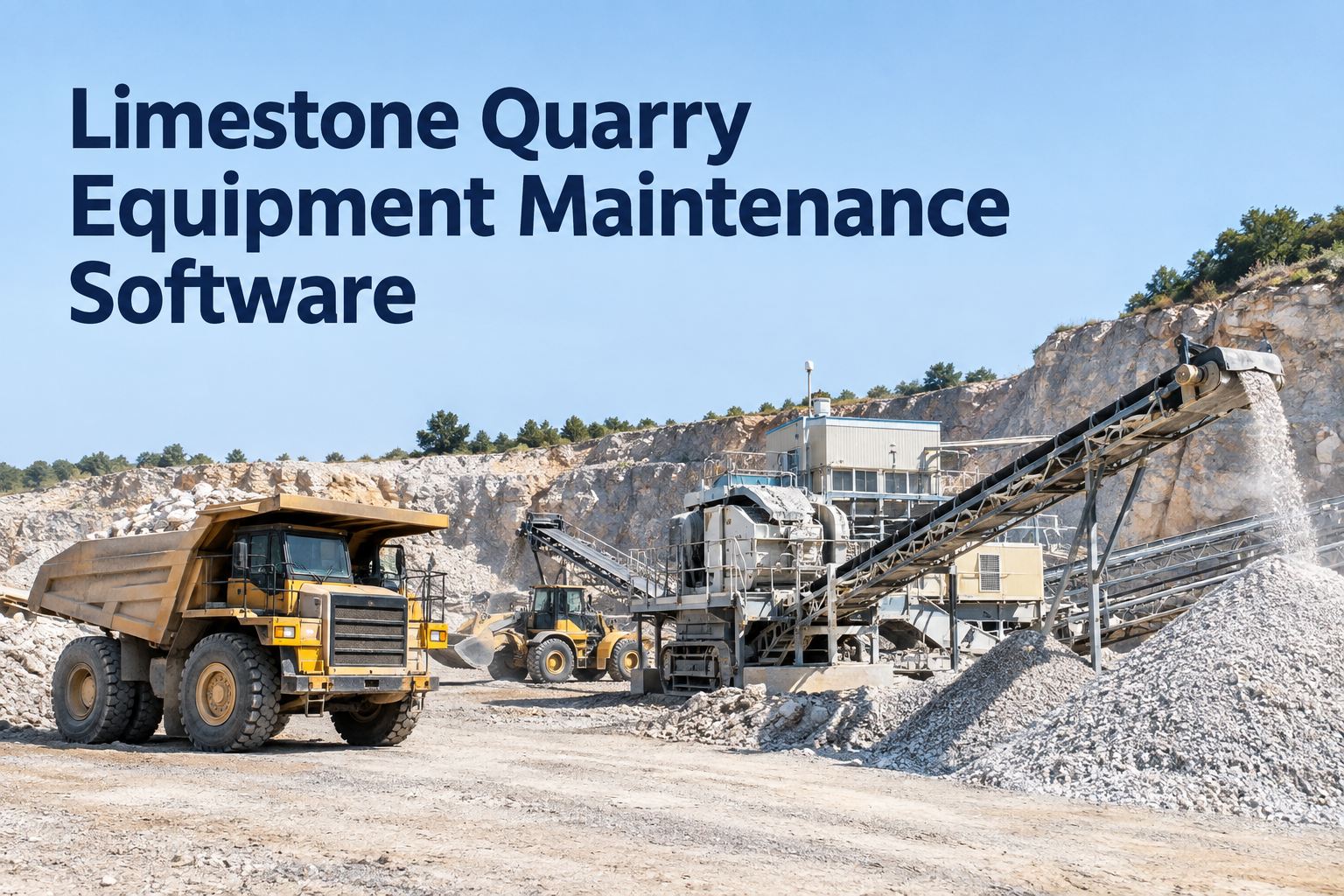
A cement plant doesn't really run a quarry and a plant — it runs one long chain, and the quarry is the front of it. Limestone gets drilled, blasted, loaded, hauled, and crushed, then feeds a kiln that can't stop. There's very little buffer between the two, so the moment a haul truck or, worse, the primary crusher goes down, the raw mill starves and the kiln runs out of feed within a shift. Limestone and cement quarry equipment maintenance isn't about keeping individual machines healthy — it's about protecting the one production chain the whole plant's economics ride on. This guide is about where that chain actually breaks, and how to defend it. Book a demo to see constraint-asset downtime tracked in HVI.
The quarry doesn't feed a plant — it feeds a chain, and every link stops the next
From the quarry face to the kiln, material moves through a sequence where a failure at any stage backs up everything behind it and starves everything ahead. Trace the chain, and the choke point is impossible to miss.
That chain is the whole reason cement-quarry maintenance is different from ordinary fleet upkeep: availability of the mobile fleet and the primary crusher directly constrains kiln feed, and kiln feed is plant economics. Below is the buffer math that shows where a failure actually stops the plant, why the primary crusher earns disproportionate attention, how abrasive dust rewrites your service intervals, and the continuous-duty and silica realities you're maintaining around.
The buffer math: where a failure actually stops the plant
Not every breakdown stops the kiln, and knowing the difference is the entire game. The chain has small buffers — a surge pile here, a few haul trucks' redundancy there — and a failure only halts the plant when it drains a buffer faster than the buffer can absorb it. The primary crusher is the point where the buffer is thinnest and the consequence is largest.
Contrast that with a single haul truck going down, where a bit of fleet redundancy usually absorbs the loss without touching kiln feed. The lesson isn't "maintain everything equally" — it's maintain against the buffer, concentrating attention where the buffer is thin and the downstream cost is catastrophic. Book a demo to see which asset's downtime actually constrains production
The primary crusher: one machine worth disproportionate attention
Every asset in the chain matters, but they don't matter equally — and the primary crusher sits alone at the top. It's the first machine limestone touches after the quarry, it usually has no parallel redundancy, and it takes a brutal beating: swallowing boulders up to a meter across at 800–1,200 tonnes per hour, shattering rock by force. When it trips, everything upstream backs up and everything downstream starves. It earns more maintenance attention than any other single asset, and here's the good news the numbers support: its failures are among the most preventable in the whole operation.
The practical move is to treat the primary crusher as a named constraint asset with its own severe-duty schedule, tonnage-based wear triggers, and first call on critical spares — because everything else in the plant is downstream of it. Book a demo to make the crusher a monitored constraint asset Start free and put the crusher on tonnage-based wear tracking
Abrasive dust rewrites your service intervals
A limestone quarry is one of the harshest environments a machine can work in, and the reason is the dust. Fine abrasive limestone dust gets everywhere, and it attacks exactly the systems that keep an engine and a hydraulic circuit alive. The manufacturer's standard service interval assumes a clean environment — run it unchanged in a quarry and you're servicing far too late.
Filtration loads up fast
Air, fuel, and hydraulic filters clog far quicker in heavy dust. A filter on a standard interval is already choked halfway through it — starving the engine, restricting flow, and dropping efficiency. Dust-service intervals have to be shortened, not inherited from the manual.
Cooling packs blind over
Dust packs radiator and cooler cores, cutting airflow until the machine runs hot — and heat is what kills engines and hydraulic oil. Cores need frequent cleaning on a dust schedule, and cooling condition belongs on the daily inspection, not just the PM.
Seals and bearings grind out
Abrasive dust past a worn seal turns grease into grinding paste, killing bearings, pins, and bushings early. Sealed and easy-lube points, frequent greasing, and seal checks are what stand between the dust and the wear surfaces it destroys.
This is why severe-duty interval configuration matters more here than almost anywhere: the same excavator on the same meter reading needs a tighter schedule in a limestone quarry than it would on a clean site. Setting dust-adjusted intervals per asset — and letting the meter trigger them — is the difference between filtration protecting the machine and filtration being the thing that failed. Book a demo to configure severe-duty intervals for high dust
Continuous duty, thin windows, and the silica obligation
Two more realities shape how you maintain a cement quarry: there's barely a moment to do the work, and the material itself carries a health obligation you can't set aside.
Both point the same direction: in a continuous-duty, silica-bearing operation, documented and scheduled maintenance isn't administrative overhead — it's how you protect production and meet obligations at the same time. Always apply the specific exposure-control and equipment requirements that govern your operation. Start free and document dust-control equipment inspections
From a reliability manager at a cement quarry
The thing that took me years to get through to a new crew: we're not in the business of keeping equipment running. We're in the business of keeping the crusher fed and the kiln fed. A haul truck down for a morning barely registers — we've got redundancy there. The primary crusher down for a morning is a plant event, and everybody upstairs knows the number.
So we stopped spreading maintenance evenly and started spending it where the buffer's thin. The crusher gets condition monitoring, tighter intervals, and first call on spares. Dust intervals on everything are half what the manual says. And when a bearing starts trending warm, it's a work order that morning, not a note for next week. Since we started tracking which asset's downtime actually cost us kiln feed, the arguments about where the maintenance budget goes basically ended — the data settles it.
Frequently asked questions
Why does quarry equipment downtime matter so much to a cement plant?
Because a cement operation runs as a single production chain with very little buffer between the quarry and the kiln, so quarry equipment availability directly constrains kiln feed — and kiln feed is plant economics. Limestone moves from the quarry face through drilling and blasting, loading, hauling, primary crushing, and conveying before it ever reaches the raw mill and kiln. The buffers between those stages are small: a surge pile, some fleet redundancy. When a critical asset fails, particularly the primary crusher, material stops moving past that point, the surge pile between the crusher and the raw mill draws down within hours, and the kiln's feed reserve can run dry within a shift. At that point the plant faces a slowdown or shutdown, and a rotary kiln cannot simply be stopped and restarted without significant cost and hours of thermal recovery. Industry reporting puts the cost of an unplanned stoppage in the range of roughly $120,000 to $350,000 per day for a mid-size plant, before the repair and thermal-recovery costs stack on top. This is why cement-quarry maintenance is fundamentally about protecting the chain rather than keeping individual machines healthy: the goal is to prevent a front-of-chain failure from starving everything downstream.
Why is the primary crusher the most critical asset in a cement quarry?
The primary crusher is the most critical asset because it is a single point of failure that the entire downstream operation depends on, usually with no parallel redundancy. It is the first machine limestone touches after leaving the quarry, and every stage after it — conveying, raw milling, the kiln — depends on it to keep material flowing. It also works under extreme conditions: a primary jaw crusher accepts boulders up to a meter across and processes on the order of 800 to 1,200 tonnes per hour, shattering rock by force, so its wear components and bearings take a brutal beating. When it trips without warning, everything upstream backs up because haul trucks have nowhere to dump, and everything downstream starves because no crushed material is moving to the plant. The reassuring part is that primary crusher failures are among the most preventable in the operation: the large majority are bearing- or wear-related, wear on liners, jaw plates, and blow bars tracks predictably against tonnage processed, and bearing degradation produces detectable heat and vibration signatures weeks before it seizes. That predictability is why the crusher justifies disproportionate maintenance attention — tonnage-based wear tracking, condition monitoring, tighter service intervals, and priority access to critical spares — relative to assets that have redundancy or sit off the critical path.
How does abrasive dust change equipment maintenance intervals?
Abrasive limestone dust dramatically shortens the safe service interval for the systems that keep an engine and hydraulic circuit alive, which means the manufacturer's standard intervals — written for a clean environment — are too long for a quarry. Three areas are hit hardest. First, filtration: air, fuel, and hydraulic filters load up and clog far faster in heavy dust, so a filter left on its standard interval can be substantially choked partway through, starving the engine of air and restricting hydraulic flow. Second, cooling: fine dust packs radiator and cooler cores and cuts airflow, driving the machine to run hot, and heat is a primary killer of both engines and hydraulic oil, so cores need frequent cleaning and cooling condition should be checked daily rather than only at PM. Third, seals and bearings: abrasive dust that gets past a worn seal turns lubricating grease into a grinding paste that destroys bearings, pins, and bushings prematurely, making frequent greasing and seal inspection essential. The practical response is severe-duty interval configuration — deliberately shortening the dust-affected service intervals below the manual's figures and triggering them on the machine's meter reading — so that the same excavator or loader running the same hours in a dusty quarry is serviced more often than it would be on a clean site. Setting these adjusted intervals per asset is what keeps filtration and cooling protecting the machine instead of becoming the failure point themselves.
What maintenance triggers work best for quarry-to-plant equipment?
Quarry-to-plant equipment is best maintained on a mix of triggers matched to how each asset actually accumulates wear, rather than a single scheme. Mobile fleet such as excavators, loaders, and haul trucks generally schedules well on meter-based triggers — engine or operating hours — often combined with calendar triggers for time-based tasks, with the intervals shortened for severe dust duty. Wear components on crushers are different: liner, jaw plate, blow bar, and hammer wear correlates with tonnage processed rather than hours or calendar time, so the most accurate trigger for those is cumulative tonnes through the machine, with replacement scheduled at a configured wear limit per component set. Conveyor components like idlers and belt splices tend to run on a mix of run-hours and periodic inspection intervals. Calendar triggers still matter for time-based items like certain fluid changes, regulatory inspections, and seasonal tasks. The key principle is that a good system lets each asset carry the trigger or combination of triggers that fits it and fires maintenance on whichever comes due first, so a crusher wear set is replaced on tonnage while the same plant's mobile fleet runs on hours and the fixed structures run on calendar inspections. Configuring the right trigger per asset class, with severe-duty adjustment for the dust environment, is what keeps a quarry's maintenance aligned with real wear instead of arbitrary dates.
What are the dust and silica obligations in a limestone quarry?
Limestone is a silica-bearing material, and the activities of a quarry — drilling, blasting, crushing, hauling, and conveying — generate respirable crystalline silica, a fine airborne dust recognized as a serious health hazard. Because of that, quarry operations carry regulatory obligations around controlling and monitoring worker exposure to respirable silica and dust, and dust-control equipment is central to meeting them: water suppression sprays at crushers and transfer points, filtration and dust-collection systems, and enclosed, filtered operator cabs all serve to reduce airborne exposure. The maintenance implication is important and often underappreciated — this dust-control equipment isn't only there to protect machinery from abrasive dust, it's part of the operation's exposure-control program, so its inspection, servicing, and functional verification carry a compliance weight beyond simple uptime. A suppression spray that isn't working or a cab filtration system that's neglected is both a machine issue and a potential exposure-control failure. Keeping dust-control equipment documented, inspected, and functional therefore sits at the intersection of maintenance and health-and-safety compliance. The specific exposure limits, monitoring requirements, and control obligations vary by jurisdiction and regulator, so operations should always apply the particular respirable-silica and dust-control rules that govern their site rather than relying on a general description.
See constraint-asset maintenance in HVI
HVI maintains a cement quarry as the production chain it is — equipment-specific templates across mobile fleet and fixed plant, meter and calendar PM with severe-duty intervals configured for high-dust service, tonnage-based wear tracking on crusher components, automated defect-to-work-order so a warning bearing becomes an assigned job, and analytics that identify which asset's downtime is actually constraining production. Concentrate maintenance where the buffer is thin and the kiln is at stake. Live for your operation in days.
No credit card · Severe-duty PM · Constraint-asset analytics · Onboard in days