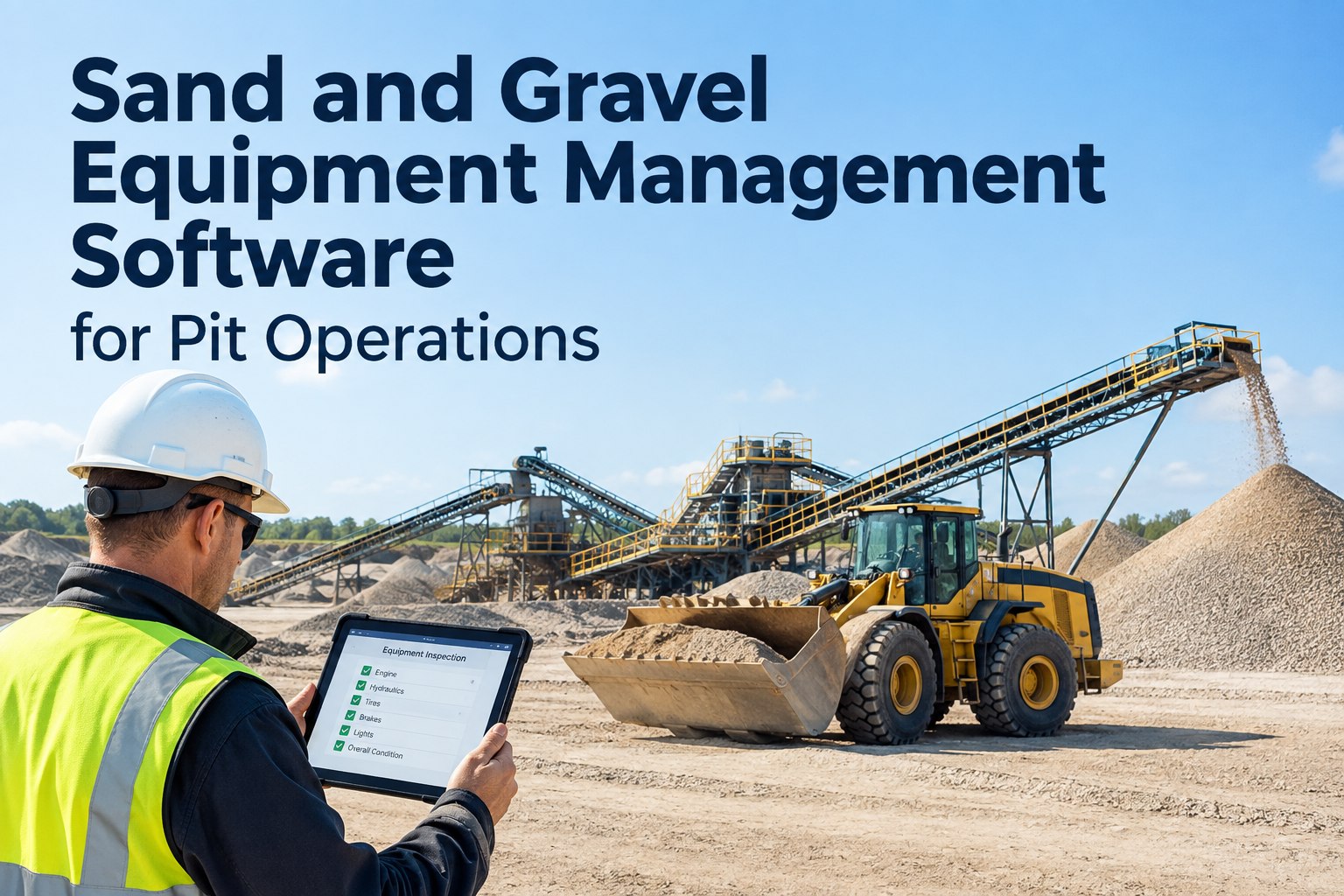
A sand and gravel pit doesn't wear like a dry stone quarry. Abrasive slurry runs through dredge pumps, wash plants, and conveyors all day, grinding down impellers and screen media a dry crusher would never touch — and it's often a lean crew keeping it running from a remote pit with spotty signal. That's exactly what sand and gravel equipment management software has to handle: mixed mobile and fixed assets, wet production-critical plant, and a small team that won't tolerate a system that's more work than the paper it replaces. Book a demo to see it on your own site.
Four Realities a Pit System Has to Handle
Generic fleet tools miss what makes a sand and gravel operation different. A system that works here has to fit all four of these at once.
If you run a sand and gravel operation, you already know the equipment picture is messier than a single-fleet spreadsheet can hold: a loader and a couple of haul trucks, an excavator or a dredge, and a processing line of conveyors, screens, and wash equipment that's the actual heart of production. When the data on all of that lives in different places — or on paper in a truck cab — one missed defect turns into downtime, a safety issue, or a compliance gap. Equipment management software earns its place by making inspections, preventive maintenance, and work orders simple enough that a small crew actually uses them every shift.
The Wet Plant Is Where the Money Leakswhy sand and gravel wear is its own problem
Here's what generic fleet software misses about a pit: the most expensive, fastest-wearing equipment often isn't the trucks — it's the wet processing plant. Abrasive slurry moving through dredge pumps, sand screws, washers, and conveyors grinds down components continuously, and a wash-plant or dredge-pump failure doesn't just cost the repair, it stops production for the whole site.
The specific culprits are predictable, which is exactly why scheduled inspection catches them. Dredge and slurry-pump downtime frequently traces back to clogging, blockages, and impeller and liner wear — wear that a routine check would have flagged before it became a shutdown. Screen media blinds and tears; conveyor belts, pulleys, and idlers take a beating from wet, gritty material; sand screws and dewatering screens wear where the abrasive load concentrates. None of this is exotic; it's steady, predictable degradation that rewards a maintenance program built around the wet plant specifically, not just the rolling fleet. A pit that manages its trucks carefully but treats the wash plant reactively is watching the wrong assets. Book a demo to put wash-plant and dredge PM on the same footing as your fleet
One System for Mobile and Fixed Assetsthe whole pit, not just the trucks
A pit's equipment splits into two worlds that most tools handle separately — and the value of a pit-specific system is holding both in one place, each with the right kind of maintenance.
The mobile side runs on pre-shift inspections and hour-based service; the fixed plant runs on scheduled inspections and wear-part monitoring. They wear differently and get maintained differently — but a manager needs to see all of it in one status view, because in a pit they're one production chain: the dredge or excavator feeds the plant, the plant feeds the stockpile, and a failure anywhere stops the tons. Start free and track every asset in the pit, mobile and fixed, in one place
Meter-Based PM & Defects That Become Work Orderscatch the failure before it stops the tons
The point of managing pit equipment digitally isn't to generate reports — it's to catch the failure while it's still a $200 part instead of a week of lost production. Two connected habits do that.
First, preventive maintenance scheduled by run hours, not the calendar. A loader working a double shift and one used a few hours a week hit their service intervals at completely different times; hour-based PM services each machine on its actual duty cycle, which matters in a pit where a dredge or wash plant may run near-continuously through the season. Second, inspection defects that flow straight into work orders. When an operator flags a fraying conveyor belt or a leaking pump seal on the inspection, that finding shouldn't die in a notebook — it should become a tracked work order with the part identified and the fix assigned, so it's closed before it fails. On a lean crew, that connection is everything: the person who spots the problem usually isn't the person who fixes it, and the handoff is where things fall through the cracks on paper. Book a demo to turn a flagged defect into an assigned work order automatically
Offline Inspections for Remote Pitsthe check can't depend on a signal
Sand and gravel operations are often well outside reliable cell coverage — down in a pit, out by a pond, at a site the tower barely reaches. A digital inspection tool that needs a live connection to work is useless exactly where the work happens, so offline capture isn't a nice-to-have; it's the difference between the system getting used and getting abandoned.
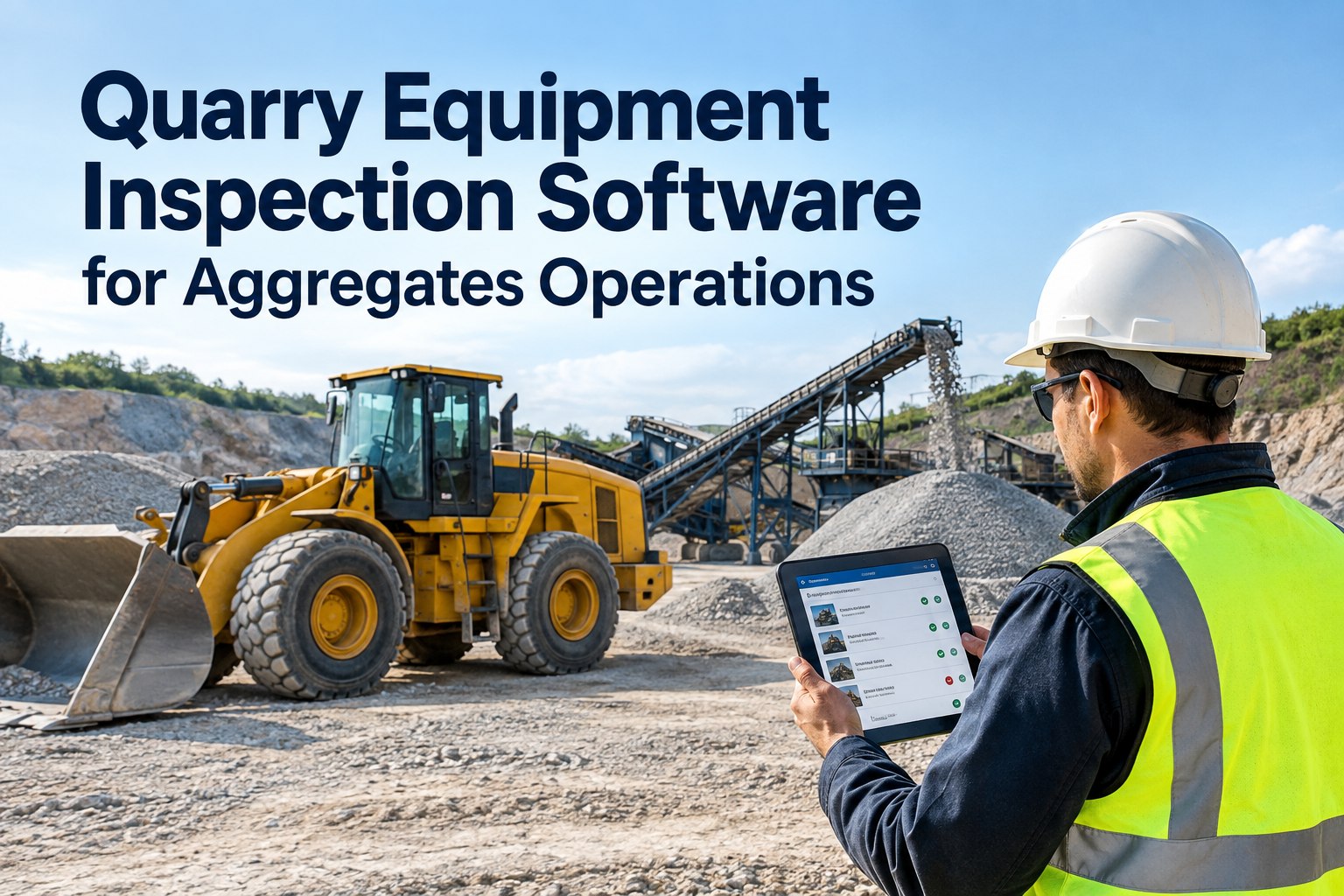
The workflow that actually holds up in a pit: the operator scans a QR code on the machine to pull up the right checklist for that unit, completes the inspection with photos of any defects, and it all saves on the device — then syncs automatically the moment a connection returns, whether that's back at the scale house or the shop. No signal at the pit face doesn't stop the inspection, and nothing gets lost. The QR code also solves a quieter problem: it guarantees the operator is running the correct checklist for the correct asset, so a haul-truck form never gets filled out for a conveyor. For a lean crew moving fast, scan-and-go is faster than finding the right paper form, which is why it actually gets done. Start free and run offline pit inspections that sync when you're back in range
What a Failure Actually Costs a Pitthe repair is the small number
The reason all of this matters comes down to how downtime works in a pit, where the equipment isn't a fleet of interchangeable units but a single production chain. When one link stops, the tons stop.
Picture a suction dredge that clogs mid-shift because a wear point nobody was tracking finally let go. The dredge is down — but so is everything downstream: the wash plant it feeds has nothing to process, the conveyors run empty, the loader has no fresh material to move, and the trucks waiting to haul finished product have nothing to load. One unmanaged wear part didn't cost a dredge repair; it cost a shift of whole-site production, plus the scramble to source a part that wasn't on the shelf because nobody saw it coming. That's the real math of pit downtime: the repair bill is the small number, and the lost production and emergency-sourcing are the big ones. A maintenance program that catches the wear early — and keeps the common wear parts stocked because it knows what's coming due — turns a shift-killing failure into a scheduled ten-minute swap.
Records That Are Ready When MSHA Arrivesthe compliance side, kept simple
Sand and gravel operations are mines under MSHA, and the same digital records that keep the plant running also keep you audit-ready. For self-propelled mobile equipment at surface operations, MSHA's standards (30 CFR Part 56) require inspection before the equipment is placed in operation each shift, with safety-affecting defects corrected in a timely manner and records kept — and it's worth noting that requirements aren't identical across every equipment category or operation, so the applicable standard should be confirmed for each asset rather than assumed.
The practical benefit of managing equipment digitally is that compliance stops being a separate chore. The inspection your operator does for operational reasons is the same record an inspector wants to see, complete with the date, the items checked, any defect, its photo, and the corrective action — retained and retrievable in a search instead of a filing-cabinet dig. One system covers the operational job and the compliance job at once, which is exactly what a lean crew needs, since nobody has time to maintain a separate paper trail just for audits. Keep the distinction clear, though: the software captures and organizes the records; the required inspections and corrections still have to actually happen. Book a demo to make your pit's inspection records audit-ready by default
From a pit manager running a lean crew
We're not a big operation — me, a handful of guys, one wash plant, a dredge, a couple loaders and trucks. The wash plant is the whole business; if it's down, we're not making money that day. And we'd tried "software" before that was built for some giant mine and just buried us in screens nobody had time for.
What changed things was the offline inspections and the defect-to-work-order piece. My operator scans the machine, does the check right there in the pit with no signal, and if he flags a bad pump seal it lands on my phone as a work order — I order the part before it fails instead of after. We stopped getting surprised by the wash plant. For a crew our size, not getting surprised is the whole game.
Sand and gravel equipment management: the takeaway
Sand and gravel equipment management software succeeds or fails on whether it fits the real pit: a mixed fleet of mobile and fixed assets, a wet processing plant that wears fast and stops everything when it goes down, a remote site with unreliable signal, and a lean crew that has no patience for admin. Get inspections working offline, schedule PM by real run hours, turn every flagged defect into a tracked work order, and keep the wear parts you know are coming due on the shelf — and the wash-plant shutdown that used to wreck a week becomes a scheduled swap. That's the difference between managing a pit and reacting to it. Book a demo to see sand and gravel equipment management run end-to-end in HVI
Frequently asked questions
What is sand and gravel equipment management software?
Sand and gravel equipment management software is a digital platform that centralizes the inspections, preventive maintenance, defects, work orders, and records for all the equipment in a pit operation — both the mobile fleet (loaders, haul trucks, excavators, and dredges) and the fixed processing plant (conveyors, screens, sand screws, washers, and pumps). Instead of scattered paper checklists and spreadsheets, it gives a small crew one place to inspect equipment, schedule maintenance by run hours, flag defects that become tracked work orders, and store the records needed for MSHA compliance. What makes pit-specific software different from generic fleet tools is that it accounts for the operational realities of a sand and gravel operation: a mix of mobile and fixed assets that wear and get maintained differently, wet processing equipment that wears fast from abrasive slurry, remote sites with unreliable cell coverage that require offline inspection capture, and lean crews that need a workflow simpler than the paper it replaces. The goal is to connect operational data with maintenance action so that a wear problem is caught and scheduled before it becomes a production-stopping failure.
How do you manage wash plant and dredge maintenance?
Wash plant and dredge maintenance in a sand and gravel operation centers on the fact that abrasive, waterlogged material wears these components far faster than dry material wears crushing equipment. The most common failures are predictable: dredge and slurry-pump downtime frequently traces to clogging, blockages, and wear on impellers and liners; screen media blinds and tears; conveyor belts, pulleys, and idlers degrade from wet, gritty loads; and sand screws and dewatering screens wear where the abrasive load concentrates. Because these are steady, predictable forms of wear, they respond well to a preventive-maintenance program built specifically around the wet plant, using scheduled inspections to catch developing wear and monitoring the condition of wear parts so they can be replaced on a plan rather than after a failure. The practical approach is to treat the wash plant and dredge as priority assets rather than afterthoughts — keeping their common wear parts in inventory, inspecting them on a defined schedule, and turning any flagged wear into a work order — since a wash-plant or dredge failure typically stops the entire site's production, not just one machine, making it far more costly than the repair itself.
Why does sand and gravel equipment need offline inspections?
Sand and gravel operations are frequently located in areas with poor or no cell coverage — down in a pit, out by a dredging pond, or at a remote site far from a tower — and inspections happen precisely at those low-signal locations, at the equipment itself. A digital inspection tool that requires a live internet connection to function would be unusable exactly where the work needs to be done, which is why offline capture is essential rather than optional for pit operations. With offline capability, an operator can complete a full inspection at the pit face — scanning the machine's QR code to load the correct checklist, working through the items, and attaching photos of any defects — with everything saved locally on the device. The inspection then syncs automatically as soon as a connection is available again, such as when the operator returns to the scale house or shop, so no data is lost and no inspection is skipped for lack of signal. For a lean crew, this reliability is what determines whether the system actually gets used every shift or gets abandoned the first time it fails in a dead zone.
What MSHA requirements apply to sand and gravel operations?
Sand and gravel operations are regulated as mines under MSHA, and as surface metal and nonmetal operations they fall primarily under 30 CFR Part 56. A central equipment requirement is found in the mobile-equipment standards: self-propelled mobile equipment such as loaders and haul trucks must be inspected before being placed in operation each shift, defects that affect safety must be corrected in a timely manner, and records must be kept. Related Part 56 standards address specific systems and hazards including brakes, steering, guarding, and warning devices. Two important clarifications: first, these equipment-inspection requirements are separate from MSHA's Part 46 miner-training requirements, which govern training rather than equipment condition; and second, the specific inspection obligations are not identical across every equipment category or operation, since self-propelled mobile equipment, fixed processing plant, and portable plant are governed by different provisions. For that reason, operators should verify the applicable standard for each type of equipment and their specific operation against the current MSHA regulations rather than assuming a single uniform requirement. Digital equipment management helps by capturing the required inspection and correction records in an organized, retrievable form, but the underlying inspections and corrections still have to be performed.
How does equipment software reduce downtime in a pit?
Equipment management software reduces pit downtime by shifting maintenance from reactive to planned, which matters more in a sand and gravel operation than in many others because the equipment functions as a single production chain rather than a set of interchangeable units. When one link fails — say a suction dredge clogs or a wash-plant pump seizes — everything downstream stops too: the plant has nothing to process, conveyors run empty, and trucks have nothing to load, so a single unmanaged wear part can cost a whole shift of site production plus the scramble to source a part that wasn't stocked. Software reduces this in several connected ways: preventive maintenance scheduled by actual run hours services each machine on its real duty cycle before components fail; inspections catch developing wear — a fraying belt, a worn impeller — while it's still a small, planned repair; flagged defects become tracked work orders so nothing falls through the cracks between the person who spots it and the person who fixes it; and knowing what maintenance is coming due lets the operation keep common wear parts on the shelf. Together these turn a shift-killing surprise failure into a scheduled, brief replacement, which is where the real savings are — not in the repair cost, but in the production that no longer gets lost.
Run your whole pit from one simple system
HVI holds every asset in your operation — loaders, haul trucks, excavators, dredges, conveyors, screens, and wash plant — in one place: QR-scan inspections that work offline at the pit face, preventive maintenance scheduled by real run hours, defects that become assigned work orders, and MSHA-ready records by default. Complete enough to keep the plant running, simple enough for a lean crew to use every shift.
No credit card · No hardware required to start · Offline pit inspections on day one