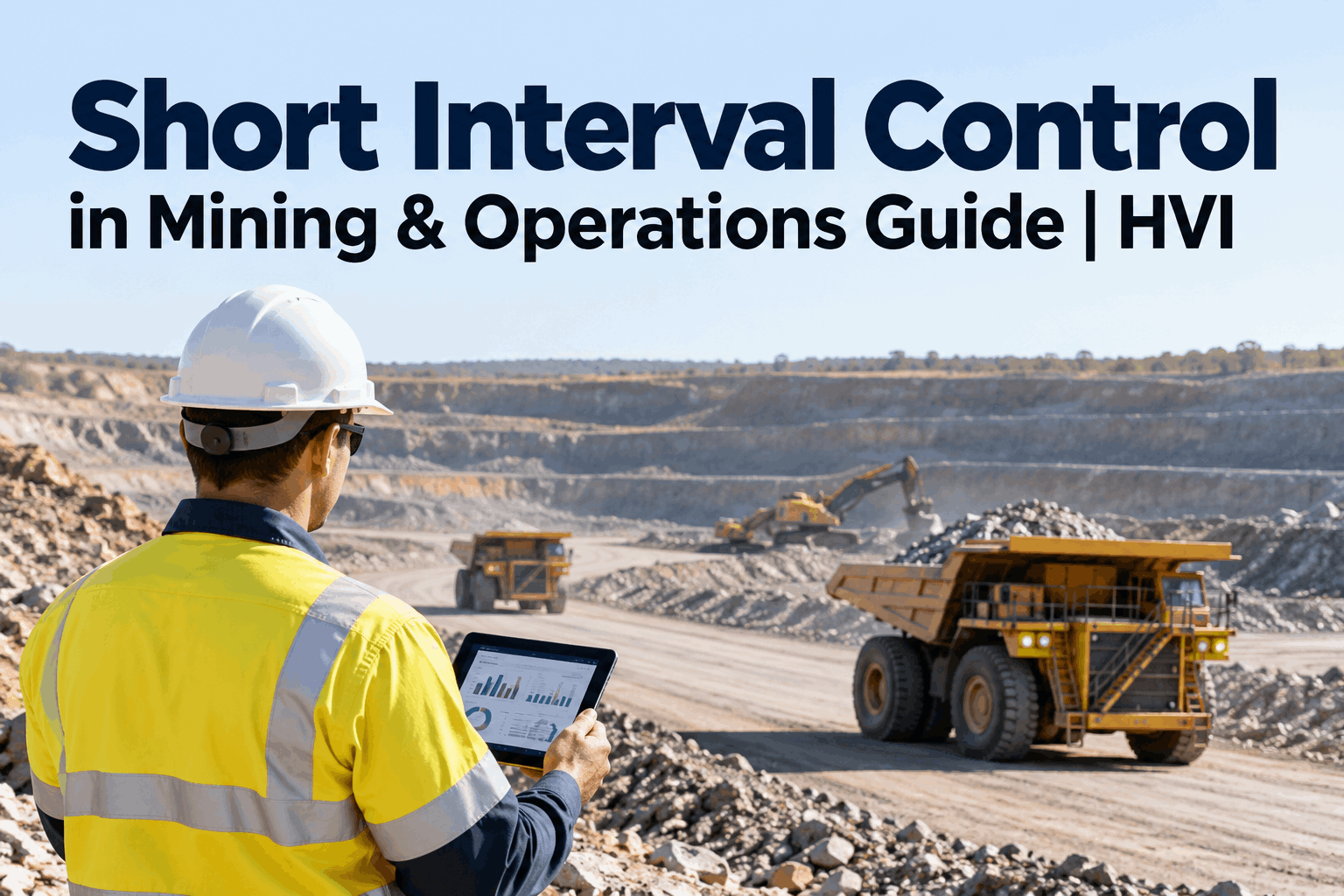
Short interval control is the difference between finding out you missed the plan at end of shift and fixing the problem two hours in. Instead of one big reckoning at handover, the shift is broken into short intervals, actual production is checked against target at each one, and when a gap opens, someone acts on it now. It's a simple idea that lives or dies on one thing: data fast enough to act on. Here's how it works — or book a demo to see the data behind it.
Fix the shift while it's still the shift.
Short interval control turns a shift from a single result into a series of checkpoints — target versus actual, every interval, with action the moment a gap appears. The method is proven; the bottleneck is almost always getting shift and equipment data fast enough to use it.
An honest framing first: HVI is not a short interval control or mine-dispatch system. It doesn't run a real-time production-control room, assign trucks or drive the interval-by-interval control loop — dedicated SIC and dispatch platforms do that. What HVI does is supply the equipment and shift data that a SIC process needs to work: digital operator reports, equipment availability and downtime, and fleet performance, captured in the field and visible fast. It's the data layer under the method — especially the equipment-reliability side of production performance. HVI's production reconciliation guide covers the end-of-period view; this is about acting within the shift. Book a demo of fleet performance reporting to see the data.
Why short interval control works: catch the gap earlythe case for in-shift monitoring over end-of-shift reporting
The whole value of SIC is time. A delay found at the interval it starts can be fixed with most of the shift still ahead; the same delay found at handover is simply lost production. Here's the same shift, managed two ways:
- On-target interval
- Lost production
- Delay detected
Same problem, same mine — the only difference is when it was seen. That gap between "found now" and "found later" is the entire return on short interval control. Book a demo of daily operator reporting to see in-shift data land.
The short interval control loopthe four steps that repeat every interval
SIC isn't a one-off report — it's a short cycle you run again and again through the shift. Each pass is the same four steps, and the faster the data moves, the tighter you can run them.
Set a clear target for the next short interval, by crew and machine.
Capture what's really happening in the field — output, delays, equipment status.
Spot the gap the moment it opens, not three intervals later.
Remove the blocker while there's still shift left to recover.
Steps 2 and 3 are where most SIC programs stall — the data is too slow or too patchy to compare in time. Digital field reporting is what keeps the loop tight. Start a free trial to get shift data in real time.
Where HVI fits the SIC processthe equipment and shift data layer under short interval control
HVI doesn't run the control loop — it feeds it. Five features produce the equipment-side performance data that makes the monitor-and-compare steps possible and trustworthy.
Daily operator reporting
Operators log output, delays and equipment status from the cab, so the interval data is live, not end-of-shift.
Analytics & reporting
Dashboards that show target against actual and surface the gap, so the compare step is instant.
Fleet performance reporting
Availability, utilization and downtime per machine — the equipment reasons behind a missed interval.
Asset management
One record per machine ties status, hours and defects together, so you know what you're working with.
Equipment inspection records
Inspection and defect history that explains an equipment delay — and flags the next one early.
It runs on the same analytics and reporting and daily operator reporting your crews already use. Book a demo of the analytics dashboards.
What tighter shift control delivers
Delays caught early
Problems surface at the interval they start, when there's still shift left to recover.
More from the same fleet
Recovering lost intervals lifts production without adding iron or people.
Decisions on live data
Supervisors act on what's happening now, not on a report that lands tomorrow.
A record of the why
Every delay and its cause is captured, feeding the next shift and the end-of-period reconciliation.
The same operational data feeds both your in-shift control and your mining operations reporting. Start a free trial and tighten your shift control.
From a mine shift supervisor
We'd run the shift, and only at the wash-up would we find out we were down a few hundred tonnes. By then there was nothing to do but write it up. The intent was always to run short interval control properly, but the data came off paper and radios — by the time I had a real picture of the first two hours, the shift was half gone.
Getting the operator reports and equipment status onto phones changed the tempo completely. I can see how an interval went almost as it closes, spot the machine or the face that's dragging, and actually move on it while it still matters. We don't catch everything, but catching a delay at interval two instead of at handover is the whole game. The method was never the problem — the speed of the data was.
Short interval control — FAQs
What is short interval control in mining?
Short interval control (SIC) is a management method that breaks a shift into short intervals — often one to two hours — and checks actual production against target at each one. When a gap appears, the supervisor acts on it immediately instead of waiting for end-of-shift numbers. The point is a fast feedback loop: catch delays while there's still shift left to recover them, rather than discovering shortfalls after they're locked in.
Is HVI a short interval control or dispatch system?
No — and it's important to be clear. HVI is not a dedicated SIC platform or mine-dispatch system. It doesn't run a real-time control room, assign trucks or drive the control loop; specialized SIC and dispatch tools do that. HVI supplies the equipment and shift data a SIC process depends on — digital operator reports, equipment availability, downtime and fleet performance — captured in the field and visible fast. It's the data layer under the method, not the control engine.
Why do SIC programs often fail?
Usually not because the method is wrong, but because the data is too slow. The monitor-and-compare steps only work if you can see actual versus target within the interval — and when that data comes off paper, radios or end-of-shift reports, the gap is already history by the time anyone sees it. Digital field capture is what keeps the loop fast enough to act on, which is the part HVI supports.
How does equipment data fit into short interval control?
A large share of missed intervals are equipment problems — a truck down, low availability, an unplanned stop. If you can see availability, downtime and fleet performance per machine in near real time, you can tell why an interval slipped and act on the actual cause, not a guess. That equipment-reliability data is exactly what HVI brings to the SIC picture alongside the production numbers.
How does SIC relate to production reconciliation?
They're two ends of the same timeline. Short interval control is in-shift — catching and fixing gaps as they happen. Production reconciliation is after the fact — explaining the total variance once the period closes. The same operational data feeds both: if your shift and equipment data is digital and complete, you run a tighter SIC loop during the shift and a cleaner reconciliation after it.
Make short interval control run on data, not guesswork
Keep your dispatch and control tools where they are — and give the loop the equipment and shift data it needs to run tight: output and delays from the field, availability and performance per machine, visible fast enough to act within the interval. Catch the gap while the shift can still recover.
Live shift reporting · Fleet performance per machine · Delays caught early