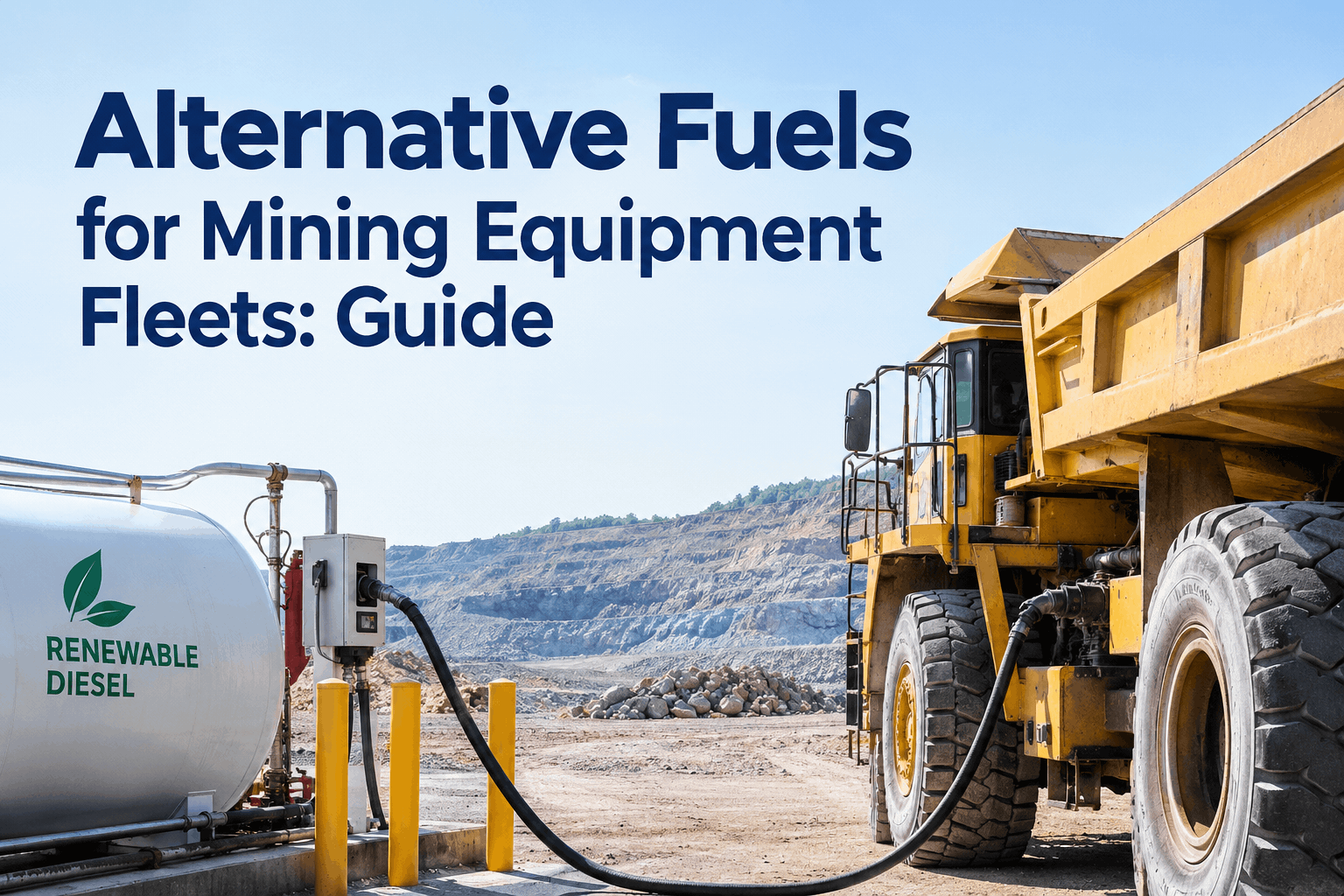
The pressure to cut mine emissions lands hardest on the diesel fleet, and the first realistic lever isn't a battery haul truck — it's what goes in the tank today. Renewable diesel, HVO and biodiesel blends lower your carbon without replacing a machine, but each asks something different of your engines, storage and records. Choosing well among alternative fuels for mining equipment starts with how fuel actually performs in your fleet — start a free trial to track fuel use before you switch.
Cut emissions from the tank, not just the showroom.
A drop-in renewable diesel can lower your fleet's carbon today, with no new machines. But the switch only pays off if you track consumption, cost and the maintenance it touches — so the gain is proven, not assumed.
Weighing alternative fuels for mining equipment comes down to four things: knowing the real options and what each cuts, understanding what they ask of your engines and storage, tracking fuel performance before and after a switch, and reporting the emissions result. Below is each — plus the fuel logging that turns a fuel transition from a leap of faith into a measured decision.
The alternative fuel options comparedrenewable diesel, HVO and biodiesel blends side by side
There's no single "alternative fuel" — there's a ladder of options, each trading emissions cut against how much it asks of your fleet. Here's the honest comparison before you pick a lane, with the drop-in options at one end and the higher-blend ones at the other.
| Fuel | What it is | Fleet impact | Tracking need |
|---|---|---|---|
| Renewable diesel / HVO | Paraffinic diesel from fats or oils — chemically close to fossil diesel | Drop-in; runs in existing engines with little or no change | Low — log consumption to prove the emissions cut |
| Biodiesel blend (B5–B20) | Fossil diesel blended with FAME biodiesel at 5–20% | Usually fine at low blends; watch filters, storage and cold flow | Medium — track filter life and fuel quality closely |
| High biodiesel (B50+) | Higher FAME content for a larger emissions cut | Check OEM limits; more effect on seals, injectors and storage | High — close maintenance and quality monitoring |
| Fossil diesel (baseline) | Conventional mine diesel | No change; the baseline you measure everything against | Baseline — your reference for cost and CO₂e per tonne |
Renewable diesel wins on simplicity; biodiesel blends cut cost differently but demand closer watching. Either way, the decision rests on your own fuel and maintenance numbers. Sign up free and baseline your fleet fuel before you choose a fuel.
What each fuel asks of your fleetthe compatibility and maintenance factors to plan for
A fuel switch is mostly invisible — until it shows up in a clogged filter or a storage tank issue. These are the practical factors that decide whether a transition is smooth, and every one is something you track in maintenance and fuel records.
Renewable diesel sidesteps most of these; biodiesel rewards the fleets that watch filters and storage closely. Knowing which applies to your machines is the planning step. Book a demo to plan a fuel switch around your maintenance.
The data that makes a fuel switch safetrack before, during and after to prove it works
The fleets that switch fuel without drama all do the same thing: they measure first. A clean baseline turns "the fuel feels fine" into a number — and catches a problem in week one instead of at the next major service. Four things to have on record.
- 1Baseline consumptionFuel per machine and per tonne on fossil diesel, before anything changes.
- 2Post-switch consumptionThe same figures on the new fuel, to see any real efficiency change.
- 3Maintenance effectsFilter life, injector and fuel-system health flagged against the fuel change.
- 4Emissions resultCO₂e per tonne, ready to report against your sustainability targets.
With those four on record, a fuel switch stops being a gamble and becomes a decision you can defend to finance and to a sustainability auditor alike. Start free and build your fuel baseline this month.
Alternative fuel transition checklistwhat to confirm before switching a mining fleet's fuel
Before the first tanker of a new fuel arrives, run the fleet through these. Tick them off in your records and the switch is controlled — not a surprise that shows up as downtime three weeks later.
Logged per asset, this checklist is also your audit trail if a warranty or compliance question ever comes up. Sign up free and build this transition checklist into your fleet.
Mining fleet fuel management softwarehow HVI fuel logs make an alternative-fuel switch measurable
An alternative fuel only earns its place if you can prove the cut and catch the side effects. HVI's fuel logs and storage tracking record every litre per machine, tie fuel to maintenance, and report cost and emissions — so the transition is managed on evidence.
Treat fuel as data, not just a cost line, and an alternative-fuel decision gets easy to prove and easy to report. Explore mining fleet maintenance management, and pair it with Read our mining fixed plant energy guide for the stationary side of your emissions.
What a mining fleet manager actually watches
We moved our haul fleet to renewable diesel expecting a fight, and the surprise was how little changed in the cab — the trucks just ran. The real work was proving it: I needed fuel per tonne before and after, and the emissions number for our sustainability report. Because we'd logged fuel per machine from the start, I had the whole before-and-after on one screen instead of guessing from bulk deliveries.
Frequently asked questions
What are the main alternative fuels for mining equipment?
The practical ones today are renewable diesel (HVO), a drop-in diesel replacement, and biodiesel blends like B5 to B20. Renewable diesel needs little change; biodiesel cuts emissions too but asks for closer filter, storage and quality tracking.
Is renewable diesel a drop-in fuel for existing engines?
Largely yes. HVO is chemically similar to fossil diesel and generally runs in existing engines with little or no modification, which is why it's often the first step in fleet decarbonisation. Always confirm the specific OEM approval for each engine.
Does biodiesel affect mining equipment maintenance?
It can. Biodiesel may loosen tank deposits and clog filters soon after a switch, and higher blends affect storage stability and cold flow. Plan an early filter change and track fuel quality — the effects are manageable when you watch for them.
How do I prove an alternative fuel cuts emissions?
Baseline fuel use and CO₂e per tonne on your current diesel, then measure the same after the switch. The difference, tied to logged consumption per machine, is your reportable emissions cut — far stronger than a supplier estimate.
How does fuel-logging software support a fuel switch?
It records fuel per machine, ties it to maintenance and storage, and reports cost and emissions per tonne. That gives you a clean before-and-after, catches any maintenance side effects early, and produces the numbers finance and sustainability teams need.
Switch to alternative fuels with the numbers to back it
HVI logs fuel per machine, links it to maintenance and storage, and reports cost and emissions per tonne — so an alternative fuel is a measured decision, not a leap. Start free and baseline your mining fleet in under two weeks, no hardware.
Fuel logs per machine · Storage & quality tracking · Emissions reporting