Twice a year, an MSHA inspector walks onto your pit or quarry unannounced and asks for the training plan. Not certificates — the plan itself, and the records behind it. An MSHA Part 46 training plan is the one document every aggregates operator has to produce cold. Book a demo to see records ready before the inspector asks
Twenty-Four Hours. Three Checkpoints. Track the Clock.
A new miner's training doesn't land in one session — it accrues against the calendar. Tap a checkpoint to see what's owed by that day.
Mine tour, hazard recognition, emergency procedures, task hazards, miners' statutory rights, lines of authority, and how to report a hazard — all before the miner does a single shift.
Self-rescue and respiratory device use, plus a first aid review — roughly two more hours added to the four already delivered.
Whatever balance remains of the 24 hours, covering any other subject that promotes health and safety at that mine. The clock closes here.
Part 46 doesn't ask MSHA to approve your plan before you run it — it asks you to build one that's already complete. Below: what the plan must contain, the training it has to cover, who's allowed to train, and the records that prove it happened.
What an MSHA Part 46 training plan must contain
Here's the part that surprises most operators: your plan doesn't need MSHA's sign-off before you use it. It's considered approved the moment it contains five specific things.
Operator and mine identified
Your name, mine name, and MSHA mine ID or contractor ID number, listed against the plan.A named responsible person
Who is accountable for health and safety training at the mine, by name and position.Teaching methods and content
The subject areas covered and the approximate time spent on each one.Instructors named to subjects
Who teaches, and the specific areas each person is competent to instruct in.How you evaluate it works
The procedures used to confirm the training is actually effective, not just delivered.Miss one of these five and the plan doesn't self-certify — it has to go to MSHA's Regional Manager for formal approval instead. That's a slower path most operators would rather avoid.
The plan also has to be posted or handed to miners two weeks before it takes effect, and available at the mine for MSHA and miners to inspect any time. Book a demo to see your plan stored and retrievable per mine ID. Confirm current requirements with MSHA before finalizing yours.
The five training programs your plan has to cover
Content is only half of it. The plan also has to run five distinct training programs, each triggered by a different event in a miner's time at the mine.
New miner training
24 hours minimum for anyone without prior mining or equivalent experience, across the day-0/60/90 checkpoints above.
Newly hired experienced miner training
A shorter track for someone who already qualifies as experienced — the same core subjects before starting, plus a 60-day follow-up.
New task training
Required before a miner performs any task they have no prior experience in — the trigger most sites forget when someone changes equipment.
Annual refresher training
8 hours minimum every 12 months for every miner, covering site changes and relevant health and safety subjects.
Site-specific hazard awareness
For non-miners on site — delivery drivers, vendors, visitors — before they're exposed to any mine hazard.
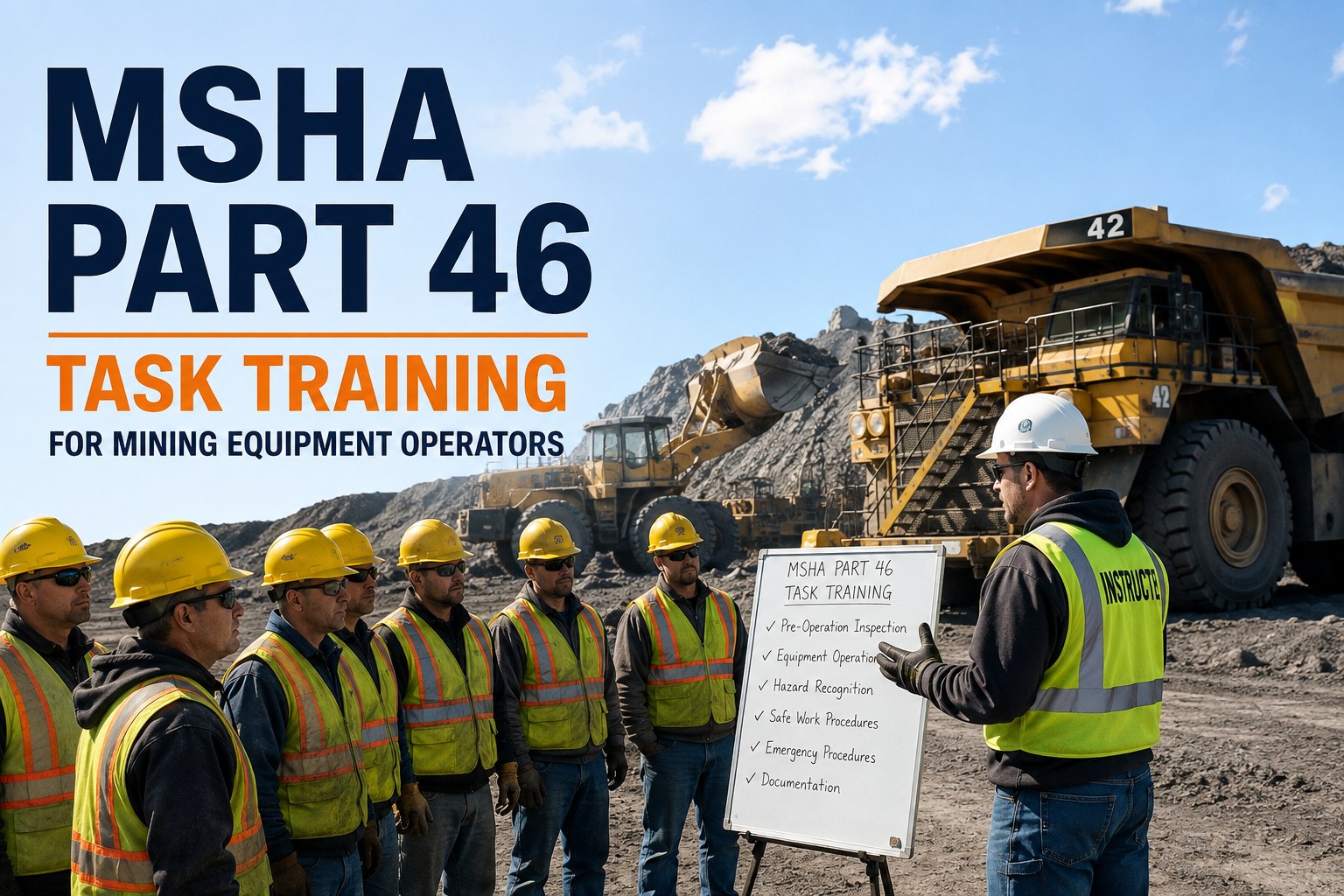
Task training is where audits get expensive. Move an operator from a loader to a haul truck without documenting it, and that's a citation waiting to happen. See our task training deep-dive for how 46.7 applies equipment by equipment.
Who's allowed to be the trainer
Part 46 doesn't require an MSHA-approved instructor. It requires a "competent person" — and that's a determination you make and document yourself, not a credential you apply for.
Ability, training, knowledge or experience
Someone you designate who can teach their subject and evaluate whether the miner actually learned it — not just deliver a slideshow.
Naming a person without naming a limit
If your shop lead can teach machine guarding but not electrical hazards, the plan has to say so — otherwise an inspector assumes they're covering everything.
Document the determination the same way you'd document any other qualification: who, what subject, based on what experience, and when it was made. Book a demo to see competent-person determinations tracked per trainer and subject.
What the records have to show, and how long you keep them
Training that happened but was never certified on paper might as well not have happened, as far as an inspector is concerned. Every session needs a record, and every record has its own clock.
| Training type | Certified by | Retained for |
|---|---|---|
| New miner (24 hrs) | Completion of the full 24 hours | Full employment, plus 60 days after leaving |
| Newly hired experienced miner | Completion of that training | Full employment, plus 60 days after leaving |
| New task training | At least once every 12 months, or on request | Full employment, plus 60 days after leaving |
| Annual refresher (8 hrs) | Completion of each session | Two years only |
| Site-specific hazard awareness | Completion, for miners under 46.2 | Full employment, plus 60 days after leaving |
Every record needs the miner's full name, the training type, duration, date, the competent person's name, and a signed certification statement — MSHA Form 5000-23 or an equivalent that carries the same fields.
Notice refresher training has its own shorter two-year rule, separate from everything else. That's the field most spreadsheets get wrong. Sign up free and let retention periods run themselves.
Who owns training when a contractor is on site
Contractors don't fall under your training plan automatically, and getting this split wrong is a common Part 46 gap. The obligation splits cleanly in two.
Site-specific hazard awareness
Primary responsibility for making sure contractor employees who need it get site-specific training, plus telling contractors about site hazards up front.
Everything else
New miner, newly hired experienced, task, and annual refresher training for their own crew — and telling you about hazards their work creates.
A contractor's employee who counts as a "miner" under 46.2 needs the full training suite from their own employer, not a shortened version from you. Book a demo to see contractor training tracked alongside your own crew.
Three failure modes that show up in almost every audit
None of these are exotic. They're the same three gaps, mine after mine, and every one of them is a records problem before it's a training problem.
Training happened, the record didn't
A toolbox talk that covered real Part 46 subjects, with nobody signing off duration, date and competent person — so on paper it never occurred.
Refreshers missed by rotating and seasonal crew
The 12-month clock doesn't pause for a layoff. A seasonal hire who returns after 13 months needs the refresher they missed, not a pass.
Task training skipped on equipment moves
An operator shifted to a new machine without documented task training — the fastest citation an inspector can write, because it's a yes-or-no records check.
All three are visible in the gap between when training happened and when someone recorded it. Close that gap and most audits become a formality.
From a safety coordinator at a sand and gravel operation
We had a seasonal loader operator come back in April after being laid off since October — fourteen months. Nobody flagged that his refresher had lapsed, because the paperwork was a binder and binders don't send reminders.
The inspector caught it in about ninety seconds. Now every training record has a date attached and something pings me before it expires. I haven't missed one since, and audits take a fraction of the time.
Frequently asked questions
Does MSHA have to approve a Part 46 training plan?
Not in the usual case. A plan is considered approved the moment it contains five required elements under 30 CFR 46.3(b): operator and mine identification, a named responsible person, teaching methods and content, named instructors, and evaluation procedures. Missing any one sends it to formal Regional Manager approval instead.
How many hours of training does a new miner need?
No less than 24 hours total, under 30 CFR 46.5. At least 4 hours come before the miner begins work, covering mine tour, hazard recognition, emergency procedures, task hazards, miners' rights, and hazard reporting. Self-rescue and first aid follow within 60 days; the remaining balance is due within 90 days.
Who can deliver Part 46 training?
A "competent person" — someone the operator or contractor designates who can teach a subject and evaluate whether the training worked. Unlike Part 48, MSHA doesn't require the trainer to be agency-approved; the operator makes and documents the determination, limited to subjects that person is genuinely qualified in.
How long must Part 46 training records be kept?
Records for new miner, newly hired experienced miner, task, and site-specific hazard awareness training run for the miner's full employment, plus 60 calendar days after they leave. Annual refresher records are the exception — kept only two years. All must be available at the mine on request.
Who is responsible for training a contractor's employees?
It splits under 30 CFR 46.12. The production-operator is primarily responsible for ensuring site-specific hazard awareness training happens, and for telling contractors about site hazards. The independent contractor is primarily responsible for their own crew's new miner, task, and annual refresher training — the production-operator doesn't cover that for them.
A Part 46 training plan is a document you can hand over, not a filing cabinet
Five required elements, five training types running on their own clocks, one competent-person determination per trainer, and records that survive the day someone checks. None of it is complicated on its own.
What breaks it is drift — a refresher that slips past 12 months, a task change nobody logged, a binder an inspector can't find in the time they're willing to wait. Confirm any specifics against MSHA's current text before you finalize your plan.
Make your Part 46 training plan audit-ready every day, not just inspection day
HVI tracks new miner, task, refresher, and site-specific training per person with 90-, 60- and 30-day expiry alerts, ties equipment assignments to whoever's actually qualified, and keeps every record retrievable from a phone when MSHA walks up unannounced.
Training & competency records · Expiry alerts · Equipment assignment tracking