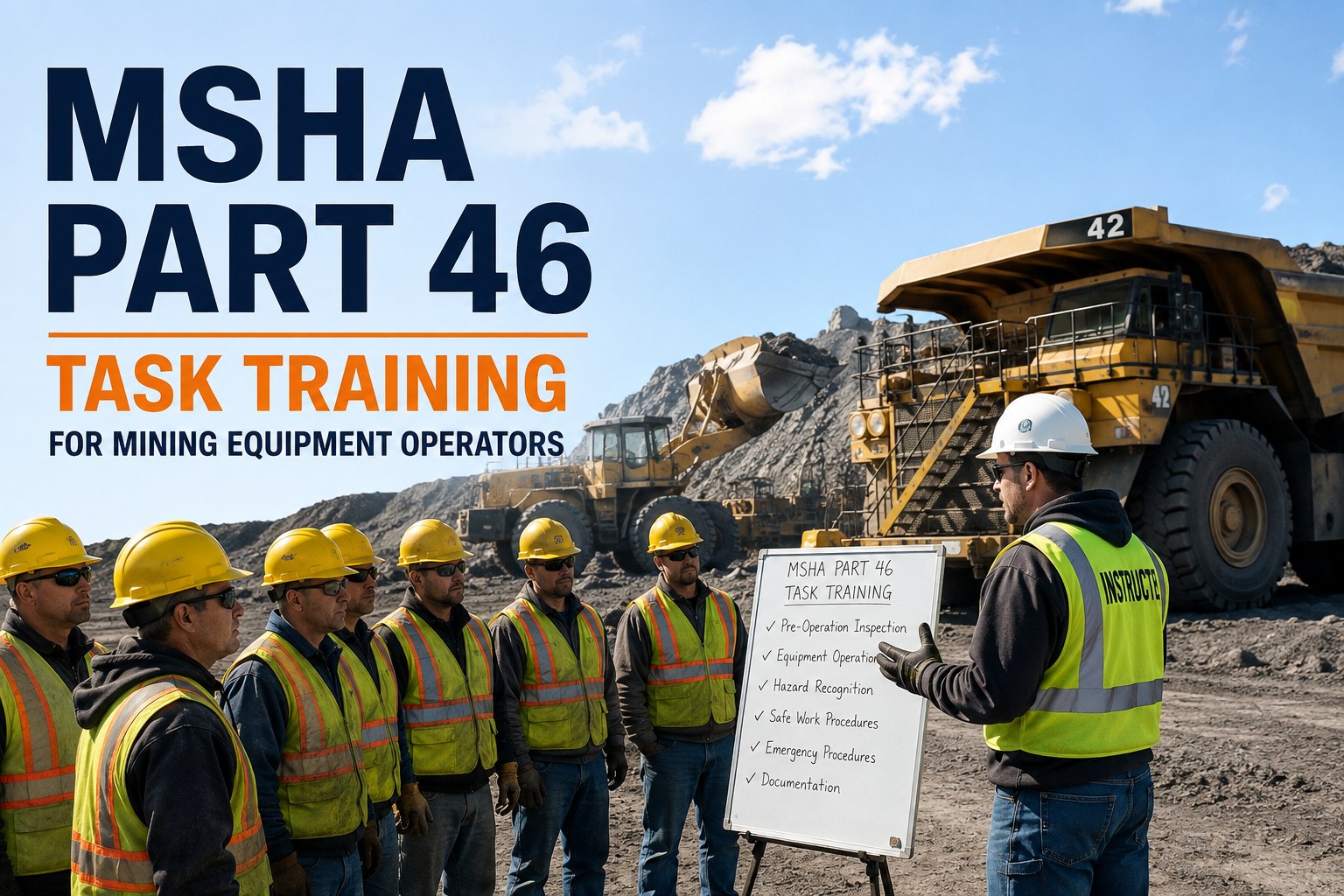
When an MSHA inspector pulls onto your site and asks to see task training records for the haul truck operator who just climbed into the cab, you either have the documentation ready or you do not. MSHA Part 46 task training for mining equipment operators is one of the fastest citations an inspector can write because it comes down to a records question with a yes-or-no answer. The operator must be trained on the specific piece of equipment before they perform any task, including the pre-shift inspection, and the training file is usually the first thing requested during an audit. If you are defending a move to digital documentation internally, walk through it on your own units to see how fast retrieval works.
MSHA PART 46 COMPLIANCE
Can you prove task training before the inspector reaches the cab?
Part 46.7 requires that every operator be trained on the specific equipment they run before performing any task, including pre-shift inspections. If the record is not ready in seconds, the citation writes itself.
THE REAL COST OF A MISSING FILE
Why training documentation is the fastest citation on a mine site
A Part 46 citation is not a debate about competency. It is a paperwork question the inspector answers by looking at your training plan and records.
Unlike a maintenance defect that might warrant discussion, a missing training record is binary. The inspector asks for the file, you either produce a compliant certificate or you cannot. That is why MSHA training records are the low-hanging fruit of compliance enforcement, and why contractors running mixed fleets lose days to paperwork citations that have nothing to do with how well their people actually operate the equipment.
PART 46 VS PART 48
Applying the wrong MSHA framework is itself a compliance failure
Part 46 and Part 48 cover different mine populations and different training architectures. Choosing the wrong one invalidates your entire training program.
| Factor | Part 46 (Surface) | Part 48 (Underground) |
|---|---|---|
| Mine type | Sand, gravel, surface stone, surface clay, colloidal phosphate | Underground, coal, deep metal and non-metal |
| Training plan | Written plan, submitted and approved by MSHA before training begins | Written plan, MSHA-approved with stricter instructor certification |
| New miner hours | 24 hours minimum before starting work | 40 hours minimum with specific task scheduling |
| Annual refresher | 8 hours per year | 8 hours per year |
| Record format | Certificate signed by the training manager | Certificate with MSHA certificate number issued |
If you run surface aggregate operations and train to Part 48 standards expecting that to cover you, you still fail the MSHA Part 46 training requirement because the plan and records are structured under the wrong part. Conversely, applying Part 46 to a Part 48 operation creates immediate violations. If you are unsure which applies, confirm it with your local MSHA office before building the training plan. To see how a single system handles both populations without manual sorting, book a 30-minute walkthrough.
THE FOUR CATEGORIES
New miner, newly hired experienced miner, new task, and annual refresher
Part 46 splits training into four distinct categories. Each has its own trigger, its own minimum hours, and its own record obligation.
New Miner Training
For a miner with no prior mining experience. Requires no less than 24 hours of training covering hazard recognition, emergency procedures, health and safety standards, and task-specific instruction before they can begin work at the mine.
Newly Hired Experienced Miner
For a miner who has completed Part 46 or Part 48 training at a previous operation. You must provide site-specific hazard training and document the transfer of their existing training records before they start tasks at your site.
New Task Training
Triggered when a miner is assigned to a new task or new equipment. The operator must be trained on the specific machine before performing the task, and the training must be documented in the plan. This includes pre-shift inspection duties.
Annual Refresher
A minimum of 8 hours of refresher training each year. Covers changes at the mine, new equipment, updated hazard information, and reinforces prior training. Miss the deadline and the miner cannot legally operate until it is completed.
The new task training MSHA requirement is where most contractors get caught. A loader operator who is moved to a haul truck for a shift is not automatically qualified. The training must cover the specific equipment, the specific task, and be recorded before the operator starts. If you are tracking these categories on a spreadsheet that nobody updates in real time, start logging inspections and training free to see how automated alerts prevent the gap.
REQUIREMENT-TO-RECORD MAPPING
How to map Part 46.7 task training to audit-ready records
Every Part 46.7 obligation has a corresponding record. If the record does not exist, the obligation has not been met.
| Part 46 Requirement | What the Inspector Asks For | Record You Must Produce |
|---|---|---|
| Written training plan | Current approved plan on site | Signed, dated plan with MSHA approval notation |
| Task training before assignment | Proof the operator was trained on that specific equipment | Training certificate listing equipment, date, trainer, operator |
| Competent person instruction | Qualification of the person who delivered the training | Trainer credentials and signature on the training record |
| Record retention | Current and historical training files for each miner | Accessible file held for the duration of employment plus 2 years |
| Annual refresher compliance | 8-hour refresher completed within 12 months | Dated certificate with topics covered and hours logged |
When mining training documentation is mapped this clearly, an inspection becomes a retrieval exercise rather than a scramble. The inspector names the operator and the equipment, you pull the file, and the audit moves on. If your current process involves calling three foremen to find a binder that may or may not be in the maintenance shop, see how HVI handles retrieval in seconds.
PROVE COMPLIANCE IN SECONDS
Stop hunting for training binders when the inspector is already on site
Book a demo and see how HVI ties every training record to the operator, the equipment, and the inspection, so nothing falls through the cracks.
HOW HVI HELPS
How HVI keeps MSHA Part 46 task training audit-ready
HVI maps directly to the four Part 46 training categories and the record-retention rules that trip up most contractors.
Per-person training records
Every operator has a digital training file holding certificates, task training logs, equipment assignments, and refresher history. No binders, no spreadsheets, no missing pages.
90, 60, and 30-day expiry alerts
HVI sends automated alerts before annual refresher deadlines and task training expiries. You see who is about to lapse at 90 days, 60 days, and 30 days out, so no operator runs equipment with stale training.
Equipment tied to qualified operators
HVI links each piece of equipment to the operators who hold valid task training for it. If an unqualified operator tries to log a pre-shift inspection, the system flags it before the shift starts.
Audit-ready retrieval
When MSHA asks for a training record, you pull it up on a phone or tablet in seconds. Filter by operator, equipment, or date. Role-based access means the inspector sees exactly what they need and nothing more.
For a 40-operator site running loaders, haul trucks, and support vehicles, the difference between a paper binder and HVI is roughly 2 hours saved per inspection and zero risk of a missing-file citation. Walk through the record-retrieval flow on a live demo to see what audit-ready actually feels like.
KEY TAKEAWAYS
What every safety manager needs to lock down
Confirm your part. Know whether you are Part 46 or Part 48 before building a training plan. Applying the wrong framework is a compliance failure on its own.
Train before assignment. Task training on specific equipment must be completed and documented before the operator performs any task, including the pre-shift inspection.
Track four categories. New miner, newly hired experienced miner, new task, and annual refresher each have distinct triggers and minimum hour requirements.
Make retrieval instant. An MSHA inspector will not wait while you search a binder. Records must be accessible in seconds, filtered by operator and equipment.
Automate expiry alerts. Do not rely on memory for annual refresher deadlines. Use 90, 60, and 30-day alerts to catch lapses before they become citations.
"I used to keep training certificates in a three-ring binder in the site office. When MSHA showed up and asked for the haul truck operator's task training, nobody could find the binder. Now I pull it up on my phone in ten seconds. That is the difference between a clean inspection and a citation I have to explain to corporate."
Dale Rimmer
Site Supervisor, independent aggregate contractor running a 22-machine mixed fleet
FAQ
MSHA Part 46 task training questions, answered
What does MSHA Part 46.7 require for task training?
Part 46.7 requires that miners be trained to perform their assigned tasks safely before they begin work. For equipment operators, this means task-specific training on the machine they will operate, including instruction on hazards, controls, and safe operating procedures, and the training must be documented in the approved training plan. This applies to every task, including pre-shift inspections.
What is the difference between Part 46 and Part 48 training?
Part 46 covers surface non-metal mines such as sand, gravel, and surface stone operations. Part 48 covers underground mines and coal operations with stricter instructor certification and record-keeping rules. Applying Part 46 when Part 48 applies, or vice versa, invalidates your training records. Confirm with MSHA which part governs your operation before building your plan. Book a demo to see how HVI handles both frameworks.
How long must MSHA Part 46 training records be retained?
Training records must be retained for the duration of the miner's employment plus two years after they leave, or for 60 months from the date of training, whichever is longer. Records must be accessible at the mine site and available to MSHA upon request. HVI holds these records digitally with no expiration, so you never lose access.
Does new task training apply to pre-shift inspections?
Yes. Pre-shift inspection is a task. If an operator has not been trained on the specific equipment they are inspecting, the inspection itself is non-compliant under Part 46.7. The operator must have documented task training on that machine before performing the pre-shift check.
Can training records be kept digitally instead of on paper?
Yes. MSHA accepts digital training records as long as they contain the required information and are accessible for inspection. Digital records must show the operator's name, equipment type, training date, trainer's name, and a signed certification. HVI stores all of this per person, per piece of equipment, with timestamped retrieval. Start logging training records free to see how it works.
GET AUDIT-READY
See HVI running on your own fleet, book a 30-minute demo
Tie every operator to their training, every machine to its qualified personnel, and every inspection to a compliant record. Walk through the full MSHA Part 46 workflow on a live system.
Free to start - Works on any phone - No card needed