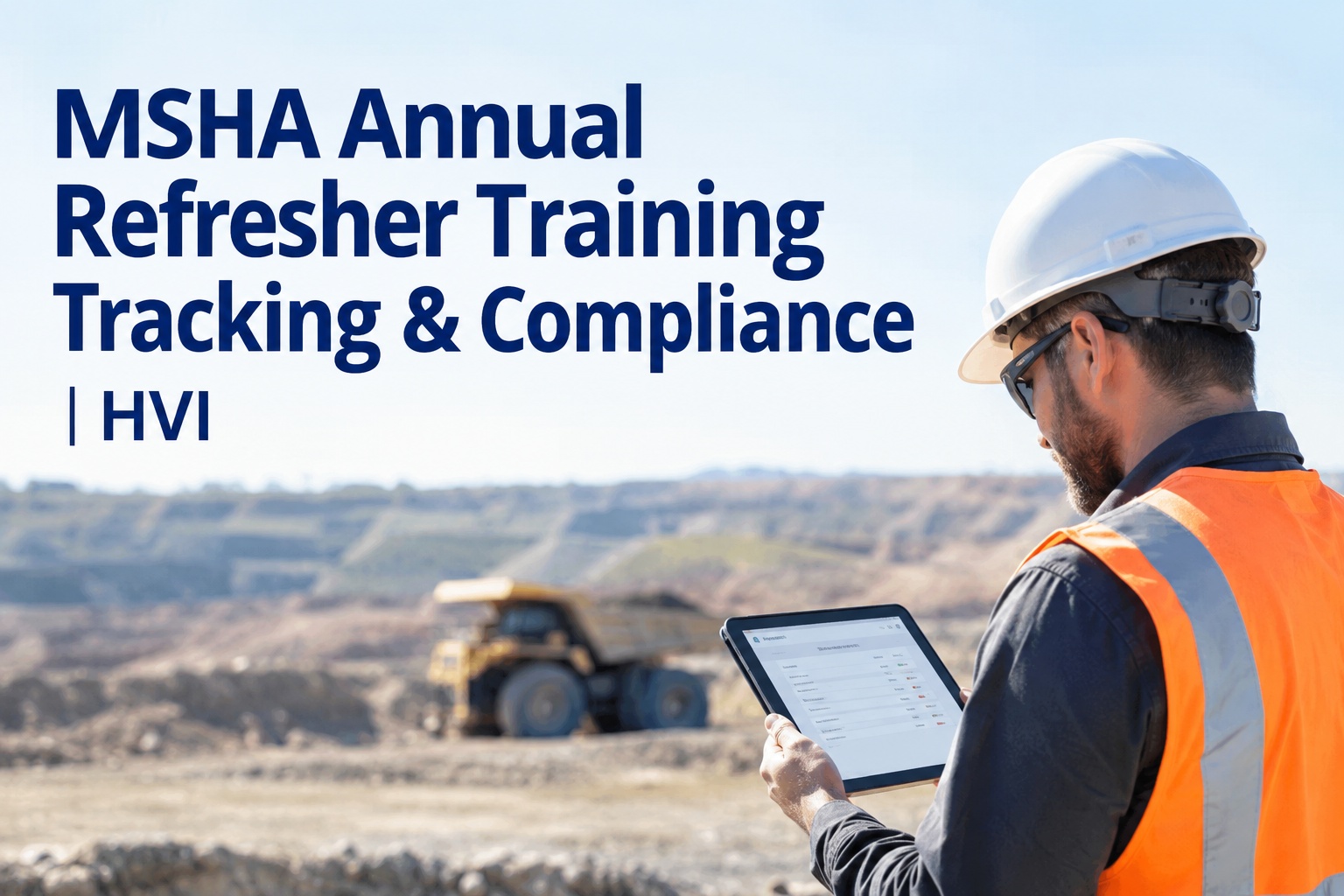
A miner shows up for a swing shift and gets turned around at the gate. Not for a safety violation on the job. His MSHA annual refresher training lapsed eleven days ago, and nobody in the office caught it until the badge scanner did.
The company held a training day four months ago. Most of the crew got refreshed. This miner was on his off-swing that week, and his personal anniversary date quietly passed while everyone assumed the group session had covered it.
That's the core problem with refresher training. It isn't a company event. It's a per-person clock, and a rotating or seasonal workforce makes that clock brutally hard to track by hand.
None of these numbers are hard to meet on their own. What's hard is knowing, on any given Tuesday, exactly where every miner sits against their own clock.
MSHA Annual Refresher Training Runs on Each Miner's Anniversary
30 CFR §48.8 for surface operations and §48.28 for underground both set the same baseline: 8 hours of refresher training in every 12-month period, per miner.
That 12-month window starts the day a specific person completed their last session. Not the calendar year. Not the date of the company's last training event.
A single annual training day works fine for whoever is scheduled to attend it. It does nothing for anyone hired mid-year, transferred in from another site, or out on leave that week.
Run that logic across a workforce with dozens of hire dates and you get dozens of separate deadlines, each one silently ticking whether or not anyone is watching it. Book a demo to see individual training clocks tracked automatically
The Rotating Roster Problem
Rotation crews make the anniversary problem worse. A worker on a two-week-on, two-week-off swing might have their refresher deadline land squarely in the middle of their week off.
Nobody is deliberately ignoring it. The person who'd normally flag it is offsite, and the training coordinator has no reason to think about that specific name until the next roster overlap.
By the time that miner rotates back in, they can already be out of compliance, and the mine finds out the same way the miner in the intro did: at the gate, on a shift day, with a crew short-handed.
FIFO camps, offshore-style rotations, and multi-site contractor crews all carry the same structural risk. Book a demo to see how rotation schedules line up against training expiry
Seasonal Operations Leave Training Currency in Different States
Seasonal mines and contractors add a second layer to the same problem. Workers leave at the end of a season and come back months later, each carrying a training record in a different state.
Refresher still current
Left the site four months ago with eight months left on their annual clock. Cleared to work the day they return.
Refresher expired mid-off-season
Same layoff, different hire date. Their 12-month window closed while the site was idle, and nobody was tracking it.
Both workers show up on the same morning. Only one of them is legally allowed on site until the gap gets closed, and the crew lead has no easy way to tell which is which without pulling individual records first.
Multiply that by a seasonal crew of thirty or more, rehired on a rolling basis, and a manual roster becomes a guessing exercise instead of a compliance check.
Contractors add a third layer. A drilling or hauling contractor working under a mine's site-specific training may carry their own refresher records from a different employer entirely.
Verifying those records at the gate, rather than assuming a contractor's badge means their training is current, is its own recurring task on a multi-contractor site.
What Annual Refresher Training Content Has to Cover
The 8-hour minimum isn't a blank block of time. 30 CFR §48.28 lists specific courses of instruction that a compliant refresher session has to include.
Site-specific changes also belong in the session. Anything new at the mine that could affect a miner's health or safety has to be addressed, not just the standard curriculum.
Sessions can be delivered in blocks of 30 minutes or more rather than one continuous day, as long as every miner is told the session counts toward their annual refresher. Book a demo to see a training matrix built around these exact topics
An Expired Refresher Creates a Staffing Problem, Not Just a Compliance One
Once a miner's annual refresher lapses, they are not permitted to work until it's brought current. That's not a fine to pay later. It's an immediate stop.
Pull one experienced operator off a shift with no warning and the compliance issue becomes an operational one in the same instant. Someone has to cover the gap or the work slows down.
Do it on a day when two or three other names are quietly in the same position, and a routine morning turns into a scramble to figure out who's actually cleared to be on site.
The fix isn't reacting faster once someone's expired. It's seeing the gap coming with enough lead time to schedule around it. Book a demo to see expiring training flagged before it becomes a shift problem
A safety manager defending this internally isn't just protecting a compliance record. They're protecting the crew from being handed a job short-staffed, which carries its own safety risk on top of the paperwork one.
Building Visibility Before the Deadline Becomes a Surprise
Genuine planning lead time is the difference between rescheduling a shift calmly and scrambling to cover one. That means flagging a coming expiry well before the day it actually lapses.
Days out
Training coordinators get early warning to slot the miner into an upcoming session before it becomes urgent.
Days out
Supervisors see the name on their crew's list, so shift planning can route around a known gap in advance.
Days out
Escalation stage. If a session still isn't booked, this is the last comfortable window to schedule one.
Role-based access matters just as much as the alerts themselves. A training coordinator needs the full roster and course details. A site supervisor mainly needs to know who on their crew is coming due.
And when an inspector asks for proof, the record needs to be pulled in minutes, not reconstructed from paper files or someone's memory of who attended what session. Start free and get 90, 60, and 30-day alerts running from day one.
From a safety manager who's had this conversation with an inspector
I used to keep this in a binder sorted by hire date, which worked fine until we started running two rotation crews and a seasonal contractor pool on top of the regular staff.
The alerts changed the job from checking dates every Monday to just handling the two or three names that actually needed action that week. That's the whole difference.
MSHA Annual Refresher Training Needs a Per-Person System, Not a Calendar Reminder
A company training day is a useful event. It was never designed to be the whole compliance system, and rotating or seasonal crews expose that gap fast.
MSHA annual refresher training compliance comes down to knowing, for every individual miner, exactly where their clock stands and how much runway is left before it matters.
Build that visibility once and the surprises at the gate stop happening. Start free and let the alerts do the watching your spreadsheet never could.
Frequently Asked Questions
How often is MSHA annual refresher training required?
Every miner must complete a minimum of 8 hours of refresher training within every 12-month period, measured from that individual miner's own last training date under 30 CFR §48.8 (surface) or §48.28 (underground).
It is not tied to a calendar year or a single company-wide training day, which is why tracking it person by person matters more than scheduling one annual event.
Does one company training day satisfy everyone's annual refresher?
Only for miners whose 12-month window happens to fall on or before that date. Anyone hired later, transferred in, or absent that day still has their own separate deadline running in the background.
Relying on a single event to cover a whole roster is one of the most common ways sites end up with a miner working past their expiry without anyone noticing.
What topics must MSHA refresher training content include?
30 CFR §48.28 lists required courses including mandatory health and safety standards, transportation controls, barricading, ground control and ventilation, emergency evacuation, first aid, electrical hazards, accident prevention, health measurements, and self-rescue devices.
Site-specific changes that could affect a miner's health or safety also have to be covered, on top of the standard curriculum.
What happens if a miner's refresher training expires?
A miner whose annual refresher has lapsed is not permitted to work until the training is brought current. This creates an immediate staffing gap on top of the compliance issue, since the person has to be pulled from the schedule right away.
Catching an approaching deadline weeks in advance, rather than on the day it lapses, is what turns this from an emergency into routine scheduling.
How can a mine track refresher deadlines across a rotating or seasonal workforce?
Manual tracking, such as a spreadsheet sorted by hire date, tends to break down once rotation schedules and seasonal rehiring are involved, since deadlines can fall due while a worker is offsite entirely.
A system that tracks each miner's individual training clock and sends advance alerts, such as at 90, 60, and 30 days out, gives coordinators and supervisors enough lead time to schedule sessions before anyone is turned away at the gate.