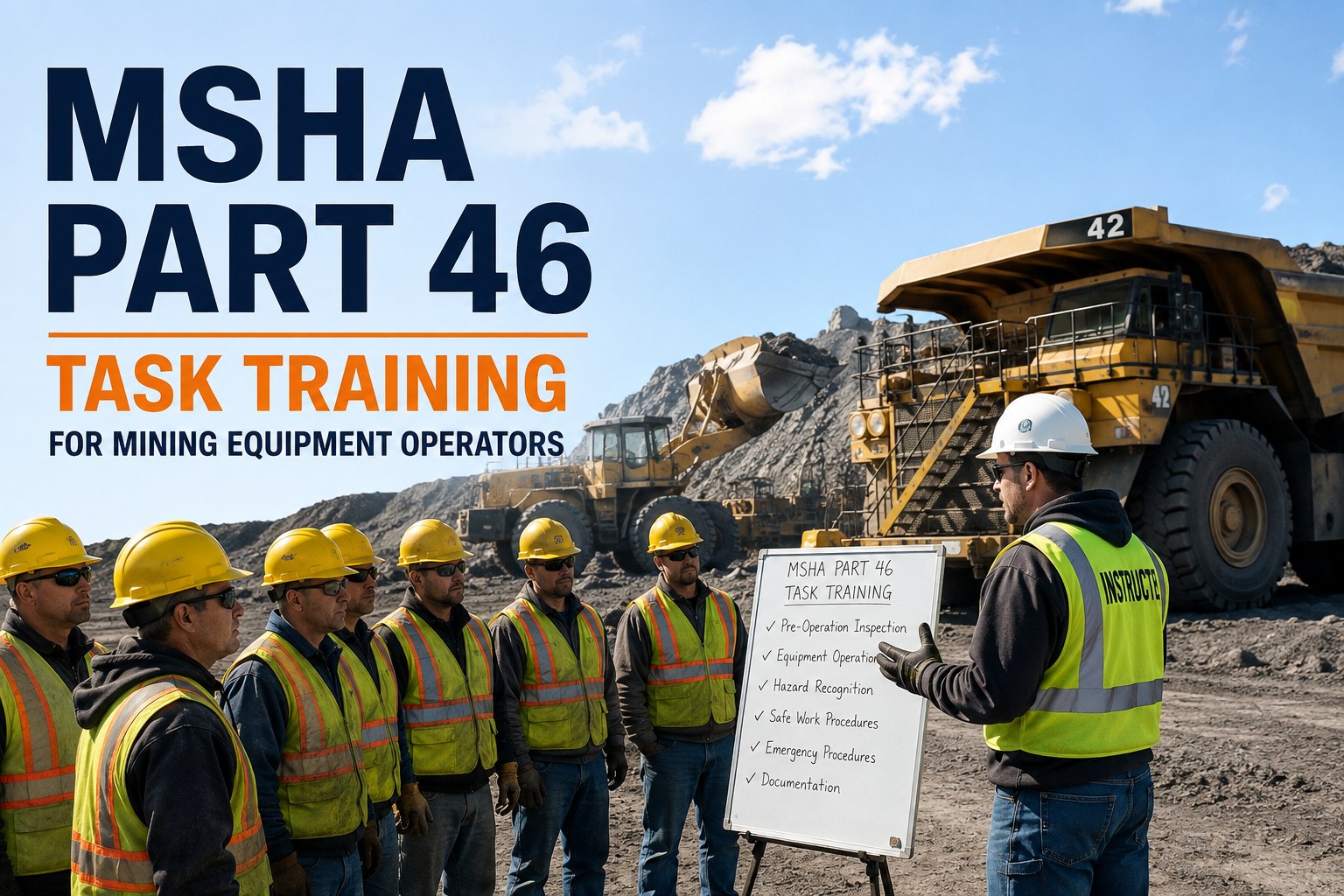
You've seen it on the pit camera: a loaded haul truck taking the corner at the ramp too fast, tyres scrubbing, or sitting at the shovel idling for twenty minutes because the operator never learned what that costs. Mining equipment operator training and competency management is where that gets fixed — and it's also a legal obligation, because regulators require documented task training before anyone operates a machine, with records that survive an audit. The gap most sites live with is a training register in a spreadsheet, a few signed cards in a filing cabinet, and no connection between what an operator was taught and what the telematics says they're actually doing. If that sounds familiar, it's worth seeing how a digital competency and inspection record works when you book a walkthrough on your own fleet data.
The operator is the most expensive component on the machine. Are you managing them like one?
Task training is a regulatory requirement with a records test attached. Competency is what decides your tyre bill, your fuel burn and your component life. Most sites track the first on paper and ignore the second entirely.
- Task training before first operation
- Refresher and re-assessment triggers
- Records that survive an audit
- Technique that protects tyres and components
- Idle and throttle habits that burn fuel
- Inspection quality that catches defects early
Four numbers that make the case for operator competency management
These are the levers a trained operator pulls every shift. Each one is a cost line you already pay — the question is whether you're managing it or just absorbing it.
Task training: what the regulation actually requires before an operator touches the machine
In the US, MSHA's Part 46 and Part 48 rules require that miners receive task training before performing a new task — and that includes operating a piece of mobile equipment and conducting the pre-shift inspection on it. Equivalent obligations exist under UK's PUWER and HSE guidance, Australia's WHS regulations and NHVR standards, and UAE OSH requirements. The common thread: training must happen before the task, it must be documented, and the records must be producible.
Before first operation
New operators, and experienced operators moving to a new machine type, need documented equipment familiarization covering controls, capacity limits, blind spots, emergency procedures and site-specific hazards. "He's driven trucks before" is not a defence.
Pre-shift inspection training
The operator conducting the pre-shift inspection must be trained on what to look for on that specific machine. A generic walkaround doesn't satisfy the requirement — the training must be equipment-specific and the record must show it.
Records maintained and producible
Training records must show who was trained, on what, by whom, and when. When an inspector or auditor asks, you produce them in minutes — not after a week of digging through filing cabinets and hoping the signatures are legible.
Refresher and re-assessment triggers
Annual refreshers are the baseline. But re-assessment should also trigger after an incident or near-miss, after extended absence from a machine type, after a machine modification, or when observation or data shows technique has degraded.
The practical problem isn't knowing the rules — it's running a system that keeps every operator current across every machine type without a full-time training administrator. That's exactly the gap a 30-minute demo of HVI's training record system will show you closing.
Operator competency: where the real money is won or lost
Compliance gets you past the audit. Competency is what decides whether your haul trucks make their component life targets or come in early with blown finals and scrubbed tyres. These are the four technique areas where operator behaviour shows up directly on your cost report.
Tyre life
Cornering speed, wheel spin on loading, rock cuts from poor road positioning, and overloading all destroy tyres that cost more than a car. A trained operator who understands what a tyre costs drives differently. An untrained one just drives.
Fuel burn
Excessive idling, aggressive throttle, poor gear selection and unnecessary braking all burn diesel without moving rock. Across a fleet of haul trucks burning thousands of litres a day, a 15% improvement in operator fuel practice is a six-figure annual saving.
Component wear
Harsh shifting, overspeed on descents, brake riding, and shock loading through the bucket or body all accelerate wear on transmissions, final drives, brake packs and hydraulic systems. The maintenance team sees the result; the cause is in the cab.
Inspection quality
A rushed or pencil-whipped pre-shift inspection misses the cracked hydraulic line, the low tyre pressure, the worn cutting edge. A trained operator who understands why each check matters finds the defect before it becomes a breakdown or an incident.
How to assess mining operator competency without a classroom test
A written test tells you someone can pass a written test. It doesn't tell you how they take the ramp corner at 40 tonnes or whether they actually check the final drive oil on the pre-shift. Real competency assessment combines structured observation with machine data.
Structured observation
A qualified assessor rides along or observes from a safe position with a standardised checklist: pre-start checks, loading technique, hauling practice, dumping, shutdown and post-op inspection. Score each item, note the gaps, and record it against the operator's file — not on a clipboard that gets lost.
Telematics and inspection data
GPS and telematics show overspeed events, harsh braking, idle time and throttle patterns. Inspection analytics show how long each operator takes on their pre-shift and what they flag. An operator who consistently completes a 15-point inspection in 90 seconds is not inspecting — they're ticking.
Data-informed coaching conversation
The coaching session isn't a discipline meeting. It's a conversation: "Your idle time is running 40% higher than the fleet average on the same circuit — walk me through what happens at the shovel." The data makes it specific and removes the argument. The operator keeps their dignity and gets a clear target.
Re-assessment and record update
After coaching, re-assess within a defined window. If the numbers improve, record it. If they don't, escalate to formal retraining or reassignment. Either way, the record shows a closed loop — which is exactly what an auditor or an investigator wants to see.
HVI's per-operator inspection analytics and time analytics give you the observation data without adding a single clipboard. When you're ready to see it on your own units, book a demo and bring your toughest operator scenario.
Stop guessing who's qualified. Start proving it.
HVI tracks every operator's training, certification and inspection quality in one system — with expiry alerts at 90, 60 and 30 days so nobody slips through.
Building a training matrix that actually stays current
A training matrix maps every operator against every machine type and task they're qualified for. On paper or in a spreadsheet, it's stale the day after you update it. Here's what a working matrix looks like when it's managed digitally.
| Matrix element | Paper / spreadsheet | HVI digital system |
|---|---|---|
| Certification expiry tracking | Manual calendar reminders, or none — you find out when the auditor does | Automatic alerts at 90, 60 and 30 days before expiry, per operator, per qualification |
| Equipment assignment | Shift supervisor assigns from memory or a printed list that's weeks old | Assignment tied to current qualifications — unqualified operators flagged before they get the keys |
| Training records | Signed cards in a filing cabinet, scanned PDFs in a shared drive, or both | Timestamped, searchable digital records attached to each operator profile |
| Inspection quality per operator | No visibility — you assume everyone inspects the same way | Per-operator analytics show completion time, defect rate and skipped items |
| Audit response | Days of gathering, photocopying and hoping nothing is missing | Filter by operator, machine or date range and export in minutes |
The difference isn't just convenience. When an incident happens and the investigator asks for the operator's training records, the speed and completeness of your answer changes the outcome. Sites that start tracking training records in HVI typically have their full matrix digitised within the first week.
When to re-assess: the five triggers that should put an operator back in the seat with an assessor
Annual refresher training is the floor, not the ceiling. These five events should automatically trigger a re-assessment — and your system should flag them without anyone having to remember.
Incident or near-miss
Any contact, rollover, tyre event or near-miss involving the operator triggers a formal re-assessment of the task being performed. The record shows you responded systematically, not just with a toolbox talk.
Extended absence from machine type
An operator who hasn't run a haul truck in six months is not current, even if their card says they are. Set a threshold — 90 days is common — and flag anyone past it for a supervised re-familiarization before solo operation.
Machine modification or new model
A new truck model, a retrofit, a different body configuration or a control layout change means the operator's previous familiarization no longer covers the machine. Document the delta training before they operate it.
Data flags degraded technique
Telematics showing increasing overspeed events, harsh braking trending up, or inspection completion times dropping below a credible threshold — these are leading indicators. Act on them before they become lagging ones.
Scheduled refresher cycle
The baseline: annual or biennial refresher training per your site plan and regulatory requirement. This should be automatic — the system tells you who's due, not the other way around.
Four HVI capabilities that close the operator competency gap
Each one maps to a specific problem you've read about above — and each one works on any phone or tablet, in the pit, in the shop or at a remote site.
Training & certification records
Every operator's qualifications, task training and certifications in one profile with 90, 60 and 30-day expiry alerts. No more spreadsheet matrices that go stale. When the auditor asks, you filter and export in seconds.
Per-operator inspection analytics
See how each operator completes their pre-shift inspection: time taken, items flagged, defects reported. Spot the pencil-whippers and the thorough ones — and coach with data, not suspicion.
Time analytics flagging rushed inspections
HVI flags inspections completed faster than a credible threshold. An operator who finishes a full pre-shift in 90 seconds gets a coaching conversation, not a breakdown at the face. The data makes the conversation factual.
Equipment assignment tied to qualifications
Assign machines only to operators with current qualifications for that type. The system flags mismatches before the shift starts, so an unqualified operator never gets past the dispatch board.
A worked example: what one operator's technique costs in a year
Take a single 100-tonne haul truck running two shifts, 300 days a year. Here's how the numbers stack up between a trained, coached operator and an untrained one on the same machine.
- Tyre set replaced at 4,000 hours instead of 6,000 — one extra set per year at $60,000+
- Fuel burn 20% above benchmark — roughly $45,000 extra diesel per year
- Final drive rebuild at 8,000 hours instead of 12,000 — unplanned $80,000+ repair
- Pre-shift inspections pencil-whipped — two missed defects become breakdowns, 3 days lost production
- Tyres reach design life — no premature replacement
- Fuel burn at or below benchmark through idle management and smooth throttle
- Components reach expected service intervals — planned maintenance, not emergency rebuilds
- Defects caught on pre-shift — repaired in the shop, not at the face
Multiply that across a fleet of 10, 20 or 50 machines and the case writes itself. The sites that see HVI's operator analytics in a demo usually spot their first coaching target within the first screen.
Mining equipment operator training: what to do Monday morning
You don't need a training department or a new hire. You need a system that tracks who's qualified for what, alerts you before anyone expires, and shows you how each operator actually performs — so you can coach with facts instead of gut feel.
Digitise your training matrix. Move every operator's qualifications, task training records and certification dates into a system with automatic expiry alerts. If you're still using a spreadsheet, you're one audit away from a bad week.
Tie equipment assignment to qualifications. The dispatch board should check the matrix before the operator gets the keys, not after the incident report.
Use inspection data as a coaching tool. Per-operator analytics and time flags tell you who's thorough and who's ticking boxes. That's your coaching priority list, delivered automatically.
Set re-assessment triggers and enforce them. Incidents, extended absence, machine changes, data flags and the annual cycle — all five should put an operator back in the seat with an assessor, and the system should track that it happened.
Mining equipment operator training and competency management isn't a nice-to-have program — it's a cost control system and a compliance shield. The sites that run it well spend less on tyres, fuel and unplanned repairs, and they sleep better when the auditor shows up. Sign up free and start building your matrix today, or book a demo to see it running on real fleet data.
I used to find out an operator's ticket had expired when the client auditor asked for it. Now I get a 90-day heads-up and I book the refresher before it's a problem. The thing I watch most is inspection time — anyone finishing a pre-shift in under two minutes gets a ride-along that week. It's not about catching people, it's about not finding out the hard way that they stopped looking.
Mining operator training and competency: your questions answered
What is task training and when is it required?
Task training is instruction on the specific health and safety aspects of a task before a miner performs it. Under MSHA Part 46 and Part 48, it's required before a miner operates new equipment, performs a new task, or when conditions change. Equivalent requirements exist in UK, Australian and UAE regulations. The training must be documented with who, what, when and by whom.
How do you assess operator competency beyond a written test?
Combine structured ride-along observation with a standardised checklist, telematics data on speed, braking and idle patterns, and inspection analytics showing how thoroughly each operator completes their pre-shift checks. A written test confirms knowledge; observation and data confirm practice. Book a demo to see how HVI surfaces the inspection data automatically.
What should trigger refresher training or re-assessment?
Five triggers: an incident or near-miss involving the operator, extended absence from a machine type (90 days is a common threshold), a machine modification or new model, data showing degraded technique (rising overspeed events, dropping inspection times), and the scheduled annual or biennial refresher cycle. Your system should flag all five automatically.
How does operator technique affect maintenance costs?
Directly and measurably. Poor cornering and wheel spin can cut tyre life by 30% or more. Excessive idling and aggressive throttle add 15–25% to fuel burn. Harsh shifting and brake riding double the wear rate on drivetrain components. Across a fleet, operator technique is often the single largest controllable maintenance cost variable.
Can HVI track training records alongside inspection and maintenance data?
Yes. HVI stores training and certification records per operator with automatic 90, 60 and 30-day expiry alerts, ties equipment assignment to current qualifications, and provides per-operator inspection analytics — all in the same platform you use for digital inspections, work orders and preventive maintenance. Sign up free to start building your matrix.
Your operators are your biggest cost lever. Manage them like it.
See how HVI tracks training, flags expired certifications, and shows you exactly how each operator performs — on your own fleet, in 30 minutes.
Free to start — Works on any phone — No card needed