Send a Part 48 miner through a Part 46 class and the certificate will look almost right — but the training won't be valid, and your new hire may not be allowed to start work. That's the stakes on MSHA Part 46 vs Part 48: two different training frameworks under 30 CFR, and picking the wrong one is a compliance failure before anyone sets foot on site. This guide compares the two on what actually differs — which mines each covers, who can train, whether the plan needs approval, and the required hours — with the honest caveat that applicability can hinge on your specific operation.
Two Rules, One Question: Which Applies to You?
Part 46 and Part 48 both train miners — but they differ on who they cover, who can teach, and whether MSHA has to approve your plan. Here's the side-by-side.
If you're a mine operator, safety manager, training coordinator, or contractor, getting the Part 46 vs Part 48 call right is the first step in a compliant training program — and one of the easier things to get wrong, because the certificates look nearly identical and the shorthand ("aggregates are Part 46, coal is Part 48") is only half the story. This guide lays out the real differences and a way to decide, while being clear about where the answer genuinely depends on the specifics of your site and MSHA's definitions.
What Is MSHA Part 46?the flexible framework for surface aggregate operations
30 CFR Part 46 is the training standard built for surface metal and nonmetal operations of the aggregate type — sand and gravel pits, crushed stone and limestone quarries, surface clay, colloidal phosphate, shell dredging, and similar operations. It was designed to be more flexible than Part 48, reflecting the operations it covers.
Two features define Part 46's flexibility. First, training is conducted by a "competent person" the operator designates — someone with the ability, training, knowledge, or experience to provide it, with no requirement to be MSHA-approved. Second, the operator writes their own training plan and generally only provides it to MSHA on request rather than getting it pre-approved. The operator also has latitude in format — classroom, online, or OJT — which is why online delivery is common for Part 46. The flexibility is real, but it isn't looseness: the required topics, hours, and records still must be met and documented. Book a demo to keep Part 46 competent-person training records organized and audit-ready
What Is MSHA Part 48?the stricter framework for underground, coal, and other operations
30 CFR Part 48 is the more prescriptive training standard, and it splits into two subparts: Subpart A covers underground mines, and Subpart B covers surface coal mines and surface metal/nonmetal mines that aren't covered by Part 46. In plain terms, if your operation is underground, or it's a surface coal mine, or it's a surface metal/nonmetal mine outside Part 46's aggregate scope, you're likely in Part 48 territory — but confirm against the regulation, because the surface metal/nonmetal line is exactly where it gets specific.
Part 48 is tighter in the ways Part 46 is flexible. Training must be conducted by an MSHA-approved instructor whose credentials are on file with the agency — not just a person the operator deems competent. And the training plan must be submitted to and approved by the MSHA District Manager before training begins, rather than kept on hand for request. Part 48 also tends to be more prescriptive about hands-on content and mapping task training to specific equipment. The through-line: Part 48 puts MSHA in the approval loop for both the trainer and the plan, where Part 46 leaves those to the operator. Start free and track MSHA-approved instructor credentials and plan status
Part 46 vs Part 48, Side by Sidethe dimensions that actually differ
Here's the full comparison across the points that matter for building a compliant program. Treat the hours and specifics as a starting reference and verify the current figures for your operation against the regulation.
The pattern to hold onto: both parts share the 8-hour annual refresher and both require new-miner and task training — the differences are scope, who teaches, whether MSHA pre-approves, and the underground 40-hour requirement. Remember one thing: Part 48 loops MSHA into approving both your instructor and your plan; Part 46 doesn't. Book a demo to track both frameworks' training and refresher requirements in one place
The Training Itself: New Miner, Refresher, Taskwhat a miner actually has to complete
Under both parts, a miner's training life has three main components — new miner, annual refresher, and task training — but the specifics differ, especially at the new-miner stage.
Part 46 requires 24 hours, with a portion completed before the miner starts work and the balance within a set window. Part 48 requires 40 hours for underground miners, completed before they begin underground work, and 24 hours for surface Part 48 miners. This is the biggest hours difference between the frameworks.
Both Part 46 and Part 48 require 8 hours of refresher training every 12 months to keep a miner's training current. This is the recurring obligation that lapses if it isn't tracked — the single most common training-compliance gap, and the one an expiry-tracking system exists to close.
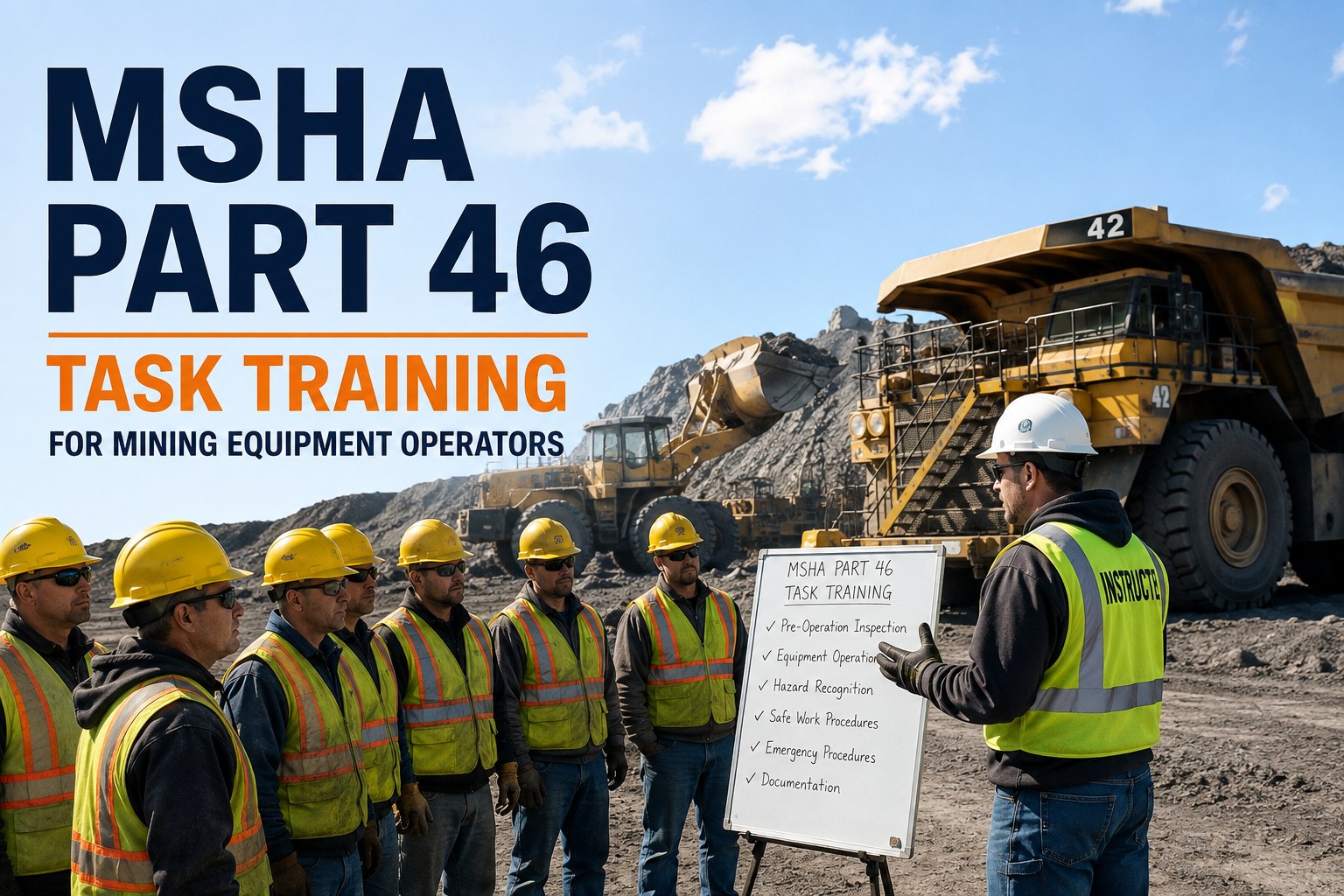
Both parts require task training before a miner performs a new task, covering the hazards and controls specific to that job and equipment. Part 48 tends to be more prescriptive, often mapping task training to named equipment and including hands-on components. A defensible plan names the specific tasks and triggers.
The refresher is where most operations get caught. New-miner training is a one-time event at hire, easy to remember; the 8-hour annual refresher is a recurring clock on every miner, and one person's date easily slips by unnoticed — at which point that miner is out of compliance and shouldn't be working until it's current. Tracking those expiration dates across a workforce is the practical heart of training compliance under either part. Start free and never miss an annual refresher deadline again
How to Decide Which Part Appliesa starting framework — not the final word
Here's a practical way to reason through it — but read the caveat that follows before treating it as definitive, because the simple categories don't always settle it.
The honest caveat the whole topic demands: the shorthand categories are a useful starting point, not a universal rule. Applicability can depend on the specific commodity, the mining method, and MSHA's regulatory definitions for your operation — and the surface metal/nonmetal boundary in particular is not something to eyeball. Use the framework above to orient yourself, then verify the applicable part against the current 30 CFR text and confirm with your MSHA district before you build the program. Getting this wrong isn't a paperwork nuisance — it means your miners' training may not count. Book a demo to keep every miner's training tied to the right framework and current
Recordkeeping & Expiration Trackingwhere compliance is proven or lost
Under both parts, you have to document that training happened and keep those records available for MSHA. The record proves the miner completed new-miner, refresher, and task training, and it's what an inspector reviews to confirm compliance. Part 46 training is documented with a training record (which can serve the same purpose as the traditional 5000-23 certificate), signed by the competent person named in the plan; Part 48 uses the MSHA 5000-23 signed by the approved instructor. Either way, the record has to exist, be complete, and be producible.
The part that trips operations up isn't creating the record — it's tracking the expirations. Every miner's 8-hour annual refresher is a rolling 12-month clock, and across a workforce those dates scatter. Miss one and that miner is out of compliance, often unnoticed until an audit or a blocked mobilization. This is the gap a digital records system closes: it stores every record in one place, tracks each miner's refresher expiration, alerts you before a lapse, and produces the full history on demand for an inspection. The framework decision determines what training is required; recordkeeping determines whether you can prove it. Book a demo to centralize training records and automate refresher alerts
From a mine training coordinator managing both frameworks
We run a couple of aggregate sites under Part 46 and a metal operation that falls under Part 48, and honestly the trickiest part was never the training content — it was keeping straight which rule applied where, and then never letting a single refresher date slip. Eight hours a year sounds simple until you've got a hundred-plus people with a hundred-plus different due dates.
We got burned once when a guy's refresher had lapsed and we didn't catch it until he showed up for a shift — he couldn't work, and that's a real cost. Now every record's in one system with the expiration tracked and an alert well before it's due. The Part 46 versus Part 48 call we make carefully up front; the ongoing compliance is all about not missing a date.
Part 46 vs Part 48: the takeaway
MSHA Part 46 vs Part 48 comes down to two jobs done well: correctly identifying which framework governs your operation, and then keeping every miner's training current under it. The frameworks differ most on scope, who's allowed to train, and whether MSHA approves your plan and instructor — but they converge on the 8-hour annual refresher that quietly drives most training-compliance failures. Make the applicability call carefully against the current regulation, especially for surface metal/nonmetal sites where the categories blur, and then run disciplined recordkeeping so you can always prove, on the day an inspector asks, that every miner's training is complete and current. Book a demo to manage Part 46 and Part 48 training records in one platform
Frequently asked questions
What is the difference between MSHA Part 46 and Part 48?
Part 46 and Part 48 are two different MSHA training frameworks under 30 CFR, and they differ mainly in scope, who may conduct the training, and whether MSHA approves the plan. Part 46 applies to surface metal and nonmetal operations of the aggregate type — sand, gravel, crushed stone, limestone, clay, colloidal phosphate, shell dredging and similar — and is more flexible: training is conducted by a "competent person" the operator designates (no MSHA approval of the trainer required), and the operator writes their own training plan and generally provides it to MSHA only on request. Part 48 applies to underground mines (Subpart A) and to surface coal and surface metal/nonmetal mines not covered by Part 46 (Subpart B), and is stricter: training must be conducted by an MSHA-approved instructor whose credentials are on file with the agency, and the training plan must be submitted to and approved by the MSHA District Manager before training begins. Both frameworks require new-miner training, an 8-hour annual refresher, and task training. Because applicability can depend on the specific operation and MSHA's definitions, operators should verify the correct part against the current regulation rather than relying on shorthand categories.
Which mines are covered by Part 46 vs Part 48?
As a general framework, Part 46 covers surface metal and nonmetal operations of the aggregate type — sand and gravel pits, crushed stone and limestone quarries, surface clay, colloidal phosphate, and shell dredging operations are the classic examples. Part 48 covers underground mines of all kinds under Subpart A, and under Subpart B it covers surface coal mines and surface metal/nonmetal mines that are not covered by Part 46. So an underground mine or a coal operation, surface or underground, is almost always Part 48, and a typical surface aggregate site like a gravel pit or limestone quarry is typically Part 46. The area that requires the most care is surface metal/nonmetal operations that fall outside the aggregate scope, because those can be governed by Part 48 Subpart B rather than Part 46. This is exactly the boundary where the simple categories can mislead, so it should not be decided by assumption. Because applicability depends on the specific commodity, mining method, and MSHA's regulatory definitions for your operation, you should confirm the applicable part against the current 30 CFR text and with your MSHA district before building your training program.
Does Part 46 require an MSHA-approved trainer?
No. One of the defining features of Part 46 is that training does not have to be conducted by an MSHA-approved or MSHA-certified instructor. Instead, Part 46 training is provided by a "competent person" — someone the mine operator or independent contractor designates who has the ability, training, knowledge, or experience to provide the required training. The operator makes that determination; MSHA does not approve the individual trainer. This is a significant contrast with Part 48, under which training must be delivered by an MSHA-approved instructor whose instructor credentials are kept on file by the agency. The difference reflects the broader flexibility of Part 46: along with not requiring an approved trainer, Part 46 also lets the operator write their own training plan and provide it to MSHA on request rather than obtaining pre-approval, and allows flexibility in delivery format including classroom, online, and on-the-job training. That flexibility does not reduce the substance of what must be covered, however — the required topics, training hours, and recordkeeping still apply, and the competent person is responsible for delivering training that meets the standard.
How long is MSHA training valid, and how often is refresher required?
Under both Part 46 and Part 48, miners must complete 8 hours of annual refresher training every 12 months to keep their training current, so in effect training is "valid" for one year before refresher is due again. This annual refresher requirement is identical between the two frameworks and is the recurring obligation that keeps a miner qualified to work. New-miner training, by contrast, is a one-time requirement at the start of a mining career and differs by framework: Part 46 requires 24 hours of new-miner training (with a portion completed before the miner begins work and the remainder within a set window), Part 48 requires 40 hours for underground miners before they begin underground work, and surface Part 48 new-miner training is 24 hours. Task training is also required under both parts whenever a miner is assigned a new task. The practical compliance challenge is the annual refresher, because it is a rolling deadline on every individual miner, and if a miner's refresher lapses they are no longer current and should not continue working until it is completed. Tracking those expiration dates across an entire workforce is central to staying compliant, which is why many operations use a system that stores records and alerts them before each refresher comes due.
Does Part 48 require an approved training plan?
Yes. Under Part 48, the mine operator's training plan must be submitted to and approved by the MSHA District Manager before training is conducted — MSHA is in the approval loop for the plan itself, not just the instructor. This is a key procedural difference from Part 46, where the operator writes their own training plan and generally only has to make it available to MSHA on request rather than obtaining advance approval. A Part 48 plan must cover the required training topics and identify how miners will receive task training when assigned to new tasks, and a well-constructed plan names the specific equipment and job categories, the events that trigger task training such as a new assignment or a return from an extended absence, the training hours, and the documentation method. Because the plan must be approved before training begins, operators under Part 48 need to build in time for that approval step and should not start training against an unapproved plan. As with all of these requirements, the exact plan contents and procedures should be confirmed against the current Part 48 regulation and coordinated with the operator's MSHA district office.
Make the framework call once — then never miss a refresher
Whether your operation runs under Part 46, Part 48, or both, the ongoing compliance job is the same: prove every miner's training is complete and current. HVI centralizes training records for both frameworks, tracks each miner's annual-refresher clock, fires renewal alerts before certifications lapse, and keeps everything audit-ready — so no one loses day-one access to a lapsed date and an inspector's request is a filtered search, not a fire drill.
No credit card · No hardware required to start · Training records & expiry tracking on day one