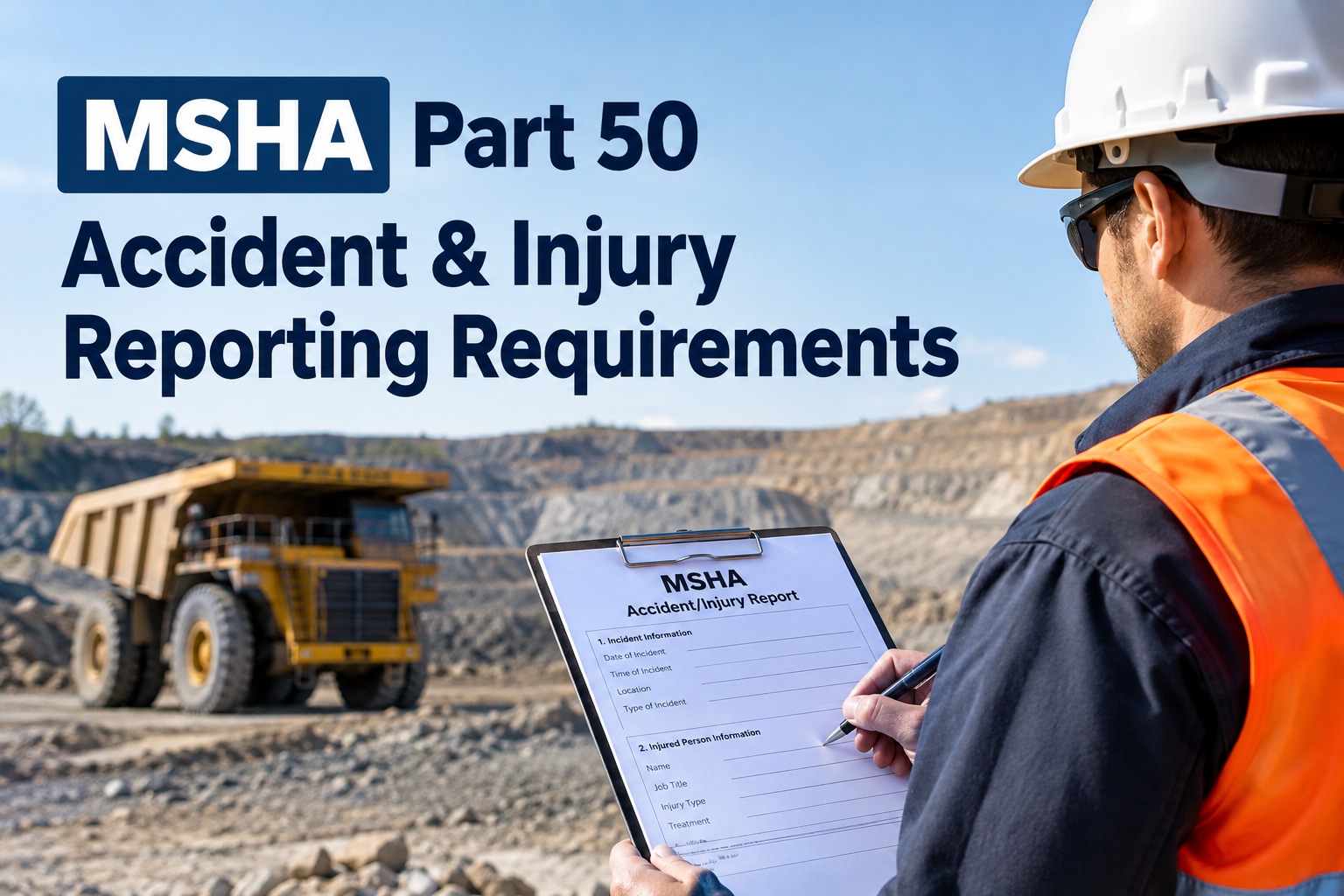
When a serious accident happens at a mine, the clock that matters most is 15 minutes long — that's how fast MSHA Part 50 reporting requires an operator to notify the agency once they know a reportable accident has occurred. It's the first of several deadlines and forms Part 50 sets, and getting it right is about knowing what to report, how fast, and on which form, then preserving the records to prove you did. This guide walks the framework exactly as the regulation stands: the 15-minute call, Forms 7000-1 and 7000-2, the deadlines, and the line between reporting and investigating. Book a demo to keep it all straight.
Three Clocks Every Mine Operator Has to Beat
Part 50 runs on deadlines. Miss the fastest one — the 15-minute notification — and you're already in violation before the paperwork even starts.
If you're a mine operator, safety manager, or compliance lead, Part 50 is one of the highest-stakes obligations you carry, because the consequences of getting it wrong are steep and the timelines are unforgiving. The framework itself isn't complicated once it's laid out — a fast phone call for serious accidents, a written form for reportable injuries and illnesses, and a routine quarterly report — but the details of what counts, how fast, and what you must preserve are where operations stumble. This guide is a plain-English map of the requirements, with the firm caveat that whether a specific event is reportable depends on its circumstances, so verify against the current regulation.
What Is MSHA Part 50?notification, investigation, reports, and records
30 CFR Part 50 is the regulation governing how mine accidents, injuries, illnesses, employment, and production are reported to MSHA. Its full title captures its scope: "Notification, Investigation, Reports and Records of Accidents, Injuries, Illnesses, Employment, and Coal Production in Mines." In practice it does four things: it requires operators to immediately notify MSHA of serious accidents, requires operators to investigate accidents and injuries, restricts disturbing an accident scene, and requires operators to file reports on accidents, injuries, illnesses, and employment/production data.
Two clarifications up front: first, "accident" has a specific regulatory meaning under Part 50 — the defined list of serious events in §50.2(h) that trigger immediate notification, not any mishap. Second, reporting and investigating are distinct obligations, and assuming your internal investigation satisfies the reporting requirement is a common, costly mistake. Book a demo to keep reporting and investigation as separate, tracked workflows
The 15-Minute Rule: Immediate Notification§50.10 — the fastest clock in mining compliance
Under §50.10, an operator must contact MSHA "at once without delay and within 15 minutes" at the toll-free number 1-800-746-1553 once the operator knows or should know that an accident has occurred. This is the single most time-critical requirement in Part 50, and the trigger is broad: the 15 minutes starts when you know or should know, not when you've had time to investigate.
The events that require this immediate call are the serious "accidents" defined in §50.2(h) — the categories are specific, and while you should read the full list in the regulation, they broadly include:
Because the list is specific and consequences hinge on it, treat the §50.2(h) categories as a memorized trigger for anyone who might first learn of an incident — and when in doubt, make the call. Alongside notification, §50.12 restricts disturbing the scene: except to rescue people or prevent further harm, the area must generally be preserved until MSHA decides whether to investigate.
The Two Forms: 7000-1 and 7000-2the written reports behind the phone call
The 15-minute call handles urgent notification; the written reporting happens on two MSHA forms that serve completely different purposes. Knowing which is which — and their deadlines — is core to Part 50 compliance.
The written report for each reportable accident, occupational injury, or occupational illness. Under §50.20 it must be mailed within ten working days after the event occurs or an illness is diagnosed. The responsible officer or supervisor completes it, and Section D (return-to-duty) is completed when the miner returns to work.
The routine quarterly report of employment and production data under §50.30, due within 15 days after the close of each calendar quarter. It isn't tied to any specific accident — it's ongoing data MSHA uses (with injury data) to calculate industry rates. Filed late, it's still counted as late.
A key point people miss: Form 7000-1 is a report, not an investigation. The regulation limits using 7000-1 as an investigation report (with a narrow small-mine exception), because reporting and investigating are separate duties. And knowingly filing a false report is a federal offense with criminal penalties, so accuracy matters as much as timeliness. Book a demo to capture the information each form needs accurately from the start
Reporting vs Investigating: Two Separate Dutiesthe distinction that trips up compliance programs
Conflating the two is one of the most common Part 50 misunderstandings — they happen around the same event but are different obligations with different purposes.
Notifying MSHA of the accident (the 15-minute call) and filing the required forms within their deadlines. This is about informing the agency, on time, in the prescribed way. Missing it is a citable violation regardless of how well you handled the incident internally.
Part 50 also requires the operator to investigate each accident and injury and produce an investigation report — understanding root cause and preventing recurrence. This is your internal process, separate from the MSHA report, and it's where corrective actions live.
A complete response to a reportable event runs both halves at once: the reporting clock (call, then forms) and the investigation (find the cause, fix it, document it). Neither substitutes for the other — a thorough investigation doesn't excuse a missed notification, and filing the forms doesn't discharge the duty to investigate. Start free and run investigation and corrective actions alongside the reporting record
Is This Incident Reportable?a framework — but circumstances decide
Not every incident at a mine is reportable, and figuring out which are is where judgment (and the regulation) comes in. Here's a practical way to reason through it, with the essential caveat that the specific facts determine the answer.
The general shape: a §50.2(h) event triggers the fast call plus a form; a reportable injury or illness that isn't a §50.2(h) accident still needs the 10-working-day form; routine employment data flows on the quarterly 7000-2. But the edges depend on circumstances — which is exactly why "when in doubt, verify and ask" is the right posture, and why over-reporting a borderline case is safer than missing a required one. Book a demo to flag potentially reportable incidents the moment they're logged
Where Part 50 Compliance Goes Wrongthe common, costly mistakes
Part 50 citations tend to come from the same handful of failures. Knowing them is the cheapest way to avoid them.
What ties most of these together is a lack of a clear, fast, well-understood process — who calls, on what number, within what window; who owns the form and its deadline; what gets preserved. When those answers live in one person's head or a dusty binder, the deadlines get missed under the stress of an actual incident. A defined workflow, ready before anything happens, is the real safeguard.
Building the Incident Workflow — and Where Software Fitswhat the tool does, and what it doesn't
A digital system doesn't file your MSHA report or make the 15-minute call for you — those remain human obligations owned by the operator. What it does is make sure the person who owns them has everything they need, instantly, and that the parallel investigation and corrective-action work is captured and closed. Here's the honest division of labor.
When an incident happens, a field-first tool lets whoever is on scene capture it immediately — what happened, where, who, with photo evidence timestamped and preserved before the scene changes (within the §50.12 limits on disturbance). That captured record gives the responsible person the complete information to make the notification decision and complete Form 7000-1 accurately and on time. In parallel, the operator's investigation and corrective actions are assigned, tracked, and driven to closure in the same system, so the internal duty doesn't fall through the cracks. And every piece — the incident record, the photos, the corrective actions, their completion — is retained and audit-ready, so when MSHA reviews your records you can produce a complete, organized history in a search. The clear boundary: the software captures, organizes, and preserves; the required notifications, filings, and corrections are still performed by the operator on the regulator's timeline. Start free and capture incidents with photo evidence and tracked corrective actions
From a mine safety manager who rebuilt the incident process
The 15-minute rule is the one that keeps you up at night. It's not that we didn't want to report — it's that in the chaos of an actual serious incident, is the guy who finds it going to remember the number, know it counts as an accident, and get to a phone in time? That's a lot to ask of someone in a bad moment.
We built a real process: every supervisor has the triggers and the number, and the incident gets logged in the app immediately with photos so nothing about the scene is lost. The reporting and the investigation are separate tracks now, so we stopped treating "we looked into it" as if it satisfied MSHA. The software doesn't make the call for me — a person still has to — but everything that person needs is right there instead of scattered.
MSHA Part 50 reporting: the takeaway
MSHA Part 50 reporting comes down to speed, accuracy, and proof: notify fast when a serious accident occurs, file the right form within its deadline, run your own investigation as a separate track, and preserve the records that show you did all of it. The 15-minute rule is the sharpest edge, but the routine failures — a late 7000-1, a forgotten quarterly, an under-reported injury — cause just as many citations. The operations that stay clean aren't the ones that never have incidents; they're the ones with a defined workflow ready before an incident happens, so the deadlines are met even under pressure and the records are always ready for an inspector. Book a demo to see mining incident capture, corrective actions, and records in HVI
Frequently asked questions
What is MSHA Part 50?
30 CFR Part 50 is the MSHA regulation governing the notification, investigation, reporting, and recordkeeping of mine accidents, injuries, illnesses, employment, and coal production. It requires operators to immediately notify MSHA of serious accidents, to investigate accidents and injuries, to preserve accident-related areas until MSHA decides whether to investigate, and to file reports on accidents, injuries, illnesses, and quarterly employment and production data. Two foundational points shape how it works. First, "accident" has a specific regulatory meaning — the defined list of serious events in section 50.2(h) that trigger immediate notification, not every mishap. Second, reporting and investigating are separate obligations: notifying the agency and filing the forms is distinct from the operator's own duty to investigate root cause and take corrective action. Because reportability depends on specific circumstances, operators should verify requirements against the current regulation and their MSHA district office.
What is the MSHA 15-minute notification rule?
Under 30 CFR 50.10, a mine operator must contact MSHA "at once without delay and within 15 minutes" once the operator knows or should know that an accident has occurred, using the toll-free number 1-800-746-1553. This is the most time-critical requirement in Part 50, and the trigger is important: the 15-minute clock starts when the operator knows or should know an accident happened, not when they have finished assessing the situation. The rule applies to the serious events defined as "accidents" in section 50.2(h), which broadly include a death at a mine, an injury with a reasonable potential to cause death, the entrapment of a person for more than 30 minutes or with a reasonable potential to cause death, an unplanned mine inundation, an unplanned ignition or explosion of gas or dust, an unplanned mine fire not extinguished within a set time, an unplanned ignition or explosion of a blasting agent or explosive, and certain unplanned roof falls or outbursts — among others in the full list. Because so much rides on recognizing these events quickly, the practical approach is to make sure everyone who might first learn of an incident knows both the trigger categories and the number, and to make the call whenever there is genuine doubt.
What is the difference between MSHA Form 7000-1 and 7000-2?
They are two entirely different MSHA reports. Form 7000-1, the Mine Accident, Injury, and Illness Report, is filed for each reportable accident, occupational injury, or occupational illness. Under 30 CFR 50.20 it must be mailed to MSHA within ten working days after the accident or injury occurs or the illness is diagnosed, and it is completed by the responsible officer or supervisor, with a separate section (Section D) for return-to-duty information once the injured miner returns to work. Form 7000-2, the Quarterly Employment and Coal Production Report, is a routine report of employment and production data that is not tied to any specific incident. Under 30 CFR 50.30 it must be filed within 15 days after the close of each calendar quarter, and reports filed after that period are counted as late. In short, 7000-1 is event-driven and injury/accident-specific with a 10-working-day deadline, while 7000-2 is a recurring quarterly data report with a 15-day-after-quarter deadline. One important note about 7000-1: the regulation limits its use as an investigation report, because reporting to MSHA and conducting an internal investigation are separate duties. Knowingly filing false information on either form carries criminal penalties, so accuracy is as important as meeting the deadline.
Does every mine incident have to be reported to MSHA?
No — not every incident is reportable, and determining which are depends on the specific circumstances. The framework has tiers. The most serious events, the "accidents" defined in section 50.2(h) such as a death, an injury with potential to cause death, entrapment, inundation, ignition or explosion, or a mine fire, require the immediate 15-minute notification to MSHA. Reportable occupational injuries — injuries to miners arising out of and in the course of mining that meet the reporting criteria — must be reported on Form 7000-1 within ten working days even if they did not require the 15-minute call. Reportable occupational illnesses that are diagnosed and meet the criteria are likewise reported on Form 7000-1. Routine employment and production figures are reported quarterly on Form 7000-2. However, the edges genuinely depend on facts: for example, whether an injury arose from the mine environment or the operator's equipment can affect whether it is reportable. Because of this, operators should verify borderline cases against the current regulation and consult their MSHA district office, and as a matter of prudence it is generally safer to report a borderline case than to under-report a required one, since MSHA scrutinizes under-reporting closely.
What happens if an MSHA Part 50 report is late?
Late or missing Part 50 reports are citable violations, and MSHA does enforce them. Failing to make the 15-minute notification for a section 50.2(h) accident, filing Form 7000-1 after the ten-working-day deadline, failing to submit return-to-duty information, and missing the quarterly Form 7000-2 deadline can all result in citations, and enforcement histories show inspectors doing exactly that. Beyond timeliness, accuracy carries its own severe exposure — knowingly making a false statement on a Part 50 report is a federal criminal offense punishable by fine or imprisonment. A missed notification can also delay MSHA's investigation decision and raise questions about scene preservation under section 50.12. The practical takeaways: treat every deadline as firm, have a defined process so the 15-minute clock is never missed in the confusion of an incident, and keep complete, retrievable records to demonstrate compliance during an inspection. When any deadline or requirement is unclear, verify it against the current regulation rather than relying on memory.
Be ready before the incident, not scrambling after it
Part 50's clocks are unforgiving — but the record behind them doesn't have to be a scramble. HVI captures an incident from the field with photo evidence the moment it happens, runs your internal investigation and corrective actions to closure, and keeps every record organized and audit-ready — so the person who owns the MSHA notification and forms has complete information in hand and can meet every deadline. You still make the call and file the report; HVI makes sure nothing you need is ever missing.
No credit card · No hardware required to start · Incident capture & corrective actions on day one