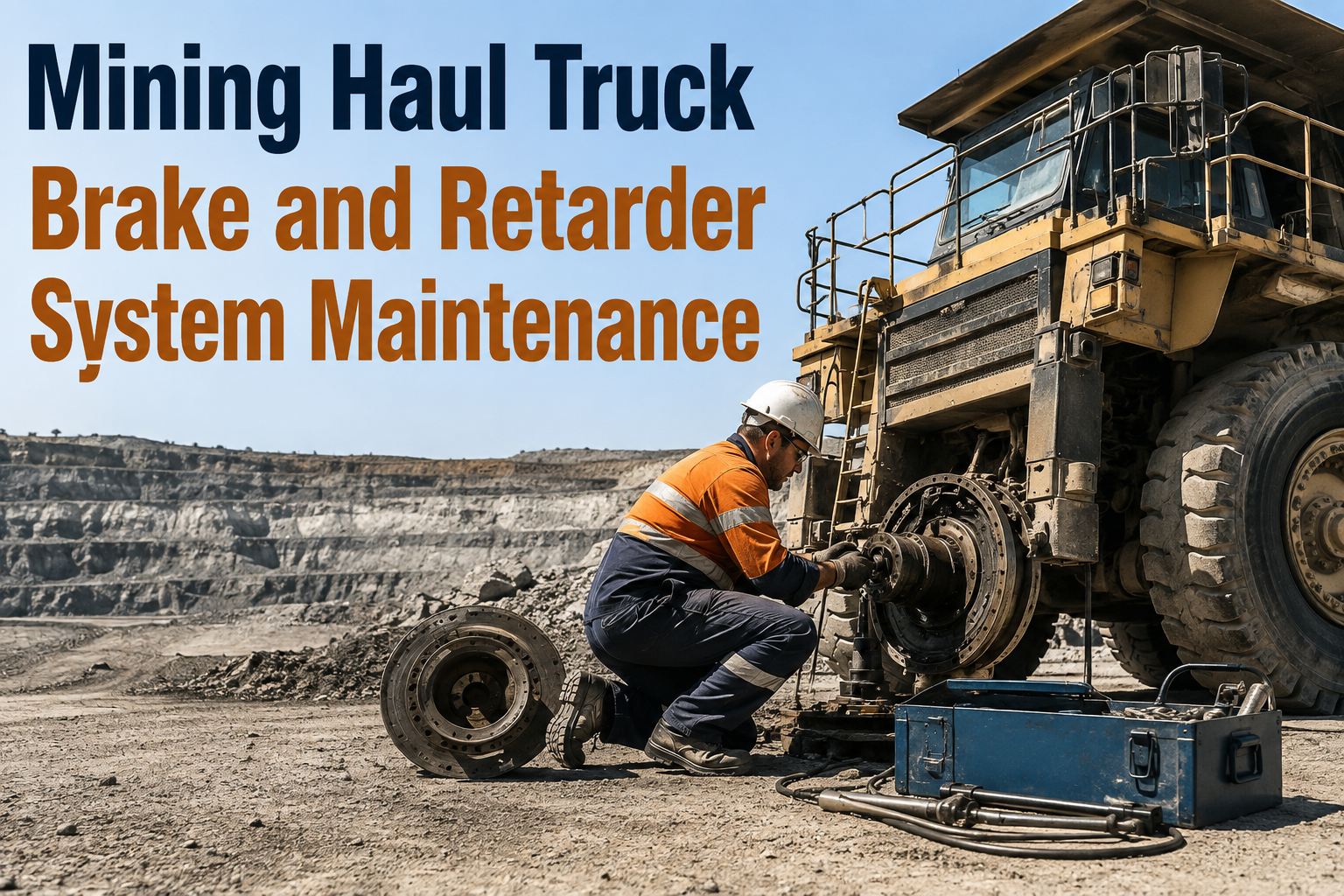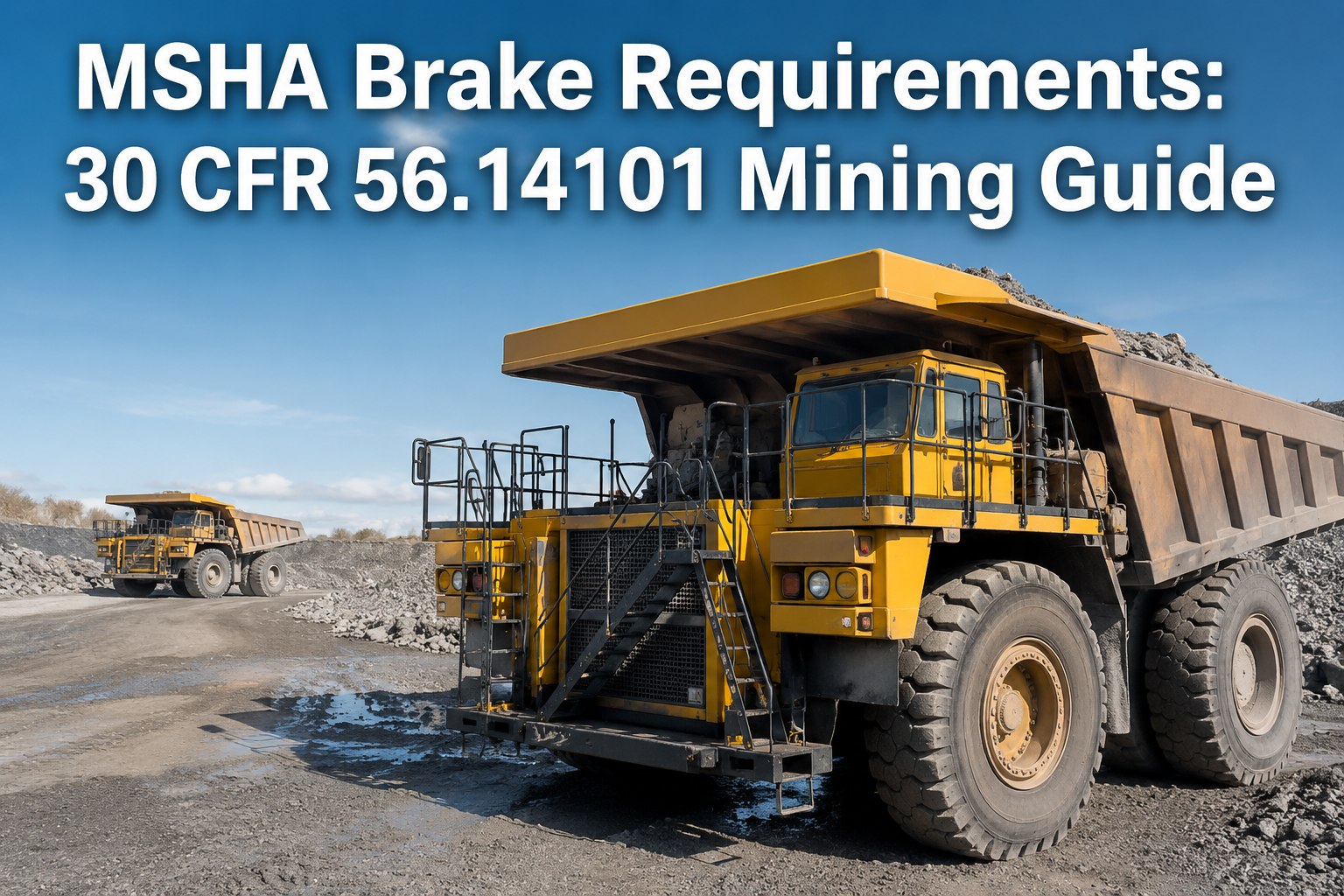
MSHA 30 CFR 56.14101 sets three brake requirements for self-propelled mobile equipment on surface metal and nonmetal mines: a service brake system that can stop and hold the loaded equipment on its maximum operating grade, a parking brake (where equipped) that can hold on that same grade, and functional maintenance of every braking system on the machine. This guide translates the standard into practical pre-shift inspection, defect documentation, and return-to-service workflows mine operators can defend during an MSHA inspection. Book a demo to see brake templates configured for MSHA compliance.
Three Regulatory Requirements. Three Different Braking Systems.
MSHA's brake rule is short. Compliance is about knowing which systems are regulated, which are recommended, and how to document both.
Service brake system
Must stop AND hold the equipment with its typical load on the maximum grade it travels.
Parking brake
If the unit is equipped with a parking brake, it must hold the loaded equipment on maximum grade.
Functional maintenance
All braking systems installed on the equipment shall be maintained in functional condition.
Two things worth flagging upfront. First, 56.14101 doesn't apply to rail equipment, and doesn't apply to equipment never originally brake-equipped unless the way it's being operated requires brakes for safe operation. Second, the "stops AND holds" language in (a)(1) is often misread as two options — it's not. Service brakes must do both: bring the equipment to a stop and then keep it stationary on the same grade. Miss either capability and the equipment fails the standard.
The 3 braking systems on a typical haul truckRegulated vs recommended — and why the distinction matters at citation time
A modern ultra-class haul truck (250–400 ton payload class) typically runs three braking systems. Only the first two are directly regulated by 56.14101(a)(1) and (a)(2); the third falls under (a)(3) if installed. Knowing which is which is the difference between defending a citation and paying one. Book a demo to see how HVI templates separate regulated vs optional items
Service brake system
Primary operator-controlled brake. Typically oil-cooled multi-disc on ultra-class trucks. Must bring the loaded truck to a full stop and hold it on max grade.
Parking / holding brake
Independent from service brake. Applied when parked or during operator absence. Spring-applied, air-released on most mobile equipment.
Retarder / auxiliary
Speed-management system for descending grades. Dynamic (electric) or hydraulic. Reduces heat load on service brakes but does not replace their required capability.
MSHA's brake testing protocolWhat Table M-1 actually says — and when it applies
56.14101(b) describes the test protocol MSHA inspectors use when they have "reasonable cause to believe" the service brakes don't meet the standard. This test is not a routine pre-shift check — it's what happens when an inspector challenges the equipment. Understanding the protocol lets you pre-empt it with your own testing on the same terms.
Test speed: 10–20 mph
Equipment must be capable of reaching at least 10 mph. Tested with typical load (front-end loaders tested with empty bucket). Hazardous loads like explosives never used for the test.
Approach + 100-foot measured course
Approach must be long enough to reach and hold constant test speed before entering the 100-foot measured area. Constant speed maintained until brake signal is given.
Service brakes + retarders only
Only service brakes and auxiliary retarders designed for normal-condition stops may be used. Parking or emergency (secondary) brakes cannot be actuated during the test.
Compared against Table M-1
Stopping distance measured from the signal-to-apply point to full stop. Compared against Table M-1's maximum allowable stopping distance for that equipment weight and test speed.
Retest allowed on failure
If the initial run exceeds max allowable distance, the operator may request up to four additional runs (two in each direction). Brakes are acceptable if equipment stays within limit on those retests.
Practical pre-shift brake inspectionWhat to check, what to record, what to escalate
MSHA doesn't dictate a specific pre-shift form — it dictates that unsafe equipment cannot be placed into service. The inspection below is the practical shape most mining operations use to demonstrate compliance during audits. Every item ties back to a specific requirement in 56.14101. Book a demo to see the full haul-truck brake template
Functional test at start-of-shift
- Roll test at low speed on level ground — brakes engage smoothly, no pull
- Pedal feel — firm, no sponginess, no unusual travel
- Hydraulic pressure gauge reading within OEM spec
- Visual: no fluid weeping at wheel cylinders, calipers, or lines
- Reservoir fluid at proper level, correct color (not milky or dark)
Grade-hold verification
- Apply parking brake on the steepest grade unit will operate on that shift
- Release service brake — unit must not move
- Verify parking brake indicator functional (dash light / audible)
- Visual: no visible damage to actuator, cable, or linkage
- Check for air-pressure gauge in range if spring-applied / air-released
Function & response check
- Engage retarder at test speed on descending grade — verify speed reduction
- Retarder engagement lever/pedal responds without lag
- No warning lamps on operator display
- Cooling system temp readings in normal range under retarder load
- Absence of unusual noise or vibration during engagement
What the record must show
- Operator name, date, unit ID, shift start meter reading
- Pass / defect for each system — free-text notes on any defect
- Photo evidence attached where template configured for critical items
- Digital signature on submission
- Timestamp of submission for audit chain of custody
Every one of the checks above ties back to a specific requirement in 56.14101 — which is what makes the record defensible when an auditor asks how the pre-shift maps to the regulation. Book a demo to see the full MSHA-aligned template
Defect documentation & return-to-serviceThe workflow that turns a defect into a defensible audit record
When a brake defect is identified, the workflow from finding to fix to return-to-service is where MSHA compliance either holds up or falls apart. Digital DVIR platforms structure this as a repeatable 5-step chain that leaves an unbroken paper trail. Note: HVI does not automatically block dispatch on critical defects — the operator responsibility to remove unsafe equipment from service remains with the mine operator's own procedures and enforcement.
Defect flagged on pre-shift DVIR
Operator documents the specific system, symptom, and severity. Photo attached where template requires it. Timestamp locks the finding.
Work order created & assigned
Defect converts to a shop work order with the DVIR record linked. Shop foreman assigns to a qualified tech. Priority tag applied per operator's own dispatch rules.
Equipment status decision by mine operator
Per the mine operator's own procedures, unsafe equipment is removed from service. This is a human decision anchored in the site's safety program — not an automated platform action.
Repair completed & documented
Tech logs corrective action taken, parts consumed, actual labor hours, and any test measurements (pressure readings, disc thickness, pad depth) directly on the work order.
Return-to-service verification
Post-repair brake function verified — grade-hold test on parking brake, service brake pedal feel and pressure, retarder response. Signed off by tech + reviewer before equipment is released back to production.
Every step above generates an audit record that ties the finding to the fix to the return-to-service confirmation. That chain is what an MSHA inspector wants to see when asking "how do you know this equipment was safe when you sent it back to the pit?" Start a free trial and build the record chain into your own pre-shift workflow.
From a safety manager on a copper mine surface fleet
We had a 240-ton haul truck flagged during a pre-shift for a soft brake pedal. Operator did the right thing — documented it, photo attached, unit red-tagged, work order fired to the shop. Tech found a leaking wheel cylinder, replaced it, ran the pressure test, signed it off. Truck was back in the pit that afternoon.
When MSHA came through for a regular inspection two months later and asked about our brake process, we pulled the record chain end-to-end in about 90 seconds. Finding, photo, work order, parts, tech signature, return-to-service verification, all timestamped, all tied to the same VIN. Inspector's exact words: "This is what we want to see." That's the difference between digital documentation and a paper binder nobody can find.
Frequently asked questions
Does MSHA 30 CFR 56.14101 require a parking brake on every piece of mobile equipment?
Not exactly — the regulation is conditional. 56.14101(a)(2) states that if self-propelled mobile equipment is equipped with a parking brake, that parking brake must be capable of holding the equipment with its typical load on the maximum grade it travels. The rule doesn't mandate the installation of a parking brake in the first place. In practice, virtually every piece of modern mobile mining equipment ships from the manufacturer with a parking brake, so the practical effect is that most fleets need to meet the (a)(2) grade-hold requirement. And under 56.14101(a)(3), any braking system installed on the equipment must be maintained in functional condition — so once a parking brake exists on the machine, it becomes a maintained system with performance requirements regardless of whether the underlying standard required its original installation.
Can a retarder substitute for a defective service brake system?
No. 56.14101(a)(1) explicitly requires a service brake system capable of stopping and holding the loaded equipment on the maximum grade it travels — that requirement is on the service brake specifically, not on the total braking capability of the machine. Retarders are auxiliary systems designed for speed management on descending grades, not for stopping the equipment from operating speed and holding it stationary. Under MSHA's testing protocol in 56.14101(b), retarders may be used alongside service brakes during the stopping-distance test, but they cannot replace the service brake capability. A haul truck with a fully functional retarder and a defective service brake is out-of-service equipment. Same logic applies in reverse: a truck with a functional service brake but a defective retarder is also non-compliant under (a)(3) because the retarder, as an installed braking system, must be maintained functional.
When does MSHA actually conduct the Table M-1 stopping distance test?
Under 56.14101(b)(1), the MSHA inspector conducts the service brake stopping-distance test only when they have "reasonable cause to believe that the service brake system does not function as required" — and only if the mine operator does not first remove the equipment from service for the appropriate repair. In practice this means the test is a challenge test, not a routine inspection item. If an inspector observes a brake performance concern (excessive stopping distance during operation, visible defects, driver complaints), the operator has the option to voluntarily remove the equipment from service and skip the formal test entirely. The formal test protocol involves a 100-foot measured course at 10–20 mph, with typical load, using only service brakes and auxiliary retarders. Documented pre-shift inspection findings that led to voluntary removal from service before an inspector's challenge is the strongest audit posture a mine operator can maintain.
Does MSHA require a specific brake inspection form or template?
No, MSHA does not prescribe a specific inspection form. What MSHA requires under 30 CFR Part 56 subpart M is that mobile equipment be maintained in safe operating condition and that unsafe equipment be removed from service. The pre-operational examination requirement (56.14100) requires that self-propelled mobile equipment be inspected by the operator before being placed in operation on that shift. The specific form used is a mine operator decision — paper checklists, digital DVIRs, or hybrid systems are all acceptable as long as they capture the required findings and produce a defensible record. Most mining operations design their inspection templates to explicitly tie each checklist item back to the corresponding CFR requirement (56.14101 for brakes, 56.14100 for safety devices, 56.9101 for operating speeds, etc.), which is what auditors look for during a compliance review.
What documentation should accompany a brake defect from finding to return-to-service?
A defensible audit trail typically includes: the pre-shift DVIR record showing when and by whom the defect was flagged, with photo evidence attached where the template requires it; the work order created from that DVIR with a link back to the source record; the mine operator's equipment status decision per its own safety procedures; the technician's corrective action documentation including parts consumed, labor hours, and any measurements taken (hydraulic pressure readings, disc thickness measurements, brake stroke measurements); and the return-to-service verification with post-repair function test results and signatures from both the technician and a reviewer. Every step needs a timestamp and an identified person. Digital DVIR platforms are effective for this because the chain-of-custody is built into the record structure — the DVIR, the work order, the parts, the tech signature, and the RTS confirmation all share the same asset ID and can be pulled as a single audit package in under two minutes.
Document brake compliance the way an MSHA inspector wants to see it
HVI supports configurable digital pre-shift inspection templates with dedicated brake items aligned to 30 CFR 56.14101, photo evidence attachment where configured, defect documentation with severity flags, maintenance work-order workflows linked to source DVIRs, and audit-ready record export. Purpose-built for the way surface mining compliance actually works.
No credit card · No hardware · MSHA-aligned templates on day one