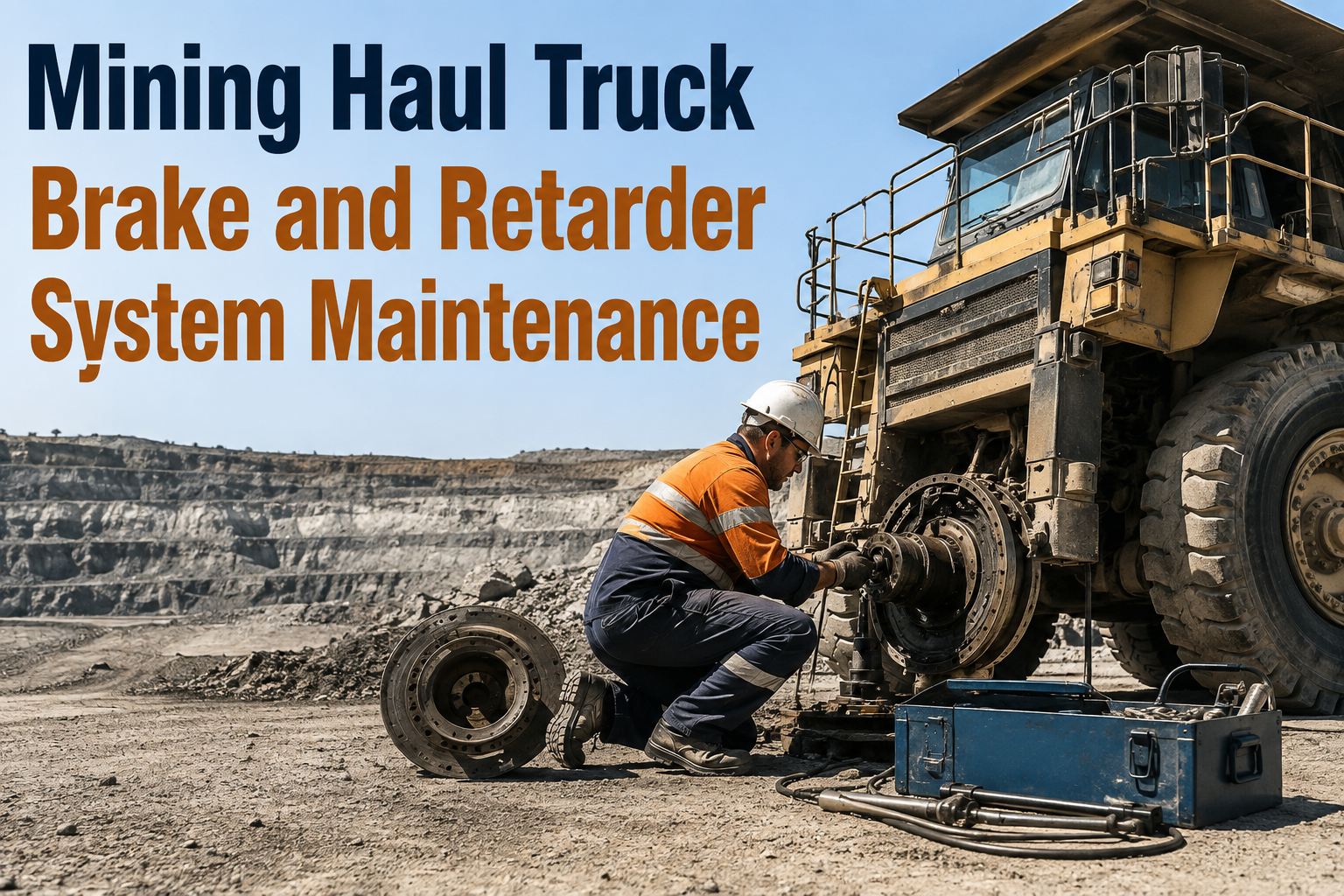
A loaded haul truck at the top of a long descent is the one moment in mining where there is no margin for a brake system that is "probably fine." Effective haul truck brake maintenance is built on a simple division of labour: the retarder or dynamic braking system controls speed all the way down the grade, and the service brakes are held in reserve for stopping and emergencies. When the retarder fades halfway down and the operator reaches for service brakes that were never tested on grade, the failure mode is not a gradual loss of performance - it is a runaway. This guide walks through how to test on grade under 30 CFR 56.14101, how to manage brake cooling oil and temperatures on wet disc arrangements, how to measure wear where it is accessible, and why any brake defect means an immediate tag-out. If you want to see how digital inspections enforce that rule automatically, you can book a 30-minute walkthrough on your own fleet setup.
Mining brake systems - descent control
If the retarder fades at 6% grade, what is holding your truck?
On a loaded descent the retarder is the primary speed control and the service brakes are the reserve. That makes retarder performance a safety system, not a convenience - and it changes how you inspect, test and schedule brake work.
What brake neglect actually costs
Haul truck brake maintenance in four numbers
Brake defects rarely announce themselves gradually on a descent. These are the figures that should frame every maintenance decision you make on braking systems.
Tag-out rule
Any brake defect - service, parking or retarder - removes the truck from service immediately. There is no "run it to the end of shift" on brakes.
MSHA brake test rule
30 CFR 56.14101 requires service brakes capable of stopping and holding the machine with its typical load on the maximum grade it travels.
Inspection frequency
Brakes and steering get their own pre-shift check every single shift - not weekly, not when someone remembers. Photo evidence makes it provable.
Cost of one runaway
A runaway on grade means tyre damage, driveline shock, possible collision and a reportable event - before you count the investigation downtime.
Division of labour
Retarder vs service brakes: who does what on a descent
The single most important concept in mining brake maintenance is that these two systems have different jobs. Confusing them is how trucks end up at the bottom of a ramp out of control.
Why this matters for maintenance: a truck can pass a static service brake test in the yard and still have a degraded retarder that only shows up under sustained load on grade. Your inspection program has to test both systems in the conditions they actually work in. If you want to see how a digital pre-shift forces both checks separately, walk through it on a live demo with your own truck list.
Compliance testing
How to run a brake test on grade under 30 CFR 56.14101
The regulation is short but the test has to be done properly to mean anything. Here is the sequence that satisfies MSHA and actually tells you whether the truck is safe.
Identify the maximum grade
Find the steepest grade the truck travels with its typical load. The test must happen there or on an equivalent grade - not on the flat outside the shop.
Test the retarder under descent load
On a loaded descent, engage the retarder and confirm it holds speed without service brake input. Monitor brake and retarder temperatures continuously - rising temps under steady retarder load mean fading capacity.
Hold-test the service brakes on grade
Bring the truck to a stop on the maximum grade using service brakes, then hold it stationary with service brakes alone. The truck must hold without creep. Any roll or creep is a defect.
Test the parking brake
Apply the parking brake on grade with the service brakes released. The truck must hold. A parking brake that cannot hold a loaded truck on grade is a tag-out defect.
Record everything with evidence
Log the test result, the grade, the load condition and temperatures. A photo of the brake temperature reading and the test location makes the record audit-proof. You can start logging brake tests with photo evidence free and have a timestamped record from the first shift.
Wet disc systems
Brake cooling oil and temperature monitoring checklist
Most large haul trucks run oil-cooled wet disc brakes. The oil is both the coolant and the friction medium - its condition directly determines whether the brakes work on the next descent.
Cooling oil level and condition
Check brake cooling oil level every shift. Dark, burnt-smelling or contaminated oil means the system is running hot or the discs are shedding material. Sample the oil on PM intervals - wear metals in the analysis tell you disc condition before you can measure it.
Temperature monitoring on descent
Watch brake temperatures during every loaded descent. A temperature that climbs faster than usual on the same grade with the same load is an early warning of reduced cooling flow or worn discs. Log the peak temperature per descent so you can trend it.
Wear measurement where accessible
On arrangements with wear indicators or accessible measurement points, record disc or plate wear at every PM. Compare against OEM wear limits. Where direct measurement is not possible, oil analysis and temperature trending are your proxies.
Cooling circuit flow and filtration
Verify brake cooling oil flow and pressure on PM. A partially blocked cooler or filter reduces flow and lets temperatures climb under load. Replace brake circuit filters on schedule - a restricted filter is a cheap part that causes an expensive failure.
See how HVI enforces the brake tag-out rule automatically
Critical brake defects flagged on a pre-shift inspection auto-block dispatch until a supervisor signs off. No truck rolls with a brake defect because someone "didn't see the note."
Inspection to record mapping
Brake system inspection points and what to record
Every brake check should produce a record that proves the check happened, what was found and what was done about it. This is what an MSHA inspector or a client auditor will ask for.
| Inspection point | Frequency | What to check | Record required |
|---|---|---|---|
| Service brake hold test | Pre-shift, on grade | Truck holds stationary on max grade, no creep | Pass/fail + photo of location and grade |
| Retarder function | Pre-shift + under load | Engages smoothly, holds speed on descent | Pass/fail + peak temperature reading |
| Parking brake hold | Pre-shift, on grade | Holds loaded truck with service brakes released | Pass/fail + photo evidence |
| Brake cooling oil | Pre-shift level / PM sample | Level, colour, contamination, wear metals | Level check + oil analysis report on PM |
| Brake temperature trend | Every loaded descent | Peak temp vs baseline for same grade and load | Temperature log with timestamp |
| Disc / plate wear | At PM interval | Wear vs OEM limit at accessible points | Measurement + remaining life estimate |
| Cooling circuit flow | At PM interval | Flow rate, pressure, filter condition | Flow reading + filter change record |
Every row above maps to a checklist item in a digital pre-shift inspection. When a technician or operator flags a fail on any brake item, the system should create a work order and block dispatch automatically - that is exactly how HVI handles critical defects, and you can see the defect-to-work-order flow in a live demo.
How HVI helps
Brake maintenance enforcement, built into every shift
HVI is a cloud and mobile CMMS built for fleet-heavy operations. These four capabilities map directly to the brake maintenance problems above.
Dedicated brakes and steering section
Brakes and steering get their own pre-shift section that requires photo evidence to pass. The operator cannot skip it, cannot pencil-whip it and cannot submit without a photo of the brake check.
Critical defects auto-block dispatch
A failed brake item flags the truck as out of service instantly. Dispatch sees the block, the supervisor gets an alert and a work order is created - all before anyone can hand the operator keys.
Meter-based PM for brake service
Schedule brake oil changes, filter replacements and wear measurements by engine hours or calendar - whichever the OEM specifies. Due and overdue alerts mean the interval never slips because someone forgot a spreadsheet.
Audit-ready brake records
Every brake test, every temperature log, every oil analysis and every work order is timestamped and searchable. When MSHA or a client auditor asks for brake maintenance history, you pull it in seconds, not hours.
If you are running brake checks on paper or in a group chat, book a demo and see the pre-shift brake section running on a phone - it takes about 30 minutes and uses your own fleet structure.
Key takeaways
What to do differently on Monday morning
Treat the retarder as a safety system. It is the primary speed control on every loaded descent. Test it under load, monitor its temperature and never send a truck out with a degraded retarder because "the service brakes still work."
Test on the maximum grade, not the yard. 30 CFR 56.14101 requires brakes to hold with a typical load on the maximum grade travelled. A flat-ground test tells you almost nothing about descent capability.
Watch the oil and the temperatures. On wet disc systems, cooling oil condition and descent temperature trends are your earliest warning of brake wear and cooling restriction. Log them every shift and trend them over time.
Tag out on any brake defect, every time. No exceptions, no "one more load." A digital inspection system that auto-blocks dispatch on a critical brake defect removes the human temptation to let it slide. You can set that up free and have it running before the next shift.
I track one number on brakes: peak retarder temperature on our steepest ramp, per truck, per shift. When a truck starts running 15 degrees hotter on the same load and same grade, I know the cooling circuit or the discs are going before any alarm fires. We used to write brake checks on a paper sheet that nobody read until something went wrong. Now the pre-shift blocks the truck if a brake item fails, and I get the alert on my phone before the operator even walks back to the ready line.
Common questions
Haul truck brake and retarder maintenance FAQs
What is the difference between a retarder and service brakes on a haul truck?
How often should haul truck brakes be tested on grade?
What does 30 CFR 56.14101 require for brake testing?
How do I know if wet disc brakes are wearing out if I cannot see them?
Can a digital inspection system really enforce brake tag-out?
Stop trusting brake checks to paper and memory
HVI gives you photo-backed brake inspections, automatic tag-out on critical defects, meter-based PM and audit-ready records - on any phone, at any site, from the first shift.
Free to start - Works on any phone - No card needed